PUBLISHER: Mordor Intelligence | PRODUCT CODE: 2119908

PUBLISHER: Mordor Intelligence | PRODUCT CODE: 2119908
Structured Cabling - Market Share Analysis, Industry Trends & Statistics, Growth Forecasts (2026 - 2031)
According to Mordor Intelligence, the structured cabling market size is projected to be USD 12.08 billion in 2025, USD 13.45 billion in 2026, and reach USD 21.26 billion by 2031, growing at a CAGR of 9.59% from 2026 to 2031.
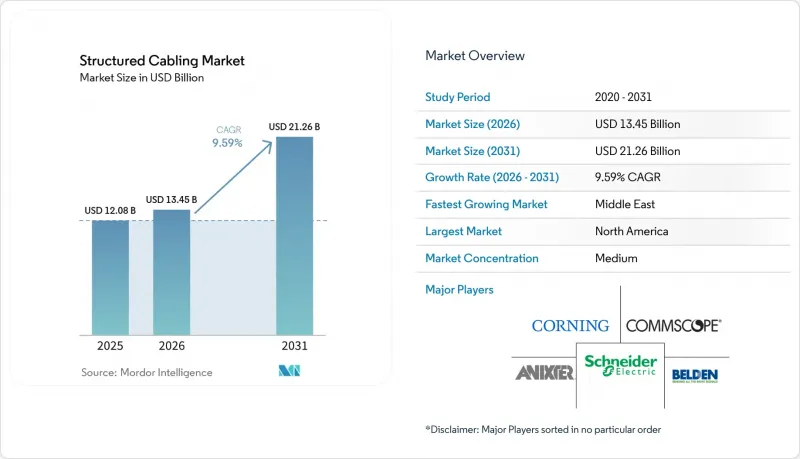
This report is Segmented by Offering (Hardware, Services, and Software), Cable Type (Copper, and Fiber), Cable Category Standard (Cat 5e, Cat 6, Cat 6A, Cat 7/7A, and Cat 8), Application (LAN, Data Center, Fttx, and Industrial Automation), End-User (IT and Telecom, Cloud and Colocation, BFSI, Healthcare, Government, Manufacturing, and Education), and Geography. Market Forecasts are in Value (USD).
Global Structured Cabling Market Trends and Insights
Accelerating Hyperscale and Edge Data Center Build-Outs
India's capacity is forecast to climb from roughly 1.8 GW in 2026 to up to 4.5 GW by 2030, with Mumbai alone approaching 2 GW of installed load. Edge facilities in Tier 2 and Tier 3 cities multiply project counts and require pre-terminated trunks to hit short deployment windows. Rack densities of 80-200 kW and AI traffic that bypass aggregation layers drive dense fiber counts, multi-fiber push-on connectors, and liquid-cooling-friendly cable trays. Hyperscalers now specify deterministic latency budgets and optical-loss margins that only ultra-low-loss fiber can meet. Compliance with India's Digital Personal Data Protection Act and incentives under the draft National Data Center Policy accelerate certified-system adoption.
Surge in PoE and Remote Powering Requirements
IEEE 802.3bt delivers up to 90 W over twisted pair, enabling a single cable to support data and power for access points, cameras, and sensors. Higher wattage raises conductor temperature, pushing installers toward larger-gauge copper or shorter run lengths to meet TIA and ISO/IEC thermal limits. Passive optical LAN with PoE-capable optical network units centralizes power and mitigates spark risk in hazardous industrial zones. ETSI's industrial PON spec also mandates extended temperature classes, adding cost but widening deployment scenarios. Smart-building plays increasingly treat PoE budgeting software as critical to reduce downtime and comply with facility energy codes.
Rising Adoption of Enterprise WLAN and 5G Fixed Wireless Access
Wi-Fi 7 delivers multi-gigabit speeds in the 6 GHz band, prompting offices to drop horizontal copper links at every desk. Private mid-band 5G covers warehouses and hospitals with roughly 15,000 ft2 per cell, easing mobility constraints. Integrated small-cell designs relax fronthaul latency, allowing reuse of existing LAN wiring, yet they increase PoE backhaul density. The trade-off slows copper volumes but lifts demand for high-capacity fiber uplinks and PoE budgeting software. Regional variance is strong: Europe's historic stone buildings retain wired runs, while U.S. tech campuses lean wireless-first.
Other drivers and restraints analyzed in the detailed report include:
- Increasing Retrofits for Smart Buildings and Campuses
- Adoption of 400 G / 800 G Active Optical Cables in AI Clusters
- Supply-Chain Volatility in Copper and Optical Fiber
For complete list of drivers and restraints, kindly check the Table Of Contents.
Segment Analysis
Hardware held 57.48% of structured cabling market share in 2025, driven by fiber trunks, connectors, and high-density racks. Services followed, as installers accelerate campus upgrades using pre-terminated assemblies. The structured cabling market size for software remains small but its 10.04% CAGR through 2031 outpaces all other offerings, reflecting growing demand for digital documentation and PoE budgeting tools. Hyperscalers integrate physical-layer telemetry into DCIM suites to trim mean-time-to-repair, while healthcare and finance entities value automated compliance reports.
Software's predictive-maintenance algorithms leverage machine-learning models to warn of micro-bends and connector contamination, protecting uptime in AI clusters. New license models bundle cloud dashboards with connector warranties, shifting revenue toward recurring subscriptions. Meanwhile, services revenue pivots from bulk installation toward retrofit consulting and moves-adds-changes managed services. Larger integrators cross-sell maintenance contracts alongside fiber trunks, deepening wallet share. Vendors that fail to unify hardware, services, and software risk margin squeeze as buyers seek single-pane-of-glass platforms.
Fiber captured 64.12% share in 2025 and is poised to expand at a 10.34% CAGR, reinforcing its status as backbone of the structured cabling market. Single-mode dominates long runs, while multi-mode holds short-reach links below 500 m. Active optical cables and linear optics compress cost per bit, further tilting spend toward fiber.
Copper retains relevance in cost-sensitive retrofits and in harsh industrial environments where shielded twisted-pair mitigates electromagnetic interference. Category 8 over 30 m remains cheaper than optics for some top-of-rack links, delaying full fiber displacement. Sustainability policies push both copper and fiber to adopt low-smoke zero-halogen jackets, marginally inflating material costs. Hybrid optical-electrical cables gain mindshare because they deliver fiber bandwidth plus PoE power in a single sheath, cutting pull time in smart-building retrofits.
Complete Report Scope:
- By Offering
- Hardware
- Cabling (Copper, Fiber)
- Connectivity (Connectors, Patch-Panels, Jacks, Cords)
- Racks, Cabinets and Cable Management
- Services
- Design and Consulting
- Installation and Integration
- Maintenance and Support
- Software
- Hardware
- By Cable Type
- Copper
- Copper Cable
- Copper Connectivity
- Fiber
- Single-Mode Cable
- Multi-Mode Cable
- Fiber Connectivity
- Copper
- By Cable Category Standard
- Cat 5e
- Cat 6
- Cat 6A
- Cat 7/7A
- Cat 8
- By Application
- LAN
- Data Center
- FTTx, Campus Backbone
- Industrial Automation Networks
- By End-User Industry
- IT and Telecom Service Providers
- Cloud and Colocation Data Centers
- BFSI and Enterprise Offices
- Healthcare Facilities
- Government and Defense
- Manufacturing and Industrial
- Education
- By Geography
- North America
- United States
- Canada
- Mexico
- South America
- Brazil
- Argentina
- Rest of South America
- Europe
- United Kingdom
- Germany
- France
- Italy
- Spain
- Nordics
- Russia
- Rest of Europe
- Asia Pacific
- China
- India
- Japan
- South Korea
- ASEAN
- Australia
- New Zealand
- Rest of Asia Pacific
- Middle East and Africa
- Middle East
- Saudi Arabia
- United Arab Emirates
- Turkey
- Rest of Middle East
- Africa
- South Africa
- Egypt
- Nigeria
- Rest of Africa
- Middle East
- North America
Geography Analysis
Asia Pacific accounted for 30.59% of structured cabling market share in 2025, energized by India's rapid data-center additions and China's AI parks. Tier-2 Indian cities such as Kochi and Visakhapatnam invite modular edge facilities that favor pre-connectorized trunks. Japanese industrial automation and South Korean electronics clusters sustain factory cabling uptick, while ASEAN fiber-to-the-home rollouts drive outdoor cable demand.
North America remains a mature yet dynamic pocket as hyperscalers cluster in Virginia, Oregon, and Texas. Smart-building retrofits add PoE-rich links in legacy offices, whereas colocation cages adopt Cat 8 for short reach. Federal sustainability targets encourage LSZH adoption in government properties, pushing specifiers toward certified suppliers.
Europe's growth stems from low-smoke zero-halogen mandates, energy-efficiency retrofits, and Industry 4.0 upgrades in Germany and France. Historic structures complicate new duct routes, making micro-cables and air-blown fiber attractive. The Middle East, though smaller in base, posts the highest 10.56% CAGR as Saudi Arabia's NEOM and UAE sovereign AI centers demand terabit fabrics and gigawatt power envelopes.
Latin America and Africa lag because of import dependency and economic volatility, yet Brazil's cloud build-outs and Nigeria's fintech boom create focused demand pockets. Political stability and low electricity pricing increasingly dictate hyperscaler site selection, redistributing new capacity away from legacy Western hubs toward Asia and the Middle East.
- CommScope Holding Company Inc.
- Corning Incorporated
- Belden Inc.
- Legrand SA
- Nexans SA
- Panduit Corp.
- Prysmian Group
- Schneider Electric SE
- The Siemon Company
- TE Connectivity Ltd.
- Furukawa Electric Co. Ltd.
- Hubbell Incorporated
- Rosenberger Hochfrequenztechnik GmbH & Co. KG
- Datwyler Cabling Solutions AG
- LS Cable & System Ltd.
- Reichle & De-Massari AG (R&M)
- Superior Essex Inc.
- Anixter International Inc. (WESCO International)
- AFL (AFL Global)
- Black Box Corporation
Additional Benefits:
- The market estimate (ME) sheet in Excel format
- 3 months of analyst support
TABLE OF CONTENTS
1 INTRODUCTION
- 1.1 Study Assumptions and Market Definition
- 1.2 Scope of the Study
2 RESEARCH METHODOLOGY
3 EXECUTIVE SUMMARY
4 MARKET LANDSCAPE
- 4.1 Market Overview
- 4.2 Market Drivers
- 4.2.1 Accelerating Hyperscale and Edge Data Center Build-Outs
- 4.2.2 Surge in PoE and Remote Powering Requirements
- 4.2.3 Increasing Retrofits for Smart Buildings and Campuses
- 4.2.4 Adoption of 400G/800G Active Optical Cables in AI Clusters
- 4.2.5 Sustainability Mandates Driving Low-Smoke Zero-Halogen Cabling
- 4.2.6 Converged OT/IT Cabling for Industry 4.0 Time-Sensitive Networking
- 4.3 Market Restraints
- 4.3.1 Rising Adoption of Enterprise WLAN and 5G Fixed Wireless Access
- 4.3.2 Supply-Chain Volatility in Copper and Optical Fiber
- 4.3.3 Emerging Silicon Photonics Eliminating High-Speed Copper Runs
- 4.3.4 Increasing Use of Modular Plug-Terminated Links Reducing Patch-Panel Demand
- 4.4 Industry Value Chain Analysis
- 4.5 Regulatory Landscape
- 4.6 Technological Outlook
- 4.7 Porter's Five Forces Analysis
- 4.7.1 Bargaining Power of Suppliers
- 4.7.2 Bargaining Power of Buyers
- 4.7.3 Threat of New Entrants
- 4.7.4 Threat of Substitutes
- 4.7.5 Competitive Rivalry
- 4.8 Impact of Macroeconomic Factors on the Market
- 4.9 Key Use Cases and Case Studies
- 4.10 Investment Analysis
5 MARKET SIZE AND GROWTH FORECASTS (VALUE)
- 5.1 By Offering
- 5.1.1 Hardware
- 5.1.1.1 Cabling (Copper, Fiber)
- 5.1.1.2 Connectivity (Connectors, Patch-Panels, Jacks, Cords)
- 5.1.1.3 Racks, Cabinets and Cable Management
- 5.1.2 Services
- 5.1.2.1 Design and Consulting
- 5.1.2.2 Installation and Integration
- 5.1.2.3 Maintenance and Support
- 5.1.3 Software
- 5.1.1 Hardware
- 5.2 By Cable Type
- 5.2.1 Copper
- 5.2.1.1 Copper Cable
- 5.2.1.2 Copper Connectivity
- 5.2.2 Fiber
- 5.2.2.1 Single-Mode Cable
- 5.2.2.2 Multi-Mode Cable
- 5.2.2.3 Fiber Connectivity
- 5.2.1 Copper
- 5.3 By Cable Category Standard
- 5.3.1 Cat 5e
- 5.3.2 Cat 6
- 5.3.3 Cat 6A
- 5.3.4 Cat 7/7A
- 5.3.5 Cat 8
- 5.4 By Application
- 5.4.1 LAN
- 5.4.2 Data Center
- 5.4.3 FTTx, Campus Backbone
- 5.4.4 Industrial Automation Networks
- 5.5 By End-User Industry
- 5.5.1 IT and Telecom Service Providers
- 5.5.2 Cloud and Colocation Data Centers
- 5.5.3 BFSI and Enterprise Offices
- 5.5.4 Healthcare Facilities
- 5.5.5 Government and Defense
- 5.5.6 Manufacturing and Industrial
- 5.5.7 Education
- 5.6 By Geography
- 5.6.1 North America
- 5.6.1.1 United States
- 5.6.1.2 Canada
- 5.6.1.3 Mexico
- 5.6.2 South America
- 5.6.2.1 Brazil
- 5.6.2.2 Argentina
- 5.6.2.3 Rest of South America
- 5.6.3 Europe
- 5.6.3.1 United Kingdom
- 5.6.3.2 Germany
- 5.6.3.3 France
- 5.6.3.4 Italy
- 5.6.3.5 Spain
- 5.6.3.6 Nordics
- 5.6.3.7 Russia
- 5.6.3.8 Rest of Europe
- 5.6.4 Asia Pacific
- 5.6.4.1 China
- 5.6.4.2 India
- 5.6.4.3 Japan
- 5.6.4.4 South Korea
- 5.6.4.5 ASEAN
- 5.6.4.6 Australia
- 5.6.4.7 New Zealand
- 5.6.4.8 Rest of Asia Pacific
- 5.6.5 Middle East and Africa
- 5.6.5.1 Middle East
- 5.6.5.1.1 Saudi Arabia
- 5.6.5.1.2 United Arab Emirates
- 5.6.5.1.3 Turkey
- 5.6.5.1.4 Rest of Middle East
- 5.6.5.2 Africa
- 5.6.5.2.1 South Africa
- 5.6.5.2.2 Egypt
- 5.6.5.2.3 Nigeria
- 5.6.5.2.4 Rest of Africa
- 5.6.5.1 Middle East
- 5.6.1 North America
6 COMPETITIVE LANDSCAPE
- 6.1 Market Concentration
- 6.2 Strategic Moves
- 6.3 Market Share Analysis
- 6.4 Company Profiles (includes Global Level Overview, Market Level Overview, Core Segments, Financials as Available, Strategic Information, Market Rank/Share for Key Companies, Products and Services, and Recent Developments)
- 6.4.1 CommScope Holding Company Inc.
- 6.4.2 Corning Incorporated
- 6.4.3 Belden Inc.
- 6.4.4 Legrand SA
- 6.4.5 Nexans SA
- 6.4.6 Panduit Corp.
- 6.4.7 Prysmian Group
- 6.4.8 Schneider Electric SE
- 6.4.9 The Siemon Company
- 6.4.10 TE Connectivity Ltd.
- 6.4.11 Furukawa Electric Co. Ltd.
- 6.4.12 Hubbell Incorporated
- 6.4.13 Rosenberger Hochfrequenztechnik GmbH & Co. KG
- 6.4.14 Datwyler Cabling Solutions AG
- 6.4.15 LS Cable & System Ltd.
- 6.4.16 Reichle & De-Massari AG (R&M)
- 6.4.17 Superior Essex Inc.
- 6.4.18 Anixter International Inc. (WESCO International)
- 6.4.19 AFL (AFL Global)
- 6.4.20 Black Box Corporation
7 MARKET OPPORTUNITIES AND FUTURE OUTLOOK
- 7.1 White-Space and Unmet-Need Assessment

