PUBLISHER: Mordor Intelligence | PRODUCT CODE: 2120278

PUBLISHER: Mordor Intelligence | PRODUCT CODE: 2120278
Vietnam Power - Market Share Analysis, Industry Trends & Statistics, Growth Forecasts (2026 - 2031)
According to Mordor Intelligence, the Vietnam power market size is expected to grow from 86.81 gigawatt in 2025 to 95.46 gigawatt in 2026 and is forecast to reach 153.62 gigawatt by 2031 at 9.98% CAGR over 2026-2031.
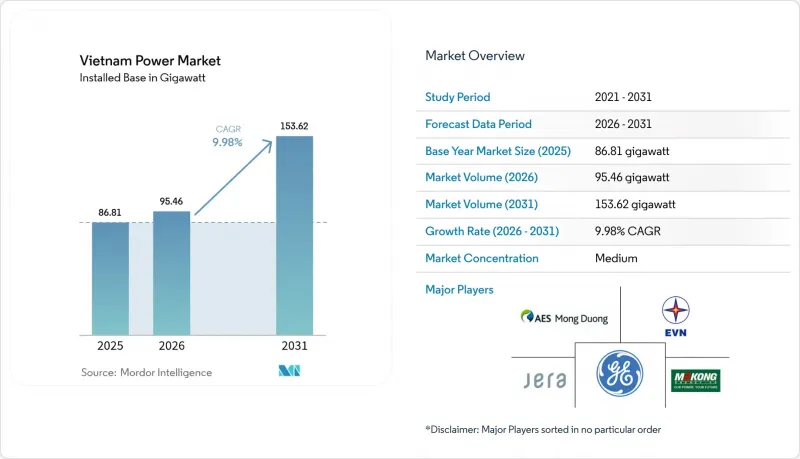
This report is Segmented by Power Source (Thermal, Nuclear, and Renewables) and End-User (Utilities, Commercial and Industrial, and Residential). The Market Sizes and Forecasts are Provided in Terms of Installed Capacity (GW).
Vietnam Power Market Trends and Insights
Rapid Industrialisation-Led Electricity Demand Surge
Industrial production jumped 8.4% 2024, lifting nationwide electricity use to 1 billion kWh in late May and prompting EVN to deploy demand-response programs. The semiconductor sector alone is valued at USD 18.23 billion in 2024 and is expanding at 11.48% CAGR, an outcome of Vietnam's "Silicon Delta" policy that targets 45% of output from high-tech goods by 2030. South Korea reclaimed the top-investor slot in early 2025, with SK Group allocating multibillion-dollar budgets to LNG and small-modular reactors. Meeting the government's 8% GDP objective for 2025 requires 12-16% yearly additions to generation, magnifying the Vietnam power market dependency on fast-track grid projects. Foreign investors now cite a stable electricity supply as a precondition for high-tech plant siting.
Government Renewable-Energy Targets & FITs
The revised PDP-8 sets a 500.4-557.8 billion kWh consumption band for 2030 while mandating that renewables claim 28-36% of the mix, signaling a pivot away from coal dominance. New price caps place onshore wind at VND 1,959.4/kWh (USD 0.078) in the north and near-shore projects at VND 1,987.4/kWh (USD 0.079), restoring investor visibility after years of stalled guidance.Yet simultaneous retroactive tariff cuts threaten USD 13 billion in operating solar and wind assets, sparking protests from international developers. Decree 57/2025 introduced DPPAs, allowing private generators to bypass EVN and transact directly with qualified consumers, a reform expected to lower state-budget strain and quicken renewable deployment. These shifts align Vietnam with the ASEAN Power Grid vision that foresees clean sources covering up to 50% of regional output by 2030.
Slow PPA Approval & Regulatory Uncertainty
Around USD 13 billion in wind and solar assets are at risk after auditors found misapplied FIT rules and suspended new PPAs pending review, prompting exits by Enel, Equinor, and Orsted despite Vietnam's headline plan to double capacity by 2030. A 6 GW offshore-wind zone was removed from the latest PDP-8 draft, deepening perceptions of policy volatility. Transmission approvals are equally sluggish; government data show only 2 of 16 mandated grid projects met 2024 timelines. These delays restrain the Vietnam power market's tempo in the short run.
Other drivers and restraints analyzed in the detailed report include:
- PDP-8-Driven FDI Inflow in Generation & Grid
- Grid-Modernisation Funding (ADB, JICA)
- ESG-Driven Coal-Financing Squeeze
For complete list of drivers and restraints, kindly check the Table Of Contents.
Segment Analysis
Renewables delivered 56.85% of installed capacity in 2025, underscoring their status as the anchor of the Vietnam power market. The segment is forecast to compound at 11.46% annually through 2031 as solar rooftops scale, onshore wind spreads across the Central Highlands, and offshore wind turbines begin to populate typhoon-exposed coastal waters. Solar already totals 19.4 GW, yet curtailment surpasses 15% in Ninh Thuan and Binh Thuan during the dry season when local lines overload. High curtailment has prompted developers to pair new projects with battery storage, a trend facilitated by PDP-8's target of 10-16 GW of batteries by decade-end. Offshore wind's 6 GW 2030 target equates to 1.2 GW of annual installs starting in 2026, demanding prompt port upgrades and localized supply chains. Together, these trends point to an expanded Vietnam power market size at the segment level that will eclipse thermal additions within three years.
Thermal capacity remains relevant but is losing ground. Coal units ran at a 68% capacity factor in 2024 as merit-order rules favored cheaper wind and hydropower. New coal projects lack financing, and depleting offshore gas fields hinder gas-fired growth. The government, therefore, places nuclear back on the table with preliminary 4-6.4 GW plans for the 2030-2035 horizon, though finance and public acceptance remain hurdles. In the interim, combined-cycle gas and large-scale batteries are set to bridge the capacity gap and provide ramping support, shaping a technology mix that allows the Vietnam power market to continue its rapid growth while lowering emissions intensity.
Complete Report Scope:
- By Power Source
- Thermal (Coal, Natural Gas, Oil and Diesel)
- Nuclear
- Renewables (Solar, Wind, Hydro, Geothermal, Biomass & Waste, Tidal)
- By End User
- Utilities
- Commercial and Industrial
- Residential
- By T&D Voltage Level (Qualitative Analysis only)
- High-Voltage Transmission (Above 230 kV)
- Sub-Transmission (69 to 161 kV)
- Medium-Voltage Distribution (13.2 to 34.5 kV)
- Low-Voltage Distribution (Up to 1 kV)
List of Companies Covered in this Report:
- Vietnam Electricity (EVN)
- PetroVietnam Power Corporation (PV Power)
- AES Corporation (Vietnam)
- JERA Co., Inc.
- Trung Nam Group
- Mekong Energy Company Ltd
- Vietnam Sunergy Joint Stock Company
- Sharp Energy Solutions Corporation
- B.Grimm Power (Vietnam)
- Siemens Energy Vietnam
- General Electric Vietnam
- Vestas Vietnam
- Orsted Vietnam
- Sunseap / EDP Renewables APAC
- Trina Solar Vietnam
- T&T Group Power
- Bamboo Capital Group (BCG Energy)
- Hitachi Energy Vietnam
- SP Group Vietnam
- Power Engineering Consulting JSC 2 (PECC2)
Additional Benefits:
- The market estimate (ME) sheet in Excel format
- 3 months of analyst support
TABLE OF CONTENTS
1 Introduction
- 1.1 Study Assumptions & Market Definition
- 1.2 Scope of the Study
2 Research Methodology
3 Executive Summary
4 Market Landscape
- 4.1 Market Overview
- 4.2 Market Drivers
- 4.2.1 Rapid industrialisation-led electricity demand surge
- 4.2.2 Government renewable-energy targets & FITs
- 4.2.3 PDP-8-driven FDI inflow in generation & grid
- 4.2.4 Grid-modernisation funding (ADB, JICA)
- 4.2.5 Offshore-wind auction pipeline unlock
- 4.2.6 Data-centre boom raising flexible-generation need
- 4.3 Market Restraints
- 4.3.1 Slow PPA approval & regulatory uncertainty
- 4.3.2 ESG-driven coal-financing squeeze
- 4.3.3 Land-acquisition conflicts for solar farms
- 4.3.4 Import-dependency for high-voltage equipment
- 4.4 Supply-Chain Analysis
- 4.5 Regulatory Landscape
- 4.6 Technological Outlook
- 4.7 Porters Five Forces
- 4.7.1 Threat of New Entrants
- 4.7.2 Bargaining Power of Suppliers
- 4.7.3 Bargaining Power of Buyers
- 4.7.4 Threat of Substitutes
- 4.7.5 Competitive Rivalry
- 4.8 PESTLE Analysis
5 Market Size & Growth Forecasts
- 5.1 By Power Source
- 5.1.1 Thermal (Coal, Natural Gas, Oil and Diesel)
- 5.1.2 Nuclear
- 5.1.3 Renewables (Solar, Wind, Hydro, Geothermal, Biomass & Waste, Tidal)
- 5.2 By End User
- 5.2.1 Utilities
- 5.2.2 Commercial and Industrial
- 5.2.3 Residential
- 5.3 By T&D Voltage Level (Qualitative Analysis only)
- 5.3.1 High-Voltage Transmission (Above 230 kV)
- 5.3.2 Sub-Transmission (69 to 161 kV)
- 5.3.3 Medium-Voltage Distribution (13.2 to 34.5 kV)
- 5.3.4 Low-Voltage Distribution (Up to 1 kV)
6 Competitive Landscape
- 6.1 Market Concentration
- 6.2 Strategic Moves (M&A, Partnerships, PPAs)
- 6.3 Market Share Analysis (Market Rank/Share for key companies)
- 6.4 Company Profiles (includes Global level Overview, Market level overview, Core Segments, Financials as available, Strategic Information, Products & Services, and Recent Developments)
- 6.4.1 Vietnam Electricity (EVN)
- 6.4.2 PetroVietnam Power Corporation (PV Power)
- 6.4.3 AES Corporation (Vietnam)
- 6.4.4 JERA Co., Inc.
- 6.4.5 Trung Nam Group
- 6.4.6 Mekong Energy Company Ltd
- 6.4.7 Vietnam Sunergy Joint Stock Company
- 6.4.8 Sharp Energy Solutions Corporation
- 6.4.9 B.Grimm Power (Vietnam)
- 6.4.10 Siemens Energy Vietnam
- 6.4.11 General Electric Vietnam
- 6.4.12 Vestas Vietnam
- 6.4.13 Orsted Vietnam
- 6.4.14 Sunseap / EDP Renewables APAC
- 6.4.15 Trina Solar Vietnam
- 6.4.16 T&T Group Power
- 6.4.17 Bamboo Capital Group (BCG Energy)
- 6.4.18 Hitachi Energy Vietnam
- 6.4.19 SP Group Vietnam
- 6.4.20 Power Engineering Consulting JSC 2 (PECC2)
7 Market Opportunities & Future Outlook
- 7.1 White-space & Unmet-Need Assessment

