PUBLISHER: Mordor Intelligence | PRODUCT CODE: 2120289

PUBLISHER: Mordor Intelligence | PRODUCT CODE: 2120289
Europe Carbon Black - Market Share Analysis, Industry Trends & Statistics, Growth Forecasts (2026 - 2031)
According to Mordor Intelligence, the Europe carbon black market size was valued at USD 5.31 billion in 2025 and estimated to grow from USD 5.59 billion in 2026 to reach USD 7.24 billion by 2031, at a CAGR of 5.31% during the forecast period (2026-2031).
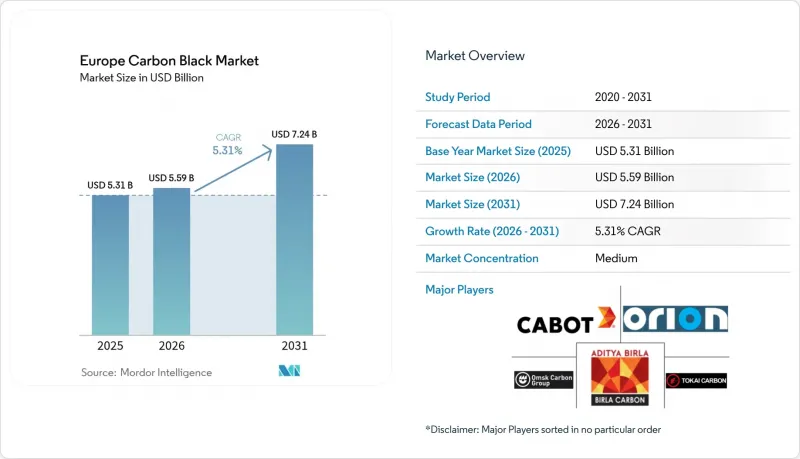
This report is Segmented by Process Type (Furnace Black, Gas Black, Thermal Black, and Lamp Black), Application (Tire and Industrial Rubber Product, Plastic, Toner and Printing Ink, Coating, Textile Fiber, and Others), and Geography (Germany, United Kingdom, France, Italy, Russia, and Rest of Europe). The Market Forecasts are Provided in Terms of Value (USD).
Europe Carbon Black Market Trends and Insights
EV-tire demand accelerates low rolling resistance applications
Electric-vehicle adoption is rewriting tire compound specifications as OEMs emphasize energy efficiency over conventional performance criteria. Low rolling resistance tires require narrowly controlled particle size distribution and customized surface treatments that cut hysteresis losses, allowing suppliers to command 15-20% price premiums over commodity grades. Europe's major tire makers are jointly developing bio-based and recycled carbon blacks that retain grip while trimming energy loss, and the collaboration intensity is highest in Germany and France, where EV production scales fastest. These efforts are tightening long-term offtake agreements between tire majors and regional specialty-grade producers, thus improving demand visibility across the European carbon black market.
Battery casing applications drive specialty black demand
Lithium-ion battery pack designers now specify low-ash, high-conductivity carbon blacks to ensure uniform current distribution and electromagnetic interference shielding. Imerys has commercialized grades with finely tuned specific surface areas supporting stable lithium-ion transport in cylindrical, pouch, and prismatic cells. Gigafactories in Sweden, Germany, and Poland stipulate local sourcing as part of supplier scorecards to cut embedded emissions, spurring European specialty producers to add capacity and fast-track product qualification processes.
Silica substitution challenges premium market share
High-end passenger car tire makers are boosting silica reinforcement to satisfy fuel-efficiency labeling, trimming virgin carbon black content by up to 15% in select tread compounds. The performance gap between silica and advanced hybrid carbon black-silica systems is narrowing, pressuring commodity-grade volumes in premium portfolios. Suppliers are racing to engineer surface-modified blacks that bond efficiently with organosilane coupling agents, hoping to restore their share in these profitable niches.
Other drivers and restraints analyzed in the detailed report include:
- Circular-economy regulations mandate recovered carbon black integration
- Hydrogen-rich off-gas reduces feedstock dependencies
- Feedstock price volatility pressures margins
For complete list of drivers and restraints, kindly check the Table Of Contents.
Segment Analysis
Furnace black accounted for 73.88% of the Europe carbon black market share in 2025, underscoring its versatility in both reinforcement and pigment applications. Despite that dominance, lamp black's projected 7.72% CAGR through 2031 signals that demand is fragmenting toward high-value niches where color strength and blue undertone are prized. Furnace producers are extending portfolios with low-PAH and surface-modified variants to meet REACH thresholds due in 2025 and fight specialty encroachment.
Sustained growth in coatings, batteries, and plastics encourages suppliers to allocate fresh capital toward smaller gas-black lines that deliver ultra-fine particle topography required in premium pigments. These investments look attractive because coatings command 20-30% pricing premiums over tire grades, and they insulate suppliers from cyclical swings in automotive tire replacement demand. Thermal black maintains a dependable but modest foothold, mainly in sealants and polymer modification, where its larger particle size enhances damping properties.
Complete Report Scope:
- By Process Type
- Furnace Black
- Gas Black
- Thermal Black
- Lamp Black
- By Application
- Tire and Industrial Rubber Product
- Plastic
- Toner and Printing Ink
- Coating
- Textile Fiber
- Others
- By Geography
- Germany
- United Kingdom
- France
- Italy
- Russia
- Rest of Europe
List of Companies Covered in this Report:
- Birla Carbon (Aditya Birla Group)
- Black Bear Carbon B.V.
- Cabot Corporation
- Cancarb Limited
- Circtec Ltd.
- Continental Carbon Company
- Imerys Graphite & Carbon
- JSC Nizhnekamskneftekhim Carbon
- Mitsubishi Chemical Corp.
- Omsk Carbon Group
- Orion Engineered Carbons
- PCBL Limited
- Pyrum Innovations
- Scandinavian Enviro Systems
- Tokai Carbon Co., Ltd.
Additional Benefits:
- The market estimate (ME) sheet in Excel format
- 3 months of analyst support
TABLE OF CONTENTS
1 Introduction
- 1.1 Study Assumptions and Market Definition
- 1.2 Scope of the Study
2 Research Methodology
3 Executive Summary
4 Market Landscape
- 4.1 Market Overview
- 4.2 Market Drivers
- 4.2.1 Surge in EV-tire demand for low-rolling-resistance blacks
- 4.2.2 OEM shift to specialty blacks for Li-ion battery casings
- 4.2.3 Circular-economy mandates boost recovered carbon black (rCB)
- 4.2.4 Hydrogen-rich cracker off-gas lowers feedstock costs
- 4.2.5 Rapid adoption of smart factory retrofits drives the demand
- 4.3 Market Restraints
- 4.3.1 Green-tire silica substitution in premium segments
- 4.3.2 Volatile CBFS and coal-tar pitch prices
- 4.3.3 Russia-EU conflict disrupts supply chains
- 4.4 Value Chain Analysis
- 4.5 Porter's Five Forces
- 4.5.1 Bargaining Power of Suppliers
- 4.5.2 Bargaining Power of Buyers
- 4.5.3 Threat of New Entrants
- 4.5.4 Threat of Substitutes
- 4.5.5 Degree of Competition
5 Market Size and Growth Forecasts (Value)
- 5.1 By Process Type
- 5.1.1 Furnace Black
- 5.1.2 Gas Black
- 5.1.3 Thermal Black
- 5.1.4 Lamp Black
- 5.2 By Application
- 5.2.1 Tire and Industrial Rubber Product
- 5.2.2 Plastic
- 5.2.3 Toner and Printing Ink
- 5.2.4 Coating
- 5.2.5 Textile Fiber
- 5.2.6 Others
- 5.3 By Geography
- 5.3.1 Germany
- 5.3.2 United Kingdom
- 5.3.3 France
- 5.3.4 Italy
- 5.3.5 Russia
- 5.3.6 Rest of Europe
6 Competitive Landscape
- 6.1 Market Concentration
- 6.2 Strategic Moves
- 6.3 Market Share(%)/Ranking Analysis
- 6.4 Company Profiles (includes Global level Overview, Market level overview, Core Segments, Financials as available, Strategic Information, Market Rank/Share for key companies, Products and Services, and Recent Developments)
- 6.4.1 Birla Carbon (Aditya Birla Group)
- 6.4.2 Black Bear Carbon B.V.
- 6.4.3 Cabot Corporation
- 6.4.4 Cancarb Limited
- 6.4.5 Circtec Ltd.
- 6.4.6 Continental Carbon Company
- 6.4.7 Imerys Graphite & Carbon
- 6.4.8 JSC Nizhnekamskneftekhim Carbon
- 6.4.9 Mitsubishi Chemical Corp.
- 6.4.10 Omsk Carbon Group
- 6.4.11 Orion Engineered Carbons
- 6.4.12 PCBL Limited
- 6.4.13 Pyrum Innovations
- 6.4.14 Scandinavian Enviro Systems
- 6.4.15 Tokai Carbon Co., Ltd.
7 Market Opportunities and Future Outlook
- 7.1 White-space and Unmet-need Assessment

