PUBLISHER: Mordor Intelligence | PRODUCT CODE: 2120437

PUBLISHER: Mordor Intelligence | PRODUCT CODE: 2120437
Middle East And Africa Cosmetic Packaging - Market Share Analysis, Industry Trends & Statistics, Growth Forecasts (2026 - 2031)
According to Mordor Intelligence, the Middle East and Africa cosmetic packaging market size was valued at USD 1.62 billion in 2025 and estimated to grow from USD 1.69 billion in 2026 to reach USD 2.11 billion by 2031, at a CAGR of 4.48% during the forecast period (2026-2031).
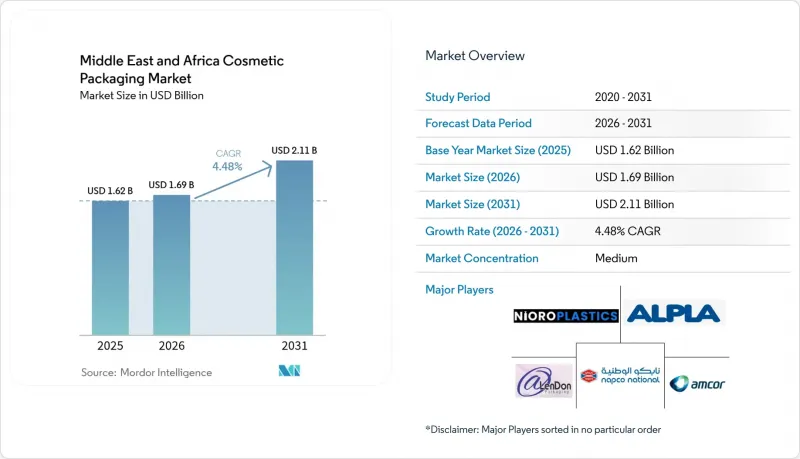
This report is Segmented by Material Type (Plastic, Glass, and More), Product Type (Bottles and Jars, Tubes and Sticks, and More), Cosmetic Type (Skin Care, Hair Care, and More), Distribution Channel (Direct Sales Channel, and Indirect Sales Channel), and Geography. The Market Forecasts are Provided in Terms of Value (USD).
Middle East And Africa Cosmetic Packaging Market Trends and Insights
Shift Toward Customized and Luxury Packs
Personalized packaging now differentiates brands as Gulf consumers expect culturally resonant aesthetics, such as Arabic calligraphy and heritage-inspired color palettes. Limited-edition fragrance launches with local artists have demonstrated strong engagement and loyalty. Suppliers are funding regional design centers and installing digital printers that deliver cost-effective small-batch runs, enabling premium pricing without inflating inventory costs. Brands leverage this agility to test micro-collections aligned with major cultural events, deepening relevance. The focus on cultural customization is also encouraging collaborations between global converters and local design houses that bring nuanced insights to premium packaging programs.
Rise of Sustainable Beauty and Circular-Economy Mandates
Extended Producer Responsibility in the UAE obligates cosmetic firms to finance waste management across the product lifecycle. Manufacturers like Pack2Earth supply compostable substrates engineered for high-temperature desert environments. Traditional resin converters face specification shifts that inflate R&D cycles and capital expenditure but create premium opportunities for sustainability specialists. Life-cycle assessment models now accompany most bid responses, introducing environmental metrics alongside price and lead time. As material accountability becomes mainstream, early adopters lock in multiyear contracts that enhance visibility on raw-material sourcing and cost structures.
Stringent Regional Plastics and Labeling Regulations
The UAE's single-use plastic ban and Saudi Arabia's EPR rules compel rapid design alterations, raising unit costs by 15-25% and favoring suppliers already versed in sustainable alternatives. Multilingual labeling statutes expand panel real estate, prompting larger primary packs or extended fold-out labels. Compliance complexity accelerates consolidation as smaller converters struggle to fund testing and certification. Regulators tie import permits to proof of recyclability, prompting brands to negotiate take-back programs with material recovery firms.
Other drivers and restraints analyzed in the detailed report include:
- E-commerce Boom Driving Protective/Omni-Channel Designs
- Growth of Halal and Clean-Label Brands Needing Compliant Packs
- Currency Volatility Inflating Imported Resin Costs
For complete list of drivers and restraints, kindly check the Table Of Contents.
Segment Analysis
The Middle East and Africa cosmetic packaging market size for plastic substrates remained the largest in 2025 as advanced polymers met performance and cost targets pivotal to high-volume categories. Bio-degradable and compostable options, while still niche, are growing fastest at 5.52% CAGR on regulatory tailwinds that reward circular design. Glass preserves an aura of luxury, especially in perfume and prestige skincare, where tactile heft commands premium shelf pricing. Metal retains relevance in aerosol and gift SKUs that benefit from structural rigidity and upscale aesthetics. Paperboard gains share in secondary applications as barrier-coated grades improve moisture protection.
The transition toward greener substrates compels intricate supply-chain recalibration. Packaging converters pair life-cycle assessment audits with pricing proposals, enabling brand owners to quantify environmental benefits. Partnerships such as Eastman Chemical's molecular recycling program offer drop-in resins that maintain functional parity with virgin polymers while satisfying recyclability thresholds. Paper primary packs, fortified through water-based barrier coatings, advance into skin-treatment jars and compact cases, signaling broader acceptance of fiber-based formats in traditionally plastic-centric segments.
Bottles and jars secured the largest revenue slice in 2025, underscoring consumer familiarity and premium cues critical to skincare and fragrance. Yet flexible pouches and sachets, pivotal to cost-sensitive markets and weight-optimized logistics, are accelerating at 6.01% CAGR, capturing incremental volumes from mass hair-care and body-wash refills. Tubes and sticks hold steady as targeted applicators in lip care and medicinal skin treatments, where dosage control and portability resonate.
Retail migration online amplifies demand for flexibles that reduce dimensional weight and minimize breakage. Multilayer laminates adopt high-barrier EVOH layers, safeguarding volatile actives during long-haul shipping. Sachet innovation explores twin-chamber formats that enable mixing at the point of use, supporting customizable regimens. Pump and sprayer assemblies integrate locking collars and clip seals to comply with courier regulations, mitigating leakage during air transport.
Complete Report Scope:
- By Material Type
- Plastic
- Glass
- Metal
- Paper and Paperboard
- Bio-degradable/Compostable
- By Product Type
- Bottles and Jars
- Tubes and Sticks
- Pouches and Sachets
- Other Product Types
- By Cosmetic Type
- Skin Care
- Hair Care
- Color Cosmetics
- Fragrances
- Other Cosmetic Types
- By Distribution Channel
- Direct Sales Channel
- Indirect Sales Channel
- By Geography
- Middle East
- Saudi Arabia
- United Arab Emirates
- Turkey
- Rest of Middle East
- Africa
- South Africa
- Nigeria
- Egypt
- Rest of Africa
- Middle East
List of Companies Covered in this Report:
- Amcor plc
- ALPLA Werke Alwin Lehner GmbH & Co KG
- Napco National Company
- Nioro Plastics (Pty) Ltd
- Al LendOn Packaging (Pty) Ltd
- Mpact Ltd (Mpact Plastics)
- AptarGroup Inc.
- Gerresheimer AG
- Quadpack Industries SA
- Huhtamaki Oyj
- Coveris Management GmbH
- Albea Services SAS
- Plastipak Holdings Inc.
- Tetra Pak International SA
- Almarai Company (Jeddah Plastics)
- Takween Advanced Industries Co.
- Cosmopak (CPK Packaging) LLC
- APC Packaging Ltd
- RPC M&H Plastics Ltd
Additional Benefits:
- The market estimate (ME) sheet in Excel format
- 3 months of analyst support
TABLE OF CONTENTS
1 INTRODUCTION
- 1.1 Study Assumptions and Market Definition
- 1.2 Scope of the Study
2 RESEARCH METHODOLOGY
3 EXECUTIVE SUMMARY
4 MARKET LANDSCAPE
- 4.1 Market Overview
- 4.2 Industry Value Chain Analysis
- 4.3 Market Drivers
- 4.3.1 Shift toward customized and luxury packs
- 4.3.2 Rise of sustainable beauty and circular-economy mandates
- 4.3.3 E-commerce boom driving protective/omni-channel designs
- 4.3.4 Growth of halal and clean-label brands needing compliant packs
- 4.3.5 Premiumization of men's grooming and niche fragrances
- 4.3.6 Under-the-radar: Tourism-led duty-free demand rebound
- 4.4 Market Restraints
- 4.4.1 Stringent regional plastics and labeling regulations
- 4.4.2 Currency volatility inflating imported resin costs
- 4.4.3 Skills gap in sustainable material engineering
- 4.4.4 Under-the-radar: Political instability disrupting supply chains
- 4.5 Technological Outlook
- 4.6 Porter's Five Forces Analysis
- 4.6.1 Bargaining Power of Suppliers
- 4.6.2 Bargaining Power of Buyers
- 4.6.3 Threat of New Entrants
- 4.6.4 Threat of Substitutes
- 4.6.5 Intensity of Competitive Rivalry
- 4.7 The Impact of Macroeconomic Factors on the Market
5 MARKET SIZE AND GROWTH FORECASTS (VALUE)
- 5.1 By Material Type
- 5.1.1 Plastic
- 5.1.2 Glass
- 5.1.3 Metal
- 5.1.4 Paper and Paperboard
- 5.1.5 Bio-degradable/Compostable
- 5.2 By Product Type
- 5.2.1 Bottles and Jars
- 5.2.2 Tubes and Sticks
- 5.2.3 Pouches and Sachets
- 5.2.4 Other Product Types
- 5.3 By Cosmetic Type
- 5.3.1 Skin Care
- 5.3.2 Hair Care
- 5.3.3 Color Cosmetics
- 5.3.4 Fragrances
- 5.3.5 Other Cosmetic Types
- 5.4 By Distribution Channel
- 5.4.1 Direct Sales Channel
- 5.4.2 Indirect Sales Channel
- 5.5 By Geography
- 5.5.1 Middle East
- 5.5.1.1 Saudi Arabia
- 5.5.1.2 United Arab Emirates
- 5.5.1.3 Turkey
- 5.5.1.4 Rest of Middle East
- 5.5.2 Africa
- 5.5.2.1 South Africa
- 5.5.2.2 Nigeria
- 5.5.2.3 Egypt
- 5.5.2.4 Rest of Africa
- 5.5.1 Middle East
6 COMPETITIVE LANDSCAPE
- 6.1 Market Concentration
- 6.2 Strategic Moves
- 6.3 Market Share Analysis
- 6.4 Company Profiles (includes Global level Overview, Market level overview, Core Segments, Financials as available, Strategic Information, Market Rank/Share, Products and Services, and Recent Developments)
- 6.4.1 Amcor plc
- 6.4.2 ALPLA Werke Alwin Lehner GmbH & Co KG
- 6.4.3 Napco National Company
- 6.4.4 Nioro Plastics (Pty) Ltd
- 6.4.5 Al LendOn Packaging (Pty) Ltd
- 6.4.6 Mpact Ltd (Mpact Plastics)
- 6.4.7 AptarGroup Inc.
- 6.4.8 Gerresheimer AG
- 6.4.9 Quadpack Industries SA
- 6.4.10 Huhtamaki Oyj
- 6.4.11 Coveris Management GmbH
- 6.4.12 Albea Services SAS
- 6.4.13 Plastipak Holdings Inc.
- 6.4.14 Tetra Pak International SA
- 6.4.15 Almarai Company (Jeddah Plastics)
- 6.4.16 Takween Advanced Industries Co.
- 6.4.17 Cosmopak (CPK Packaging) LLC
- 6.4.18 APC Packaging Ltd
- 6.4.19 RPC M&H Plastics Ltd
7 MARKET OPPORTUNITIES AND FUTURE OUTLOOK
- 7.1 White-Space and Unmet-Need Assessment

