PUBLISHER: Mordor Intelligence | PRODUCT CODE: 2120756

PUBLISHER: Mordor Intelligence | PRODUCT CODE: 2120756
Europe Cosmetic Packaging - Market Share Analysis, Industry Trends & Statistics, Growth Forecasts (2026 - 2031)
According to Mordor Intelligence, the Europe cosmetic packaging market size is projected to be USD 5.56 billion in 2025, USD 5.71 billion in 2026, and reach USD 6.52 billion by 2031, growing at a CAGR of 2.69% from 2026 to 2031.
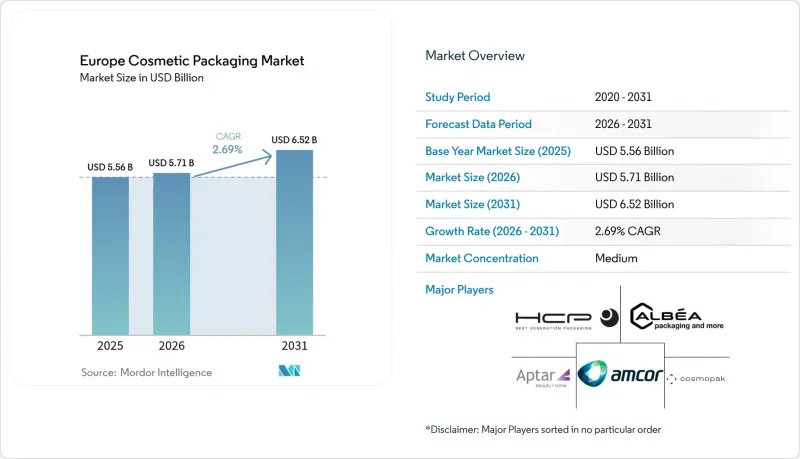
This report is Segmented by Material Type (Plastic, and More), Product Type (Bottles and Jars, Tubes and Sticks, and More), Cosmetic Type (Skin Care, Hair Care, and More), Distribution Channel (Direct Sales, and Indirect Sales), Packaging Format (Rigid, and More), Sustainability Attribute (Recyclable, and More), and Geography. The Market Forecasts are Provided in Terms of Value (USD).
Europe Cosmetic Packaging Market Trends and Insights
EU Packaging and Packaging-Waste Regulation Push
Full enforcement in 2025 obliges all cosmetic packs to be recyclable or reusable by 2030 with interim recycled-content targets of 25% for PET bottles by 2027 and 30% by 2030. Brands are redesigning multi-layer laminates into single-material tubes, which requires plasma-coating investments many mid-tier converters cannot fund alone. Extended producer responsibility fees now rival material costs for non-recyclable formats, doubling landed prices and accelerating interest in refillable systems. Transparent PET now earns lower fees than dark variants, challenging prestige firms that relied on opaque black to signal luxury. Early movers in Germany and the Netherlands report faster line-qualification approvals from retailers, securing priority shelf space ahead of laggards.
Surge in Refillable and Reusable Formats
Refillable packaging represented 15% of new European cosmetic launches in 2025, nearly double 2023 levels. France's AGEC law mandates a 10% refillable share by weight by 2027, spurring magnetic-closure compacts and twist-lock lipstick cases that accept in-store or subscription cartridges. Gerresheimer's modular glass jar lets consumers keep an outer shell and replace an inner liner, cutting 60% of material over five cycles. Economics work best for high-turnover creams depleted within three months, while low-usage eye shadow struggles to recoup the initial premium. Limited retail refill stations under 20% of European drugstores restrain uptake outside urban hubs, so brands embed NFC chips to reward repeat refills and maintain engagement.
High-Cost Differential for Bio-Based Polymers
Bio-based polyethylene and polypropylene traded 20-35% above fossil alternatives during 2025, limiting uptake to premium brands able to absorb the gap. The region's bio-plastic capacity sits below 80 000 t annually, so broader adoption would outstrip supply if more than 15% of converters switch simultaneously. Processing windows are tighter, driving scrap rates three points higher during line changeovers. Regulatory clarity on mass-balance accounting will not arrive until late 2026, postponing volume commitments. Consumer willingness to pay an 8-12% green premium fails to fully offset converter cost increases, making multi-year offtake contracts essential to close the margin gap.
Other drivers and restraints analyzed in the detailed report include:
- E-commerce Led Demand for Protective Aesthetics
- Gen-Z Preference for Minimalist Mono-Material Designs
- Intra-EU rPET Supply Shortages
For complete list of drivers and restraints, kindly check the Table Of Contents.
Segment Analysis
In the European cosmetic packaging market, plastics accounted for 43.26% of the material revenue in 2025. This dominance is attributed to its versatility, cost-effectiveness, and widespread use across various cosmetic product categories. Glass, benefiting from its infinite recyclability and premium appeal, secured about 22% of the market share. It remains a preferred choice for fragrances and high-end creams, where aesthetics and sustainability are key considerations.
Forecasted to grow at a rate of 3.34% CAGR, bio-degradable and compostable resins are set to expand the fastest. These materials are gaining traction as brands proactively address environmental concerns and prepare for potential microplastic bans. By securing EN 13432-certified supply contracts, companies are ensuring compliance with stringent regulations while promoting sustainable practices. This shift is steering the European cosmetic packaging industry towards a more diverse range of feedstocks, reducing dependency on traditional materials. Aluminum tubes, with an impressive 76% collection rate, solidify their significance in both sunscreen and color cosmetic segments. Their high recyclability and durability make them a reliable choice for brands aiming to meet sustainability goals. Suppliers showcasing multi-material agility, capable of transitioning from plastic to glass without the need for new tooling, gain a crucial edge as Extended Producer Responsibility (EPR) fees become more stringent. This adaptability allows them to cater to evolving market demands while minimizing operational disruptions
In 2025, bottles and jars dominated the European cosmetic packaging market, accounting for 29.84% of the revenue. These packaging formats remain popular due to their durability, reusability, and ability to preserve product integrity. Following closely, tubes and sticks made up roughly 24% of the market, highlighting consumers' preference for the portability of creams and balms. The convenience offered by these formats, especially for on-the-go usage, continues to drive their demand.
Flexible pouches and sachets are on the rise, boasting a 3.21% CAGR through 2031. Their lighter weights not only reduce shipping costs but also align with lower carbon targets, making them an attractive option for environmentally conscious brands and consumers. This trend suggests a potential shift in the European cosmetic packaging market's focus towards high-barrier laminates, which offer enhanced protection and sustainability benefits. While pumps and droppers, essential for oxygen-sensitive serums, see robust demand, brands are increasingly leaning towards metal-spring-free designs to simplify recycling and meet sustainability goals. Additionally, decoration services, particularly digital printing, are reaping higher margins as converters assist indie labels in distinguishing themselves in the bustling online marketplace. The ability to offer customized and visually appealing designs has become a key differentiator for brands aiming to capture consumer attention in a competitive digital landscape.
Complete Report Scope:
- By Material Type
- Plastic
- Glass
- Metal
- Paper and Paperboard
- Bio-Degradable/Compostable
- By Product Type
- Bottles and Jars
- Tubes and Sticks
- Folding Cartons
- Pump, Dispenser and Droppers
- Caps, Closures and Applicators
- Flexible Pouches and Sachets
- By Cosmetic Type
- Skin Care
- Hair Care
- Color Cosmetics
- Fragrances
- Other Cosmetic Types
- By Distribution Channel
- Direct Sales Channel
- Indirect Sales Channel
- By Packaging Format
- Rigid
- Semi-Rigid
- Flexible
- By Sustainability Attribute
- Recyclable
- Reusable/Refillable
- Bio-Based Content ?30 %
- Compostable
- By Country
- Germany
- United Kingdom
- France
- Italy
- Spain
- Rest of Europe
List of Companies Covered in this Report:
- Albea SA
- AptarGroup Inc.
- Amcor Plc
- Silgan Holdings Inc.
- Gerresheimer AG
- Quadpack Industries SA
- Berlin Packaging LLC
- International Paper Company
- Smurfit WestRock
- HCP Packaging Co., Ltd.
- Coverpla SAS
- Cosmopak USA LLC
- Huhtamaki Oyj
- Graham Packaging Company
- Mondi Group
- Sealed Air Corporation
- Rexam Plc (Ball Corporation)
- Raepak Ltd.
- Stoelzle Glass Group
- Verescence SA
- SGD Pharma SA
- Vetroplast SA
Additional Benefits:
- The market estimate (ME) sheet in Excel format
- 3 months of analyst support
TABLE OF CONTENTS
1 INTRODUCTION
- 1.1 Study Assumptions and Market Definition
- 1.2 Scope of the Study
2 RESEARCH METHODOLOGY
3 EXECUTIVE SUMMARY
4 MARKET LANDSCAPE
- 4.1 Market Overview
- 4.2 Market Drivers
- 4.2.1 EU Packaging and Packaging-Waste Regulation (PPWR) Push
- 4.2.2 Surge in Refillable and Reusable Formats
- 4.2.3 E-commerce Led Demand for Protective Aesthetics
- 4.2.4 Gen-Z Preference for Minimalist, Mono-Material Designs
- 4.2.5 Microplastic Restriction Shifting Material Mix
- 4.2.6 On-Demand 3D-Printed Packaging for Indie Brands
- 4.3 Market Restraints
- 4.3.1 High Cost Differential for Bio-Based Polymers
- 4.3.2 Intra-EU rPET Supply Shortages
- 4.3.3 Energy Price Volatility Impacting Glass Furnaces
- 4.3.4 Escalating EPR Fees for Non-Recyclable Formats
- 4.4 Industry Value-Chain Analysis
- 4.5 Regulatory Landscape
- 4.6 Technological Outlook
- 4.7 Porter's Five Forces Analysis
- 4.7.1 Bargaining Power of Suppliers
- 4.7.2 Bargaining Power of Buyers
- 4.7.3 Threat of New Entrants
- 4.7.4 Threat of Substitutes
- 4.7.5 Intensity of Competitive Rivalry
- 4.8 Impact of Macroeconomic Factors on the Market
5 MARKET SIZE AND GROWTH FORECASTS (VALUE)
- 5.1 By Material Type
- 5.1.1 Plastic
- 5.1.2 Glass
- 5.1.3 Metal
- 5.1.4 Paper and Paperboard
- 5.1.5 Bio-Degradable/Compostable
- 5.2 By Product Type
- 5.2.1 Bottles and Jars
- 5.2.2 Tubes and Sticks
- 5.2.3 Folding Cartons
- 5.2.4 Pump, Dispenser and Droppers
- 5.2.5 Caps, Closures and Applicators
- 5.2.6 Flexible Pouches and Sachets
- 5.3 By Cosmetic Type
- 5.3.1 Skin Care
- 5.3.2 Hair Care
- 5.3.3 Color Cosmetics
- 5.3.4 Fragrances
- 5.3.5 Other Cosmetic Types
- 5.4 By Distribution Channel
- 5.4.1 Direct Sales Channel
- 5.4.2 Indirect Sales Channel
- 5.5 By Packaging Format
- 5.5.1 Rigid
- 5.5.2 Semi-Rigid
- 5.5.3 Flexible
- 5.6 By Sustainability Attribute
- 5.6.1 Recyclable
- 5.6.2 Reusable/Refillable
- 5.6.3 Bio-Based Content ?30 %
- 5.6.4 Compostable
- 5.7 By Country
- 5.7.1 Germany
- 5.7.2 United Kingdom
- 5.7.3 France
- 5.7.4 Italy
- 5.7.5 Spain
- 5.7.6 Rest of Europe
6 COMPETITIVE LANDSCAPE
- 6.1 Market Concentration
- 6.2 Strategic Moves
- 6.3 Market Share Analysis
- 6.4 Company Profiles (includes Global Level Overview, Market Level Overview, Core Segments, Financials as available, Strategic Information, Market Rank/Share, Products and Services, Recent Developments)
- 6.4.1 Albea SA
- 6.4.2 AptarGroup Inc.
- 6.4.3 Amcor Plc
- 6.4.4 Silgan Holdings Inc.
- 6.4.5 Gerresheimer AG
- 6.4.6 Quadpack Industries SA
- 6.4.7 Berlin Packaging LLC
- 6.4.8 International Paper Company
- 6.4.9 Smurfit WestRock
- 6.4.10 HCP Packaging Co., Ltd.
- 6.4.11 Coverpla SAS
- 6.4.12 Cosmopak USA LLC
- 6.4.13 Huhtamaki Oyj
- 6.4.14 Graham Packaging Company
- 6.4.15 Mondi Group
- 6.4.16 Sealed Air Corporation
- 6.4.17 Rexam Plc (Ball Corporation)
- 6.4.18 Raepak Ltd.
- 6.4.19 Stoelzle Glass Group
- 6.4.20 Verescence SA
- 6.4.21 SGD Pharma SA
- 6.4.22 Vetroplast SA
7 MARKET OPPORTUNITIES AND FUTURE OUTLOOK
- 7.1 White-Space and Unmet-Need Assessment

