PUBLISHER: Mordor Intelligence | PRODUCT CODE: 2120462

PUBLISHER: Mordor Intelligence | PRODUCT CODE: 2120462
Latin America Pharmaceutical Contract Manufacturing Organization - Market Share Analysis, Industry Trends & Statistics, Growth Forecasts (2026 - 2031)
According to Mordor Intelligence, Latin America pharmaceutical contract manufacturing organization market size in 2026 is estimated at USD 3.21 billion, growing from 2025 value of USD 3.13 billion with 2031 projections showing USD 3.63 billion, growing at 2.52% CAGR over 2026-2031.
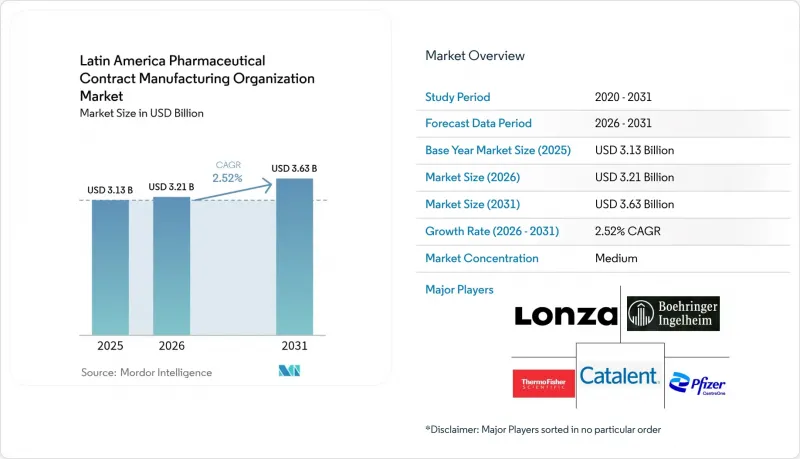
This report is Segmented by Service Type (API Manufacturing, Secondary Packaging, and More), Drug Molecule Type (Small Molecule, Biologics, and More), Scale of Operation (Clinical-Phase Manufacturing, Commercial-Scale Manufacturing), End User (Big Pharma, Generic Pharma, and More), Therapeutic Area (Oncology, Cardiovascular, and More). The Market Forecasts are Provided in Terms of Value (USD).
Latin America Pharmaceutical Contract Manufacturing Organization Market Trends and Insights
Rising biologics outsourcing within LATAM
Pharmaceutical firms are increasingly outsourcing biologics because the specialized bioreactors, purification skids, and validated cold-chain infrastructure required for large-molecule products demand steep capital expenditures. PAHO's mRNA transfer hubs in Argentina and Brazil catalyze domestic know-how, while the Fiocruz-Boehringer agreement to localize Jardiance showcases how established CMOs pivot toward higher-margin biologics work. National policies that subsidize technology transfer amplify the trend, and regional CDMOs are now scaling single-use systems and 2,000 L stainless bioreactors. The shift helps the Latin America pharmaceutical contract manufacturing organization market secure larger, multi-year contracts from innovator companies that prefer variable cost models over owning dedicated biologics capacity. As a result, biologics now occupy a rising share of facility CapEx plans across Brazil's primary clusters in Sao Paulo and Minas Gerais.
Growing near-shoring by North-American pharma companies
Heightened geopolitical friction and pandemic supply-chain bottlenecks have prompted U.S. and Canadian sponsors to relocate portions of their manufacturing portfolios nearer to the United States. Mexico's proximity, bilingual workforce, and USMCA tariff advantages enable faster cycle times and simplified FDA audits, encouraging partnerships like Lupin-Huons for regional supply coverage. Flexible manufacturing lines inside Brazilian free-trade zones equally appeal to specialty drug makers aiming to hedge over-reliance on Asia. As these relocations mature, the Latin America pharmaceutical contract manufacturing organization market gains consistent baseline volumes that smooth production scheduling and heighten plant utilization.
Frequent regulatory inspections causing project delays
ANVISA's 2025 agenda heightened unannounced GMP audits, compelling plants to maintain perpetual inspection readiness and occasionally suspend production for remediation. COFEPRIS mirrored the stance, increasing cross-border dossier harmonization with the FDA, which widens the documentation burden. Smaller CMOs in the Latin America pharmaceutical contract manufacturing organization market divert engineers from process improvement to compliance firefighting, diluting resource focus and slowing tech-transfer launches.
Other drivers and restraints analyzed in the detailed report include:
- Expansion of local vaccine manufacturing post-COVID-19
- AI-enabled process optimization boosting CMO margins
- Currency volatility impacting imported raw-material costs
For complete list of drivers and restraints, kindly check the Table Of Contents.
Segment Analysis
API lines accounted for 42.10% of the Latin America pharmaceutical contract manufacturing organization market share in 2025, and their 3.62% CAGR forecast underscores clients' preference to outsource potent-compound synthesis. Brazilian and Mexican plants now operate dedicated HPAPI suites with occupant-protection barriers that meet EU Annex 1 revisions. Secondary packaging remains smaller yet benefits from serialization mandates that mandate line upgrades across the region. As regulatory confidence rises, innovators funnel more tech-transfers for complex steps toward Latin facilities, lifting dollar-denominated backlog for the Latin America pharmaceutical contract manufacturing organization market.
Growing biologics API work further enriches margins. Single-use assemblies and tangential flow filtration installations become common, while analytical laboratories adopt mass-spectrometry-based release testing. Consequently, service-mix evolution migrates revenue from low-margin tablet compression to higher-value chemical and biological ingredient production, propelling reinvestment cycles that reinforce regional competitiveness inside the Latin America pharmaceutical contract manufacturing organization market.
Small molecules still anchor 56.85% of revenue thanks to entrenched generic demand and scalable chemistry. However, the 3.95% CAGR in cell and gene therapy manufacturing illustrates the shifting portfolio. CDMOs retrofit Grade B suites for viral-vector fill-finish, and regulators craft fast-track biologics guidelines. Biologics pipelines such as monoclonal antibodies drive stainless and single-use hybrid facilities that diversify risk and attract venture-backed biotech clients to the Latin America pharmaceutical contract manufacturing organization market.
Emerging modalities create network effects: as ex-U.S. sponsors secure reliable viral-vector supply, they also shift analytical and stability work. This virtuous cycle nudges more capital toward specialized platforms, gradually diluting small-molecule weight without displacing its dominant revenue role through 2031.
Complete Report Scope:
- By Service Type
- API Manufacturing
- Small Molecule
- Large Molecule
- High-Potency API (HPAPI)
- FDF Development and Manufacturing
- Solid Dose
- Liquid Dose
- Injectable Dose
- Secondary Packaging
- API Manufacturing
- By Drug Molecule Type
- Small Molecule
- Biologics
- Advanced Therapies (Cell and Gene)
- By Scale of Operation
- Clinical-Phase Manufacturing
- Commercial-Scale Manufacturing
- By End User
- Big Pharma
- Generic Pharma
- Emerging / Virtual Biotech
- Specialty Pharma
- By Therapeutic Area
- Oncology
- Cardiovascular
- Central Nervous System (CNS)
- Infectious Disease
- Other Therapeutic Areas
- By Country
- Brazil
- Chile
- Argentina
- Rest of Latin America
List of Companies Covered in this Report:
- Catalent, Inc.
- Thermo Fisher Scientific Inc.
- Lonza Group AG
- Boehringer Ingelheim International GmbH
- Pfizer Inc. (Pfizer CentreOne)
- Baxter International Inc. (BioPharma Solutions)
- Acino International AG
- Siegfried Holding AG
- Recipharm AB
- Fareva S.A.
- AbbVie Inc. (AbbVie Contract Manufacturing)
- Jubilant Pharmova Limited
- WuXi AppTec Co., Ltd.
- Samsung Biologics Co., Ltd.
- Grifols S.A.
- Eurofarma Laboratorios S.A.
- Libbs Farmaceutica Ltda.
- Blau Farmaceutica S.A.
- BCM Farma Industria Farmaceutica Ltda.
- Laboratorios Liomont S.A. de C.V.
Additional Benefits:
- The market estimate (ME) sheet in Excel format
- 3 months of analyst support
TABLE OF CONTENTS
1 INTRODUCTION
- 1.1 Study Assumptions and Market Definition
- 1.2 Scope of the Study
2 RESEARCH METHODOLOGY
3 EXECUTIVE SUMMARY
4 MARKET LANDSCAPE
- 4.1 Market Overview
- 4.2 Market Drivers
- 4.2.1 Rising biologics outsourcing within LATAM
- 4.2.2 Growing near-shoring by North-American pharma companies
- 4.2.3 Expansion of local vaccine manufacturing post-COVID-19
- 4.2.4 Government tax incentives for export-oriented CMOs
- 4.2.5 AI-enabled process-optimisation boosting CMO margins
- 4.2.6 Regional ESG-linked financing unlocking CapEx
- 4.3 Market Restraints
- 4.3.1 Frequent regulatory inspections causing project delays
- 4.3.2 Currency volatility impacting imported raw-material costs
- 4.3.3 GMP-trained talent shortage in secondary cities
- 4.3.4 Power-grid instability raising operating costs in Brazil's Northeast
- 4.4 Industry Value Chain Analysis
- 4.5 Porter's Five Forces Analysis
- 4.5.1 Bargaining Power of Suppliers
- 4.5.2 Bargaining Power of Buyers
- 4.5.3 Threat of New Entrants
- 4.5.4 Intensity of Competitive Rivalry
- 4.5.5 Threat of Substitutes
- 4.6 The Impact of Macroeconomic Factors on the Market
- 4.7 Regulatory Landscape
- 4.8 Technological Outlook
5 MARKET SIZE AND GROWTH FORECASTS
- 5.1 By Service Type
- 5.1.1 API Manufacturing
- 5.1.1.1 Small Molecule
- 5.1.1.2 Large Molecule
- 5.1.1.3 High-Potency API (HPAPI)
- 5.1.2 FDF Development and Manufacturing
- 5.1.2.1 Solid Dose
- 5.1.2.2 Liquid Dose
- 5.1.2.3 Injectable Dose
- 5.1.3 Secondary Packaging
- 5.1.1 API Manufacturing
- 5.2 By Drug Molecule Type
- 5.2.1 Small Molecule
- 5.2.2 Biologics
- 5.2.3 Advanced Therapies (Cell and Gene)
- 5.3 By Scale of Operation
- 5.3.1 Clinical-Phase Manufacturing
- 5.3.2 Commercial-Scale Manufacturing
- 5.4 By End User
- 5.4.1 Big Pharma
- 5.4.2 Generic Pharma
- 5.4.3 Emerging / Virtual Biotech
- 5.4.4 Specialty Pharma
- 5.5 By Therapeutic Area
- 5.5.1 Oncology
- 5.5.2 Cardiovascular
- 5.5.3 Central Nervous System (CNS)
- 5.5.4 Infectious Disease
- 5.5.5 Other Therapeutic Areas
- 5.6 By Country
- 5.6.1 Brazil
- 5.6.2 Chile
- 5.6.3 Argentina
- 5.6.4 Rest of Latin America
6 COMPETITIVE LANDSCAPE
- 6.1 Market Concentration
- 6.2 Strategic Moves
- 6.3 Market Share Analysis
- 6.4 Company Profiles (includes Global level Overview, Market level overview, Core Segments, Financials as available, Strategic Information, Market Rank/Share for key companies, Products and Services, and Recent Developments)
- 6.4.1 Catalent, Inc.
- 6.4.2 Thermo Fisher Scientific Inc.
- 6.4.3 Lonza Group AG
- 6.4.4 Boehringer Ingelheim International GmbH
- 6.4.5 Pfizer Inc. (Pfizer CentreOne)
- 6.4.6 Baxter International Inc. (BioPharma Solutions)
- 6.4.7 Acino International AG
- 6.4.8 Siegfried Holding AG
- 6.4.9 Recipharm AB
- 6.4.10 Fareva S.A.
- 6.4.11 AbbVie Inc. (AbbVie Contract Manufacturing)
- 6.4.12 Jubilant Pharmova Limited
- 6.4.13 WuXi AppTec Co., Ltd.
- 6.4.14 Samsung Biologics Co., Ltd.
- 6.4.15 Grifols S.A.
- 6.4.16 Eurofarma Laboratorios S.A.
- 6.4.17 Libbs Farmaceutica Ltda.
- 6.4.18 Blau Farmaceutica S.A.
- 6.4.19 BCM Farma Industria Farmaceutica Ltda.
- 6.4.20 Laboratorios Liomont S.A. de C.V.
7 MARKET OPPORTUNITIES AND FUTURE OUTLOOK
- 7.1 White-space and Unmet-Need Assessment

