PUBLISHER: Mordor Intelligence | PRODUCT CODE: 2121993

PUBLISHER: Mordor Intelligence | PRODUCT CODE: 2121993
Europe Pharmaceutical Contract Manufacturing - Market Share Analysis, Industry Trends & Statistics, Growth Forecasts (2026 - 2031)
According to Mordor Intelligence, the pharmaceutical contract manufacturing market size in Europe was valued at USD 45.18 billion in 2025 and estimated to grow from USD 47.42 billion in 2026 to reach USD 60.38 billion by 2031, at a CAGR of 4.95% during the forecast period (2026-2031).
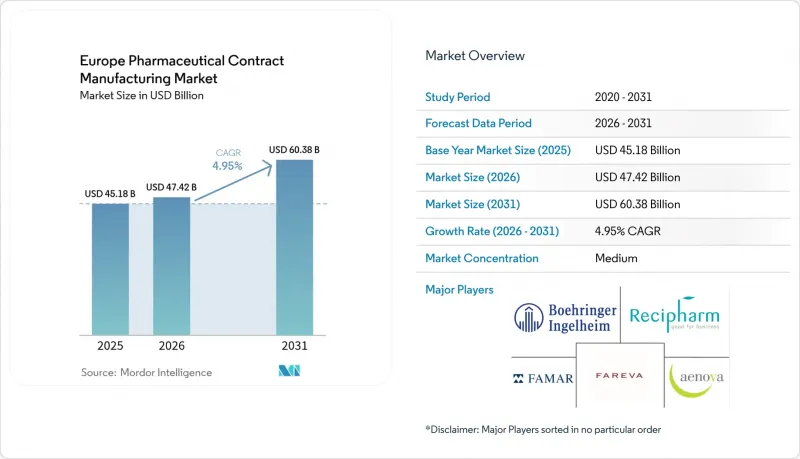
This report is Segmented by Service Type (API Manufacturing, FDF Development and Manufacturing, and Secondary Packaging), Molecule Type (Small Molecule, and More), Therapeutic Area (Oncology, Cardiovascular, and More), Development Phase (Pre-Clinical, and More), End-Client Type (Big Pharma, and More), and Geography. The Market Forecasts are Provided in Terms of Value (USD).
Europe Pharmaceutical Contract Manufacturing Market Trends and Insights
Growing Biologics and HPAPI Pipeline Complexity
Rising demand for monoclonal antibodies, bispecifics, and antibody-drug conjugates is pushing CDMOs to invest in large-scale single-use bioreactors, high-containment suites, and advanced purification trains that few facilities can match. Samsung Biologics' USD 1.4 billion multiyear contract with a European sponsor and the 180,000-liter expansion of Plant 5 exemplify the premium tied to specialized capacity. Digital twin systems are being deployed across European plants to enable predictive maintenance and real-time batch analytics, reducing failure rates and shortening tech-transfer cycles. These capital-heavy upgrades raise barriers to entry, concentrating pharmaceutical contract manufacturing market capacity among a handful of technologically advanced providers. As biologic payloads gain potency, compliance with updated EU GMP Annex 1 standards further differentiates operators equipped with isolators, restricted-access barrier systems, and robust contamination control strategies.
Increasing Outsourcing Volume by EU Pharma Majors
Regional drug makers continue divesting non-core sites while locking in long-term supply agreements with CDMOs that can ensure capacity, quality, and regulatory alignment. Sanofi's facility transfer to Thermo Fisher illustrates a broader pivot that allows originators to redeploy capital toward R&D and commercialization. The Critical Medicines Act encourages multi-site European production to mitigate supply risks, prompting pharmaceutical companies to split portfolios across several contract partners. Outsourcing decisions now extend beyond cost, encompassing cyber-resilient data exchange, serialization compliance, and post-approval change management support. CDMOs that can bundle early-phase development, tech transfer, commercial supply, and regulatory liaison functions benefit from higher wallet share and deeper client lock-in.
Rising EU Energy Prices Pressuring Margins
Escalating power tariffs have added close to EUR 1 billion in incremental annual costs for European generics manufacturers alone. Energy-intensive unit operations such as lyophilization and high-temperature HPAPI syntheses face acute margin compression, especially in Germany, where industrial electricity prices remain elevated. CDMOs respond by accelerating heat-recovery retrofits, procuring long-term renewable-energy PPAs, and piloting continuous processes that lower energy per kilogram output. Smaller providers lacking capital for energy-efficiency upgrades risk being priced out of competitive bids.
Other drivers and restraints analyzed in the detailed report include:
- Contract-friendly EU Tax Incentives and Grants
- CDMO M&A Unlocking One-Stop-Shop Capabilities
- Capacity Utilization Gaps in Small-Molecule Plants
For complete list of drivers and restraints, kindly check the Table Of Contents.
Segment Analysis
API manufacturing contributed 42.02% of 2025 revenue, underlining its anchor role in the pharmaceutical contract manufacturing market size. Projects involve complex multi-step chemistries, biocatalysis, and high-containment work that sustain premium pricing. Recent demand spikes in antiviral and oncology payloads have pushed European CDMOs to debottleneck kilolab through commercial kilo-scale assets while integrating real-time release testing to curtail cycle times.
FDF work, though currently smaller, is projected to outpace overall market growth at 6.67% CAGR on the back of patient-friendly oral thin films, autoinjectors, and inhaled formulations. Serialization rules under the Falsified Medicines Directive drive added packaging revenues, while Annex 1's sterile-drug revisions prompt investments in isolator-based filling lines. The interplay between bulk-drug and dosage manufacturing strengthens bundled contracting, further consolidating pharmaceutical contract manufacturing market opportunities within multi-service providers.
The pharmaceutical contract manufacturing market share for small molecules stood at 58.12% in 2025, reflecting Europe's entrenched synthetic-chemistry heritage and extensive reactor infrastructure. Continuous-flow retrofits have trimmed solvent consumption and cycle times, helping older assets remain competitive amid escalating energy costs.
Highly-potent API programs grow at 7.02% CAGR as oncology and targeted therapies proliferate. Investments in negative-pressure suites, glove-box isolators, and advanced dust-collection systems are mandatory to meet Occupational Exposure Limit thresholds below 10 µg/m3. Large-molecule biologics projects command longer timelines but deliver durable revenue streams due to multi-year tech-transfer complexity and higher regulatory scrutiny, reinforcing the blended portfolio approach of leading CDMOs.
Complete Report Scope:
- By Service Type
- Active Pharmaceutical Ingredient (API) Manufacturing
- Finished Dosage Formulation (FDF) Development and Manufacturing
- Solid Dose Formulation
- Liquid Dose Formulation
- Injectable Dose Formulation
- Secondary Packaging
- By Molecule Type
- Small Molecule
- Large Molecule / Biologics
- Highly-Potent APIs (HPAPI)
- Advanced Therapies (Cell and Gene)
- By Therapeutic Area
- Oncology
- Cardiovascular
- CNS Disorders
- Infectious Diseases
- Respiratory
- Other Therapeutic Area
- By Development Phase
- Pre-clinical
- Clinical - Phase I
- Clinical - Phase II
- Clinical - Phase III
- Commercial Manufacturing
- By End-Client Type
- Big Pharma
- Small and Mid-size Pharma
- Virtual / Biotech Start-ups
- Generics Manufacturers
- By Country
- United Kingdom
- Germany
- France
- Italy
- Spain
- Rest of Europe
List of Companies Covered in this Report:
- Lonza Group Ltd
- Recipharm AB
- Catalent Inc
- Fareva Holding SAS
- Aenova Group GmbH
- Boehringer Ingelheim Pharma GmbH & Co. KG
- Siegfried Holding AG
- Almac Group Ltd
- Famar SA
- Cenexi SAS
- Eurofins CDMO S.A.
- Thermo Fisher Scientific Inc (Patheon)
- Samsung Biologics Co., Ltd
- Baxter BioPharma Solutions LLC
- Delpharm SAS
- Polpharma Biologics S.A.
- IDT Biologika GmbH
- Rentschler Biopharma SE
- Alcami Corporation
- Novasep Holding SAS
Additional Benefits:
- The market estimate (ME) sheet in Excel format
- 3 months of analyst support
TABLE OF CONTENTS
1 INTRODUCTION
- 1.1 Study Assumptions and Market Definition
- 1.2 Scope of the Study
2 RESEARCH METHODOLOGY
3 EXECUTIVE SUMMARY
4 MARKET LANDSCAPE
- 4.1 Market Overview
- 4.2 Market Drivers
- 4.2.1 Increasing outsourcing volume by EU pharma majors
- 4.2.2 Growing biologics and HPAPI pipeline complexity
- 4.2.3 Contract-friendly EU tax incentives and grants
- 4.2.4 CDMO MandA unlocking one-stop-shop capabilities
- 4.2.5 On-demand manufacturing tech (continuous, modular) gaining traction
- 4.2.6 Near-shoring driven by supply-chain security clauses in EU HTA law
- 4.3 Market Restraints
- 4.3.1 Rising EU energy prices pressuring margins
- 4.3.2 Capacity utilisation gaps in small-molecule plants
- 4.3.3 Talent shortage in aseptic processing specialists
- 4.3.4 Inflation-linked CDMO input contracts limiting price passthrough
- 4.4 Industry Value Chain Analysis
- 4.5 Regulatory Landscape
- 4.6 Technological Outlook
- 4.7 Porter's Five Forces Analysis
- 4.7.1 Bargaining Power of Suppliers
- 4.7.2 Bargaining Power of Buyers
- 4.7.3 Threat of New Entrants
- 4.7.4 Threat of Substitutes
- 4.7.5 Intensity of Competitive Rivalry
- 4.8 Impact of Macroeconomic Factors on the Market
5 MARKET SIZE AND GROWTH FORECASTS (VALUE)
- 5.1 By Service Type
- 5.1.1 Active Pharmaceutical Ingredient (API) Manufacturing
- 5.1.2 Finished Dosage Formulation (FDF) Development and Manufacturing
- 5.1.2.1 Solid Dose Formulation
- 5.1.2.2 Liquid Dose Formulation
- 5.1.2.3 Injectable Dose Formulation
- 5.1.3 Secondary Packaging
- 5.2 By Molecule Type
- 5.2.1 Small Molecule
- 5.2.2 Large Molecule / Biologics
- 5.2.3 Highly-Potent APIs (HPAPI)
- 5.2.4 Advanced Therapies (Cell and Gene)
- 5.3 By Therapeutic Area
- 5.3.1 Oncology
- 5.3.2 Cardiovascular
- 5.3.3 CNS Disorders
- 5.3.4 Infectious Diseases
- 5.3.5 Respiratory
- 5.3.6 Other Therapeutic Area
- 5.4 By Development Phase
- 5.4.1 Pre-clinical
- 5.4.2 Clinical - Phase I
- 5.4.3 Clinical - Phase II
- 5.4.4 Clinical - Phase III
- 5.4.5 Commercial Manufacturing
- 5.5 By End-Client Type
- 5.5.1 Big Pharma
- 5.5.2 Small and Mid-size Pharma
- 5.5.3 Virtual / Biotech Start-ups
- 5.5.4 Generics Manufacturers
- 5.6 By Country
- 5.6.1 United Kingdom
- 5.6.2 Germany
- 5.6.3 France
- 5.6.4 Italy
- 5.6.5 Spain
- 5.6.6 Rest of Europe
6 COMPETITIVE LANDSCAPE
- 6.1 Market Concentration
- 6.2 Strategic Moves
- 6.3 Market Share Analysis
- 6.4 Company Profiles (includes Global level Overview, Market level overview, Core Segments, Financials as available, Strategic Information, Market Rank/Share for key companies, Products and Services, and Recent Developments)
- 6.4.1 Lonza Group Ltd
- 6.4.2 Recipharm AB
- 6.4.3 Catalent Inc
- 6.4.4 Fareva Holding SAS
- 6.4.5 Aenova Group GmbH
- 6.4.6 Boehringer Ingelheim Pharma GmbH & Co. KG
- 6.4.7 Siegfried Holding AG
- 6.4.8 Almac Group Ltd
- 6.4.9 Famar SA
- 6.4.10 Cenexi SAS
- 6.4.11 Eurofins CDMO S.A.
- 6.4.12 Thermo Fisher Scientific Inc (Patheon)
- 6.4.13 Samsung Biologics Co., Ltd
- 6.4.14 Baxter BioPharma Solutions LLC
- 6.4.15 Delpharm SAS
- 6.4.16 Polpharma Biologics S.A.
- 6.4.17 IDT Biologika GmbH
- 6.4.18 Rentschler Biopharma SE
- 6.4.19 Alcami Corporation
- 6.4.20 Novasep Holding SAS
7 MARKET OPPORTUNITIES AND FUTURE OUTLOOK
- 7.1 White-space and Unmet-Need Assessment

