PUBLISHER: Mordor Intelligence | PRODUCT CODE: 2125343

PUBLISHER: Mordor Intelligence | PRODUCT CODE: 2125343
United States Contract Manufacturing Services - Market Share Analysis, Industry Trends & Statistics, Growth Forecasts (2026 - 2031)
According to Mordor Intelligence, the United States contract manufacturing services market size in 2026 is estimated at USD 265.78 billion, growing from 2025 value of USD 248.11 billion with 2031 projections showing USD 374.82 billion, growing at 7.12% CAGR over 2026-2031.
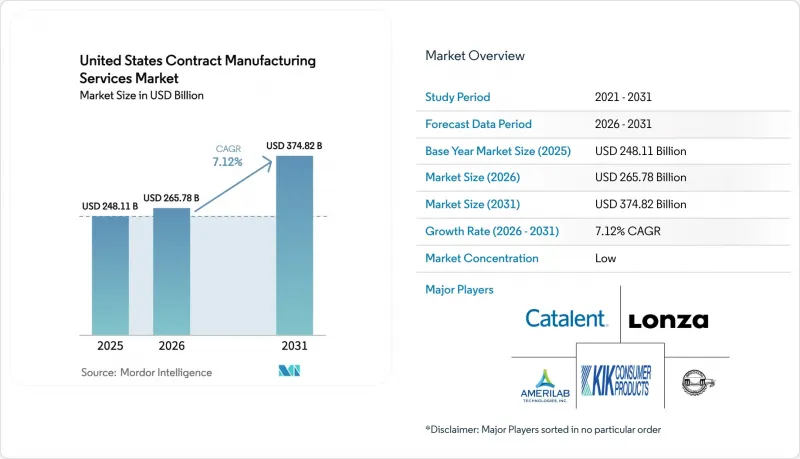
This report is Segmented by Pharmaceutical Services (Active Pharmaceutical Ingredient Manufacturing, and More), Food Processing and Manufacturing (Food Manufacturing Services, Research and Development, and More), Beverage (Beer, Carbonated Drinks, and More), Personal Care (Skin Care, Hair Care, and More), and Geography. The Market Forecasts are Provided in Terms of Value (USD).
United States Contract Manufacturing Services Market Trends and Insights
Surge in Reshoring Initiatives Post-Inflation Reduction Act
Federal tax credits tied to domestic content are shifting capital budgets toward U.S. factories, allowing the United States contract manufacturing services market to recapture production once located overseas. Contractors that can document Buy American compliance now secure multiyear agreements, particularly in pharmaceuticals and renewable-energy components. The advanced manufacturing production credit elevates margins for qualifying operations, encouraging accelerated groundbreakings in the Midwest and South where land and utilities cost less. Major pharmaceutical announcements such as Eli Lilly's multi-site buildout topping USD 50 billion since 2020 illustrate the policy's reach. Similar momentum appears in materials processing; Covestro's EUR 35 million (USD 38 million) investment in Ohio polycarbonate output underscores cross-sector capital flow. These projects enlarge the skilled labour pool yet lead times for facility commissioning keep near-term capacity tight, preserving pricing leverage for incumbent contractors. In response, some producers lock in long-term offtake to hedge against future slot scarcity, cementing demand visibility for the United States contract manufacturing services market.
Tightening FDA Quality-by-Design Guidelines Driving Professional Outsourcing
Updated FDA guidance requires continuous monitoring, process analytical technology, and data-rich validation, raising the floor for compliant production. Many mid-tier drug developers deem internal upgrades uneconomic, opting instead for contractors already running real-time release platforms. These providers shorten commercialization timelines by up to 18 months, delivering a speed premium that translates into earlier revenue recognition for brand owners. M&A activity remains brisk as leading CDMOs buy assets with mature QbD infrastructure; PCI Pharma Services' purchase of Ajinomoto Althea's aseptic fill-finish network is emblematic. The consequence is heightened consolidation inside the United States contract manufacturing services market, with scale players harvesting operational synergies while widening the compliance gap versus smaller rivals. Over the forecast window, incremental guidance on software assurance and continuous manufacturing is expected to keep capital intensity high, locking in the outsourcing thesis.
Persistent Skilled-Labor Shortages Inflating Turnkey Service Pricing
Roughly 2.1 million manufacturing roles remain unfilled nationwide, and competition from technology and healthcare verticals elevates wage expectations for experienced technicians. High-potency suites, aseptic fill-finish lines, and continuous food-processing equipment require specialized certifications that shrink the eligible talent pool. Contract manufacturers raise hourly rates to retain staff, then pass higher costs into service quotes, nudging average turnkey project pricing upward across the United States contract manufacturing services market. Apprenticeship programs mitigate attrition yet require 12-18 months before yielding productivity, leaving an interim gap that automation only partially offsets. Geographic wage differentials further skew project-award patterns toward the South and Midwest, where lower cost-of-living indexes moderate labour premiums. Nevertheless, scarcity persists in niche skills such as sterile compounding, delaying schedule adherence for some GMP renovations.
Other drivers and restraints analyzed in the detailed report include:
- Acceleration of Biologics and HPAPI Pipelines Requiring Specialized Capacity
- Beverage Brands' Pivot to Functional/RTD Formats Needing Agile Co-Packers
- Volatility in Raw-Material Input Costs Compressing Contractor Margins
For complete list of drivers and restraints, kindly check the Table Of Contents.
Segment Analysis
Finished Dosage Formulation accounted for 42.21% of 2025 revenue, underscoring its role as the throughput anchor for the United States contract manufacturing services market share in life-science applications. High-Potency API manufacturing is forecast to deliver a 9.62% CAGR through 2031, the steepest curve in the pharmaceutical bucket, fuelled by oncology pipelines and complex conjugates demanding containment grades OEB 4-5. The United States contract manufacturing services market size for HPAPI work is projected to accelerate as brand owners underwrite new isolator trains to secure scarce capacity. Secondary Packaging keeps momentum amid federal serialization mandates that extend traceability to the unit level, making data-rich labelling a value driver. Throughout the period, automation and single-use technologies compress changeover times, enabling smaller batch sizes that align with precision-medicine strategies.
Complementing high-containment assets, small-molecule API production remains relevant for generic and specialty drugs that still require cost arbitration and cGMP compliance. Injectable Dose Formulation shows above-average expansion because parenteral delivery offers better bioavailability for biologics and long-acting injectables. Contract manufacturers widen pre-filled-syringe and cartridge lines, blending robotics with vision-inspection systems to assure sterile integrity. Investment examples include Evonik's automated vial-filling program and PCI Pharma's Rockford expansion, both reinforcing the capability gap between top-tier CDMOs and regional players. This divergence is expected to entrench tiered pricing within the United States contract manufacturing services market.
Convenience Foods occupied 37.05% of 2025 turnover, cementing its position as the largest in the food domain of the United States contract manufacturing services market. Plant-based Convenience Foods, already benefiting from a 9.41% CAGR outlook, ride consumer shifts toward alternative proteins and clean-label nutrition. Shear-cell texturization and high-moisture extrusion necessitate specialized equipment, incentivizing brands to outsource rather than invest in asset-specific lines. The United States contract manufacturing services market size for alternative protein runs is expected to widen as startup incubators contract for pilot-scale volumes ahead of nationwide distribution.
Bakery Products continue to rely on contract manufacturers for gluten-free and artisan varieties where segregation from wheat-based inputs is mandatory. Similarly, Dairy Products outsourcing grows on the back of lactose-free and plant-based variants that require separate pasteurization flows. R&D services have become embedded in supply contracts, with co-manufacturers offering bench-to-shelf formulation under one roof, thereby shortening innovation cycles. Packaging lines shift toward PCR plastics and compostable films, aligned with retailer sustainability scorecards. This evolution reinforces the strategic relevance of food-grade contractors within the broader United States contract manufacturing services market.
Complete Report Scope:
- By Pharmaceutical Services
- Active Pharmaceutical Ingredient (API) Manufacturing
- Small Molecule
- Large Molecule
- High-Potency API
- Finished Dosage Formulation Development and Manufacturing
- Solid Dose Formulation
- Liquid Dose Formulation
- Injectable Dose Formulation
- Secondary Packaging
- Active Pharmaceutical Ingredient (API) Manufacturing
- By Food Processing and Manufacturing
- Food Manufacturing Services
- Convenience Foods
- Bakery Products
- Confectionery Products
- Dairy Products
- Research and Development
- Food Packaging Services
- Food Manufacturing Services
- By Beverage
- Beer
- Carbonated Drinks and Fruit-based Beverages
- Bottled Water
- Sport Drinks
- By Personal Care
- Skin Care
- Hair Care
- Make-Up and Color Cosmetics
- Others
List of Companies Covered in this Report:
- Catalent Pharma Solutions Inc.
- Lonza Group AG
- Thermo Fisher Scientific Inc. (Patheon)
- Jubilant HollisterStier LLC
- Aenova Group GmbH
- Amerilab Technologies Inc.
- Niagara Bottling LLC
- G3 Enterprises Inc.
- Southeast Bottling and Beverage LLC
- Brooklyn Bottling Group
- KIK Consumer Products Inc.
- Colep Packaging USA Inc.
- Cosmetic Essence Innovations LLC
- Western Innovations Inc.
- CSD Copackers Inc.
- Big Brands LLC
- Sensible Organics LLC
- Recipharm AB
- PCI Pharma Services
- Aurobindo Pharma USA Inc.
Additional Benefits:
- The market estimate (ME) sheet in Excel format
- 3 months of analyst support
TABLE OF CONTENTS
1 INTRODUCTION
- 1.1 Study Assumptions and Market Definition
- 1.2 Scope of the Study
2 RESEARCH METHODOLOGY
3 EXECUTIVE SUMMARY
4 MARKET LANDSCAPE
- 4.1 Market Overview
- 4.2 Market Drivers
- 4.2.1 Surge in reshoring initiatives post-Inflation Reduction Act
- 4.2.2 Tightening U.S. FDA quality-by-design guidelines driving professional outsourcing
- 4.2.3 Acceleration of biologics and HPAPI pipelines requiring specialized capacity
- 4.2.4 Beverage brands' pivot to functional/RTD formats needing agile co-packers
- 4.2.5 Corporate sustainability targets boosting demand for recyclable contract packaging
- 4.2.6 DARPA and BARDA funding for rapid domestic surge-capacity platforms
- 4.3 Market Restraints
- 4.3.1 Persistent skilled-labor shortages inflating turnkey service pricing
- 4.3.2 Volatility in raw-material input costs compressing contractor margins
- 4.3.3 Legacy facility footprints limiting flexibility for short-run SKUs
- 4.3.4 Heightened CFIUS scrutiny on foreign ownership of U.S. plants
- 4.4 Industry Value Chain Analysis
- 4.5 Regulatory Landscape
- 4.6 Technological Outlook
- 4.7 Impact of Macroeconomic Factors
- 4.8 Porter's Five Forces Analysis
- 4.8.1 Bargaining Power of Suppliers
- 4.8.2 Bargaining Power of Buyers
- 4.8.3 Threat of New Entrants
- 4.8.4 Threat of Substitutes
- 4.8.5 Intensity of Competitive Rivalry
- 4.9 PESTEL Analysis
5 MARKET SIZE AND GROWTH FORECASTS (VALUE)
- 5.1 By Pharmaceutical Services
- 5.1.1 Active Pharmaceutical Ingredient (API) Manufacturing
- 5.1.1.1 Small Molecule
- 5.1.1.2 Large Molecule
- 5.1.1.3 High-Potency API
- 5.1.2 Finished Dosage Formulation Development and Manufacturing
- 5.1.2.1 Solid Dose Formulation
- 5.1.2.2 Liquid Dose Formulation
- 5.1.2.3 Injectable Dose Formulation
- 5.1.3 Secondary Packaging
- 5.1.1 Active Pharmaceutical Ingredient (API) Manufacturing
- 5.2 By Food Processing and Manufacturing
- 5.2.1 Food Manufacturing Services
- 5.2.1.1 Convenience Foods
- 5.2.1.2 Bakery Products
- 5.2.1.3 Confectionery Products
- 5.2.1.4 Dairy Products
- 5.2.2 Research and Development
- 5.2.3 Food Packaging Services
- 5.2.1 Food Manufacturing Services
- 5.3 By Beverage
- 5.3.1 Beer
- 5.3.2 Carbonated Drinks and Fruit-based Beverages
- 5.3.3 Bottled Water
- 5.3.4 Sport Drinks
- 5.4 By Personal Care
- 5.4.1 Skin Care
- 5.4.2 Hair Care
- 5.4.3 Make-Up and Color Cosmetics
- 5.4.4 Others
6 COMPETITIVE LANDSCAPE
- 6.1 Market Concentration
- 6.2 Strategic Moves (M and A, JVs, Capacity Expansions)
- 6.3 Market Share Analysis
- 6.4 Company Profiles (includes Global Level Overview, Market Level Overview, Core Segments, Financials as available, Strategic Information, Market Rank/Share for key companies, Products and Services, and Recent Developments)
- 6.4.1 Catalent Pharma Solutions Inc.
- 6.4.2 Lonza Group AG
- 6.4.3 Thermo Fisher Scientific Inc. (Patheon)
- 6.4.4 Jubilant HollisterStier LLC
- 6.4.5 Aenova Group GmbH
- 6.4.6 Amerilab Technologies Inc.
- 6.4.7 Niagara Bottling LLC
- 6.4.8 G3 Enterprises Inc.
- 6.4.9 Southeast Bottling and Beverage LLC
- 6.4.10 Brooklyn Bottling Group
- 6.4.11 KIK Consumer Products Inc.
- 6.4.12 Colep Packaging USA Inc.
- 6.4.13 Cosmetic Essence Innovations LLC
- 6.4.14 Western Innovations Inc.
- 6.4.15 CSD Copackers Inc.
- 6.4.16 Big Brands LLC
- 6.4.17 Sensible Organics LLC
- 6.4.18 Recipharm AB
- 6.4.19 PCI Pharma Services
- 6.4.20 Aurobindo Pharma USA Inc.
7 MARKET OPPORTUNITIES AND FUTURE OUTLOOK
- 7.1 White-Space and Unmet-Need Assessment

