PUBLISHER: Mordor Intelligence | PRODUCT CODE: 2120504

PUBLISHER: Mordor Intelligence | PRODUCT CODE: 2120504
North America Plastic Bottles And Containers - Market Share Analysis, Industry Trends & Statistics, Growth Forecasts (2026 - 2031)
According to Mordor Intelligence, North America plastic bottles and containers market size in 2026 is estimated at 8.32 million tonnes, growing from 2025 value of 8.06 million tonnes with 2031 projections showing 9.78 million tonnes, growing at 3.28% CAGR over 2026-2031.
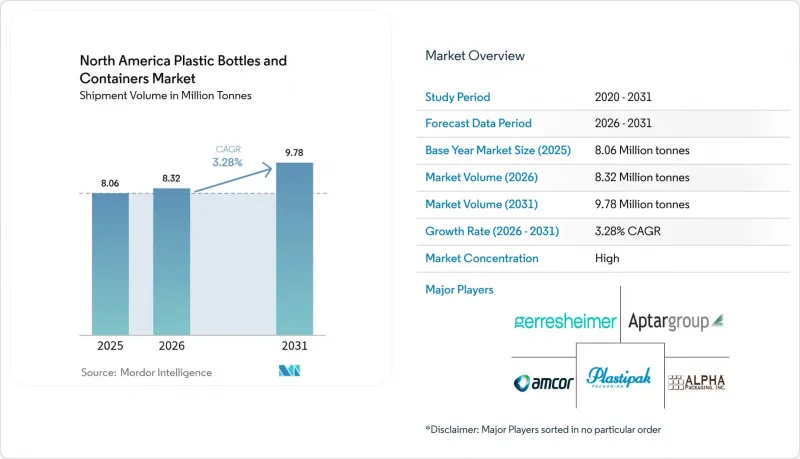
This report is Segmented by Material (PET, HDPE, PP, LDPE, Bioplastics, and More), Packaging Type (Bottles, Jars and Canisters, Jerrycans, and More), End-User Industry (Beverages, Food, Pharmaceuticals, and More), Manufacturing Technology (Extrusion Blow Moulding, Injection Stretch Blow Moulding, and More), and Country. The Market Forecasts are Provided in Terms of Volume (Tonnes).
North America Plastic Bottles And Containers Market Trends and Insights
Rising lightweight-packaging adoption in beverages
Beverage producers intensify lightweighting to cut transport costs and meet climate pledges, achieving up to 15% bottle weight cuts without losing barrier strength through advanced injection stretch blow molding. Coca-Cola cut plastic usage across its North American operations by 20% in 2024, encouraged by dimensional-weight freight charges that reward slimmer pack formats. Consumer research still ranks portability and convenience ahead of material concerns, which sustains plastic adoption in outdoor recreation channels. FDA food-contact rules oblige brands to validate thinner walls for safety, spurring resin suppliers to commercialize higher-intrinsic-viscosity PET grades that maintain drop resistance. The driver will sustain mid-single-digit volume gains in premium hydration, flavored waters, and enhanced sports drinks through 2030.
Deposit-return schemes boosting rPET bottle demand
Ten U.S. states and multiple Canadian provinces operate deposit-return systems that raised regional PET recycling to 41.3% in 2024, well above global averages. Cleaner bales and closed-loop economics let converters certify food-grade recycled PET at scale, feeding brand pledges for 30-35% recycled content by 2035. California processed more than 18 billion beverage containers in 2024, creating a dense supply of high-quality rPET for bottle-to-bottle reprocessing. PepsiCo's reset goals depend on a stable recycled supply, which lifts long-term resin contracts for reclaimed material. Equipment makers are responding by integrating decontamination modules and vision systems that validate pellet clarity in-line, accelerating rPET uptake across the North America plastic bottles and containers market.
Volatile petro-feedstock prices
Natural-gas-linked ethylene costs swung by 25-30% in 2024, pinching margins for resin buyers locked into quarterly contracts. Smaller molders face 30-90-day pass-through lags that erode profitability during spikes. Plant outages at major Gulf Coast crackers amplify volatility, forcing converters to hedge or carry high inventory. Silgan trimmed USD 50 million of operating costs in 2024 to offset resin swings, illustrating the overhead burden placed on the supply base. Continued price turbulence weighs on near-term expansion plans within the North America plastic bottles and containers market.
Other drivers and restraints analyzed in the detailed report include:
- Premiumisation trend in cosmetics and personal-care SKU sizing
- E-commerce demand spike for durable, shippable containers
- Escalating brand-owner sustainability commitments
For complete list of drivers and restraints, kindly check the Table Of Contents.
Segment Analysis
PET supplied 51.87% of 2025 volume, retaining lead due to cost-effective barrier strength and a continent-wide collection network that supports closed-loop bottle-to-bottle programs. High-density polyethylene remains entrenched in dairy and household chemicals thanks to chemical resistance, whereas polypropylene commands heat-resistant drug and personal-care lines. Bioplastics, though just a niche today, are slated for a 5.72% CAGR, reflecting brand bids for compostable or low-carbon alternatives despite capacity shortages.
Intensified lightweighting lets converters shave 15% resin from PET bottles, translating to freight and carbon gains that sync with brand pledges. Regulatory attention to per- and polyfluoroalkyl substances is minimal for PET, further safeguarding its share. The North America plastic bottles and containers market size for PET will thus edge upwards, even as bioplastics nibble high-margin applications in premium cosmetics and specialty foods.
Bottles controlled 47.78% of 2025 shipments, serving beverages, personal care products, and household cleaners. New base geometries and optimized neck threads help maintain rigidity after weight reduction, locking in its dominance. Ampoules and vials are forecast to climb at 4.63% CAGR, propelled by parenteral drugs and biologics that require precise micro-dosing.
Pharmaceutical guidelines that stress particulate control and extractables run compliance costs high, cementing value-added pricing in these small formats. The North America plastic bottles and containers market size for ampoules will therefore outpace macro volumes as injectable therapies rise.
Other types, such as jars and canisters, remain important in premium beauty and food preservation niches, where barrier laminations guard oxygen-sensitive formulas.
Complete Report Scope:
- By Material
- Polyethylene Terephthalate (PET)
- High-Density Polyethylene (HDPE)
- Polypropylene (PP)
- Low-Density Polyethylene (LDPE)
- Bioplastics
- Other Plastics
- By Packaging Type
- Bottles
- Jars and Canisters
- Jerrycans
- Ampoules and Vials
- Other Packaging Types
- By End-user Industry
- Beverages
- Non-Alcoholic Beverages
- Bottled Water
- Carbonated Soft Drinks
- Dairy and Functional Drinks
- Other Non-Alcoholic Beverages
- Alcoholic Beverages
- Non-Alcoholic Beverages
- Food
- Pharmaceuticals
- Cosmetics and Personal Care
- Industrial Chemicals
- Other End-user Industries
- Beverages
- By Manufacturing Technology
- Extrusion Blow Moulding
- Injection Stretch Blow Moulding
- Injection Blow Moulding
- Compression Blow Moulding
- Other Manufacturing Technologies
- By Country
- United States
- Canada
- Mexico
List of Companies Covered in this Report:
- Amcor plc
- Plastipak Holdings Inc.
- Graham Packaging Company LP
- Alpha Packaging Inc.
- Altium Packaging LLC (Loews Corp.)
- Gerresheimer AG
- AptarGroup Inc.
- Comar LLC
- Silgan Holdings Inc.
- Consolidated Container Company LLC
- RPC MandH Plastics Ltd.
- Pretium Packaging LLC
- O.Berk Company LLC
- Inteplast Group Ltd.
- Ring Container Technologies
- Alpla Werke Alwin Lehner GmbH and Co KG
- KP Plastics Inc.
- Sonoco Products Company
- C.L. Smith Company
Additional Benefits:
- The market estimate (ME) sheet in Excel format
- 3 months of analyst support
TABLE OF CONTENTS
1 INTRODUCTION
- 1.1 Study Assumptions and Market Definition
- 1.2 Scope of the Study
2 RESEARCH METHODOLOGY
3 EXECUTIVE SUMMARY
4 MARKET LANDSCAPE
- 4.1 Market Overview
- 4.2 Market Drivers
- 4.2.1 Rising lightweight-packaging adoption in beverages
- 4.2.2 Premiumisation trend in cosmetics and personal-care SKU sizing
- 4.2.3 E-commerce demand spike for durable, shippable containers
- 4.2.4 Deposit-return schemes boosting rPET bottle demand
- 4.2.5 Craft RTD alcoholic beverages shifting to plastic cans
- 4.3 Market Restraints
- 4.3.1 Volatile petro-feedstock prices
- 4.3.2 Escalating brand-owner sustainability commitments
- 4.3.3 Municipal single-use-plastic bans in key U.S. states (under-reported)
- 4.3.4 Emergence of aluminum bottles in sports drinks (under-reported)
- 4.4 Porter's Five Forces Analysis
- 4.4.1 Bargaining Power of Suppliers
- 4.4.2 Bargaining Power of Buyers/Consumers
- 4.4.3 Threat of New Entrants
- 4.4.4 Threat of Substitute Products
- 4.4.5 Intensity of Competitive Rivalry
- 4.5 Industry Value Chain Analysis
- 4.6 Impact of Macroeconomic Factors on the Market
5 MARKET SIZE AND GROWTH FORECASTS (VOLUME)
- 5.1 By Material
- 5.1.1 Polyethylene Terephthalate (PET)
- 5.1.2 High-Density Polyethylene (HDPE)
- 5.1.3 Polypropylene (PP)
- 5.1.4 Low-Density Polyethylene (LDPE)
- 5.1.5 Bioplastics
- 5.1.6 Other Plastics
- 5.2 By Packaging Type
- 5.2.1 Bottles
- 5.2.2 Jars and Canisters
- 5.2.3 Jerrycans
- 5.2.4 Ampoules and Vials
- 5.2.5 Other Packaging Types
- 5.3 By End-user Industry
- 5.3.1 Beverages
- 5.3.1.1 Non-Alcoholic Beverages
- 5.3.1.1.1 Bottled Water
- 5.3.1.1.2 Carbonated Soft Drinks
- 5.3.1.1.3 Dairy and Functional Drinks
- 5.3.1.1.4 Other Non-Alcoholic Beverages
- 5.3.1.2 Alcoholic Beverages
- 5.3.1.1 Non-Alcoholic Beverages
- 5.3.2 Food
- 5.3.3 Pharmaceuticals
- 5.3.4 Cosmetics and Personal Care
- 5.3.5 Industrial Chemicals
- 5.3.6 Other End-user Industries
- 5.3.1 Beverages
- 5.4 By Manufacturing Technology
- 5.4.1 Extrusion Blow Moulding
- 5.4.2 Injection Stretch Blow Moulding
- 5.4.3 Injection Blow Moulding
- 5.4.4 Compression Blow Moulding
- 5.4.5 Other Manufacturing Technologies
- 5.5 By Country
- 5.5.1 United States
- 5.5.2 Canada
- 5.5.3 Mexico
6 COMPETITIVE LANDSCAPE
- 6.1 Market Concentration
- 6.2 Strategic Moves
- 6.3 Market Share Analysis
- 6.4 Company Profiles (includes Global level Overview, Market level overview, Core Segments, Financials as available, Strategic Information, Market Rank/Share for key companies, Products and Services, and Recent Developments)
- 6.4.1 Amcor plc
- 6.4.2 Plastipak Holdings Inc.
- 6.4.3 Graham Packaging Company LP
- 6.4.4 Alpha Packaging Inc.
- 6.4.5 Altium Packaging LLC (Loews Corp.)
- 6.4.6 Gerresheimer AG
- 6.4.7 AptarGroup Inc.
- 6.4.8 Comar LLC
- 6.4.9 Silgan Holdings Inc.
- 6.4.10 Consolidated Container Company LLC
- 6.4.11 RPC MandH Plastics Ltd.
- 6.4.12 Pretium Packaging LLC
- 6.4.13 O.Berk Company LLC
- 6.4.14 Inteplast Group Ltd.
- 6.4.15 Ring Container Technologies
- 6.4.16 Alpla Werke Alwin Lehner GmbH and Co KG
- 6.4.17 KP Plastics Inc.
- 6.4.18 Sonoco Products Company
- 6.4.19 C.L. Smith Company
7 MARKET OPPORTUNITIES AND FUTURE OUTLOOK
- 7.1 White-space and Unmet-need Assessment

