PUBLISHER: Mordor Intelligence | PRODUCT CODE: 2120515

PUBLISHER: Mordor Intelligence | PRODUCT CODE: 2120515
North America Paper Packaging - Market Share Analysis, Industry Trends & Statistics, Growth Forecasts (2026 - 2031)
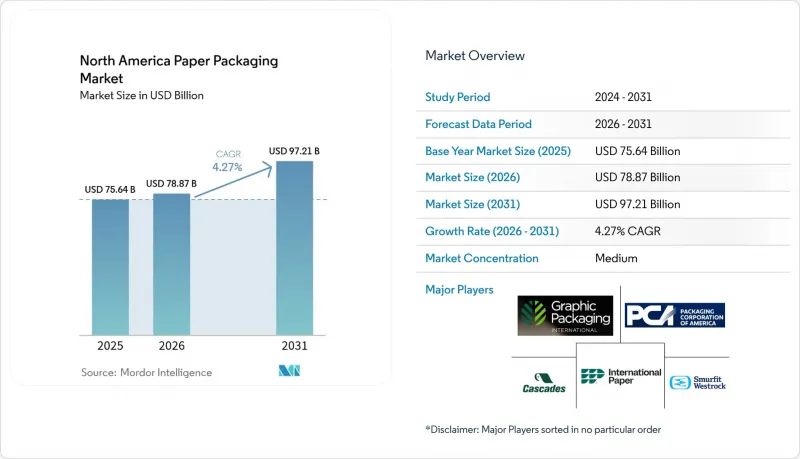
According to Mordor Intelligence, the North America paper packaging market size was valued at USD 75.64 billion in 2025 and estimated to grow from USD 78.87 billion in 2026 to reach USD 97.21 billion by 2031, at a CAGR of 4.27% during the forecast period (2026-2031).
This report is Segmented by Material Type (Kraft Paper, Paperboard, and More), Product Type (Flexible Paper Packaging, Rigid Paper Packaging), Packaging Format (Primary Packaging, Secondary Packaging, and More), End-Use Industry (Food, Beverage, Healthcare and Pharmaceuticals, and More), and Geography (United States, Canada, Mexico). The Market Forecasts are Provided in Terms of Value (USD).
North America Paper Packaging Market Trends and Insights
E-commerce Boom Elevates Corrugated-Box Demand
Explosive online retail growth lifted corrugated-box shipments by 18% in 2024 and continues to reinforce the North America paper packaging market. Direct-to-consumer brands now demand right-sized, brandable boxes that protect products while showcasing eco-credentials. International Paper's e-commerce segment expanded 25% in Q4 2024, underscoring the scale of this tailwind. Digital presses allow high-graphics runs without lengthy setups, enabling seasonal or influencer-driven artwork at low cost. Fulfillment centers nearer to end consumers shorten delivery windows and concentrate demand around urban hubs, advantaging local sheet plants. Smart codes and NFC tags embedded on corrugated surfaces create data loops that improve inventory planning and enhance post-purchase engagement.
Regulatory Shift from Single-Use Plastics
California's SB 54 requires a 65% reduction in single-use plastic packaging by 2032, and Canada's nationwide ban has already removed common plastic items from shelves, redirecting volumes toward fiber solutions. Together with Extended Producer Responsibility laws in 12 U.S. states, these measures generate an additional USD 2.3 billion in captive demand by 2027 for the North America paper packaging market. Converters with barrier-coating expertise gain first-mover advantage as PFAS restrictions reshape food service formats. Governance certainty accelerates capital commitments in sustainable mills, giving scale players a head start over smaller rivals still reliant on legacy film laminates.
Fiber-Supply Volatility and Deforestation Risk
Pulp price swings of 22% in 2024 stemmed from wildfires in British Columbia and tighter harvest quotas aimed at biodiversity protection. Virgin supply dips force mills to rely more on OCC, yet recycling streams struggle to keep pace as e-commerce boxes circulate longer inside households. The North America paper packaging market thus absorbs higher raw-material costs that ripple into finished goods pricing. Certification schemes raise compliance expenses, while logistics disruptions-such as hurricanes hitting Southeast U.S. forests-compel converters to diversify sources across regions. Inventory buffers mitigate shocks but tie up capital in a margin-sensitive environment.
Other drivers and restraints analyzed in the detailed report include:
- Brand Push for Sustainable Packaging
- Digital Printing Enables Mass-Customization
- Lightweight Flexible-Plastic Competition
For complete list of drivers and restraints, kindly check the Table Of Contents.
Segment Analysis
Corrugated board controlled 53.92% of the North America paper packaging market in 2025, cementing its position as the backbone of e-commerce fulfillment. Paperboard, while smaller, is slated for the fastest expansion at 6.07% CAGR as premium brands adopt high-graphics cartons that communicate sustainability and shelf appeal. The North America paper packaging market size attributable to paperboard formats is projected to widen noticeably through 2031. Barrier-coated grades, such as Billerud's FibreForm, now match oxygen-transmission benchmarks formerly exclusive to plastic, opening entree into fresh produce and chilled-food channels. Corrugated manufacturers leverage recycled-content mandates to market high-post-consumer liners, but fiber scarcity and OCC volatility put pressure on margins.
Lightweight micro-fluting, advanced starch adhesives, and AI-guided corrugators help box plants trim material weight without sacrificing stacking strength, translating into freight savings for brand owners. Paperboard converters bank on UV-ink systems and foil-free metallization to elevate tactile cues while keeping packs recyclable, broadening the North America paper packaging market appeal among cosmetics and nutraceuticals. Vertically integrated majors secure pulp at cost while independent carton makers strike sourcing alliances to buffer supply risk.
Flexible paper formats retained a 54.05% share of the North America paper packaging market in 2025, buoyed by quick-service wraps, stand-up pouches, and sachets that replace multilayer films. The segment's 4.97% CAGR underscores its relevance as converters integrate heat-sealable coatings that rival PE's seal strength. Rigid options like folding cartons and corrugated trays remain indispensable where on-shelf rigidity and impact resistance rule. However, demand bleeds toward flexibles when brands pursue material reduction and unboxing convenience.
Monomaterial barrier papers from Mondi let snack makers forego aluminum or EVOH, simplifying recycling streams and enhancing brand sustainability scores. Conversely, rigid producers innovate through precision die-cutting and nested designs that slash void ratios, reducing the North America paper packaging market size footprint per shipped item. Both product classes explore digital embellishment to unlock personalization at volume, but flexibles capture the lion's share of seasonal SKUs thanks to minimal inventory risk.
Complete Report Scope:
- By Material Type
- Kraft Paper
- Paperboard
- Corrugated Board
- Other Material Types
- By Product Type
- Flexible Paper Packaging
- Pouches and Bags
- Wraps and Films
- Other Flexible Paper Packaging
- Rigid Paper Packaging
- Folding Carton
- Corrugated Boxes
- Other Rigid Paper Packaging
- Flexible Paper Packaging
- By Packaging Format
- Primary Packaging
- Secondary Packaging
- Tertiary / Transit Packaging
- By End-Use Industry
- Food
- Beverage
- Healthcare and Pharmaceuticals
- Personal Care and Cosmetics
- Industrial and Electronic
- Other End-Use Industries
- By Country
- United States
- Canada
- Mexico
List of Companies Covered in this Report:
- International Paper Company
- Smurfit WestRock
- Packaging Corporation of America
- Graphic Packaging Holding Company
- Cascades Inc.
- Georgia-Pacific LLC
- Sonoco Products Company
- Amcor plc
- Mondi plc
- Clearwater Paper Corporation
- Sealed Air Corporation
- ProAmpac Holdings Inc.
- Pratt Industries Inc.
- Huhtamaki Oyj
- Pactiv Evergreen Inc.
- Reynolds Group Holdings Ltd.
- Kruger Packaging L.P.
- Stora Enso Oyj
Additional Benefits:
- The market estimate (ME) sheet in Excel format
- 3 months of analyst support
TABLE OF CONTENTS
1 INTRODUCTION
- 1.1 Study Assumptions and Market Definition
- 1.2 Scope of the Study
2 RESEARCH METHODOLOGY
3 EXECUTIVE SUMMARY
4 MARKET LANDSCAPE
- 4.1 Market Overview
- 4.2 Market Drivers
- 4.2.1 E-commerce boom elevates corrugated-box demand
- 4.2.2 Regulatory shift from single-use plastics
- 4.2.3 Brand push for sustainable packaging
- 4.2.4 Digital printing enables mass-customisation
- 4.2.5 Cold-chain meal-kit insulation needs
- 4.2.6 Scope-3 emissions accounting favours fibre
- 4.3 Market Restraints
- 4.3.1 Fibre-supply volatility and deforestation risk
- 4.3.2 Lightweight flexible-plastic competition
- 4.3.3 Energy-price shocks for recycled mills
- 4.3.4 Railcar shortages bottleneck containerboard
- 4.4 Impact of Macroeconomic Factors on the Market
- 4.5 Industry Value Chain Analysis
- 4.6 Regulatory Landscape
- 4.7 Technological Outlook
- 4.8 Porter's Five Forces Analysis
- 4.8.1 Bargaining Power of Suppliers
- 4.8.2 Bargaining Power of Buyers
- 4.8.3 Threat of New Entrants
- 4.8.4 Threat of Substitutes
- 4.8.5 Intensity of Competitive Rivalry
5 MARKET SIZE AND GROWTH FORECASTS (VALUE)
- 5.1 By Material Type
- 5.1.1 Kraft Paper
- 5.1.2 Paperboard
- 5.1.3 Corrugated Board
- 5.1.4 Other Material Types
- 5.2 By Product Type
- 5.2.1 Flexible Paper Packaging
- 5.2.1.1 Pouches and Bags
- 5.2.1.2 Wraps and Films
- 5.2.1.3 Other Flexible Paper Packaging
- 5.2.2 Rigid Paper Packaging
- 5.2.2.1 Folding Carton
- 5.2.2.2 Corrugated Boxes
- 5.2.2.3 Other Rigid Paper Packaging
- 5.2.1 Flexible Paper Packaging
- 5.3 By Packaging Format
- 5.3.1 Primary Packaging
- 5.3.2 Secondary Packaging
- 5.3.3 Tertiary / Transit Packaging
- 5.4 By End-Use Industry
- 5.4.1 Food
- 5.4.2 Beverage
- 5.4.3 Healthcare and Pharmaceuticals
- 5.4.4 Personal Care and Cosmetics
- 5.4.5 Industrial and Electronic
- 5.4.6 Other End-Use Industries
- 5.5 By Country
- 5.5.1 United States
- 5.5.2 Canada
- 5.5.3 Mexico
6 COMPETITIVE LANDSCAPE
- 6.1 Market Concentration
- 6.2 Strategic Moves
- 6.3 Market Share Analysis
- 6.4 Company Profiles {(includes Global-level Overview, Market-level Overview, Core Segments, Financials as available, Strategic Information, Market Rank/Share for key companies, Products and Services, and Recent Developments)}
- 6.4.1 International Paper Company
- 6.4.2 Smurfit WestRock
- 6.4.3 Packaging Corporation of America
- 6.4.4 Graphic Packaging Holding Company
- 6.4.5 Cascades Inc.
- 6.4.6 Georgia-Pacific LLC
- 6.4.7 Sonoco Products Company
- 6.4.8 Amcor plc
- 6.4.9 Mondi plc
- 6.4.10 Clearwater Paper Corporation
- 6.4.11 Sealed Air Corporation
- 6.4.12 ProAmpac Holdings Inc.
- 6.4.13 Pratt Industries Inc.
- 6.4.14 Huhtamaki Oyj
- 6.4.15 Pactiv Evergreen Inc.
- 6.4.16 Reynolds Group Holdings Ltd.
- 6.4.17 Kruger Packaging L.P.
- 6.4.18 Stora Enso Oyj
7 MARKET OPPORTUNITIES AND FUTURE OUTLOOK
- 7.1 White-space and Unmet-need Assessment

