PUBLISHER: Mordor Intelligence | PRODUCT CODE: 2120628

PUBLISHER: Mordor Intelligence | PRODUCT CODE: 2120628
Wind Turbine Maintenance, Repair, And Overhaul (MRO) - Market Share Analysis, Industry Trends & Statistics, Growth Forecasts (2026 - 2031)
According to Mordor Intelligence, the wind turbine maintenance, repair, and overhaul market size is projected to be USD 184.76 billion in 2025, USD 216.01 billion in 2026, and reach USD 452.33 billion by 2031, growing at a CAGR of 15.93% from 2026 to 2031.
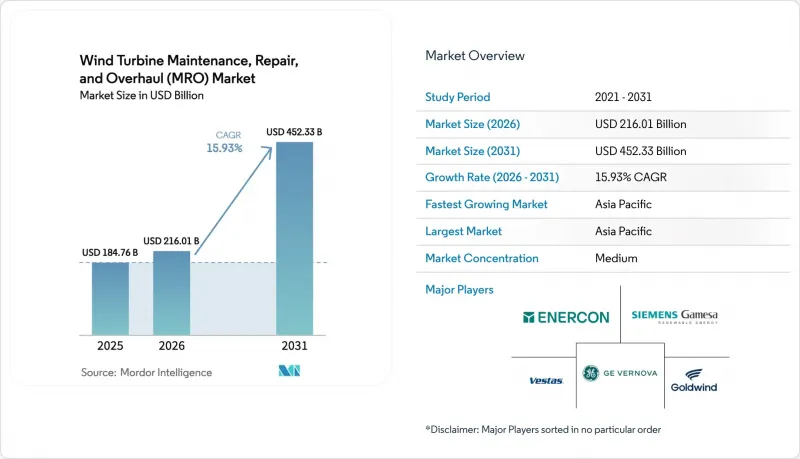
This report is Segmented by Location of Deployment (Onshore and Offshore), Service Type (Maintenance, Repair, and Overhaul), Component (Rotor Blades, Nacelle and Drivetrain, Generator, Tower, and Power-Electronics and Control), and Geography (North America, Europe, Asia-Pacific, South America, and Middle East and Africa).
Global Wind Turbine Maintenance, Repair, And Overhaul (MRO) Market Trends and Insights
Extended Turbine Lifespans Through Life-Extension Retrofits
Operators are increasingly choosing retrofit programs that add 5-10 additional operating years at one-quarter the capital outlay of full repowering. Germany alone has extended more than 4 GW of pre-2005 capacity by reinforcing blade spars and replacing main bearings, circumventing the 24-36-month permitting cycle tied to new foundations. Project costs typically fall between USD 150,000 and USD 400,000 per turbine, compared with USD 1.2 million to USD 1.8 million for a complete replacement. Vestas reported that life-extension contracts reached 18% of its 2025 service revenue, up from 11% in 2023. The trend is accelerating in the United States because the Inflation Reduction Act's production tax credit rewards incremental output from existing assets. Publication of DNV GL's updated IEC 61400 lifetime-extension guidelines in 2024 has lowered certification risk and opened the door for ISPs to compete aggressively for retrofit work.
AI-Driven Predictive Analytics Reduce Unplanned Downtime
Machine-learning algorithms that parse SCADA streams, vibration data, and thermal imagery are detecting failures 4-8 weeks in advance, turning reactive work orders into condition-based tasks. Siemens Gamesa's Digital Services platform, deployed across 25 GW by mid-2025, lowered unplanned downtime by 22% and trimmed emergency call-out costs by USD 35,000 per turbine per year. GE's Digital Wind Farm suite delivered a 15% availability gain across 18 GW of installations. Offshore owners value the technology most, using early alerts to cluster interventions into single campaigns and shave vessel charter budgets by up to 40%. Retrofits are limited by sparse sensor coverage on turbines built before 2018, creating an aftermarket for instrumentation upgrades.
Persistent Gearbox Reliability Issues in>5 MW Class
Bearing micropitting, gear-tooth spalling, and lubrication contamination keep gearbox failures the largest single cause of downtime in the 6-8 MW fleet, driving emergency repairs that can reach USD 1.2 million when offshore crane mobilization and lost generation are counted. A 2024 peer-reviewed study covering 1,200 turbines found gearbox outages at 38% of total downtime hours despite representing only 12% of the component count. Siemens Gamesa increased warranty provisions by EUR 180 million after higher-than-expected bearing failures on its 8 MW platform. While ZF's 2025 modular gearbox allows in-situ bearing swaps and trims intervention time by 40%, retrofitting legacy units remains uneconomical for most owners.
Other drivers and restraints analyzed in the detailed report include:
- Service-Oriented OEM Business Models (Power-by-the-Hour)
- National Repowering Incentives for >10-Year-Old Fleets
- Scarcity of Blade-Repair Technicians & Composite Materials
For complete list of drivers and restraints, kindly check the Table Of Contents.
Segment Analysis
Onshore installations represented 90.1% of wind turbine maintenance, repair & overhaul (MRO) market revenue in 2025, reflecting easier road access and lower labor rates. The segment's average annual spend per turbine hovers near USD 35,000, with two scheduled maintenance visits each year and minimal vessel costs. In contrast, the offshore share of the wind turbine maintenance, repair & overhaul (MRO) market size is rising quickly, advancing at 28.3% CAGR through 2031 as developers install >15 MW turbines farther from shore. A single offshore turbine typically consumes USD 95,000 annually in MRO outlays, with vessel logistics absorbing almost half of that bill.
Floating-wind adds yet another cost layer. Dynamic mooring systems, pitch-roll platform motion, and scarcer weather windows require motion-compensated gangways and autonomous inspection drones. Japan's JPY 12 billion program to build robotic blade-repair tools underscores industry recognition that conventional rope-access methods will not suffice offshore. As offshore work claims a larger slice of global capacity, specialized marine contractors are expected to capture outsized margins and consolidate a young supply chain still short on vessels and certified technicians.
Complete Report Scope:
- By Location of Deployment
- Onshore
- Offshore
- By Service Type
- Maintenance
- Repair
- Overhaul
- By Component
- Rotor Blades
- Nacelle and Drivetrain
- Generator
- Tower
- Power-Electronics and Control
- By Geography
- North America
- United States
- Canada
- Mexico
- Europe
- Germany
- United Kingdom
- France
- Spain
- Russia
- Finland
- Sweden
- Tukey
- Netherlands
- Rest of Europe
- Asia Pacific
- China
- India
- Japan
- South Korea
- Australia
- Vietnam
- Rest of Asia Pacific
- South America
- Brazil
- Argentina
- Chile
- Rest of South America
- Middle East and Africa
- Saudi Arabia
- South Africa
- Egypt
- Morocco
- Rest of Middle East and Africa
- North America
Geography Analysis
Asia-Pacific retained 53.9% of 2025 global revenue and is expected to clock a 17.6% CAGR through 2031. China's 14th Five-Year Plan mandates controller upgrades and blade extensions across 50 GW of pre-2015 assets, lifting retrofit outlays and enlarging the wind turbine maintenance, repair & overhaul (MRO) market size in the region. Goldwind's Inner Mongolia service hub, opened in October 2025, halves lead times for gearboxes and spares. India's production-linked incentive grants INR 15 per kWh for overhauled turbines, encouraging owners to invest in multi-component rebuilds rather than decommission.
Europe remains a high-value arena owing to its 30 GW offshore fleet and strict operating codes. The UK's Round 4 seabed awards compel developers to use domestic vessels for 60% of maintenance activity, spurring local supply-chain build-out. Germany and the Netherlands anchor demand for heavy-lift campaigns, while Spain accelerates onshore repowering with six-month permitting cycles.
North America benefits from the Inflation Reduction Act's extended production tax credit, which keeps older turbines profitably spinning after gearbox, blade, and inverter upgrades. GE's USD 320 million Indian onshore MRO contract in November 2025 illustrates OEM appetite for long-dated agreements that blend retrofit, overhaul, and analytics.
South America and the Middle East & Africa remain emerging contributors. Brazil's ANEEL now enforces annual blade inspections and biennial oil analysis, spawning new ISP entrants. Morocco and South Africa are the first African markets to confront large-scale overhauls as 2017-2019 turbines approach mid-life.
- Siemens Gamesa Renewable Energy SA
- Vestas Wind Systems A/S
- General Electric Company
- Goldwind Science & Technology Co. Ltd.
- Enercon GmbH
- Suzlon Energy Ltd.
- Nordex SE
- Envision Energy Ltd.
- ZF Friedrichshafen AG
- Moventas Gears Oy
- Stork (Fluor)
- Mistras Group
- Integrated Power Services LLC
- Dana SAC UK Ltd.
- Offshore Heavy Transport ASA (OHT)
- B9 Energy O&M Ltd.
- GEV Wind Power
- LM Wind Power (GE)
- BladeRepair.com
- Global Wind Service A/S
Additional Benefits:
- The market estimate (ME) sheet in Excel format
- 3 months of analyst support
TABLE OF CONTENTS
1 Introduction
- 1.1 Study Assumptions & Market Definition
- 1.2 Scope of the Study
2 Research Methodology
3 Executive Summary
4 Market Landscape
- 4.1 Market Overview
- 4.2 Market Drivers
- 4.2.1 Extended turbine lifespans through life-extension retrofits
- 4.2.2 AI-driven predictive analytics reduce unplanned downtime
- 4.2.3 Service-oriented OEM business models (power-by-the-hour)
- 4.2.4 National repowering incentives for >10-yr-old fleets
- 4.2.5 Floating-wind rollout creates specialized MRO demand
- 4.3 Market Restraints
- 4.3.1 Persistent gearbox reliability issues in >5 MW class
- 4.3.2 Scarcity of blade-repair technicians & composite materials
- 4.3.3 Revenue squeeze from 20-year service contract price-wars
- 4.3.4 Logistics bottlenecks for offshore heavy-lift vessels
- 4.4 Supply-Chain Analysis
- 4.5 Regulatory Landscape
- 4.6 Technological Outlook
- 4.7 Porter's Five Forces
- 4.7.1 Bargaining Power of Suppliers
- 4.7.2 Bargaining Power of Buyers
- 4.7.3 Threat of New Entrants
- 4.7.4 Threat of Substitutes
- 4.7.5 Competitive Rivalry
5 Market Size & Growth Forecasts
- 5.1 By Location of Deployment
- 5.1.1 Onshore
- 5.1.2 Offshore
- 5.2 By Service Type
- 5.2.1 Maintenance
- 5.2.2 Repair
- 5.2.3 Overhaul
- 5.3 By Component
- 5.3.1 Rotor Blades
- 5.3.2 Nacelle and Drivetrain
- 5.3.3 Generator
- 5.3.4 Tower
- 5.3.5 Power-Electronics and Control
- 5.4 By Geography
- 5.4.1 North America
- 5.4.1.1 United States
- 5.4.1.2 Canada
- 5.4.1.3 Mexico
- 5.4.2 Europe
- 5.4.2.1 Germany
- 5.4.2.2 United Kingdom
- 5.4.2.3 France
- 5.4.2.4 Spain
- 5.4.2.5 Russia
- 5.4.2.6 Finland
- 5.4.2.7 Sweden
- 5.4.2.8 Tukey
- 5.4.2.9 Netherlands
- 5.4.2.10 Rest of Europe
- 5.4.3 Asia Pacific
- 5.4.3.1 China
- 5.4.3.2 India
- 5.4.3.3 Japan
- 5.4.3.4 South Korea
- 5.4.3.5 Australia
- 5.4.3.6 Vietnam
- 5.4.3.7 Rest of Asia Pacific
- 5.4.4 South America
- 5.4.4.1 Brazil
- 5.4.4.2 Argentina
- 5.4.4.3 Chile
- 5.4.4.4 Rest of South America
- 5.4.5 Middle East and Africa
- 5.4.5.1 Saudi Arabia
- 5.4.5.2 South Africa
- 5.4.5.3 Egypt
- 5.4.5.4 Morocco
- 5.4.5.5 Rest of Middle East and Africa
- 5.4.1 North America
6 Competitive Landscape
- 6.1 Market Concentration
- 6.2 Strategic Moves (M&A, Partnerships, PPAs)
- 6.3 Market Share Analysis (Market Rank/Share for key companies)
- 6.4 Company Profiles (includes Global level Overview, Market level overview, Core Segments, Financials as available, Strategic Information, Products & Services, and Recent Developments)
- 6.4.1 Siemens Gamesa Renewable Energy SA
- 6.4.2 Vestas Wind Systems A/S
- 6.4.3 General Electric Company
- 6.4.4 Goldwind Science & Technology Co. Ltd.
- 6.4.5 Enercon GmbH
- 6.4.6 Suzlon Energy Ltd.
- 6.4.7 Nordex SE
- 6.4.8 Envision Energy Ltd.
- 6.4.9 ZF Friedrichshafen AG
- 6.4.10 Moventas Gears Oy
- 6.4.11 Stork (Fluor)
- 6.4.12 Mistras Group
- 6.4.13 Integrated Power Services LLC
- 6.4.14 Dana SAC UK Ltd.
- 6.4.15 Offshore Heavy Transport ASA (OHT)
- 6.4.16 B9 Energy O&M Ltd.
- 6.4.17 GEV Wind Power
- 6.4.18 LM Wind Power (GE)
- 6.4.19 BladeRepair.com
- 6.4.20 Global Wind Service A/S
7 Market Opportunities & Future Outlook
- 7.1 White-Space & Unmet-Need Assessment

