PUBLISHER: Mordor Intelligence | PRODUCT CODE: 2120715

PUBLISHER: Mordor Intelligence | PRODUCT CODE: 2120715
Commercial Seaweed - Market Share Analysis, Industry Trends & Statistics, Growth Forecasts (2026 - 2031)
According to Mordor Intelligence, the seaweed market size was valued at USD 20.69 billion in 2025 and estimated to grow from USD 22.36 billion in 2026 to reach USD 32.98 billion by 2031, at a CAGR of 8.08% during the forecast period (2026-2031).
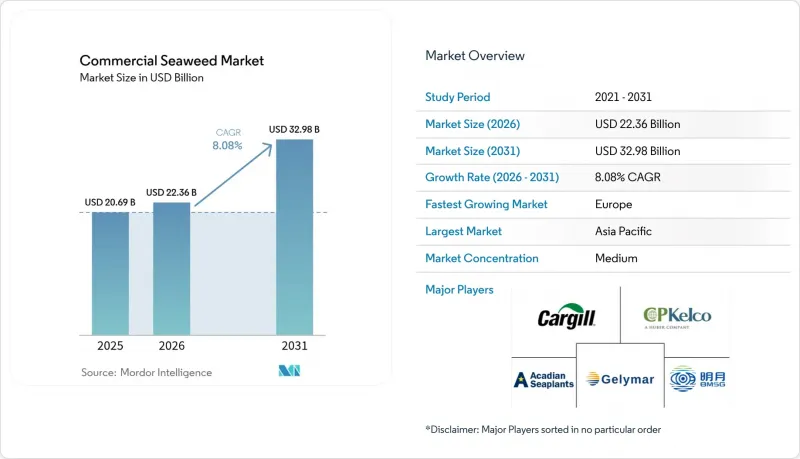
This report Segments the Industry Into Product Type (Brown Seaweed, Green Seaweed, Red Seaweed), Flavor (Plain, Flavored), Form (Fresh/Chilled and Frozen/Dried), Cultivation Method (Aquaculture and Wild Harvest), Application (Food and Beverages, Dietary Supplements, Pharmaceuticals and More), and Geography (North America, Europe, and More). The Market Forecasts are Provided in Terms of Value (USD).
Global Commercial Seaweed Market Trends and Insights
Growing consumer awareness of health benefits of seaweed
Increasing consumer awareness about the nutritional and functional benefits of seaweed is a key driver of the commercial seaweed market. Seaweed is recognized for being rich in vitamins, minerals, dietary fiber, and bioactive compounds, which support immunity, digestion, and cardiovascular health. Rising interest in plant-based, clean-label, and superfood products has encouraged greater incorporation of seaweed into everyday diets. Educational campaigns, media coverage, and health-focused product labeling have further reinforced its image as a natural and sustainable ingredient. Consumers are increasingly seeking functional foods that offer tangible health benefits, which is driving demand for seaweed in both retail and foodservice channels. This growing health consciousness is motivating manufacturers to innovate with new seaweed-based products to meet evolving consumer preferences.
Rising use of seaweed in functional foods and nutraceuticals
The use of seaweed in functional foods and nutraceuticals is rapidly increasing, supporting market growth. Seaweed extracts such as carrageenan, alginate, and fucoidan are widely utilized for their health-promoting properties, including antioxidant, anti-inflammatory, and metabolic benefits. Nutraceutical applications, including dietary supplements and fortified foods, are driving high-value demand for seaweed-based ingredients. Global market data indicates strong adoption in both food and health sectors, with new product launches consistently integrating seaweed as a functional ingredient. The trend toward plant-based nutrition, immunity-boosting products, and clean-label formulations further fuels this growth. Additionally, scientific research validating the bioactive and functional properties of seaweed strengthens its appeal among manufacturers and consumers. Consequently, seaweed is emerging as a preferred ingredient in health-oriented product development, contributing to sustained market expansion.
Seasonal and geographic limitations impacting year-round production
Seasonal and geographic limitations pose a significant restraint on the commercial seaweed market, as production is highly dependent on specific coastal regions with suitable water temperature, salinity, and nutrient conditions. Natural growth cycles and seasonal variations restrict year-round harvesting, leading to fluctuations in supply and challenges in meeting consistent demand. Regions prone to extreme weather, such as storms or temperature anomalies, can further disrupt cultivation and harvesting schedules. Geographic constraints also limit the expansion of large-scale operations to areas with optimal marine conditions, increasing reliance on imports in non-producing regions. These limitations can result in higher production costs and supply chain uncertainties, particularly for manufacturers seeking continuous raw material availability. Additionally, variability in seasonal yields affects quality consistency, which is critical for functional foods, nutraceuticals, and industrial applications.
Other drivers and restraints analyzed in the detailed report include:
- Technological advancements improving seaweed cultivation and processing
- Government support for sustainable aquaculture and seaweed farming
- High initial investment for seaweed farming infrastructure
For complete list of drivers and restraints, kindly check the Table Of Contents.
Segment Analysis
Red seaweed accounted for the largest revenue share of 47.82% in 2025, establishing itself as the leading segment within the commercial seaweed market. Its dominance is primarily attributed to extensive usage in food processing, particularly for the extraction of hydrocolloids such as agar and carrageenan, which are widely utilized as stabilizing and thickening agents. The strong demand from the food and beverage industry, especially in dairy, confectionery, and processed food applications, continues to support the segment's growth. In addition, red seaweed benefits from well-established cultivation practices and a stable supply chain across major producing regions. Increasing consumer preference for natural and plant-based ingredients has further strengthened its market position. Moreover, its application in pharmaceuticals and nutraceuticals due to bioactive compounds and nutritional benefits continues to reinforce its leading revenue contribution.
Brown seaweed is anticipated to emerge as the fastest-growing segment, projected to expand at a CAGR of 9.87% through 2031. The growth of this segment is driven by rising demand for alginate extracts used in food, cosmetics, and medical applications owing to their functional and binding properties. Increasing adoption of brown seaweed in agricultural applications, particularly as biofertilizers and soil conditioners, is also contributing to accelerated market expansion. Furthermore, growing research into its potential use in biofuels, alternative proteins, and sustainable packaging solutions is opening new avenues for commercialization. The segment is also benefiting from increased investments in large-scale seaweed farming and improved harvesting technologies.
Plain formats accounted for the largest share of the commercial seaweed market in 2025, capturing 62.07% of total revenue. The dominance of this segment is largely attributed to its widespread use as a raw material in food processing, hydrocolloid extraction, and industrial applications. Plain seaweed is preferred by manufacturers due to its versatility and ease of incorporation into various end-use products, including soups, snacks, seasonings, and processed foods. It also serves as a foundational ingredient for producing agar, carrageenan, and alginate, which are extensively used as stabilizers and gelling agents. Additionally, bulk procurement of unflavored seaweed by foodservice operators and ingredient manufacturers supports high-volume sales. The segment further benefits from lower processing requirements compared to flavored variants, making it cost-efficient and suitable for large-scale industrial utilization.
Flavored variants are projected to be the fastest-growing segment, expanding at a CAGR of 9.57% through 2031. This growth is driven by rising consumer demand for ready-to-eat and value-added seaweed snacks with enhanced taste profiles. Increasing health consciousness among consumers has fueled interest in convenient, nutrient-rich snack alternatives, positioning flavored seaweed products favorably in retail channels. Manufacturers are introducing innovative flavors tailored to regional preferences, thereby expanding their consumer base. The growing penetration of flavored seaweed in supermarkets, online platforms, and specialty health stores is also supporting segment growth. Moreover, premiumization trends and branding strategies are helping flavored variants command higher margins, further contributing to their accelerated market expansion over the forecast period.
Complete Report Scope:
- By Product Type
- Brown Seaweed
- Green Seaweed
- Red Seaweed
- By Flavor
- Plain
- Flavored
- By Form
- Fresh/Chilled
- Frozen/Dried
- By Cultivation Method
- Aquaculture (Farmed)
- Wild Harvest
- By Application
- Food & Beverages
- Dietary Supplements
- Pharmaceuticals
- Animal Feed & Pet Food
- Cosmetics & Personal Care
- Others
- By Geography
- North America
- United States
- Canada
- Mexico
- Rest of North America
- Europe
- Germany
- United Kingdom
- Italy
- France
- Spain
- Netherlands
- Poland
- Belgium
- Sweden
- Rest of Europe
- Asia-Pacific
- China
- India
- Japan
- Australia
- Indonesia
- South Korea
- Thailand
- Singapore
- Rest of Asia-Pacific
- South America
- Brazil
- Argentina
- Colombia
- Chile
- Peru
- Rest of South America
- Middle East and Africa
- South Africa
- Saudi Arabia
- United Arab Emirates
- Nigeria
- Egypt
- Morocco
- Turkey
- Rest of Middle East and Africa
- North America
Geography Analysis
In 2025, Asia-Pacific commands a 37.38% market share, capitalizing on its established aquaculture infrastructure and traditional consumption habits. However, the region grapples with challenges like climate change repercussions and rising production costs. China stands at the forefront, harnessing advanced cultivation technologies and integrated processing. Yet, it's not without challenges: environmental regulations and surging labor costs squeeze profit margins. Meanwhile, Japan and South Korea are carving niches in premium product segments. Their focus on technological innovations, such as automated harvesting and value-added processing, ensures they maintain a competitive edge, even with elevated production costs. Indonesia and the Philippines enjoy favorable growing conditions and government backing, but face hurdles like disease outbreaks and quality control issues that hinder their export ambitions.
Europe is on a growth trajectory, boasting a 9.48% CAGR through 2031. This surge is fueled by regulatory endorsements for sustainable packaging and pharmaceutical advancements, tapping into the continent's robust bioprocessing expertise. Nordic nations spearhead Europe's cultivation initiatives. Iceland and Norway are pioneering offshore farming systems tailored for challenging marine environments. In contrast, the Netherlands and Germany are advancing land-based cultivation methods, ensuring year-round yields. The European market's stringent quality and traceability standards command premium pricing, creating entry barriers. Yet, compliant suppliers enjoy lucrative margins. Policymakers are also recognizing seaweed's role in carbon sequestration, weaving it into broader blue economy strategies, solidifying Europe's growth narrative.
North America is making waves, especially in specialty applications and tech innovations. The U.S. is leading the charge, pouring USD 25 million into offshore seaweed biomass ventures and setting up cutting-edge processing hubs in Maine and Alaska. Canada champions sustainable harvesting, forging partnerships with indigenous communities. Meanwhile, Mexico reaps benefits from Ocean Rainforest's strategic takeover of Alamarsa, ushering in advanced cultivation methods to Latin America. With vast coastal territories ripe for cultivation and a burgeoning appetite for natural food ingredients, North America's growth horizon looks promising.
- Cargill, Incorporated
- CP Kelco Inc.
- Acadian Seaplants Limited
- Gelymar
- Qingdao Bright Moon Seaweed Group
- Ocean Rainforest A/S
- Algaia SAS
- Marinova Pty Ltd
- Seaweed & Co.
- Tropical Seaweed Research Foundation
- North Atlantic Organics
- Algama Foods
- Eucheuma Seaweeds (India) Pvt. Ltd.
- Mara Seaweed
- Ardith Seaweed Co.
- Kelp Blue
- Red Eagle Seafoods
- GreenWave
- Blue Evolution Seaweed
- Sundial Foods
Additional Benefits:
- The market estimate (ME) sheet in Excel format
- 3 months of analyst support
TABLE OF CONTENTS
1 INTRODUCTION
- 1.1 Study Assumptions and Market Definition
- 1.2 Scope of the Study
2 RESEARCH METHODOLOGY
3 EXECUTIVE SUMMARY
4 MARKET LANDSCAPE
- 4.1 Market Overview
- 4.2 Market Drivers
- 4.2.1 Growing consumer awareness of health benefits of seaweed
- 4.2.2 Rising use of seaweed in functional foods and nutraceuticals
- 4.2.3 Increasing applications in cosmetics and personal care products
- 4.2.4 Expansion of seaweed use in animal feed and aquaculture
- 4.2.5 Government support for sustainable aquaculture and seaweed farming
- 4.2.6 Technological advancements improving seaweed cultivation and processing
- 4.3 Market Restraints
- 4.3.1 Seasonal and geographic limitations impacting year-round production
- 4.3.2 High initial investment for seaweed farming infrastructure
- 4.3.3 Fluctuations in seaweed yield due to environmental conditions
- 4.3.4 High cost of processing and extraction technologies
- 4.4 Supply Chain Analysis
- 4.5 Regulatory Landscape
- 4.6 Technological Outlook
- 4.7 Porter's Five Forces
- 4.7.1 Threat of New Entrants
- 4.7.2 Bargaining Power of Buyers
- 4.7.3 Bargaining Power of Suppliers
- 4.7.4 Threat of Substitute Products
- 4.7.5 Intensity of Competitive Rivalry
5 MARKET SIZE AND GROWTH FORECASTS (VALUE)
- 5.1 By Product Type
- 5.1.1 Brown Seaweed
- 5.1.2 Green Seaweed
- 5.1.3 Red Seaweed
- 5.2 By Flavor
- 5.2.1 Plain
- 5.2.2 Flavored
- 5.3 By Form
- 5.3.1 Fresh/Chilled
- 5.3.2 Frozen/Dried
- 5.4 By Cultivation Method
- 5.4.1 Aquaculture (Farmed)
- 5.4.2 Wild Harvest
- 5.5 By Application
- 5.5.1 Food & Beverages
- 5.5.2 Dietary Supplements
- 5.5.3 Pharmaceuticals
- 5.5.4 Animal Feed & Pet Food
- 5.5.5 Cosmetics & Personal Care
- 5.5.6 Others
- 5.6 By Geography
- 5.6.1 North America
- 5.6.1.1 United States
- 5.6.1.2 Canada
- 5.6.1.3 Mexico
- 5.6.1.4 Rest of North America
- 5.6.2 Europe
- 5.6.2.1 Germany
- 5.6.2.2 United Kingdom
- 5.6.2.3 Italy
- 5.6.2.4 France
- 5.6.2.5 Spain
- 5.6.2.6 Netherlands
- 5.6.2.7 Poland
- 5.6.2.8 Belgium
- 5.6.2.9 Sweden
- 5.6.2.10 Rest of Europe
- 5.6.3 Asia-Pacific
- 5.6.3.1 China
- 5.6.3.2 India
- 5.6.3.3 Japan
- 5.6.3.4 Australia
- 5.6.3.5 Indonesia
- 5.6.3.6 South Korea
- 5.6.3.7 Thailand
- 5.6.3.8 Singapore
- 5.6.3.9 Rest of Asia-Pacific
- 5.6.4 South America
- 5.6.4.1 Brazil
- 5.6.4.2 Argentina
- 5.6.4.3 Colombia
- 5.6.4.4 Chile
- 5.6.4.5 Peru
- 5.6.4.6 Rest of South America
- 5.6.5 Middle East and Africa
- 5.6.5.1 South Africa
- 5.6.5.2 Saudi Arabia
- 5.6.5.3 United Arab Emirates
- 5.6.5.4 Nigeria
- 5.6.5.5 Egypt
- 5.6.5.6 Morocco
- 5.6.5.7 Turkey
- 5.6.5.8 Rest of Middle East and Africa
- 5.6.1 North America
6 COMPETITIVE LANDSCAPE
- 6.1 Market Concentration
- 6.2 Strategic Moves
- 6.3 Market Ranking Analysis
- 6.4 Company Profiles (includes Global level Overview, Market level overview, Core Segments, Financials as available, Strategic Information, Market Rank/Share for key companies, Products and Services, and Recent Developments)
- 6.4.1 Cargill, Incorporated
- 6.4.2 CP Kelco Inc.
- 6.4.3 Acadian Seaplants Limited
- 6.4.4 Gelymar
- 6.4.5 Qingdao Bright Moon Seaweed Group
- 6.4.6 Ocean Rainforest A/S
- 6.4.7 Algaia SAS
- 6.4.8 Marinova Pty Ltd
- 6.4.9 Seaweed & Co.
- 6.4.10 Tropical Seaweed Research Foundation
- 6.4.11 North Atlantic Organics
- 6.4.12 Algama Foods
- 6.4.13 Eucheuma Seaweeds (India) Pvt. Ltd.
- 6.4.14 Mara Seaweed
- 6.4.15 Ardith Seaweed Co.
- 6.4.16 Kelp Blue
- 6.4.17 Red Eagle Seafoods
- 6.4.18 GreenWave
- 6.4.19 Blue Evolution Seaweed
- 6.4.20 Sundial Foods
7 MARKET OPPPORTUNITIES AND FUTURE OUTLOOK

