PUBLISHER: Mordor Intelligence | PRODUCT CODE: 2120748

PUBLISHER: Mordor Intelligence | PRODUCT CODE: 2120748
US Li-Fi - Market Share Analysis, Industry Trends & Statistics, Growth Forecasts (2026 - 2031)
According to Mordor Intelligence, the US li-Fi market size is projected to be USD 420 million in 2025, USD 454.90 million in 2026, and reach USD 678.80 million by 2031, growing at a CAGR of 8.31% from 2026 to 2031.
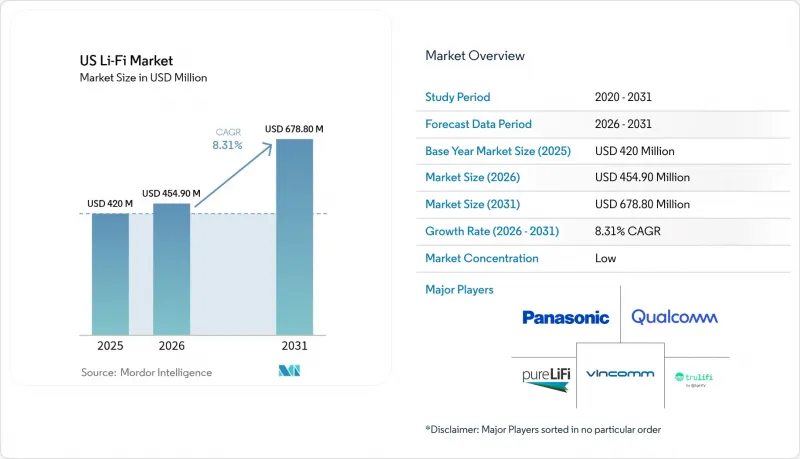
This report is Segmented by Component (LED Light Sources, Photodiodes, and More), Technology (LED-Based Li-Fi [VLC], Laser-Based Li-Fi [NIR], Hybrid Li-Fi/RF Systems), and End-User Industry (Healthcare, Transportation, Education, Military and Defense, Retail and Hospitality, Other End-User Industries). The Market Forecasts are Provided in Terms of Value (USD).
US Li-Fi Market Trends and Insights
Accelerated LED Retrofit Mandates Drive Infrastructure Foundation
California's Title 24 codes and the IECC 2021 model elevate LED adoption, inadvertently wiring ceilings with transmitters that double as Li-Fi access points . ASHRAE 90.1 pushes connected-lighting controls, letting building owners recover both energy savings and gigabit connectivity in a single investment. Power-over-Ethernet backhaul trims installation labor because low-voltage cable and data share the same run. Facility managers discover that every luminaire becomes a managed network node, so Li-Fi slips naturally into smart-building dashboards rather than standing alone. The outcome is a lower total cost per square foot compared with overlay Wi-Fi densification.
RF Spectrum Congestion Catalyzes Enterprise Adoption
Urban campuses already saturate 6 GHz Wi-Fi channels; Li-Fi escapes that bottleneck by moving up to the 400-800 THz band that offers 10,000 times the available spectrum. Light cannot leak through walls or ceilings, so floor-by-floor reuse multiplies throughput without coordination overhead. Banks and law firms appreciate the room-contained signal that curbs eavesdropping risk. Factories record cleaner machine telemetry because Li-Fi ignores electromagnetic interference that cripples RF near welders. Fraunhofer's GigaDock demo hit 12.5 Gbps with sub-millisecond latency, proving deterministic links for Industry 4.0 workloads .
Line-of-Sight Limitations Constrain Coverage Economics
Every cubicle wall and moving body can sever an optical path, forcing denser access-point grids than Wi-Fi needs. Reflective ceilings extend reach but cut throughput, so planners must balance redundancy with budget. Retailers find that seasonal aisle resets break line-of-sight maps, adding maintenance overhead. Although beam-steered lasers promise wider cones, the gear costs more than commodity LED lamps. Until automated coverage-mapping software matures, facilities weigh mobility risk against Li-Fi's security upside.
Other drivers and restraints analyzed in the detailed report include:
- Federal Defense Funding Accelerates Military Applications
- Industry 4.0 Demands Deterministic Connectivity
- Device Integration Barriers Limit Market Expansion
For complete list of drivers and restraints, kindly check the Table Of Contents.
Segment Analysis
LED light sources held 49.12% of the Li-Fi market share in 2025, demonstrating how illumination assets double as broadband gateways. Each lamp already draws power and occupies ceiling real estate, so incremental cost covers only modulation drivers and photodetectors. That synergy compresses payback periods for building owners who planned LED conversions to meet energy codes. Photodiodes follow as the next-largest hardware slice because every link needs a receive channel, and bidirectional traffic doubles diode counts in duplex installations. Microcontrollers oversee pulse-width modulation that exceeds 50 MHz yet stays flicker-free under IEEE PAR1789 guidance.
Software and firmware post a 10.08% CAGR, the fastest across component lines, because hybrid Li-Fi/Wi-Fi orchestration demands algorithms that decide which band carries which session. Network-management consoles now resemble lighting dashboards, merging lux level, occupancy sensing, and throughput graphs on a common pane. Modulator ASICs integrate signal conditioning that once lived on plug-in cards, trimming enclosure volume so transceivers fit inside desk lamps. System-integration services grow in lockstep, bundling photometrics with RF planning tools so architects can validate coverage and code compliance in one model. The Li-Fi market size allocation for services, therefore, rises faster than hardware outlays as early adopters seek guaranteed performance.
Complete Report Scope:
- By Component
- LED Light Sources
- Photodiodes
- Microcontrollers
- Modulators/Signal-Processing ASICs
- Software and Firmware
- System Integration and Services
- By Technology
- LED-based Li-Fi (VLC)
- Laser-based Li-Fi (NIR)
- Hybrid Li-Fi/RF Systems
- By End-user Industry
- Healthcare
- Transportation
- Education
- Military and Defense
- Retail and Hospitality
- Other End-user Industries (Aerospace, Industrial Automation,and others)
List of Companies Covered in this Report:
- pureLiFi Ltd.
- Signify Holding (Trulifi)
- VLNComm Inc.
- Acuity Brands, Inc. (Atrius)
- Qualcomm Technologies, Inc.
- Panasonic Holdings Corporation
- OLEDCOMM SAS
- LVX System Corporation
- Vibrint Inc.
- SaNoor Technologies Inc.
- Outstanding Technology Corp.
Additional Benefits:
- The market estimate (ME) sheet in Excel format
- 3 months of analyst support
TABLE OF CONTENTS
1 INTRODUCTION
- 1.1 Study Assumptions and Market Definition
- 1.2 Scope of the Study
2 RESEARCH METHODOLOGY
3 EXECUTIVE SUMMARY
4 MARKET LANDSCAPE
- 4.1 Market Overview
- 4.2 Market Drivers
- 4.2.1 Accelerated LED retrofit mandates in US commercial buildings
- 4.2.2 RF spectrum congestion and secure indoor-wireless demand
- 4.2.3 Federal funding for military/defense Li-Fi pilots
- 4.2.4 Industry 4.0 demand for deterministic low-latency links
- 4.2.5 PoE-enabled smart-lighting backhaul economics
- 4.2.6 CHIPS-Act incentives for domestic optical-receiver supply
- 4.3 Market Restraints
- 4.3.1 Limited line-of-sight coverage range
- 4.3.2 Lack of native Li-Fi chipsets in mass-market devices
- 4.3.3 Fragmented local flicker and building-code compliance hurdles
- 4.3.4 Competitive threat from Wi-Fi 7 and 5G enterprise DAS
- 4.4 Value Chain Analysis
- 4.5 Regulatory Landscape
- 4.6 Porter's Five Forces Analysis
- 4.6.1 Threat of New Entrants
- 4.6.2 Bargaining Power of Buyers
- 4.6.3 Bargaining Power of Suppliers
- 4.6.4 Threat of Substitutes
- 4.6.5 Intensity of Competitive Rivalry
- 4.7 Impact of Macroeconomic Factors on the Market
5 MARKET SIZE AND GROWTH FORECASTS (VALUE)
- 5.1 By Component
- 5.1.1 LED Light Sources
- 5.1.2 Photodiodes
- 5.1.3 Microcontrollers
- 5.1.4 Modulators/Signal-Processing ASICs
- 5.1.5 Software and Firmware
- 5.1.6 System Integration and Services
- 5.2 By Technology
- 5.2.1 LED-based Li-Fi (VLC)
- 5.2.2 Laser-based Li-Fi (NIR)
- 5.2.3 Hybrid Li-Fi/RF Systems
- 5.3 By End-user Industry
- 5.3.1 Healthcare
- 5.3.2 Transportation
- 5.3.3 Education
- 5.3.4 Military and Defense
- 5.3.5 Retail and Hospitality
- 5.3.6 Other End-user Industries (Aerospace, Industrial Automation,and others)
6 COMPETITIVE LANDSCAPE
- 6.1 Market Concentration
- 6.2 Strategic Moves
- 6.3 Market Share Analysis
- 6.4 Company Profiles (includes Global-level Overview, Market-level Overview, Core Segments, Financials as available, Strategic Information, Market Rank/Share, Products and Services, Recent Developments)
- 6.4.1 pureLiFi Ltd.
- 6.4.2 Signify Holding (Trulifi)
- 6.4.3 VLNComm Inc.
- 6.4.4 Acuity Brands, Inc. (Atrius)
- 6.4.5 Qualcomm Technologies, Inc.
- 6.4.6 Panasonic Holdings Corporation
- 6.4.7 OLEDCOMM SAS
- 6.4.8 LVX System Corporation
- 6.4.9 Vibrint Inc.
- 6.4.10 SaNoor Technologies Inc.
- 6.4.11 Outstanding Technology Corp.
7 MARKET OPPORTUNITIES AND FUTURE OUTLOOK
- 7.1 White-space and Unmet-Need Assessment

