PUBLISHER: Mordor Intelligence | PRODUCT CODE: 2120806

PUBLISHER: Mordor Intelligence | PRODUCT CODE: 2120806
Security Screening - Market Share Analysis, Industry Trends & Statistics, Growth Forecasts (2026 - 2031)
According to Mordor Intelligence, the security screening market size in 2026 is estimated at USD 9.94 billion, growing from 2025 value of USD 9.31 billion with 2031 projections showing USD 13.77 billion, growing at 6.74% CAGR over 2026-2031.
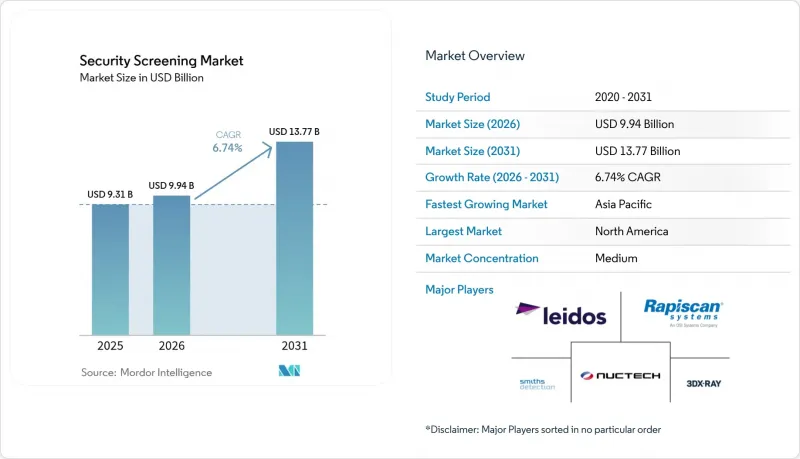
This report is Segmented by Detection Technology (X-Ray, Computed Tomography, and More), Equipment Type (Walk-Through Metal Detectors, Hand-Held Metal Detectors, and More), Application (Mail and Parcel, Baggage Scanning, Cargo and Vehicle Inspection, and More), End-User Industry (Airports, Ports and Borders, Defense, and More), and Geography. The Market Forecasts are Provided in Terms of Value (USD).
Global Security Screening Market Trends and Insights
Upsurge in Terror Activities and Security Threats Globally
Persistent extremist networks and transnational trafficking rings elevate baseline threat levels at airports, borders, and seaports. The U.S. Department of Homeland Security's 2024 maritime cybersecurity white paper underscores how kinetic and cyber vectors are converging, compelling authorities to procure multi-modal systems that screen containers, people, and digital signals in one workflow. Border agencies are piloting vertical screening towers that detect low-flying drones delivering weapons or narcotics. Portable units featuring integrated X-ray and millimeter-wave arrays are rotated among chokepoints to disrupt unpredictable smuggling routes. Governments in the Middle East and Africa are fast-tracking project financing for rapid-deployment checkpoints after a spike in cross-border incursions, bolstering long-term equipment replacement pipelines. These dynamics collectively underpin the steady expansion of the security screening market.
Regulatory Mandates for Aviation and Border Security
Regulators are translating evolving risk profiles into hard technology requirements. The European Civil Aviation Conference approved the removal of the 100 ml liquid limit at airports equipped with ECAC-certified CT scanners, forcing operators across the bloc to adopt next-generation equipment or preserve legacy restrictions that slow queues. In the United States, the Transportation Security Administration locked in USD 5.5 billion of multi-year CT contracts, standardizing checkpoint configurations nationwide. Similar mandates are emerging in India and Indonesia, where civil-aviation regulators now stipulate AI-ready imaging platforms for new terminal builds. Such codified thresholds effectively convert optional upgrades into non-negotiable capital expenditure, accelerating the security screening market's technology refresh cycle.
High Procurement and Maintenance Costs of Advanced Systems
Computed tomography and millimeter-wave installations often exceed USD 1 million per lane. OSI Systems' USD 76 million contract for a single hub airport illustrates the scale of outlays necessary to modernize checkpoints. Beyond purchase price, airports incur facility retrofits for higher power loads and cooling, along with software-update subscriptions to sustain certification. Smaller Caribbean and African airports struggle to justify the outlay against limited passenger throughput, leading to a bifurcated security environment that adversaries can exploit. Leasing models and performance-based service contracts are emerging to distribute costs over operational budgets, but uptake remains nascent.
Other drivers and restraints analyzed in the detailed report include:
- Technological Advancements in AI-Powered Automated Threat Detection
- Integration of Millimeter-Wave Imaging with 5G Infrastructure
- Data-Privacy Concerns Surrounding Body Scanners
For complete list of drivers and restraints, kindly check the Table Of Contents.
Segment Analysis
CT scanners accounted for USD 2.08 billion of revenue in 2025, translating to 22.37% of the security screening market size, and they are projected to post an 7.76% CAGR on the back of liquid-carry-on policy relaxations. X-ray systems retained their leadership with a 45.12% share in 2025, favored for lower capital cost and mature regulatory approvals. Nonetheless, airlines lobbying for faster boarding are swaying airports toward CT, particularly in Asia-Pacific's new greenfield terminals. Terahertz and neutron sensing systems cater to specialized nuclear material detection but remain below 5% of the overall revenue pool. Integration of AI classifiers into CT consoles sharply reduces false positives, a principal driver behind procurement decisions in Europe and the Gulf states.
In the medium term, chip-scale terahertz emitters emerging from MIT Lincoln Laboratory trials will unlock handheld screening formats, broadening use cases beyond fixed checkpoints. Vendors are bundling radiation monitors with conventional lanes to comply with updated International Atomic Energy Agency guidance on orphan source interdiction, gradually lifting unit shipments. The security screening industry is thereby pivoting from single-modality hardware toward software-defined, multi-sensor ecosystems that evolve through over-the-air updates rather than forklift upgrades.
Walk-through metal detectors collected 34.25% revenue share in 2025 by virtue of ubiquity and low ownership cost. Portable and mobile units, though only 11.2% of current shipments, are expanding at an 8.32% CAGR as border patrols demand rapid redeployment to emerging smuggling corridors. Explosives trace detection systems remain indispensable for alarm resolution, with the U.S. Transportation Security Administration ordering more than 2,500 Itemiser 5X devices for secondary screening in 2025. Full-body scanners record the highest average selling price but are penetrating mass-transit hubs where throughput gains offset acquisition cost.
Market leaders now package lane components, imagers, trays, and divestment tables as modular kits that fit both permanent halls and pop-up checkpoints. Lifecycle service contracts covering firmware, spare parts, and operator training comprise nearly 30% of total contract value, creating annuity revenue streams. Hardware commoditization thus shifts competitive edge toward analytics software, cybersecurity hardening, and predictive maintenance algorithms that reduce downtime at high-traffic sites.
Complete Report Scope:
- By Detection Technology
- X-ray
- Computed Tomography (CT)
- Neutron Sensing and Detection
- Terahertz and Millimeter-wave
- Other Detection Technologies
- By Equipment Type
- Walk-through Metal Detectors
- Hand-held Metal Detectors
- Full-body Scanners
- Explosives Trace Detection Systems
- Radiation Detection Equipment
- Portable / Mobile Screening Units
- By Application
- Mail and Parcel
- Baggage Scanning
- Cargo and Vehicle Inspection
- People Screening
- Explosives and Narcotics Detection
- By End-User Industry
- Airports
- Ports and Borders
- Defense
- Critical Infrastructure
- Commercial Buildings and Malls
- Law Enforcement and Public Transport
- Other End-User Industries
- By Geography
- North America
- United States
- Canada
- Mexico
- South America
- Brazil
- Argentina
- Chile
- Rest of South America
- Europe
- Germany
- United Kingdom
- France
- Italy
- Spain
- Rest of Europe
- Asia-Pacific
- China
- Japan
- South Korea
- India
- Singapore
- Australia
- Rest of Asia-Pacific
- Middle East and Africa
- Middle East
- Saudi Arabia
- United Arab Emirates
- Turkey
- Rest of Middle East
- Africa
- South Africa
- Nigeria
- Egypt
- Rest of Africa
- Middle East
- North America
Geography Analysis
North America generated 36.05% of 2025 revenue on the back of the Transportation Security Administration's multibillion-dollar CT and maintenance framework agreements. Continued contract modifications, including Leidos' eight-year USD 2.6 billion checkpoint sustainment award, lock in predictable aftermarket receipts. Canadian airports align procurement standards with U.S. counterparts, while Mexican customs deploy mobile X-ray vans along the southern border to stem narcotics inflows, adding incremental demand.
Asia-Pacific is forecast to grow at an 8.14% CAGR through 2031 as China, India, and Indonesia expand greenfield airports and high-speed rail corridors. Beijing's push for domestic AI chips used in CT consoles reduces import dependence and compresses lead times, giving local vendors cost advantages. Singapore's Changi Airport is piloting biometric-linked security lanes that fuse identity management with threat detection, setting performance benchmarks for the region.
Europe maintains a steady upgrade cadence driven by the ECAC liquid-ban repeal and stringent data-privacy rules that favor vendors with built-in anonymization features. Zurich Airport's live trials of CT and automated tray return systems exemplify how regional hubs validate new layouts before full-fleet rollouts. Eastern European states tapping EU security funds are leapfrogging directly to AI-ready CT, sidestepping intermediate X-ray generations. Meanwhile, Middle East and Africa governments allocate oil-windfall budgets to protect mega-events and critical infrastructure, often bundling physical screening with drone perimeter defenses in integrated tenders.
- Smiths Group plc (Smiths Detection)
- Leidos Holdings Inc.
- OSI Systems Inc. (Rapiscan Systems)
- Nuctech Company Limited
- 3DX-Ray Limited
- Analogic Corporation
- Astrophysics Inc.
- CEIA S.p.A.
- Gilardoni S.p.A.
- Teledyne ICM S.A.
- Muon Systems
- Decision Sciences International Corporation
- Passport Systems Inc.
- Lingacom Ltd.
- Garrett Electronics Inc.
- Thruvision Group plc
- L3Harris Technologies Inc.
- Rohde and Schwarz GmbH and Co KG
- Westminster Group plc
- Vanderlande Industries B.V.
- Autoclear LLC
Additional Benefits:
- The market estimate (ME) sheet in Excel format
- 3 months of analyst support
TABLE OF CONTENTS
1 INTRODUCTION
- 1.1 Study Assumptions and Market Definition
- 1.2 Scope of the Study
2 RESEARCH METHODOLOGY
3 EXECUTIVE SUMMARY
4 MARKET LANDSCAPE
- 4.1 Market Overview
- 4.2 Market Drivers
- 4.2.1 Upsurge in terror activities and security threats globally
- 4.2.2 Regulatory mandates for aviation and border security
- 4.2.3 Technological advancements in AI-powered automated threat detection
- 4.2.4 Integration of millimeter-wave imaging with 5G infrastructure
- 4.2.5 Contactless passenger-flow solutions post-pandemic
- 4.2.6 Drone-borne contraband driving vertical screening adoption
- 4.3 Market Restraints
- 4.3.1 High procurement and maintenance costs of advanced systems
- 4.3.2 Data-privacy concerns surrounding body scanners
- 4.3.3 Supply-chain disruptions in rare-earth and semiconductor components
- 4.3.4 False-alarm fatigue causing operational bottlenecks
- 4.4 Industry Value Chain Analysis
- 4.5 Regulatory Landscape
- 4.6 Technological Outlook
- 4.7 Impact of Macroeconomic Factors
- 4.8 Porter's Five Forces Analysis
- 4.8.1 Bargaining Power of Suppliers
- 4.8.2 Bargaining Power of Buyers
- 4.8.3 Threat of New Entrants
- 4.8.4 Threat of Substitute Products
- 4.8.5 Degree of Competition
5 MARKET SIZE AND GROWTH FORECASTS (VALUES)
- 5.1 By Detection Technology
- 5.1.1 X-ray
- 5.1.2 Computed Tomography (CT)
- 5.1.3 Neutron Sensing and Detection
- 5.1.4 Terahertz and Millimeter-wave
- 5.1.5 Other Detection Technologies
- 5.2 By Equipment Type
- 5.2.1 Walk-through Metal Detectors
- 5.2.2 Hand-held Metal Detectors
- 5.2.3 Full-body Scanners
- 5.2.4 Explosives Trace Detection Systems
- 5.2.5 Radiation Detection Equipment
- 5.2.6 Portable / Mobile Screening Units
- 5.3 By Application
- 5.3.1 Mail and Parcel
- 5.3.2 Baggage Scanning
- 5.3.3 Cargo and Vehicle Inspection
- 5.3.4 People Screening
- 5.3.5 Explosives and Narcotics Detection
- 5.4 By End-User Industry
- 5.4.1 Airports
- 5.4.2 Ports and Borders
- 5.4.3 Defense
- 5.4.4 Critical Infrastructure
- 5.4.5 Commercial Buildings and Malls
- 5.4.6 Law Enforcement and Public Transport
- 5.4.7 Other End-User Industries
- 5.5 By Geography
- 5.5.1 North America
- 5.5.1.1 United States
- 5.5.1.2 Canada
- 5.5.1.3 Mexico
- 5.5.2 South America
- 5.5.2.1 Brazil
- 5.5.2.2 Argentina
- 5.5.2.3 Chile
- 5.5.2.4 Rest of South America
- 5.5.3 Europe
- 5.5.3.1 Germany
- 5.5.3.2 United Kingdom
- 5.5.3.3 France
- 5.5.3.4 Italy
- 5.5.3.5 Spain
- 5.5.3.6 Rest of Europe
- 5.5.4 Asia-Pacific
- 5.5.4.1 China
- 5.5.4.2 Japan
- 5.5.4.3 South Korea
- 5.5.4.4 India
- 5.5.4.5 Singapore
- 5.5.4.6 Australia
- 5.5.4.7 Rest of Asia-Pacific
- 5.5.5 Middle East and Africa
- 5.5.5.1 Middle East
- 5.5.5.1.1 Saudi Arabia
- 5.5.5.1.2 United Arab Emirates
- 5.5.5.1.3 Turkey
- 5.5.5.1.4 Rest of Middle East
- 5.5.5.2 Africa
- 5.5.5.2.1 South Africa
- 5.5.5.2.2 Nigeria
- 5.5.5.2.3 Egypt
- 5.5.5.2.4 Rest of Africa
- 5.5.5.1 Middle East
- 5.5.1 North America
6 COMPETITIVE LANDSCAPE
- 6.1 Market Concentration
- 6.2 Strategic Moves
- 6.3 Market Share Analysis
- 6.4 Company Profiles (includes Global level overview, Market level overview, Core Segments, Financials as available, Strategic Information, Market Rank/Share for key companies, Products and Services, and Recent Developments)
- 6.4.1 Smiths Group plc (Smiths Detection)
- 6.4.2 Leidos Holdings Inc.
- 6.4.3 OSI Systems Inc. (Rapiscan Systems)
- 6.4.4 Nuctech Company Limited
- 6.4.5 3DX-Ray Limited
- 6.4.6 Analogic Corporation
- 6.4.7 Astrophysics Inc.
- 6.4.8 CEIA S.p.A.
- 6.4.9 Gilardoni S.p.A.
- 6.4.10 Teledyne ICM S.A.
- 6.4.11 Muon Systems
- 6.4.12 Decision Sciences International Corporation
- 6.4.13 Passport Systems Inc.
- 6.4.14 Lingacom Ltd.
- 6.4.15 Garrett Electronics Inc.
- 6.4.16 Thruvision Group plc
- 6.4.17 L3Harris Technologies Inc.
- 6.4.18 Rohde and Schwarz GmbH and Co KG
- 6.4.19 Westminster Group plc
- 6.4.20 Vanderlande Industries B.V.
- 6.4.21 Autoclear LLC
7 MARKET OPPORTUNITIES AND FUTURE OUTLOOK
- 7.1 White-space and Unmet-need assessment

