PUBLISHER: Mordor Intelligence | PRODUCT CODE: 2125504

PUBLISHER: Mordor Intelligence | PRODUCT CODE: 2125504
North America Urban Security Screening - Market Share Analysis, Industry Trends & Statistics, Growth Forecasts (2026 - 2031)
According to Mordor Intelligence, the North America urban security screening market size was valued at USD 2.32 billion in 2025 and estimated to grow from USD 2.43 billion in 2026 to reach USD 3.08 billion by 2031, at a CAGR of 4.84% during the forecast period (2026-2031).
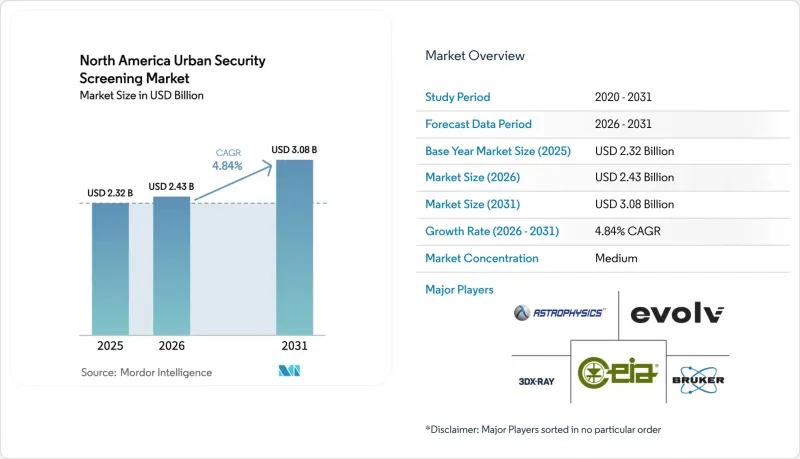
This report is Segmented by Product Type (X-Ray Products, Millimeter Wave Products, and More), End-User Industry (Corporate Buildings, Mailroom Screening, and More), Deployment Mode (Fixed Screening Systems, Portable/Handheld Screening Devices, and More), Technology (Conventional Imaging, and More), and Country. The Market Forecasts are Provided in Terms of Value (USD).
North America Urban Security Screening Market Trends and Insights
Increasing Automation in Security Screening to Detect Advanced Threats
The Department of Homeland Security allocated USD 45 million in 2024 to automate threat recognition, signaling a decisive pivot toward machine-driven detection. Automated systems now identify chemical traces in 3 seconds versus 30 seconds for manual analysis, cutting operator training costs by 40%. CT algorithms embedded in shoe scanners allow passengers to keep their footwear on, speeding lane throughput. AI models that self-learn from new threat data reduce the need for engineering updates. TSA's automated-screening-lane standards are pushing private venues to adopt similar capabilities, ensuring sustained demand across public and commercial sites.
Upsurge in Terror Activities Across the Region
The Federal Bureau of Investigation recorded a 23% jump in domestic terrorism investigations in 2024. Organizations are therefore layering perimeter screening with interior surveillance for holistic protection. Budget allocations have migrated from reactive barricades to predictive analytics that flag anomalous behavior. Demand for mobile screening vehicles has surged as firms position checkpoints farther from critical assets to counter vehicle-borne explosives. Insurers now request documented security processes before extending coverage, reinforcing market demand.
Supply Chain Issues Caused by Geopolitical Scenario and the COVID-19 Pandemic
Export restrictions on advanced imaging components announced in 2024 pushed lead times from 12 weeks to 20 weeks. Semiconductor shortages forced manufacturers to re-engineer boards around readily available chipsets. Firms are carrying 15-25% higher inventory to buffer delays, inflating working capital needs. OSI Systems expanded U.S. manufacturing to hedge geopolitical risk, a trend expected to tighten margins yet stabilize availability. Buyers increasingly choose vendors with multi-region assembly lines, influencing competitive positioning within the North America urban security screening market.
Other drivers and restraints analyzed in the detailed report include:
- Increasing Government Initiatives on Security Inspection in Schools and Colleges
- Increasing Government Initiatives for Smart Cities
- High Installation and Maintenance Costs
For complete list of drivers and restraints, kindly check the Table Of Contents.
Segment Analysis
X-ray equipment maintained 44.02% of the North America urban security screening market share in 2025, thanks to entrenched standards in aviation, logistics, and public venues. The segment's maturity results in robust resale networks and trained operator pools. Even so, the North America urban security screening market is pivoting toward capability-rich AI-powered multi-sensor systems, which are expected to rise at a 6.21% CAGR through 2031. Vendors embed convolutional neural networks that classify threat signatures in milliseconds, shrinking manual intervention. Metal detectors continue to secure stadium perimeters, while millimeter-wave scanners gain traction where radiation exposure concerns limit X-ray usage. Radiation detection units ride on heightened radiological threat awareness among government agencies. Trace detection models expand into narcotics and chemical warfare agent discovery, widening addressable demand.
Incorporating AI into legacy X-ray machines extends asset life and delivers analytics without large capital swaps. Smiths Detection rolled out a CT shoe scanner that integrates with existing lanes and reduces divestiture time. Meanwhile, open architecture interfaces permit third-party analytics overlays, encouraging best-of-breed ecosystems. This modularity sustains hardware sales while shifting value creation toward software subscriptions. Consequently, product lines that converge X-ray, trace, and radiation sensors into a unified console are seeing faster purchase cycles.
Transportation facilities controlled 32.35% revenue in 2025, reflecting regulatory mandates and continuous passenger flows. Yet data centers headline growth with a projected 6.49% CAGR. Physical breaches jeopardize uptime and compliance obligations under frameworks such as ISO 27001, catalyzing investment in biometrics and AI detectors. A Johnson Controls survey noted that 67% of data facilities recorded unauthorized access attempts in 2024. Corporate campuses also allocate funds to visitor management solutions that merge identity verification with screening gates.
Mailrooms have evolved from simple tunnel X-rays to integrated chemical sensors after headline package incidents. Warehouse and logistics operators favor mobile scanners that relocate with loading patterns, underscoring the North America urban security screening market's shift toward flexibility. Government buildings remain steady purchasers, although budget ceilings push agencies to evaluate the total cost of ownership rigorously. Law-enforcement sites demand contraband-capable devices that withstand rugged usage. Stadiums and event venues opt for portable portals to deal with seasonal spikes, cementing the case for rental and managed-service models.
Complete Report Scope:
- By Product Type
- X-ray Products
- Millimeter Wave Products
- Metal Detectors
- Radiation Detection Products
- Chemical and Trace Detection Products
- AI-Powered Multi-Sensor Systems
- By End-User Industry
- Corporate Buildings
- Mailroom Screening
- Warehouse and Logistics
- Government Buildings
- Transportation
- Data Centers
- Law Enforcement
- Stadiums and Large Venues
- Other End-User Industries
- By Deployment Mode
- Fixed Screening Systems
- Portable / Handheld Screening Devices
- Walk-through Portals
- Vehicle-mounted Screening Units
- By Technology
- Conventional Imaging
- Artificial Intelligence-based Threat Detection
- Machine Learning Enhanced Analytics
- Terahertz Imaging
- RFID and IoT Integration
- By Country
- United States
- Canada
- Mexico
List of Companies Covered in this Report:
- 3DX-Ray Ltd. (Image Scan Holdings PLC)
- Astrophysics Inc.
- Bruker Corporation
- CEIA SpA
- Evolv Technologies Holdings Inc.
- Leidos Holdings Inc.
- Liberty Defense Holdings Ltd.
- Linev Systems US Inc.
- Nuctech Company Ltd.
- Rapiscan Systems Limited
- Rohde and Schwarz GmbH and Co KG
- Smiths Detection Group Ltd.
- Tek84 Inc.
- Teledyne FLIR LLC
- Thermo Fisher Scientific Inc.
- Vehant Technologies Pvt. Ltd.
- VOTI Detection Inc.
- Garrett Metal Detectors LLC
- OSI Systems Inc.
Additional Benefits:
- The market estimate (ME) sheet in Excel format
- 3 months of analyst support
TABLE OF CONTENTS
1 INTRODUCTION
- 1.1 Study Assumptions and Market Definition
- 1.2 Scope of the Study
2 RESEARCH METHODOLOGY
3 EXECUTIVE SUMMARY
4 MARKET LANDSCAPE
- 4.1 Market Overview
- 4.2 Market Drivers
- 4.2.1 Increasing automation in security screening to detect advanced threats
- 4.2.2 Upsurge in terror activities across the region
- 4.2.3 Increasing government initiatives on security inspection in schools and colleges
- 4.2.4 Increasing government initiatives for smart cities
- 4.2.5 Rapid adoption of AI-based analytics reducing false alarms
- 4.2.6 Integration of touchless biometric screening driven by hygiene norms
- 4.3 Market Restraints
- 4.3.1 Supply chain issues caused by geopolitical scenario and the COVID-19 pandemic
- 4.3.2 High installation and maintenance costs
- 4.3.3 Public privacy concerns over advanced imaging technologies
- 4.3.4 Limited cybersecurity safeguards in networked screening devices
- 4.4 Industry Value Chain Analysis
- 4.5 Regulatory Landscape
- 4.6 Impact of Macroeconomic Factors
- 4.7 Technological Outlook
- 4.8 Porter's Five Forces Analysis
- 4.8.1 Threat of New Entrants
- 4.8.2 Bargaining Power of Buyers
- 4.8.3 Bargaining Power of Suppliers
- 4.8.4 Threat of Substitute Products
- 4.8.5 Intensity of Competitive Rivalry
5 MARKET SIZE AND GROWTH FORECASTS (VALUES)
- 5.1 By Product Type
- 5.1.1 X-ray Products
- 5.1.2 Millimeter Wave Products
- 5.1.3 Metal Detectors
- 5.1.4 Radiation Detection Products
- 5.1.5 Chemical and Trace Detection Products
- 5.1.6 AI-Powered Multi-Sensor Systems
- 5.2 By End-User Industry
- 5.2.1 Corporate Buildings
- 5.2.2 Mailroom Screening
- 5.2.3 Warehouse and Logistics
- 5.2.4 Government Buildings
- 5.2.5 Transportation
- 5.2.6 Data Centers
- 5.2.7 Law Enforcement
- 5.2.8 Stadiums and Large Venues
- 5.2.9 Other End-User Industries
- 5.3 By Deployment Mode
- 5.3.1 Fixed Screening Systems
- 5.3.2 Portable / Handheld Screening Devices
- 5.3.3 Walk-through Portals
- 5.3.4 Vehicle-mounted Screening Units
- 5.4 By Technology
- 5.4.1 Conventional Imaging
- 5.4.2 Artificial Intelligence-based Threat Detection
- 5.4.3 Machine Learning Enhanced Analytics
- 5.4.4 Terahertz Imaging
- 5.4.5 RFID and IoT Integration
- 5.5 By Country
- 5.5.1 United States
- 5.5.2 Canada
- 5.5.3 Mexico
6 COMPETITIVE LANDSCAPE
- 6.1 Market Concentration
- 6.2 Strategic Moves
- 6.3 Market Share Analysis
- 6.4 Company Profiles (includes Global level Overview, Market level overview, Core Segments, Financials as available, Strategic Information, Market Rank/Share for key companies, Products and Services, and Recent Developments)
- 6.4.1 3DX-Ray Ltd. (Image Scan Holdings PLC)
- 6.4.2 Astrophysics Inc.
- 6.4.3 Bruker Corporation
- 6.4.4 CEIA SpA
- 6.4.5 Evolv Technologies Holdings Inc.
- 6.4.6 Leidos Holdings Inc.
- 6.4.7 Liberty Defense Holdings Ltd.
- 6.4.8 Linev Systems US Inc.
- 6.4.9 Nuctech Company Ltd.
- 6.4.10 Rapiscan Systems Limited
- 6.4.11 Rohde and Schwarz GmbH and Co KG
- 6.4.12 Smiths Detection Group Ltd.
- 6.4.13 Tek84 Inc.
- 6.4.14 Teledyne FLIR LLC
- 6.4.15 Thermo Fisher Scientific Inc.
- 6.4.16 Vehant Technologies Pvt. Ltd.
- 6.4.17 VOTI Detection Inc.
- 6.4.18 Garrett Metal Detectors LLC
- 6.4.19 OSI Systems Inc.
7 MARKET OPPORTUNITIES AND FUTURE OUTLOOK
- 7.1 White-space and Unmet-Need Assessment

