PUBLISHER: Mordor Intelligence | PRODUCT CODE: 2121258

PUBLISHER: Mordor Intelligence | PRODUCT CODE: 2121258
Genetic Testing - Market Share Analysis, Industry Trends & Statistics, Growth Forecasts (2026 - 2031)
According to Mordor Intelligence, the genetic testing market size is expected to increase from USD 26.38 billion in 2025 to USD 28.56 billion in 2026 and reach USD 46.45 billion by 2031, growing at a CAGR of 10.21% over 2026-2031.
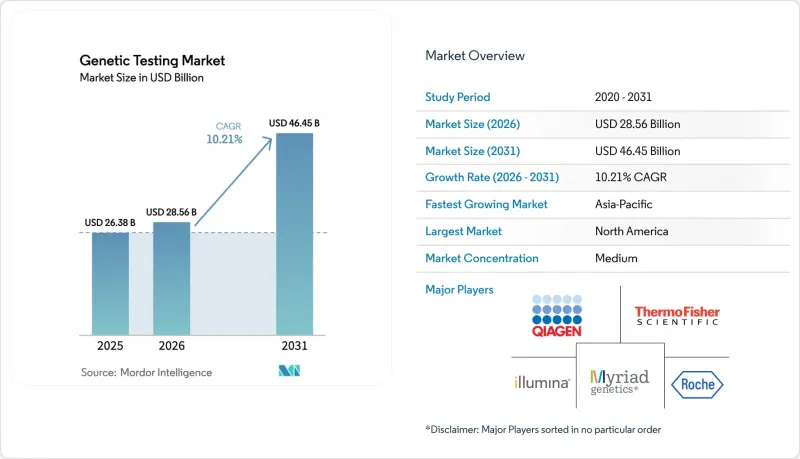
This report is Segmented by Product & Service (Consumables and Reagents, Equipment and Instruments, Software and Services), Test Type (Diagnostic, Prenatal & Newborn, and More), Technology (NGS, and More), Application (Oncology, Genetic Disease Diagnosis, and More), End User (Hospitals & Clinics, and More), and Geography (North America, and More). The Market Forecasts are Provided in Terms of Value (USD).
Global Genetic Testing Market Trends and Insights
Rapid Adoption of NIPT & Newborn Screening
Commercial payers in the United States covered NIPT for trisomies 13, 18, and 21 without prior authorization by 2025, lifting penetration above 80%. Thirty states simultaneously expanded newborn panels to 35 core conditions, boosting demand for Natera Panorama and PerkinElmer platforms. Updated American College of Obstetricians and Gynecologists guidance designated NIPT as a first-tier option for all pregnancies in 2024, removing risk-based barriers. The shift converted prenatal testing from niche to universal coverage, shortening reimbursement cycles and enabling direct-to-consumer channels. China began reimbursing NIPT in tier-1 cities in 2025, yet rural provinces remain self-pay, creating uneven adoption.
Mainstream Insurance Coverage for Multigene Panels
Medicare added BRCA1/2, PALB2, and ATM to its hereditary cancer panel coverage in 2024, aligning with NCCN guidelines. Commercial payers followed by reimbursing 25- to 80-gene panels for eligible members, pushing Myriad MyRisk and Invitae volumes up 40% year-over-year. Average panel reimbursement settled near USD 250, down steeply from historical levels, making proactive testing financially attractive to payers focused on avoiding late-stage cancer costs. Germany still limits BRCA testing to post-diagnosis use, curbing preventive uptake.
Cross-Border Data Sovereignty Restrictions
The EU Health Data Space regulation effective May 2025 mandates EU server residency for genomic data, fragmenting multinational datasets. China's rules likewise require domestic storage and government approval for sharing human genetic material abroad, limiting global collaboration. These policies raise compliance costs as labs must maintain separate infrastructures and navigate conflicting consent frameworks, delaying cross-border assay launches.
Other drivers and restraints analyzed in the detailed report include:
- Falling NGS Cost below USD 100/Genome
- Cloud-Based AI Genomic Interpretation Ecosystems
- Skilled Genetic Counselor Shortages
For complete list of drivers and restraints, kindly check the Table Of Contents.
Segment Analysis
Consumables and reagents held 37.57% of 2025 revenue, reinforcing their role as the consumable backbone of the genetic testing market. Software and services, however, will advance at a 14.57% CAGR to 2031 as interpretation rather than sequencing becomes the primary bottleneck. The genetic testing market size for software offerings is projected to widen as laboratories shift from high-capex servers to cloud subscriptions billed below USD 50,000 per year. EU IVDR rules that require CE-marked interpretation software further drive migration away from in-house pipelines. Equipment sales face semiconductor delays that stretch instrument lead times to a year, but reagent purchases remain recurring and predictable.
Recurring revenue models improve vendor cash flows while lowering startup costs for mid-tier labs. Each NovaSeq X shipped in 2025 consumes roughly USD 1 million in reagents annually at full utilization, creating annuity-like sales for Illumina. Software vendors monetize variant databases through tiered analytics, enabling community hospitals to run pan-cancer panels without dedicated bioinformaticians. Genetic testing industry players offering bundled counseling, interpretation, and billing support gain a competitive edge with payers that assess total episode cost.
Prenatal and newborn assays accounted for 36.25% in 2025, yet carrier screening is poised to grow at 13.34% CAGR as guidelines shift toward pan-ethnic panels. The genetic testing market size for carrier screening will broaden because expanded menus now cover over 400 conditions, replacing earlier Ashkenazi-focused offerings. Diagnostic testing remains high-volume but faces price pressure as exome sequencing displaces single-gene assays. Predictive panels continue to benefit from Medicare and commercial payer coverage, although uptake among unaffected adults remains modest due to privacy concerns despite GINA protections.
Expanded carrier screening surged after ACMG recommended universal panels in 2024. Adoption among fertility clinics rose 50% in 2025 for Natera Horizon. Payers, however, increasingly demand evidence of negative targeted tests before approving exome claims, a dynamic that pushes patients through stepwise testing. Pharmacogenomic panels advance at roughly 10% CAGR, but lack of EHR decision support slows physician adoption. Direct-to-consumer ancestry tests saw contraction in 2024 as privacy concerns drove 23andMe to pivot away from therapeutics and cut staff.
Complete Report Scope:
- By Product & Service
- Consumables and Reagents
- Equipments and Instruments
- Software and Services
- By Test Type
- Diagnostic
- Prenatal & Newborn
- Predictive & Presymptomatic
- Carrier
- Pharmacogenomic
- By Technology
- Next-Generation Sequencing (NGS)
- Polymerase Chain Reaction (PCR)
- Microarray
- Cytogenetic / FISH
- Other Technologies
- By Application
- Oncology
- Genetic Disease Diagnosis
- Reproductive Health
- Ancestry & DTC Wellness
- Others
- By End User
- Hospitals & Clinics
- Diagnostic Laboratories
- Research & Academic Institutes
- By Geography
- North America
- United States
- Canada
- Mexico
- Europe
- Germany
- France
- United Kingdom
- Italy
- Spain
- Rest of Europe
- Asia-Pacific
- China
- Japan
- India
- South Korea
- Australia
- Rest of Asia-Pacific
- Middle East & Africa
- GCC
- South Africa
- Rest of Middle East & Africa
- South America
- Brazil
- Argentina
- Rest of South America
- North America
Geography Analysis
North America retained 43.13% of 2025 revenue in the genetic testing market and will rise at 9.8% CAGR through 2031. Medicare and major insurers reimburse hereditary cancer, NIPT, and liquid biopsy assays, while employers broaden genomic wellness benefits. The FDA cleared 12 genetic tests in 2024, cutting approval cycles from 18 to 9 months under its Precision Medicine Initiative. Canada reimburses DPYD genotyping in Ontario and British Columbia, whereas Mexico remains largely self-pay, restricting access to urban private facilities.
Asia-Pacific is forecast to log a 12.63% CAGR, underpinned by China's national sequencing infrastructure and India's expanding diagnostics network. BGI runs the world's largest sequencing hub, processing over 1 million samples monthly and launching a USD 100 genome service in 2025. Japan reimburses comprehensive genomic profiling for advanced cancer; India's leading chains offer NIPT at USD 300, one-third U.S. prices. South Korea added BRCA testing in 2024, and Australia reimburses pharmacogenomics for thiopurine drugs at AUD 150 (USD 100).
Europe reshapes the laboratory landscape. Germany reimburses hereditary cancer panels at EUR 1,500 (USD 1,650); the U.K. NHS sequenced 100,000 cancer genomes with 30% actionable findings. France invested EUR 670 million (USD 737 million) in its Genomic Medicine Plan. Middle East and Africa will grow at an 11% CAGR, led by the UAE's plan to sequence 1 million Emirati genomes by 2030. South America advances at a 10.5% CAGR, with Brazil's Fleury and Dasa introducing hereditary panels at BRL 3,000 (USD 600).
- 23andMe
- Abbott Laboratories
- Agilent Technologies
- BGI
- Centogene
- Color Health
- Eurofins
- Exact Sciences
- Roche
- Guardant Health
- Illumina
- Invitae
- LabCorp
- Myriad Genetics
- Natera
- Oxford Nanopore Technologies
- Pacific Biosciences
- PerkinElmer
- QIAGEN
- Quest Diagnostics
- Thermo Fisher Scientific
Additional Benefits:
- The market estimate (ME) sheet in Excel format
- 3 months of analyst support
TABLE OF CONTENTS
1 Introduction
- 1.1 Study Assumptions & Market Definition
- 1.2 Scope of the Study
2 Research Methodology
3 Executive Summary
4 Market Landscape
- 4.1 Market Overview
- 4.2 Market Drivers
- 4.2.1 Rapid Adoption of NIPT & Newborn Screening
- 4.2.2 Mainstream Insurance Coverage for Multigene Panels
- 4.2.3 Falling NGS Cost Less Than USD 100/Whole Genome (Post-2027)
- 4.2.4 Cloud-Based AI Genomic Interpretation Ecosystems
- 4.2.5 Liquid-Biopsy-Ready Regulatory Pathways
- 4.2.6 Employer-Sponsored Genomic-Wellness Benefits Surge
- 4.3 Market Restraints
- 4.3.1 Cross-Border Data-Sovereignty Restrictions
- 4.3.2 Skilled-Genetic-Counsellor Shortage Bottlenecks
- 4.3.3 Patchy Reimbursement in Emerging Economies
- 4.3.4 NGS Chip Supply-Chain Dependency on 2 Fabs
- 4.4 Value / Supply-Chain Analysis
- 4.5 Regulatory Landscape
- 4.6 Technological Outlook
- 4.7 Porter's Five Forces Analysis
- 4.7.1 Bargaining Power of Suppliers
- 4.7.2 Bargaining Power of Buyers
- 4.7.3 Threat of New Entrants
- 4.7.4 Threat of Substitutes
- 4.7.5 Intensity of Competitive Rivalry
5 Market Size & Growth Forecasts (Value in USD)
- 5.1 By Product & Service
- 5.1.1 Consumables and Reagents
- 5.1.2 Equipments and Instruments
- 5.1.3 Software and Services
- 5.2 By Test Type
- 5.2.1 Diagnostic
- 5.2.2 Prenatal & Newborn
- 5.2.3 Predictive & Presymptomatic
- 5.2.4 Carrier
- 5.2.5 Pharmacogenomic
- 5.3 By Technology
- 5.3.1 Next-Generation Sequencing (NGS)
- 5.3.2 Polymerase Chain Reaction (PCR)
- 5.3.3 Microarray
- 5.3.4 Cytogenetic / FISH
- 5.3.5 Other Technologies
- 5.4 By Application
- 5.4.1 Oncology
- 5.4.2 Genetic Disease Diagnosis
- 5.4.3 Reproductive Health
- 5.4.4 Ancestry & DTC Wellness
- 5.4.5 Others
- 5.5 By End User
- 5.5.1 Hospitals & Clinics
- 5.5.2 Diagnostic Laboratories
- 5.5.3 Research & Academic Institutes
- 5.6 By Geography
- 5.6.1 North America
- 5.6.1.1 United States
- 5.6.1.2 Canada
- 5.6.1.3 Mexico
- 5.6.2 Europe
- 5.6.2.1 Germany
- 5.6.2.2 France
- 5.6.2.3 United Kingdom
- 5.6.2.4 Italy
- 5.6.2.5 Spain
- 5.6.2.6 Rest of Europe
- 5.6.3 Asia-Pacific
- 5.6.3.1 China
- 5.6.3.2 Japan
- 5.6.3.3 India
- 5.6.3.4 South Korea
- 5.6.3.5 Australia
- 5.6.3.6 Rest of Asia-Pacific
- 5.6.4 Middle East & Africa
- 5.6.4.1 GCC
- 5.6.4.2 South Africa
- 5.6.4.3 Rest of Middle East & Africa
- 5.6.5 South America
- 5.6.5.1 Brazil
- 5.6.5.2 Argentina
- 5.6.5.3 Rest of South America
- 5.6.1 North America
6 Competitive Landscape
- 6.1 Market Concentration
- 6.2 Market Share Analysis
- 6.3 Company Profiles (includes Global level Overview, Market level overview, Core Segments, Financials as available, Strategic Information, Market Rank/Share for key companies, Products & Services, and Recent Developments)
- 6.3.1 23andMe
- 6.3.2 Abbott Laboratories
- 6.3.3 Agilent Technologies
- 6.3.4 BGI Genomics
- 6.3.5 Centogene
- 6.3.6 Color Health
- 6.3.7 Eurofins Scientific
- 6.3.8 Exact Sciences
- 6.3.9 F. Hoffmann-La Roche
- 6.3.10 Guardant Health
- 6.3.11 Illumina
- 6.3.12 Invitae
- 6.3.13 Laboratory Corporation of America
- 6.3.14 Myriad Genetics
- 6.3.15 Natera
- 6.3.16 Oxford Nanopore Technologies
- 6.3.17 Pacific Biosciences
- 6.3.18 PerkinElmer
- 6.3.19 QIAGEN
- 6.3.20 Quest Diagnostics
- 6.3.21 Thermo Fisher Scientific
7 Market Opportunities & Future Outlook
- 7.1 White-space & Unmet-Need Assessment

