PUBLISHER: Mordor Intelligence | PRODUCT CODE: 2121334

PUBLISHER: Mordor Intelligence | PRODUCT CODE: 2121334
1,4 Butanediol - Market Share Analysis, Industry Trends & Statistics, Growth Forecasts (2026 - 2031)
According to Mordor Intelligence, the 1,4 butanediol market size is estimated at 2.66 million tons in 2026, and is expected to reach 3.18 million tons by 2031, at a CAGR of 3.64% during the forecast period (2026-2031).
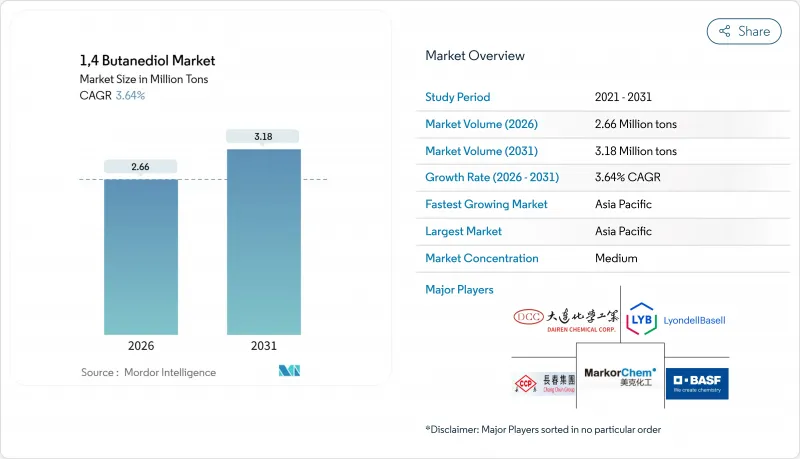
This report is Segmented by Production Process (Reppe, Davy, Butadiene-Based, Propylene Oxide-Based, and More), Derivative (Tetrahydrofuran (THF) and More), End-User Industry (Automotive, Electrical & Electronics, Healthcare & Pharmaceuticals, and More), and Geography (Asia-Pacific, North America, Europe, South America, and Middle East & Africa). Market Forecasts are Provided in Terms of Volume (tons).
Global 1,4 Butanediol Market Trends and Insights
Rising Demand for THF and Spandex Fibers
Tetrahydrofuran remains the gateway molecule to polytetramethylene ether glycol, the soft segment in spandex. BASF operates five PolyTHF plants worldwide and reported double-digit volume growth in Asia-Pacific technical-textile grades during 2025. Hyosung integrated bio-BDO into its regen BIO spandex, launched in 2025, and is realizing 10-15% price premiums in European and North American apparel markets. Apparel restocking cycles normalize faster than durable-goods demand, giving THF a buffer against macro shocks. Beyond textiles, PTMEG grades flow into thermoplastic polyurethane (TPU) used in medical tubing and automotive interior films, broadening the demand base.
Light-Weighting of EV Connectors Spurring PBT Uptake
High-voltage electric-vehicle platforms require connector housings with flame-retardant, hydrolysis-resistant, and dimensional stability. PBT synthesized from BDO meets these criteria and is displacing PA 6,6 in 400-800 V architectures. BASF's Ultradur grades passed UL 94 V-0 testing and secured design wins at several European and Chinese OEMs in 2025. Rising 5 G base-station installations and data-center construction intensify PBT demand for high-temperature circuit-breaker housings, reinforcing its 3.79% CAGR outlook.
Occupational Health and Safety Concerns
1,4 Butanediol is an eye, skin, and respiratory irritant, and prolonged exposure depresses the central nervous system. The European Chemicals Agency and ACGIH enforce exposure thresholds, prompting investments in closed-loop transfer systems and vapor recovery. Compliance can add USD 50 to USD 100 per ton to operating costs, favoring well-capitalized producers. Several Xinjiang and Shanxi plants halted operations in 2024-2025 for ventilation retrofits, temporarily tightening regional supply.
Other drivers and restraints analyzed in the detailed report include:
- Expansion of Polyurethane Applications
- Government Subsidies for Bio-BDO Capacity
- Volatile Feedstock Prices
For complete list of drivers and restraints, kindly check the Table Of Contents.
Segment Analysis
Reppe acetylene chemistry retained 50.18% of total output in 2025, reflecting decades of brownfield infrastructure. The installed base ensures that the 1,4 Butanediol market size tied to Reppe plants remains substantial through 2031. Even so, bio-fermentation grows 7.52% annually, propelled by carbon incentives that tilt project economics away from coal feedstocks. Genomatica's GENO technology underpins BASF's Verbund output and Hyosung's Vietnam complex, proving that fermentation can scale to 50,000-ton trains with 90% lower life-cycle emissions. Propylene-oxide and butadiene routes stay niche because of higher variable costs and limited license holders.
Process economics now hinge on carbon accounting. Europe's forthcoming Industrial Emissions Directive revision tightens VOC limits on acetylene plants, lifting compliance costs, while bio-routes sidestep acetylene-handling hazards. China's 2060 carbon-neutrality pledge pressures regional authorities to curb coal-to-acetylene expansions, gradually eroding Reppe's share despite its entrenched footprint.
Complete Report Scope:
- By Production Process
- Reppe Process
- Davy Process
- Butadiene-Based Process
- Propylene Oxide-Based Process
- Bio-fermentation Route
- By Derivative
- Tetrahydrofuran (THF)
- Polybutylene Terephthalate (PBT)
- Gamma-Butyrolactone (GBL)
- Polyurethane (PU)
- Other Derivatives
- By End-user Industry
- Automotive
- Textile
- Electrical and Electronics
- Healthcare and Pharmaceuticals
- Other End-user Industries
- By Geography
- Asia-Pacific
- China
- India
- Japan
- South Korea
- ASEAN Countries
- Rest of Asia-Pacific
- North America
- United States
- Canada
- Mexico
- Europe
- Germany
- United Kingdom
- France
- Italy
- NORDIC Countries
- Rest of Europe
- South America
- Brazil
- Argentina
- Rest of South America
- Middle East and Africa
- Saudi Arabia
- South Africa
- Rest of Middle East and Africa
- Asia-Pacific
Geography Analysis
Asia-Pacific accounted for 76.12% of global volume in 2025 and is set to grow at a 3.94% CAGR through 2031. China's coal-to-acetylene clusters in Xinjiang, Shanxi, and Inner Mongolia supply most regional needs but face tightening energy-intensity and safety audits, creating intermittent outages. Hyosung's USD 1 billion Vietnam complex marks Southeast Asia's entry into premium low-carbon supply and will eventually relieve Chinese export dominance. India's demand is climbing at double digits on the back of textile and automotive expansions, but lacks domestic capacity, relying on Korean and Middle-East imports.
North America and Europe, both regions, advance bio-BDO capacity to hedge CBAM penalties and Scope 3 targets. BASF, Qore, and Novamont collectively added more than 100,000 tpa of fermentation output between 2024 and 2026. Local demand tilts toward high-value TPU, PBT, and pharmaceutical intermediates, giving producers a margin buffer against feedstock volatility.
Saudi Arabia's Sipchem operates a 50,000 tpa unit integrated with low-cost ethane, targeting polyurethane and solvent markets. Brazil drives South American consumption across automotive and textile channels, yet logistical and currency hurdles slow new investment. Africa's demand is nascent, centered in South African polyurethane coatings, but infrastructure gaps remain a hurdle.
- Ashland
- BASF
- Chang Chun Group
- CJ CHEILJEDANG CORP.
- DCC
- Genomatica, Inc.
- Grupa Azoty
- Henan Kaixiang Fine Chemical Co. Ltd
- Jiangsu Hailun Petrochemical Co. Ltd
- LyondellBasell Industries Holdings B.V.
- Markor Chemicals Group Co. Ltd
- Mitsubishi Chemical Group Corporation
- NAN YA PLASTICS CORPORATION
- Novamont SpA
- Shandong Yuanli Science And Technology Co. Ltd
- Shanxi Sanwei Group Co. Ltd
- Sinochem Internation Corporation
- Sipchem Company
- SK Geocentric Co., Ltd.
- Xinjiang Blue Ridge Tunhe Sci.&Tech. Co., Ltd.
- Xinjiang Tianye (Group) Co. Ltd
Additional Benefits:
- The market estimate (ME) sheet in Excel format
- 3 months of analyst support
TABLE OF CONTENTS
1 Introduction
- 1.1 Study Assumptions & Market Definition
- 1.2 Scope of the Study
2 Research Methodology
3 Executive Summary
4 Market Landscape
- 4.1 Market Overview
- 4.2 Market Drivers
- 4.2.1 Rising demand for THF and spandex fibres
- 4.2.2 Light-weighting of EV connectors spurring PBT uptake
- 4.2.3 Expansion of polyurethane applications
- 4.2.4 Government subsidies for bio-BDO capacity
- 4.2.5 Cost-advantaged coal-to-acetylene integrations in inland China
- 4.3 Market Restraints
- 4.3.1 Occupational health and safety concerns
- 4.3.2 Volatile feedstock (acetylene, butadiene, propylene) prices
- 4.3.3 Carbon-border taxes raising cost of coal-based BDO exports
- 4.4 Value Chain Analysis
- 4.5 Porter's Five Forces
- 4.5.1 Bargaining Power of Suppliers
- 4.5.2 Bargaining Power of Buyers
- 4.5.3 Threat of New Entrants
- 4.5.4 Threat of Substitutes
- 4.5.5 Degree of Competition
5 Market Size and Growth Forecasts (Value and Volume)
- 5.1 By Production Process
- 5.1.1 Reppe Process
- 5.1.2 Davy Process
- 5.1.3 Butadiene-Based Process
- 5.1.4 Propylene Oxide-Based Process
- 5.1.5 Bio-fermentation Route
- 5.2 By Derivative
- 5.2.1 Tetrahydrofuran (THF)
- 5.2.2 Polybutylene Terephthalate (PBT)
- 5.2.3 Gamma-Butyrolactone (GBL)
- 5.2.4 Polyurethane (PU)
- 5.2.5 Other Derivatives
- 5.3 By End-user Industry
- 5.3.1 Automotive
- 5.3.2 Textile
- 5.3.3 Electrical and Electronics
- 5.3.4 Healthcare and Pharmaceuticals
- 5.3.5 Other End-user Industries
- 5.4 By Geography
- 5.4.1 Asia-Pacific
- 5.4.1.1 China
- 5.4.1.2 India
- 5.4.1.3 Japan
- 5.4.1.4 South Korea
- 5.4.1.5 ASEAN Countries
- 5.4.1.6 Rest of Asia-Pacific
- 5.4.2 North America
- 5.4.2.1 United States
- 5.4.2.2 Canada
- 5.4.2.3 Mexico
- 5.4.3 Europe
- 5.4.3.1 Germany
- 5.4.3.2 United Kingdom
- 5.4.3.3 France
- 5.4.3.4 Italy
- 5.4.3.5 NORDIC Countries
- 5.4.3.6 Rest of Europe
- 5.4.4 South America
- 5.4.4.1 Brazil
- 5.4.4.2 Argentina
- 5.4.4.3 Rest of South America
- 5.4.5 Middle East and Africa
- 5.4.5.1 Saudi Arabia
- 5.4.5.2 South Africa
- 5.4.5.3 Rest of Middle East and Africa
- 5.4.1 Asia-Pacific
6 Competitive Landscape
- 6.1 Market Concentration
- 6.2 Strategic Moves
- 6.3 Market Share(%)/Ranking Analysis
- 6.4 Company Profiles {(includes Global level Overview, Market level overview, Core Segments, Financials as available, Strategic Information,Products and Services, and Recent Developments)}
- 6.4.1 Ashland
- 6.4.2 BASF
- 6.4.3 Chang Chun Group
- 6.4.4 CJ CHEILJEDANG CORP.
- 6.4.5 DCC
- 6.4.6 Genomatica, Inc.
- 6.4.7 Grupa Azoty
- 6.4.8 Henan Kaixiang Fine Chemical Co. Ltd
- 6.4.9 Jiangsu Hailun Petrochemical Co. Ltd
- 6.4.10 LyondellBasell Industries Holdings B.V.
- 6.4.11 Markor Chemicals Group Co. Ltd
- 6.4.12 Mitsubishi Chemical Group Corporation
- 6.4.13 NAN YA PLASTICS CORPORATION
- 6.4.14 Novamont SpA
- 6.4.15 Shandong Yuanli Science And Technology Co. Ltd
- 6.4.16 Shanxi Sanwei Group Co. Ltd
- 6.4.17 Sinochem Internation Corporation
- 6.4.18 Sipchem Company
- 6.4.19 SK Geocentric Co., Ltd.
- 6.4.20 Xinjiang Blue Ridge Tunhe Sci.&Tech. Co., Ltd.
- 6.4.21 Xinjiang Tianye (Group) Co. Ltd
7 Market Opportunities and Future Outlook
- 7.1 White-space and Unmet-Need Assessment
- 7.2 Advancements in Bio-Based Production Technologies

