PUBLISHER: Mordor Intelligence | PRODUCT CODE: 2123058

PUBLISHER: Mordor Intelligence | PRODUCT CODE: 2123058
Bio-based 1,4-Butanediol - Market Share Analysis, Industry Trends & Statistics, Growth Forecasts (2026 - 2031)
According to Mordor Intelligence, the bio-based 1,4-Butanediol market size is projected to be 38.81 kilotons in 2025, 42.46 kilotons in 2026, and reach 66.54 kilotons by 2031, growing at a CAGR of 9.40% from 2026 to 2031.
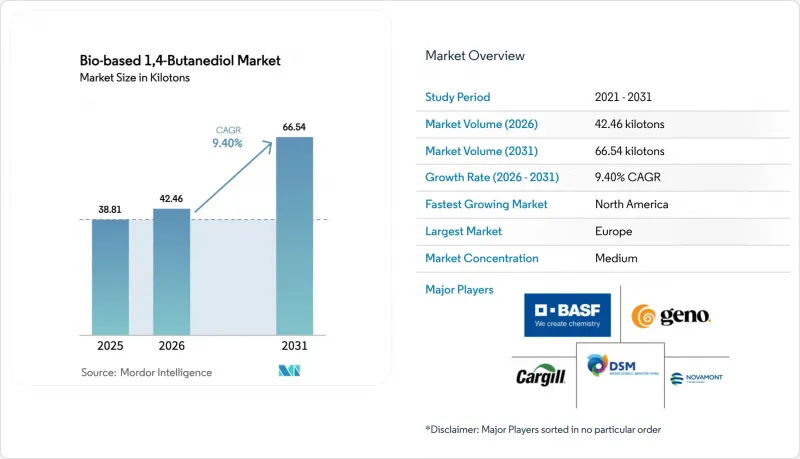
This report is Segmented by Application (Tetrahydrofuran (THF), Polybutylene Terephthalate (PBT) Gamma-Butyrolactone (GBL), and More), End-User Industry (Automotive, Electrical and Electronics, Textile and Apparel, and Industrial and Others), and Geography (Asia-Pacific, North America, Europe, and Rest of the World). The Market Forecasts are Provided in Terms of Volume (Tons).
Global Bio-based 1,4-Butanediol Market Trends and Insights
Surging Demand for Polybutylene Terephthalate (PBT)
Electric-vehicle architectures require PBT connectors, battery housings, and charging components able to endure temperatures above 150 °C. The material's thin-wall moldability drops part weight by up to 20%, a benefit amplified in range-sensitive battery platforms. Bio-based BDO acts as a drop-in precursor, letting converters certify renewable content without requalifying critical parts. BASF's REDcert2-approved biomass-balance BDO, commercial since 2024, enables identical mechanical performance while trimming embedded carbon. The electronics sector adds upside as 5G rollouts and data-center buildouts fuel 8% annual PBT demand growth to 2030.
Stringent Global and Regional Carbon-Reduction Mandates
The EU Carbon Border Adjustment Mechanism levies carbon fees on high-emission imports, raising the landed cost of coal-derived BDO by EUR 150-200 per ton once organic chemicals join the scope in 2026. California's Low Carbon Fuel Standard and U.S. Inflation Reduction Act award tradable credits and production tax relief that shave USD 0.20-0.30 per kilogram from qualifying bio-BDO output. China's dual-carbon pathway, aiming for neutrality by 2060, curtails approvals for new coal-based BDO units while prioritizing bio-routes, and RED II lifts demand for THF as a renewable fuel additive in Europe.
Price Gap Versus Fossil BDO Amid Crude Volatility
Bio-BDO tracks glucose and sucrose costs, which surge during poor harvests, while fossil peers ride naphtha and natural-gas cycles. When crude slipped below USD 70 per barrel in late 2024, bio premiums widened to 25%. Chinese coal-based BDO sold at USD 1.60-1.80 per kilogram, undercutting bio alternatives by up to 30%, pressuring converters lacking sustainability clauses.
Other drivers and restraints analyzed in the detailed report include:
- Brand-Owner Net-Zero Commitments Across CPG and Automotive
- Rapid Cost Declines in Bio-Fermentation Technologies
- Limited Large-Scale Fermentation Capacity Outside Asia-Pacific
For complete list of drivers and restraints, kindly check the Table Of Contents.
Segment Analysis
Tetrahydrofuran (THF) secured 48.40% of 2025 volume and is on track for a 9.62% CAGR through 2031, buoyed by brisk spandex demand in athleisure and intimate apparel. The spandex launch using Qore's bio-BDO cut carbon footprints by 44%, turning THF into the flagship application within the bio-based 1,4-butanediol market. PBT applications follow, driven by electric-vehicle connector needs and a predicted 8% rise in automotive PBT demand to 2030. Gamma-butyrolactone supports specialty solvents, while polyurethane elastomers tap into green-building and low-VOC trends. Vertical integration projects such as Hyosung TNC's Vietnam complex secure captive PTMEG demand, insulating THF supply chains from feedstock volatility and locking in offtake for 50,000 tons of spandex capacity by mid-2026.
Second-tier applications remain niche yet profitable. GBL feeds agrochemical intermediates where regulatory approvals favor validated bio routes. PU's move into rigid insulation broadens market scope. These diverse outlets collectively reinforce the bio-based 1,4-butanediol market's resilience against single-industry downturns and help suppliers balance production portfolios over multi-year contracts.
Complete Report Scope:
- By Application
- Tetrahydrofuran (THF)
- Polybutylene Terephthalate (PBT)
- Gamma-Butyrolactone (GBL)
- Polyurethane (PU)
- Other Applications
- By End-user Industry
- Automotive
- Electrical & Electronics
- Textile and Apparel
- Industrial and Others
- By Geography
- North America
- United States
- Canada
- Mexico
- Europe
- Germany
- United Kingdom
- France
- Italy
- Spain
- Russia
- Nordic Countries
- Turkey
- Rest of Europe
- Asia-Pacific
- China
- India
- Japan
- South Korea
- Indonesia
- Malaysia
- Thailand
- Vietnam
- Rest of Asia-Pacific
- Rest of the World
- Middle-East and Africa
- South America
- North America
Geography Analysis
Europe held 75.01% of global volume in 2025, underpinned by BASF's REDcert2-approved biomass-balance BDO and Novamont's dedicated 30-kiloton plant. The Carbon Border Adjustment Mechanism lifts imported fossil BDO costs by EUR 150-200 per ton from 2026, effectively subsidizing regional bio output. Germany, the United Kingdom, France, and Italy contribute more than 60% of European demand, driven by automotive PBT consumption and a large textile converting base. Nordic initiatives exploit forestry residues as feedstock, while Turkey's export-oriented textile sector draws bio-PTMEG to meet EU brand specifications.
North America posts the fastest 2026-2031 trajectory at 9.87% CAGR. Qore's 65-kiloton Iowa facility ships commercial volumes from 2026, feeding LYCRA's U.S. spandex lines. Inflation Reduction Act incentives drop bio-BDO cash costs and attract new fermentation proposals. California's LCFS credits and Canada's Clean Fuel Regulations spur THF molecules for fuel additives. Mexico's vehicle production hub pulls bio-PBT, integrating cross-border supply chains and undergirding regional growth.
Asia-Pacific commands the bulk of global capacity, with Chinese producers leveraging corn and cassava streams at competitive cost. Hyosung TNC's USD 1 billion Vietnam build secures captive demand and lowers supply risk. Japanese majors Toray and Mitsubishi advance cellulosic sugar routes that integrate into wider polyester and nylon programs. South Korea's LG Chem positions bio-BDO for automotive and electronics accounts, and Southeast Asian textile clusters source renewable PTMEG to satisfy Western brands. The rest of the world leans on imports, yet growth pockets appear in Middle Eastern and South American textile expansions that require low-carbon feedstocks to preserve export competitiveness.
- BASF
- DSM
- Genomatica Inc.
- Cargill, Incorporated
- Novamont S.p.A.
- Global Bio-chem Technology Group Co. Ltd.
- Shandong Landian Biological Technology Co. Ltd
- Yuanli Science & Technology
- Toray Industries
- Mitsubishi Chemical Group
- Susteen Technologies
- Dairen Chemical Corporation
- LanzaTech Global
- Green Biologics Ltd.
- Asahi Kasei Corporation
- Corbion N.V.
- Lanxess AG
- LG Chem
Additional Benefits:
- The market estimate (ME) sheet in Excel format
- 3 months of analyst support
TABLE OF CONTENTS
1 Introduction
- 1.1 Study Assumptions & Market Definition
- 1.2 Scope of the Study
2 Research Methodology
3 Executive Summary
4 Market Landscape
- 4.1 Market Overview
- 4.2 Market Drivers
- 4.2.1 Surging demand for polybutylene terephthalate (PBT)
- 4.2.2 Stringent global and regional carbon-reduction mandates
- 4.2.3 Brand owners' net-zero commitments across CPG and automotive
- 4.2.4 Rapid cost declines in bio-fermentation technologies
- 4.2.5 Commercialisation of lignocellulosic feedstocks (non-food)
- 4.3 Market Restraints
- 4.3.1 Price gap vs. fossil BDO amid crude volatility
- 4.3.2 Limited large-scale fermentation capacity outside Asia-Pacific
- 4.3.3 Strain IP litigation slowing tech-transfer deals
- 4.4 Value Chain Analysis
- 4.5 Porter's Five Forces
- 4.5.1 Bargaining Power of Suppliers
- 4.5.2 Bargaining Power of Buyers
- 4.5.3 Threat of New Entrants
- 4.5.4 Threat of Substitutes
- 4.5.5 Competitive Rivalry
- 4.6 Patent Analysis
5 Market Size & Growth Forecasts (Volume)
- 5.1 By Application
- 5.1.1 Tetrahydrofuran (THF)
- 5.1.2 Polybutylene Terephthalate (PBT)
- 5.1.3 Gamma-Butyrolactone (GBL)
- 5.1.4 Polyurethane (PU)
- 5.1.5 Other Applications
- 5.2 By End-user Industry
- 5.2.1 Automotive
- 5.2.2 Electrical & Electronics
- 5.2.3 Textile and Apparel
- 5.2.4 Industrial and Others
- 5.3 By Geography
- 5.3.1 North America
- 5.3.1.1 United States
- 5.3.1.2 Canada
- 5.3.1.3 Mexico
- 5.3.2 Europe
- 5.3.2.1 Germany
- 5.3.2.2 United Kingdom
- 5.3.2.3 France
- 5.3.2.4 Italy
- 5.3.2.5 Spain
- 5.3.2.6 Russia
- 5.3.2.7 Nordic Countries
- 5.3.2.8 Turkey
- 5.3.2.9 Rest of Europe
- 5.3.3 Asia-Pacific
- 5.3.3.1 China
- 5.3.3.2 India
- 5.3.3.3 Japan
- 5.3.3.4 South Korea
- 5.3.3.5 Indonesia
- 5.3.3.6 Malaysia
- 5.3.3.7 Thailand
- 5.3.3.8 Vietnam
- 5.3.3.9 Rest of Asia-Pacific
- 5.3.4 Rest of the World
- 5.3.4.1 Middle-East and Africa
- 5.3.4.2 South America
- 5.3.1 North America
6 Competitive Landscape
- 6.1 Market Concentration
- 6.2 Strategic Moves
- 6.3 Market Share/Ranking Analysis
- 6.4 Company Profiles (includes Global level Overview, Market level overview, Core Segments, Financials as available, Strategic Information, Market Rank/Share, Products & Services, Recent Developments)
- 6.4.1 BASF
- 6.4.2 DSM
- 6.4.3 Genomatica Inc.
- 6.4.4 Cargill, Incorporated
- 6.4.5 Novamont S.p.A.
- 6.4.6 Global Bio-chem Technology Group Co. Ltd.
- 6.4.7 Shandong Landian Biological Technology Co. Ltd
- 6.4.8 Yuanli Science & Technology
- 6.4.9 Toray Industries
- 6.4.10 Mitsubishi Chemical Group
- 6.4.11 Susteen Technologies
- 6.4.12 Dairen Chemical Corporation
- 6.4.13 LanzaTech Global
- 6.4.14 Green Biologics Ltd.
- 6.4.15 Asahi Kasei Corporation
- 6.4.16 Corbion N.V.
- 6.4.17 Lanxess AG
- 6.4.18 LG Chem
7 Market Opportunities and Future Outlook
- 7.1 White-space and Unmet-need Assessment

