PUBLISHER: Mordor Intelligence | PRODUCT CODE: 2121460

PUBLISHER: Mordor Intelligence | PRODUCT CODE: 2121460
North America Blood Glucose Monitoring - Market Share Analysis, Industry Trends & Statistics, Growth Forecasts (2025 - 2031)
According to Mordor Intelligence, the North America blood glucose monitoring market size is projected to be USD 17.55 billion in 2025, USD 19.93 billion in 2026, and reach USD 37.68 billion by 2031, growing at a CAGR of 13.59% from 2026 to 2031.
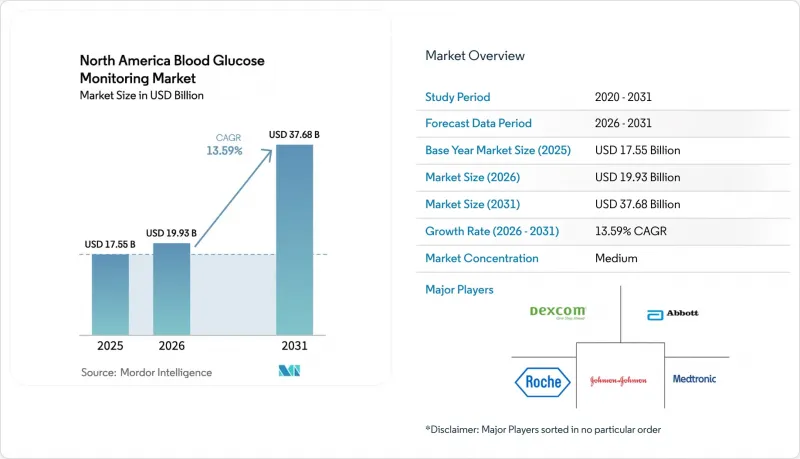
This report is Segmented by Device Type (Self-Monitoring Blood Glucose Devices, Continuous Glucose Monitoring Devices, and More), Applications (Diabetes Management and More), Age Group (Pediatrics, and More), Test Type (Invasive, Non-Invasive), End User (Hospitals, Homecare, Others), and Country (United States, Canada, Mexico). The Market Forecasts are Provided in Terms of Value (USD).
North America Blood Glucose Monitoring Market Trends and Insights
Favorable Reimbursement Expansions (CMS, Private Payers)
Medicare's 2024 rule that broadened CGM coverage to non-intensive insulin users removed a historical barrier, doubling the eligible senior population to 5.3 million and driving a 47% prescription surge among Medicare Advantage members in 1H 2025. Commercial insurers mirrored the change and cut prior-authorization hurdles, enabling pharmacies to stock OTC CGMs nationwide. Accountable-care organizations are leveraging these benefits to trim emergency visits, accelerating revenue migration from SMBG to CGM and lifting overall blood glucose monitoring market momentum.
Technological Advances in Long-Wear CGM Sensors
Fourteen- and fifteen-day sensors such as FreeStyle Libre 3 and Dexcom G7 achieve mean absolute relative difference (MARD) scores below 8.5%, meeting insulin-dosing standards without finger-stick confirmation. Manufacturing gains from roll-to-roll electrode printing have trimmed unit costs by roughly 25% since 2024. Lower per-day monitoring costs make CGM price-competitive with multi-stick SMBG, stimulating hospital pilots and retail uptake across the blood glucose monitoring market.
High Recurring Sensor & Strip Costs for Low-Income Users
Uninsured and underinsured adults face list prices of USD 350 per month for CGM sensors and USD 60-150 for branded SMBG strips . Cost burden leads to test rationing, raising risks of undetected hypo- and hyperglycemia. Although makers offer discount plans, enrollment caps leave many excluded, tempering near-term blood glucose monitoring market penetration in lower-income segments.
Other drivers and restraints analyzed in the detailed report include:
- Growing Type-2 Adoption of CGM Beyond Insulin Users
- Shift Toward Data-Driven, AI-Enabled Diabetes Platforms
- State-By-State Medicaid Coverage Disparities
For complete list of drivers and restraints, kindly check the Table Of Contents.
Segment Analysis
CGM revenue is set to eclipse SMBG despite SMBG's 60.1% blood glucose monitoring market share in 2025. CGM's 13.76% growth rate reflects extended-wear sensors, OTC availability, and Medicare expansion. The blood glucose monitoring market size for CGM is projected to compound faster as cost-per-day falls and clinical accuracy rises . SMBG remains entrenched in hospitals where point-of-care meters integrate with electronic health records, but even here, connected meters aim to mimic continuous data flow.
A bifurcated adoption pattern is emerging: majority of newly diagnosed type 1 children start on CGM within three months, yet elderly uptake lags due to interface complexity. Vendors are responding with simplified receivers and implantable six-month sensors, moderating attrition. Combined, these dynamics sustain a healthy pipeline for both premium CGM and value-focused SMBG devices inside the broader blood glucose monitoring market.
Therapeutic diabetes management applications accounted for 73.21% of the 2025 value, underpinning the largest slice of the blood glucose monitoring market share. Closed-loop pumps, telehealth reviews, and population-health dashboards intensify data utilization, supporting a 14.78% forward growth path.
Wellness-oriented monitoring via subscription models such as Levels Health introduces CGM to fitness enthusiasts and pre-diabetics, growing awareness beyond clinical indications. Though still a modest slice of the blood glucose monitoring market size, lifestyle adoption contributes incremental sensor volume and could channel users into therapeutic pathways upon diagnosis.
Complete Report Scope:
- By Device
- Self-Monitoring Blood Glucose Devices
- Continuous Glucose Monitoring Devices
- Emerging Non-Invasive Wearables
- By Applications
- Diabetes Management
- Health and wellness monitoring
- Other
- By Age Group
- Pediatrics
- Adults
- Geriatrics
- By Test Type
- Invesive
- Non-Invasive
- By End User
- Hospitals
- Homecare
- Others
- By Country
- United States
- Canada
- Mexico
List of Companies Covered in this Report:
- Abbott Laboratories
- Acon Laboratories
- AgaMatrix
- Arkray
- Ascensia
- B. Braun
- Bionime
- Dexcom
- Roche
- GlySens
- Insulet
- Johnson & Johnson
- Medtronic
- Nipro Diagnostics
- Nova Biomedical
- Rossmax
- Senseonics Holdings
- Tandem Diabetes Care
- Trividia Health
- Ypsomed
Additional Benefits:
- The market estimate (ME) sheet in Excel format
- 3 months of analyst support
TABLE OF CONTENTS
1 Introduction
- 1.1 Study Assumptions & Market Definition
- 1.2 Scope of the Study
2 Research Methodology
3 Executive Summary
4 Market Landscape
- 4.1 Market Overview
- 4.2 Market Drivers
- 4.2.1 Favorable Reimbursement Expansions (CMS, Private Payers)
- 4.2.2 Technological Advances in Long-Wear CGM Sensors
- 4.2.3 Growing Type-2 Adoption of CGM Beyond Insulin Users
- 4.2.4 Retail & OTC Channel Rollout for CGM Devices
- 4.2.5 Shift Toward Data-Driven, AI-Enabled Diabetes Platforms
- 4.2.6 Near-Shoring of Sensor Manufacturing Lowers Supply-Chain Risk
- 4.3 Market Restraints
- 4.3.1 High Recurring Sensor & Strip Costs for Low-Income Users
- 4.3.2 Accuracy / Calibration Concerns in Extreme Glucose Ranges
- 4.3.3 State-By-State Medicaid Coverage Disparities
- 4.3.4 Cyber-Security & Data-Privacy Compliance Costs (HIPAA, FDA)
- 4.4 Supply-Chain Analysis
- 4.5 Regulatory Landscape
- 4.6 Technological Outlook
- 4.7 Porter's Five Forces
- 4.7.1 Bargaining Power of Suppliers
- 4.7.2 Bargaining Power of Consumers
- 4.7.3 Threat of New Entrants
- 4.7.4 Threat of Substitute Products
- 4.7.5 Intensity of Competitive Rivalry
5 Market Size & Growth Forecasts (Value, USD)
- 5.1 By Device
- 5.1.1 Self-Monitoring Blood Glucose Devices
- 5.1.2 Continuous Glucose Monitoring Devices
- 5.1.3 Emerging Non-Invasive Wearables
- 5.2 By Applications
- 5.2.1 Diabetes Management
- 5.2.2 Health and wellness monitoring
- 5.2.3 Other
- 5.3 By Age Group
- 5.3.1 Pediatrics
- 5.3.2 Adults
- 5.3.3 Geriatrics
- 5.4 By Test Type
- 5.4.1 Invesive
- 5.4.2 Non-Invasive
- 5.5 By End User
- 5.5.1 Hospitals
- 5.5.2 Homecare
- 5.5.3 Others
- 5.6 By Country
- 5.6.1 United States
- 5.6.2 Canada
- 5.6.3 Mexico
6 Competitive Landscape
- 6.1 Market Concentration
- 6.2 Market Share Analysis
- 6.3 Company Profiles (includes Global level Overview, Market level overview, Core Segments, Financials as available, Strategic Information, Market Rank/Share for key companies, Products & Services, Recent Developments)
- 6.3.1 Abbott Laboratories
- 6.3.2 Acon Laboratories
- 6.3.3 AgaMatrix Inc.
- 6.3.4 ARKRAY Inc.
- 6.3.5 Ascensia Diabetes Care
- 6.3.6 B. Braun SE
- 6.3.7 Bionime Corporation
- 6.3.8 Dexcom Inc.
- 6.3.9 F. Hoffmann-La Roche AG
- 6.3.10 GlySens Incorporated
- 6.3.11 Insulet Corporation
- 6.3.12 Johnson & Johnson
- 6.3.13 Medtronic plc
- 6.3.14 Nipro Diagnostics
- 6.3.15 Nova Biomedical
- 6.3.16 Rossmax International
- 6.3.17 Senseonics Holdings
- 6.3.18 Tandem Diabetes Care
- 6.3.19 Trividia Health
- 6.3.20 Ypsomed AG
7 Market Opportunities & Future Outlook
- 7.1 White-space & Unmet-Need Assessment

