PUBLISHER: Mordor Intelligence | PRODUCT CODE: 2122014

PUBLISHER: Mordor Intelligence | PRODUCT CODE: 2122014
Europe Blood Glucose Monitoring - Market Share Analysis, Industry Trends & Statistics, Growth Forecasts (2026 - 2031)
According to Mordor Intelligence, the Europe blood glucose monitoring market size is expected to grow from USD 5.61 billion in 2025 to USD 6.07 billion in 2026 and is forecast to reach USD 9.04 billion by 2031 at 8.28% CAGR over 2026-2031.
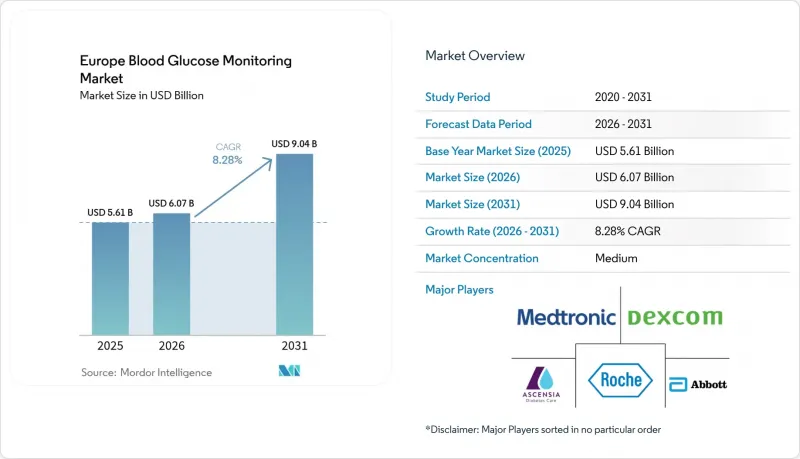
This report is Segmented by Device Type (Self-Monitoring Blood Glucose Devices, and More), Diabetes Type (Type-1, Type-2), Age Group (Pediatrics, Adults, Geriatrics), Test Type (Invasive, Non-Invasive), End User (Hospitals, Homecare, and More), and Country (Germany, France, United Kingdom, Italy, and More). Market Forecasts are Provided in Terms of Value (USD).
Europe Blood Glucose Monitoring Market Trends and Insights
Rising Diabetes Prevalence & Ageing Population
Europe counted 61 million adults living with diabetes in 2025, and the International Diabetes Federation projects this figure will reach 68 million by 2030. Germany documented 8.5 million diagnosed cases in 2025, a 9% rise from 2020, while Poland's prevalence hit 7.2% amid rural diagnostic gaps . People aged 65-plus, whose diabetes incidence is 3.2-times higher than the working-age group, are expanding fastest in Italy, Spain, and Portugal, prompting suppliers to design CGMs with larger displays and voice prompts to suit dexterity or cognitive limitations. These demographics underpin sustained unit demand for both sensors and test strips. Consequently, the Europe blood glucose monitoring market continues to see stable baseline volumes even as per-patient strip consumption falls.
CGM-SMBG Accuracy Convergence & Hybrid Data Platforms
Peer-reviewed trials in The Lancet Diabetes & Endocrinology showed leading CGM systems achieving mean absolute relative difference (MARD) values below 9%, effectively matching laboratory standards and removing the calibration rationale for SMBG. Abbott FreeStyle Libre 3 and Dexcom G7 both secured ISO 15197:2013 certification without finger-stick validation, triggering Germany's G-BA to reimburse CGM for basal-insulin Type-2 users from July 2025 . Hybrid data platforms now merge CGM feeds with insulin-pump algorithms and electronic health records, elevating closed-loop accuracy and squeezing the EUR 0.45 per-test price edge that SMBG once held. As decision makers weigh the total cost of care, strip-based economics alone can no longer shield SMBG from share erosion.
High Cost of CGM Devices & Consumables
Out-of-pocket spending remains a hurdle where reimbursement is partial or absent. Italian users paid EUR 120-160 per month for Libre sensors in 2025, 12% of the median disposable income in the south . Spain's autonomous regions showed 70% coverage in Catalonia but only 18% in Extremadura, fuelling legal challenges from patient groups. Poland funds CGM solely for children, leaving 280,000 adult insulin users on SMBG strips that cost EUR 35 monthly, reinforcing health inequities.
Other drivers and restraints analyzed in the detailed report include:
- Expanded Public Reimbursement for CGM Across EU-5
- Digital-Health Integration Enabling Virtual Diabetes Clinics
- Semiconductor-Grade MEMS Supply-Chain Constraints
For complete list of drivers and restraints, kindly check the Table Of Contents.
Segment Analysis
SMBG still accounted for 60.1% of Europe's blood glucose monitoring market share in 2025, buoyed by entrenched reimbursement for Type-2 patients on oral agents and the 12 million-unit installed base of finger-stick users. Roche Accu-Chek Guide and LifeScan OneTouch Verio Reflect anchor pharmacy contracts, though their test-strip volumes slipped 4-6% in 2025 as CGM accelerated among insulin users. The European blood glucose monitoring market size linked to CGM is forecast to expand at 10.23% CAGR, propelled by accuracy parity, ISO certification without calibration, and interoperability with closed-loop pumps.
Emerging non-invasive wearables-Biolinq's microneedle patch and Nemaura's sugarBEAT-entered limited pilots in 2025, courting the 8 million pre-diabetics who refuse finger pricks. Medtronic's Guardian 4 sensor reached 18% of new CGM starts in Germany within six months of its March 2025 launch, underscoring the momentum behind fully integrated systems. To blunt share loss, SMBG vendors now bundle Bluetooth meters with analytics portals, seeking to shift dialogue from "device" to "data" even as per-test economics erode.
Type-2 cases delivered 73.21% of revenue in 2025, confirming their numeric dominance, yet Type-1 drives disproportionate growth and technology mix. The Europe blood glucose monitoring market size earned from Type-1 users is projected to climb 13.5% CAGR, as pediatric guidelines prescribe CGM as standard of care and closed-loop systems proliferate. Germany leads with 78% CGM penetration among Type-1 patients.
Type-1 patients also spend 4.2-times more per capita on sensors and pump supplies than Type-2 SMBG users, concentrating manufacturer margins. Expanded reimbursement for Type-2 CGM now hinges on clinical demonstration of hypoglycemia reduction rather than glycemic averages alone, a hurdle that vendors are actively studying. Broader inclusion of pre-diabetes monitoring could unlock 18 million additional users, but supportive cost-effectiveness dossiers remain a prerequisite.
Complete Report Scope:
- By Device Type
- Self-Monitoring Blood Glucose (SMBG)
- Continuous Glucose Monitoring (CGM)
- Emerging Non-Invasive Wearables
- By Diabetes Type
- Type-1 Diabetes
- Type-2 Diabetes
- By Age Group
- Pediatrics
- Adults
- Geriatrics
- By Test Type
- Invasive
- Non-Invasive
- By End User
- Hospitals
- Homecare
- Others
- By Country
- Germany
- France
- United Kingdom
- Italy
- Spain
- Rest of Europe
List of Companies Covered in this Report:
- Abbott Laboratories
- Acon Laboratories
- AgaMatrix
- Arkray
- Ascensia
- Biolinq
- Bionime
- Dexcom
- Roche
- Glysens Inc.
- Insulet
- i-Sens Inc.
- Lifescan
- Medisana GmbH
- Medtronic
- Nemaura Medical
- Nipro
- Nova Biomedical
- Rossmax
- Senseonics Inc.
- Terumo
- Trividia Health
- Ypsomed
Additional Benefits:
- The market estimate (ME) sheet in Excel format
- 3 months of analyst support
TABLE OF CONTENTS
1 Introduction
- 1.1 Study Assumptions & Market Definition
- 1.2 Scope of the Study
2 Research Methodology
3 Executive Summary
4 Market Landscape
- 4.1 Market Overview
- 4.2 Market Drivers
- 4.2.1 Rising Diabetes Prevalence & Ageing Population
- 4.2.2 CGM-SMBG Accuracy Convergence & Hybrid Data Platforms
- 4.2.3 Expanded Public Reimbursement For CGM Across EU-5
- 4.2.4 Digital-Health Integration Enabling Virtual Diabetes Clinics
- 4.2.5 Value-Based Procurement & Outcomes-Linked Tenders
- 4.2.6 ESG-Driven Demand For Eco-Designed Reusable Sensors
- 4.3 Market Restraints
- 4.3.1 High cost of CGM devices & consumables
- 4.3.2 Semiconductor-grade MEMS supply-chain constraints
- 4.3.3 GLP-1-driven insulin volume decline dampening sensor demand
- 4.3.4 EU MDR / IVDR bottlenecks & limited Notified-Body capacity
- 4.4 Supply-Chain Analysis
- 4.5 Regulatory Landscape
- 4.6 Technological Outlook
- 4.7 Porter's Five Forces
- 4.7.1 Bargaining Power of Suppliers
- 4.7.2 Bargaining Power of Consumers
- 4.7.3 Threat of New Entrants
- 4.7.4 Threat of Substitutes
- 4.7.5 Intensity of Competitive Rivalry
5 Market Size & Growth Forecasts (Value, USD)
- 5.1 By Device Type
- 5.1.1 Self-Monitoring Blood Glucose (SMBG)
- 5.1.2 Continuous Glucose Monitoring (CGM)
- 5.1.3 Emerging Non-Invasive Wearables
- 5.2 By Diabetes Type
- 5.2.1 Type-1 Diabetes
- 5.2.2 Type-2 Diabetes
- 5.3 By Age Group
- 5.3.1 Pediatrics
- 5.3.2 Adults
- 5.3.3 Geriatrics
- 5.4 By Test Type
- 5.4.1 Invasive
- 5.4.2 Non-Invasive
- 5.5 By End User
- 5.5.1 Hospitals
- 5.5.2 Homecare
- 5.5.3 Others
- 5.6 By Country
- 5.6.1 Germany
- 5.6.2 France
- 5.6.3 United Kingdom
- 5.6.4 Italy
- 5.6.5 Spain
- 5.6.6 Rest of Europe
6 Competitive Landscape
- 6.1 Market Concentration
- 6.2 Market Share Analysis
- 6.3 Company Profiles (includes Global level Overview, Market level overview, Core Segments, Financials as available, Strategic Information, Market Rank/Share for key companies, Products & Services, and Recent Developments)
- 6.3.1 Abbott Laboratories
- 6.3.2 ACON Laboratories
- 6.3.3 AgaMatrix
- 6.3.4 Arkray Inc.
- 6.3.5 Ascensia Diabetes Care
- 6.3.6 Biolinq
- 6.3.7 Bionime Corporation
- 6.3.8 Dexcom Inc.
- 6.3.9 F. Hoffmann-La Roche Ltd
- 6.3.10 Glysens Inc.
- 6.3.11 Insulet Corporation
- 6.3.12 i-Sens Inc.
- 6.3.13 LifeScan Inc.
- 6.3.14 Medisana GmbH
- 6.3.15 Medtronic plc
- 6.3.16 Nemaura Medical
- 6.3.17 Nipro Corporation
- 6.3.18 Nova Biomedical
- 6.3.19 Rossmax International
- 6.3.20 Senseonics Inc.
- 6.3.21 Terumo Corporation
- 6.3.22 Trividia Health
- 6.3.23 Ypsomed AG
7 Market Opportunities & Future Outlook
- 7.1 White-space & Unmet-Need Assessment

