PUBLISHER: Mordor Intelligence | PRODUCT CODE: 2121481

PUBLISHER: Mordor Intelligence | PRODUCT CODE: 2121481
Methylene Diphenyl Di-isocyanate (MDI) - Market Share Analysis, Industry Trends & Statistics, Growth Forecasts (2026 - 2031)
According to Mordor Intelligence, the methylene diphenyl di-isocyanate market size is expected to grow from 8.62 million tons in 2025 to 9.06 million tons in 2026 and is forecast to reach 11.64 million tons by 2031 at a 5.13% CAGR over 2026-2031.
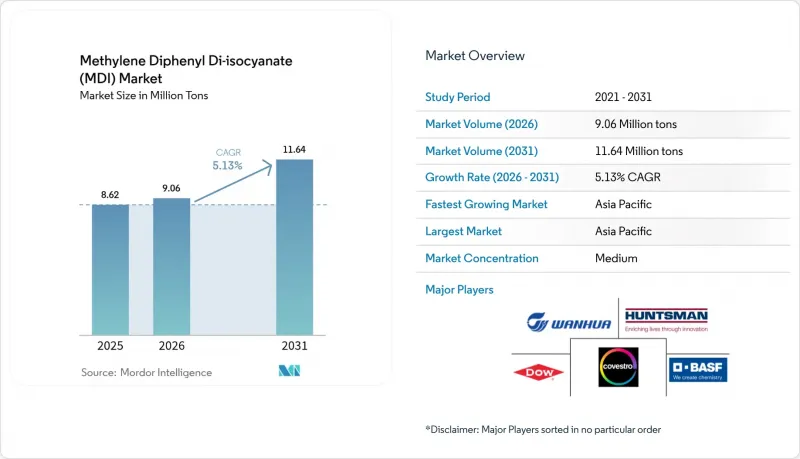
This report is Segmented by Application (Rigid Foams, Flexible Foams, Coatings, Elastomers, Adhesives and Sealants, and Others), End-User Industry (Construction, Furniture and Interiors, Electronics and Appliances, Automotive, Footwear, and Others), and Geography (Asia-Pacific, North America, Europe, and More). Market Forecasts are Provided in Terms of Volume (Tons).
Global Methylene Diphenyl Di-isocyanate (MDI) Market Trends and Insights
Surge in Polyurethane-Insulation Demand From Net-Zero Buildings
Across Europe, the U.S., and parts of Asia, energy codes mandate wall R-values between 20 and 30. This benchmark is achieved using polyiso boards, as opposed to opting for thicker mineral wool. The EU Energy Performance of Buildings Directive is set to drive upgrades in millions of homes. This initiative is projected to boost the consumption of rigid foam in the coming years. Starting January 2026, California's Title 24 update will elevate roof R-values statewide, solidifying the demand for Class A fire-rated polyiso boards. Passive House certifications in Germany and Austria saw a significant increase, underscoring a homeowner trend towards continuous insulation, which curtails heating loads annually.
Cold-Chain Capacity Build-Out for Food and Pharma
Biologic drugs and mRNA vaccines mandate storage temperatures between 2 °C and 8 °C, frequently dipping below -70 °C during transit. Cencora pledged an investment to quintuple its refrigerated space in Alabama, employing spray-applied MDI foam to ensure temperature stability. Global refrigerated-warehouse volume is projected to increase, with rigid MDI boards continuing as the preferred insulation choice.
Stricter Worker-Exposure Limits for Di-Isocyanates
aREACH Annex XVII has introduced a mandate: users processing more than 0.1% di-isocyanate by weight must undergo certified training every five years. This requirement has led to an increase in site compliance costs and has also necessitated upgrades to ventilation systems. In 2024, the United Kingdom set similar airborne limits, and Japan is in the process of finalizing comparable regulations, targeting a 2027 implementation. While larger converters are able to absorb these added costs, smaller operations are feeling the pinch on their margins, leading to a trend of consolidation in the industry.
Other drivers and restraints analyzed in the detailed report include:
- HVAC Efficiency Regulations Boosting Appliance Foams
- Rise of Battery-Thermal-Management Foams in EV Packs
- Crude-Oil Volatility Hitting Aniline Feedstock
For complete list of drivers and restraints, kindly check the Table Of Contents.
Segment Analysis
Rigid foams captured 36.81% of the methylene diphenyl di-isocyanate market share in 2025 and will rise at a 5.69% CAGR through 2031. Continuous-panel insulation achieves R-20 wall targets with a thinner profile compared to extruded polystyrene, steering architects towards polyiso boards. Spray-foam retrofits gained significant traction due to increased funding support. Additionally, as appliance foams transition to hydrocarbon blowing agents, there's an increased preference for polymeric MDI's closed-cell density.
Among the rigid-foam options, spray-foam insulation emerged as the fastest-growing choice, with contractors prioritizing its air-sealing and vapor-barrier benefits. Rigid MDI boards are also the go-to for commercial baking ovens, refrigerated trailers, and walk-in coolers aiming to maintain sub-zero temperatures. While elastomers and coatings cater to niche markets, they remain steady, being utilized in high-abrasion rollers and chemically resistant floor finishes. Furthermore, adhesives derived from MDI prepolymers are bonding turbine blades and automotive composites, capitalizing on their high shear strength during thermal cycling.
Complete Report Scope:
- By Application
- Rigid Foams
- Flexible Foams
- Coatings
- Elastomers
- Adhesives and Sealants
- Others
- By End-user Industry
- Construction
- Furniture and Interiors
- Electronics and Appliances
- Automotive
- Footwear
- Others
- By Geography
- Asia-Pacific
- China
- India
- Japan
- South Korea
- Rest of Asia-Pacific
- North America
- United States
- Canada
- Mexico
- Europe
- Germany
- United Kingdom
- France
- Italy
- Russia
- Rest of Europe
- South America
- Brazil
- Argentina
- Rest of South America
- Middle-East and Africa
- Saudi Arabia
- South Africa
- Rest of Middle-East and Africa
- Asia-Pacific
Geography Analysis
Asia-Pacific held 46.77% of the global methylene diphenyl di-isocyanate market volume in 2025 and is set for a 5.97% CAGR through 2031. China's ambitious addition of urban housing annually, paired with Wanhua's expansive complex, solidifies the region's supply foundation. In India, a push for insulation codes and enhanced cold-storage facilities is driving volume expansion. Meanwhile, Vietnam and Indonesia are becoming hubs for relocated furniture and footwear industries. Japan and South Korea are prioritizing appliance insulation upgrades, driven by initiatives like Top Runner and energy labeling.
North America, holding a significant share in demand, sees rising consumption buoyed by weatherization retrofits and a transition to cyclopentane-blown refrigerator foams, even with a mature housing stock. In Canada, revised codes are spurring a surge in spray-foam adoption, especially in provinces experiencing more than 5,000 heating degree-days.
Europe, accounting for a notable portion of the global volume, grapples with high energy costs impacting local producers. However, stringent building directives pave a clear retrofit pathway extending through 2033. The remaining market is split between South America and the Middle-East and Africa. Brazil is poised for a rebound with easing interest rates, while Saudi Arabia's Sadara is strategically exporting competitively priced cargoes from Jubail to Europe and Asia.
- BASF
- Covestro AG
- Dow
- Hexion Inc.
- Huntsman International LLC
- Karoon Petrochemical Company
- Kumho Mitsui Chemicals Inc
- KURMY CORPORATIONS
- Sadara
- Shanghai Lianheng Isocyanate Co. Ltd
- Sumitomo Chemical Co. Ltd
- Tosoh Corporation
- Vardhman Chemicals
- Wanhua
Additional Benefits:
- The market estimate (ME) sheet in Excel format
- 3 months of analyst support
TABLE OF CONTENTS
1 Introduction
- 1.1 Study Assumptions and Market Definition
- 1.2 Scope of the Study
2 Research Methodology
3 Executive Summary
4 Market Landscape
- 4.1 Market Overview
- 4.2 Market Drivers
- 4.2.1 Surge in Polyurethane-insulation demand from net-zero buildings
- 4.2.2 Cold-chain capacity build-out for food and pharma
- 4.2.3 HVAC efficiency regulations boosting appliance foams
- 4.2.4 Rise of battery-thermal-management foams in EV packs
- 4.2.5 Mass-balanced / ISCC-Plus certified MDI gaining traction
- 4.3 Market Restraints
- 4.3.1 Stricter worker-exposure limits for di-isocyanates
- 4.3.2 Crude-oil volatility hitting aniline feedstock
- 4.3.3 Emerging non-isocyanate PU chemistries
- 4.4 Value Chain Analysis
- 4.5 Regulatory Policy Analysis
- 4.6 Porter's Five Forces
- 4.6.1 Bargaining Power of Suppliers
- 4.6.2 Bargaining Power of Consumers
- 4.6.3 Threat of New Entrants
- 4.6.4 Threat of Substitute Products and Services
- 4.6.5 Degree of Competition
- 4.7 Production Process Analysis
- 4.8 Technology Licensing and Patent Analysis
- 4.9 Price Trend Scenario
5 Market Size and Growth Forecasts (Volume)
- 5.1 By Application
- 5.1.1 Rigid Foams
- 5.1.2 Flexible Foams
- 5.1.3 Coatings
- 5.1.4 Elastomers
- 5.1.5 Adhesives and Sealants
- 5.1.6 Others
- 5.2 By End-user Industry
- 5.2.1 Construction
- 5.2.2 Furniture and Interiors
- 5.2.3 Electronics and Appliances
- 5.2.4 Automotive
- 5.2.5 Footwear
- 5.2.6 Others
- 5.3 By Geography
- 5.3.1 Asia-Pacific
- 5.3.1.1 China
- 5.3.1.2 India
- 5.3.1.3 Japan
- 5.3.1.4 South Korea
- 5.3.1.5 Rest of Asia-Pacific
- 5.3.2 North America
- 5.3.2.1 United States
- 5.3.2.2 Canada
- 5.3.2.3 Mexico
- 5.3.3 Europe
- 5.3.3.1 Germany
- 5.3.3.2 United Kingdom
- 5.3.3.3 France
- 5.3.3.4 Italy
- 5.3.3.5 Russia
- 5.3.3.6 Rest of Europe
- 5.3.4 South America
- 5.3.4.1 Brazil
- 5.3.4.2 Argentina
- 5.3.4.3 Rest of South America
- 5.3.5 Middle-East and Africa
- 5.3.5.1 Saudi Arabia
- 5.3.5.2 South Africa
- 5.3.5.3 Rest of Middle-East and Africa
- 5.3.1 Asia-Pacific
6 Competitive Landscape
- 6.1 Market Concentration
- 6.2 Strategic Moves
- 6.3 Market Share(%)/Ranking Analysis
- 6.4 Company Profiles (includes Global Overview, Market Overview, Core Segments, Financials, Strategic Information, Products and Services, Recent Developments)
- 6.4.1 BASF
- 6.4.2 Covestro AG
- 6.4.3 Dow
- 6.4.4 Hexion Inc.
- 6.4.5 Huntsman International LLC
- 6.4.6 Karoon Petrochemical Company
- 6.4.7 Kumho Mitsui Chemicals Inc
- 6.4.8 KURMY CORPORATIONS
- 6.4.9 Sadara
- 6.4.10 Shanghai Lianheng Isocyanate Co. Ltd
- 6.4.11 Sumitomo Chemical Co. Ltd
- 6.4.12 Tosoh Corporation
- 6.4.13 Vardhman Chemicals
- 6.4.14 Wanhua
7 Market Opportunities and Future Outlook
- 7.1 White-space and Unmet-need Assessment

