PUBLISHER: Mordor Intelligence | PRODUCT CODE: 2121639

PUBLISHER: Mordor Intelligence | PRODUCT CODE: 2121639
North America Paints And Coatings - Market Share Analysis, Industry Trends & Statistics, Growth Forecasts (2026 - 2031)
According to Mordor Intelligence, the North America paints and Coatings Market size in 2026 is estimated at USD 42.9 billion, growing from 2025 value of USD 41.82 billion with 2031 projections showing USD 48.78 billion, growing at 2.59% CAGR over 2026-2031.
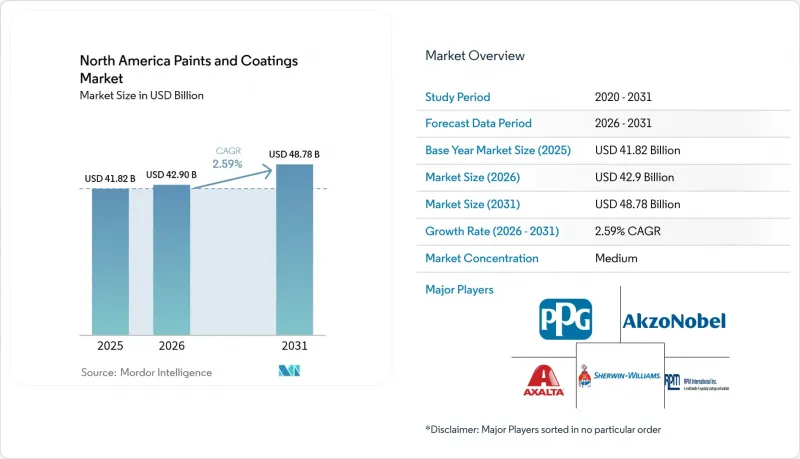
This report is Segmented by Resin Type (Acrylics, Alkyd, Epoxy, Polyurethane, and Other Resin Types), Technology (Water-Borne, Solvent-Borne, and UV-Cured Coating), End-User Industry (Architectural, Automotive, Protective Coating, General Industrial, Transportation, and Packaging), and Geography (United States, Canada, and Mexico). The Market Forecasts are Provided in Terms of Value (USD).
North America Paints And Coatings Market Trends and Insights
Surge in Commercial and Institutional Construction
Commercial outlays reached USD 180 billion in 2024, translating directly into greater demand for premium architectural coatings that meet strict indoor-air requirements. Healthcare builds alone represented USD 12 billion in coating-intensive projects as antimicrobial finishes became baseline specifications. Renovation cycles across logistics hubs, data centers, and educational facilities sustain high-margin orders for fire-retardant and static-dissipative paints. Low-emission mandates such as the South Coast Air Quality Management District cap of 50 g/L VOC further shift preference toward advanced water-borne lines. The driver, therefore, locks in steady architectural pull for the North American paints and coatings market.
Rapid Shift to Low-VOC Water-borne Technologies
Eighteen U.S. states now enforce VOC limits below federal thresholds, accelerating water-borne adoption across all usage classes. Architectural variants fetch 15-20% price premiums, cushioning margin pressure even as solvent inputs spike. Hybrid chemistries marry water clean-up with solvent-level endurance in protective segments, helping suppliers capture long-cycle industrial contracts. The regulatory tide effectively institutionalizes higher specification, lifting average selling prices within the North American paints and coatings market.
Volatile Petrochemical Raw-material Prices
Titanium dioxide swings of 25% per quarter and acrylic-monomer spikes of 30% keep procurement budgets unstable, eroding contractual margins for smaller players. Supply chain disruptions from Gulf Coast weather events and refinery maintenance cycles amplify price volatility, with Hurricane Beryl's 2024 impact on Texas petrochemical facilities demonstrating the sector's vulnerability to operational disruptions. Manufacturers with hedging programs and integrated resin capacity can shield profitability, hastening consolidation within the North American paints and coatings market.
Other drivers and restraints analyzed in the detailed report include:
- OEM Demand for High-performance Powder Coatings
- AI-driven Color-matching Platforms Accelerating Repaint Cycles
- Stringent and Diverging VOC Regulations Across North America
For complete list of drivers and restraints, kindly check the Table Of Contents.
Segment Analysis
Acrylic systems occupied 37.12% of the North American paints and coatings market share in 2025, benefiting from balanced cost, weatherability, and color retention across architectural and automotive finishes. The sub-segment also captures early wins from bio-based feedstock innovation, meeting sustainability mandates without sacrificing performance. While smaller in absolute terms, polyurethane grades log the fastest 2.95% CAGR through 2031 on demand for high-abrasion durability in OEM assemblies. Epoxies stay indispensable in marine and infrastructure applications where chemical resistance outweighs initial cost concerns. Alkyd displacement accelerates as VOC norms tighten, yet modified alkyd-water hybrids prolong relevance in niche trim and primer roles. Blended chemistries that marry acrylic elasticity with polyurethane hardness present fertile ground for differentiated offerings inside the North American paints and coatings market.
In industrial maintenance and asset-protection projects, silicone and fluoropolymer niches command premium pricing due to extreme heat or chemical exposures, although their aggregate revenue share remains modest. Polyester resins gain ground in powder lines, reinforcing the zero-VOC narrative while delivering 25-year facade warranties for aluminum extrusions. Resin choice therefore centers less on commodity cost and more on life-cycle value as facility owners calculate total operating expense. Suppliers with cross-technology R&D capacity enjoy a service moat that newcomers struggle to replicate, reinforcing competitive stratification throughout the North American paints and coatings industry.
Complete Report Scope:
- By Resin Type
- Acrylics
- Alkyd
- Epoxy
- Polyester
- Polyurethane
- Other Resin Types
- By Technology
- Water-borne
- Solvent-borne
- Powder Coating
- UV-cured Coating
- By End-user Industry
- Architectural
- Automotive
- Wood
- Protective Coating
- General Industrial
- Transportation
- Packaging
- By Country
- United States
- Canada
- Mexico
List of Companies Covered in this Report:
- 3M
- Akzo Nobel N.V.
- Axalta Coating Systems
- BASF
- Beckers Group
- Behr Process LLC
- Benjamin Moore & Co.
- Cloverdale Paint Inc.
- Dunn-Edwards Corporation
- Hempel A/S
- Jotun
- Kansai Paint Co., Ltd
- Nippon Paint Holdings Co., Ltd.
- PPG Industries, Inc.
- RPM International Inc.
- The Sherwin-Williams Company
Additional Benefits:
- The market estimate (ME) sheet in Excel format
- 3 months of analyst support
TABLE OF CONTENTS
1 Introduction
- 1.1 Study Assumptions and Market Definition
- 1.2 Scope of the Study
2 Research Methodology
3 Executive Summary
4 Market Landscape
- 4.1 Market Overview
- 4.2 Market Drivers
- 4.2.1 Surge in Commercial and Institutional Construction
- 4.2.2 Rapid Shift to Low-VOC Water-borne Technologies
- 4.2.3 OEM Demand for High-performance Powder Coatings
- 4.2.4 AI-driven Color-matching Platforms Accelerating Repaint Cycles
- 4.2.5 Reshoring of US Manufacturing Boosting Anti-corrosion Demand
- 4.3 Market Restraints
- 4.3.1 Volatile Petrochemical Raw-material Prices
- 4.3.2 Stringent and Diverging VOC Regulations Across US/Canada/Mexico
- 4.3.3 Skilled-applicator Labor Shortage in Industrial Coatings
- 4.4 Value Chain Analysis
- 4.5 Porter's Five Forces
- 4.5.1 Bargaining Power of Suppliers
- 4.5.2 Bargaining Power of Buyers
- 4.5.3 Threat of New Entrants
- 4.5.4 Threat of Substitutes
- 4.5.5 Rivalry Among Existing Firms
5 Market Size and Growth Forecasts (Value)
- 5.1 By Resin Type
- 5.1.1 Acrylics
- 5.1.2 Alkyd
- 5.1.3 Epoxy
- 5.1.4 Polyester
- 5.1.5 Polyurethane
- 5.1.6 Other Resin Types
- 5.2 By Technology
- 5.2.1 Water-borne
- 5.2.2 Solvent-borne
- 5.2.3 Powder Coating
- 5.2.4 UV-cured Coating
- 5.3 By End-user Industry
- 5.3.1 Architectural
- 5.3.2 Automotive
- 5.3.3 Wood
- 5.3.4 Protective Coating
- 5.3.5 General Industrial
- 5.3.6 Transportation
- 5.3.7 Packaging
- 5.4 By Country
- 5.4.1 United States
- 5.4.2 Canada
- 5.4.3 Mexico
6 Competitive Landscape
- 6.1 Market Concentration
- 6.2 Strategic Moves
- 6.3 Market Share (%)/Ranking Analysis
- 6.4 Company Profiles (includes Global level Overview, Market level overview, Core Segments, Financials as available, Strategic Information, Market Rank/Share for key companies, Products and Services, and Recent Developments)}
- 6.4.1 3M
- 6.4.2 Akzo Nobel N.V.
- 6.4.3 Axalta Coating Systems
- 6.4.4 BASF
- 6.4.5 Beckers Group
- 6.4.6 Behr Process LLC
- 6.4.7 Benjamin Moore & Co.
- 6.4.8 Cloverdale Paint Inc.
- 6.4.9 Dunn-Edwards Corporation
- 6.4.10 Hempel A/S
- 6.4.11 Jotun
- 6.4.12 Kansai Paint Co., Ltd
- 6.4.13 Nippon Paint Holdings Co., Ltd.
- 6.4.14 PPG Industries, Inc.
- 6.4.15 RPM International Inc.
- 6.4.16 The Sherwin-Williams Company
7 Market Opportunities and Future Outlook
- 7.1 White-space and Unmet-Need Assessment

