PUBLISHER: Mordor Intelligence | PRODUCT CODE: 2114379

PUBLISHER: Mordor Intelligence | PRODUCT CODE: 2114379
Middle-East Paints And Coatings - Market Share Analysis, Industry Trends & Statistics, Growth Forecasts (2026 - 2031)
According to Mordor Intelligence, the Middle East paints and Coatings Market size in 2026 is estimated at USD 5.98 billion, growing from 2025 value of USD 5.76 billion with 2031 projections showing USD 7.22 billion, growing at 3.85% CAGR over 2026-2031.
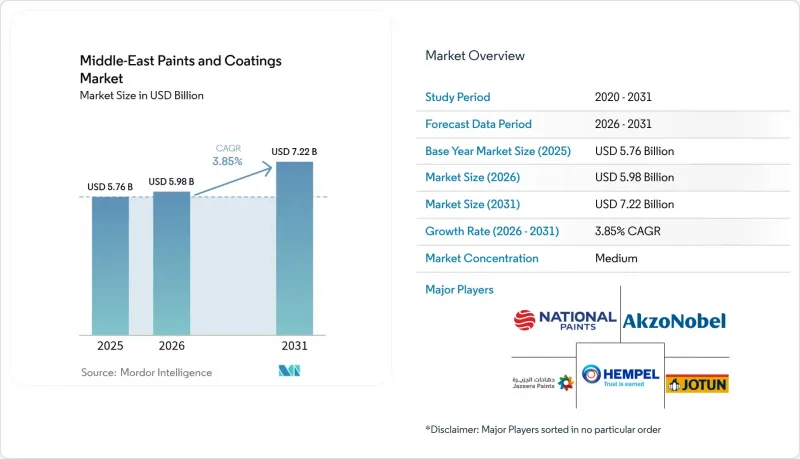
This report Segments the Industry Into Resin Type (Acrylic, Alkyd, Polyurethane, Epoxy, Polyester, Other Resin Types), Technology (Water-Borne, Solvent-Borne, Powder Coating, and UV-Cured Coating), End-User Industry (Architectural, Automotive, Industrial Wood, General Industrial, Transportation, and Other End-User Industries), and Geography (Saudi Arabia, Qatar, Kuwait, Oman, Iran, and More).
Middle-East Paints And Coatings Market Trends and Insights
Focus on tourism-led giga-projects (Saudi NEOM, Expo City Dubai)
Saudi Arabia's USD 500 billion NEOM development and Dubai's USD 2.7 billion Expo City extension project shift spending from cyclical construction toward permanent infrastructure that demands premium, climate-adapted coatings. NEOM's 200,000-strong workforce creates secondary residential and commercial builds that multiply coating volumes, while the focus on architectural icons shifts preferences toward polyurethane and self-cleaning products. These projects, therefore, convert temporary exhibition or hospitality structures into long-term asset classes that require higher-value maintenance cycles.
Booming commercial and residential construction pipeline
A USD 3.9 trillion MENA project pipeline ensures a predictable pull for the Middle East paints and coatings market across the decade. The UAE's USD 590 billion commitments and Saudi Arabia's USD 1.5 trillion backlog include high-value mixed-use towers, downstream energy plants, and logistics hubs that require both corrosion-resistant and decorative systems. Energy-linked contracts, such as ADNOC's AED 720 million local procurement award, increase protective-coating volume in harsh, salt-laden environments.
Raw-material price volatility pressures margins
Titanium dioxide hovering near USD 1,974 per metric ton and Red Sea shipping delays force producers to boost safety stocks, stretch working capital, and hedge feedstocks. While GCC petrochemical expansion is expected to ease long-term resin supply, short-term price swings still closely mirror global energy markets. Smaller regional firms, lacking integration or procurement scale, feel the squeeze hardest, hastening them as takeover targets for well-capitalized rivals.
Other drivers and restraints analyzed in the detailed report include:
- Regulatory transformation toward low-VOC systems
- Localization incentives for regional paint production
- Compliance costs challenge solvent-based incumbents
For complete list of drivers and restraints, kindly check the Table Of Contents.
Segment Analysis
Acrylics controlled 34.00% of the market in 2025, thanks to their affordability; however, polyurethanes posted the fastest 4.18% CAGR through 2031, as specifiers seek UV resistance and a long lifecycle in desert sun. Epoxy and alkyd grades hold niche roles in oil-and-gas and heritage restoration work. Investment in hybrid chemistries, led by research from the Technology Innovation Institute on soft-material composites, hints at next-generation blends that merge the cost efficiency of acrylic with the robustness of polyurethane. Manufacturing footprints expand accordingly, with National Paints' lifting capacity to 264 million liters to serve premium growth pockets.
Deadline-driven giga-projects reward suppliers able to scale polyurethanes without sacrificing color consistency or cure time. As plant numbers increase, regional buyers negotiate shorter lead times and in-country technical service support, embedding local labs within Saudi and Emirati industrial zones. This dynamic raises the floor for quality across the Middle East paints and coatings market and deepens barriers to low-spec imports.
Complete Report Scope:
- By Resin Type
- Acrylic
- Alkyd
- Polyurethane
- Epoxy
- Polyester
- Others (Silicone, Vinly, Fluoropolymer)
- By Technology
- Water-borne
- Solvent-borne
- Powder Coating
- UV-cured Coating
- By End-user Industry
- Architectural
- Automotive
- Industrial Wood
- Protective
- Transportation
- General Industrial
- Packaging
- By Geography
- Saudi Arabia
- United Arab Emirates
- Qatar
- Kuwait
- Oman
- Bahrain
- Iran
- Iraq
- Rest of Middle East
List of Companies Covered in this Report:
- Akzo Nobel N.V.
- Asian Paints Berger
- Axalta Coating Systems
- Beckers Group
- Caparol Paints
- Hempel A/S
- Henkel AG & Co. KGaA
- Jazeera Paints
- Jotun
- Kaizen Paint Middle East FZCO
- National Paints Factories Co. Ltd
- Nippon Paint Factories Co. Ltd
- PPG Industries Inc.
- Ritver Paints & Coatings
- RPM International Inc.
- Sigma Paints
- Tambour
- Terraco UAE Ltd
- The Sherwin-Williams Company
- Thermalite Middle East
Additional Benefits:
- The market estimate (ME) sheet in Excel format
- 3 months of analyst support
TABLE OF CONTENTS
1 Introduction
- 1.1 Study Assumptions & Market Definition
- 1.2 Scope of the Study
2 Research Methodology
3 Executive Summary
4 Market Landscape
- 4.1 Market Overview
- 4.2 Market Drivers
- 4.2.1 Focus on tourism-led giga-projects (Saudi NEOM, Expo City Dubai)
- 4.2.2 Booming commercial and residential construction pipeline
- 4.2.3 Regulatory shift to low-VOC water-borne systems
- 4.2.4 Localization incentives for regional paint production
- 4.2.5 Rapid uptake of self-cleaning facade coatings for high-rise maintenance
- 4.3 Market Restraints
- 4.3.1 Volatility in petro-derived raw-material prices
- 4.3.2 Stricter VOC and indoor-air-quality compliance costs
- 4.3.3 Shortage of certified spray-application labour
- 4.4 Value Chain Analysis
- 4.5 Porter's Five Forces
- 4.5.1 Bargaining Power of Suppliers
- 4.5.2 Bargaining Power of Buyers
- 4.5.3 Threat of New Entrants
- 4.5.4 Threat of Substitutes
- 4.5.5 Degree of Competition
5 Market Size & Growth Forecasts (Value)
- 5.1 By Resin Type
- 5.1.1 Acrylic
- 5.1.2 Alkyd
- 5.1.3 Polyurethane
- 5.1.4 Epoxy
- 5.1.5 Polyester
- 5.1.6 Others (Silicone, Vinly, Fluoropolymer)
- 5.2 By Technology
- 5.2.1 Water-borne
- 5.2.2 Solvent-borne
- 5.2.3 Powder Coating
- 5.2.4 UV-cured Coating
- 5.3 By End-user Industry
- 5.3.1 Architectural
- 5.3.2 Automotive
- 5.3.3 Industrial Wood
- 5.3.4 Protective
- 5.3.5 Transportation
- 5.3.6 General Industrial
- 5.3.7 Packaging
- 5.4 By Geography
- 5.4.1 Saudi Arabia
- 5.4.2 United Arab Emirates
- 5.4.3 Qatar
- 5.4.4 Kuwait
- 5.4.5 Oman
- 5.4.6 Bahrain
- 5.4.7 Iran
- 5.4.8 Iraq
- 5.4.9 Rest of Middle East
6 Competitive Landscape
- 6.1 Market Concentration
- 6.2 Strategic Moves
- 6.3 Market Share/Ranking Analysis
- 6.4 Company Profiles (includes Global overview, Market overview, Core Segments, Financials, Strategy, Market Rank/Share, Products & Services, Recent Developments)
- 6.4.1 Akzo Nobel N.V.
- 6.4.2 Asian Paints Berger
- 6.4.3 Axalta Coating Systems
- 6.4.4 Beckers Group
- 6.4.5 Caparol Paints
- 6.4.6 Hempel A/S
- 6.4.7 Henkel AG & Co. KGaA
- 6.4.8 Jazeera Paints
- 6.4.9 Jotun
- 6.4.10 Kaizen Paint Middle East FZCO
- 6.4.11 National Paints Factories Co. Ltd
- 6.4.12 Nippon Paint Factories Co. Ltd
- 6.4.13 PPG Industries Inc.
- 6.4.14 Ritver Paints & Coatings
- 6.4.15 RPM International Inc.
- 6.4.16 Sigma Paints
- 6.4.17 Tambour
- 6.4.18 Terraco UAE Ltd
- 6.4.19 The Sherwin-Williams Company
- 6.4.20 Thermalite Middle East
7 Market Opportunities & Future Outlook
- 7.1 White-space and Unmet-Need Assessment

