PUBLISHER: Mordor Intelligence | PRODUCT CODE: 2122609

PUBLISHER: Mordor Intelligence | PRODUCT CODE: 2122609
United States Paints And Coatings - Market Share Analysis, Industry Trends & Statistics, Growth Forecasts (2026 - 2031)
According to Mordor Intelligence, the United States paints and Coatings Market size is projected to expand from USD 36.49 billion in 2025 and USD 38.05 billion in 2026 to USD 46.92 billion by 2031, registering a CAGR of 4.28% between 2026 to 2031.
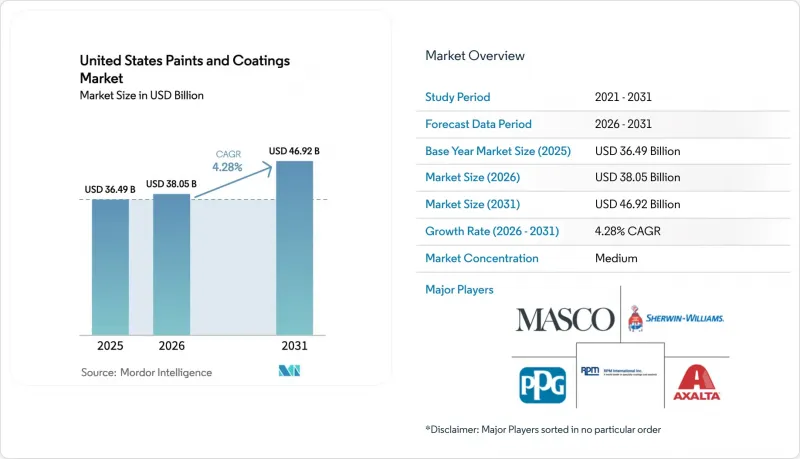
This report is Segmented by Resin Type (Acrylic, Alkyd, Polyurethane, Epoxy, Polyester, and Other Resin Types), Technology (Water-Borne, Solvent-Borne, Powder Coating, and UV Technology), Distribution Channel (Company-Owned Stores, and More), and End-User Industry (Architectural, Automotive, Wood, Protective Coatings, and More). The Market Forecasts are Provided in Terms of Value (USD).
United States Paints And Coatings Market Trends and Insights
Federal Infrastructure Spending Propels Protective Coatings
The allocation for roads and bridges is driving demand for zinc-rich primers, epoxies, and polyurethane topcoats, all promising a 25-year service life. Contractors are leaning towards single-coat products like Sherwin-Williams' Acrolon 680, which not only reduces lane-closure time but also adheres to strict SSPC specifications. Suppliers boasting NORSOK and ISO performance records are reaping premium margins, and steel fabrication hubs in the Midwest are witnessing a boost in orders, thanks to bridge refurbishments.
Home-Remodeling Boom Bolsters Architectural Paints
By Q3 2025, Harvard's Joint Center for Housing Studies projects residential remodeling outlays to grow steadily, underscoring the resilience of do-it-yourself (DIY) demand. In fiscal 2024, Home Depot reported strong paint sales. This surge in sales led Home Depot to bolster its pro-contractor platform, following its acquisition of SRS Distribution. In 2024, Sherwin-Williams expanded its footprint by adding more stores, optimizing its network for same-day deliveries. Meanwhile, BEHR capitalized on its exclusive partnership with Home Depot, significantly contributing to Masco's revenue. Although e-commerce accounts for a modest share of paint sales, there's a notable uptick in repeat orders through click-and-collect, particularly benefiting contractors with tight job schedules.
Volatile TiO2 Prices Pressure Margins
Chemours and Tronox control a significant portion of the global TiO2 supply, and their chlorination-based U.S. assets expose formulators to both energy swings and stricter environmental compliance. Pigment prices remain elevated compared to levels seen before 2020. While Masco has successfully enhanced its margins via hedging and substituting extenders, the diminished hiding power of these substitutes constrains the extent to which calcium carbonate or kaolin can replace TiO2 in high-end interior paints.
Other drivers and restraints analyzed in the detailed report include:
- Low-VOC Systems Gain Share Under Stricter Rules
- Automotive Recovery Lifts OEM Coatings
- Freight-Cost Inflation Strains Dealer Inventories
For complete list of drivers and restraints, kindly check the Table Of Contents.
Segment Analysis
In 2025, acrylics commanded 36.18% of resin consumption within the United States paints and coatings market, thanks to low odor and quick dry in DIY applications. Polyurethane is slated for a 5.16% CAGR to 2031, outpacing all other resins as bridge, marine, and industrial users prioritize abrasion and chemical resistance. Alkyd demand keeps shrinking under VOC curbs, yet remains relevant for penetrating wood stains. Epoxy dominates heavy-duty primers and floor coatings, benefiting from bridge and offshore wind investments. Polyester, integral to powder coatings, gains from appliance and furniture output, aided by BASF's new neopentyl glycol supply that lowers product carbon footprints.
Other chemistries, such as vinyl, silicone, and fluoropolymers, fill niche roles. Arkema's PVDF capacity addition in Kentucky supports high-rise facades that need ultraviolet durability. Silicone resins from Dow and Wacker enable heat-stable finishes on exhaust systems, while fluoropolymer topcoats protect EV battery casings against electrolyte spills. Tailored polymer architectures therefore multiply formulation complexity, discouraging commoditization and raising switching costs.
Water-borne systems accounted for 68.24% of the 2025 volume in the United States paints and coatings market and exhibit the swiftest 5.36% CAGR outlook to 2031. Solvent-borne coatings still serve aerospace, marine, and heavy-equipment niches where humidity tolerance and cold-spray properties outweigh emission penalties. Powder coatings, free of solvents and offering 95% transfer efficiency, advance in metal furniture and appliances, while UV-curable coatings penetrate wood flooring and packaging thanks to instant cure and minimal energy use.
End-use variation is stark: architectural interiors are nearly all latex, automotive OEM uses hybrid film stacks, and industrial maintenance leans on high-solids epoxies. Regulatory clamp-downs by the EPA and state air-quality boards continue to push research and development funds toward water-borne and UV chemistries that can match solvent-borne gloss and mar resistance. Manufacturers that master these conversions secure brand equity in sustainability-driven procurement.
Complete Report Scope:
- By Resin Type
- Acrylic
- Alkyd
- Polyurethane
- Epoxy
- Polyester
- Other Resin Types
- By Technology
- Water-borne
- Solvent-borne
- Powder Coating
- UV Technology
- By Distribution Channel
- Company-Owned Stores
- Independent Paint Dealers
- Big-Box Retailers and Home Centers
- Direct to Industrial OEM
- E-Commerce
- By End-user Industry
- Architectural
- Automotive
- Wood
- Protective Coatings
- General Industrial
- Transportation
- Packaging
List of Companies Covered in this Report:
- Akzo Nobel N.V.
- Axalta Coating Systems, LLC
- BASF
- Beckers Group
- Benjamin Moore & Co.
- Carboline
- Diamond Vogel
- Dunn-Edwards Corporation
- Hempel A/S
- ICP Group
- Kelly-Moore Paint Company
- Masco Corporation
- Nippon Paint Holdings Co., Ltd.
- Parker Hannifin
- PPG Industries, Inc.
- RPM International Inc.
- Rust-Oleum Corporation
- Sika AG
- The Sherwin-Williams Company
- Tnemec
- Wacker Chemie AG
Additional Benefits:
- The market estimate (ME) sheet in Excel format
- 3 months of analyst support
TABLE OF CONTENTS
1 Introduction
- 1.1 Study Assumptions and Market Definition
- 1.2 Scope of the Study
2 Research Methodology
3 Executive Summary
4 Market Landscape
- 4.1 Market Overview
- 4.2 Market Drivers
- 4.2.1 Federal Infrastructure and Jobs Act boosts bridge/highway coatings
- 4.2.2 Home-remodeling boom lifts DIY architectural demand
- 4.2.3 Shift to water-borne and UV-curable systems to meet VOC rules
- 4.2.4 Automotive production rebound raises OEM and refinish volumes
- 4.2.5 Antimicrobial coatings adoption in healthcare facilities
- 4.3 Market Restraints
- 4.3.1 Volatile TiO2 prices compress margins
- 4.3.2 Shortage of certified industrial painters delays projects
- 4.3.3 Freight-cost inflation disrupts retailer inventory cycles
- 4.4 Value Chain Analysis
- 4.5 Porter's Five Forces
- 4.5.1 Bargaining Power of Suppliers
- 4.5.2 Bargaining Power of Buyers
- 4.5.3 Threat of New Entrants
- 4.5.4 Threat of Substitutes
- 4.5.5 Industry Rivalry
5 Market Size and Growth Forecasts (Value)
- 5.1 By Resin Type
- 5.1.1 Acrylic
- 5.1.2 Alkyd
- 5.1.3 Polyurethane
- 5.1.4 Epoxy
- 5.1.5 Polyester
- 5.1.6 Other Resin Types
- 5.2 By Technology
- 5.2.1 Water-borne
- 5.2.2 Solvent-borne
- 5.2.3 Powder Coating
- 5.2.4 UV Technology
- 5.3 By Distribution Channel
- 5.3.1 Company-Owned Stores
- 5.3.2 Independent Paint Dealers
- 5.3.3 Big-Box Retailers and Home Centers
- 5.3.4 Direct to Industrial OEM
- 5.3.5 E-Commerce
- 5.4 By End-user Industry
- 5.4.1 Architectural
- 5.4.2 Automotive
- 5.4.3 Wood
- 5.4.4 Protective Coatings
- 5.4.5 General Industrial
- 5.4.6 Transportation
- 5.4.7 Packaging
6 Competitive Landscape
- 6.1 Market Concentration
- 6.2 Strategic Moves
- 6.3 Market Share(%)/Ranking Analysis
- 6.4 Company Profiles (includes Global level Overview, Market level overview, Core Segments, Financials as available, Strategic Information, Market Rank/Share for key companies, Products and Services, and Recent Developments)
- 6.4.1 Akzo Nobel N.V.
- 6.4.2 Axalta Coating Systems, LLC
- 6.4.3 BASF
- 6.4.4 Beckers Group
- 6.4.5 Benjamin Moore & Co.
- 6.4.6 Carboline
- 6.4.7 Diamond Vogel
- 6.4.8 Dunn-Edwards Corporation
- 6.4.9 Hempel A/S
- 6.4.10 ICP Group
- 6.4.11 Kelly-Moore Paint Company
- 6.4.12 Masco Corporation
- 6.4.13 Nippon Paint Holdings Co., Ltd.
- 6.4.14 Parker Hannifin
- 6.4.15 PPG Industries, Inc.
- 6.4.16 RPM International Inc.
- 6.4.17 Rust-Oleum Corporation
- 6.4.18 Sika AG
- 6.4.19 The Sherwin-Williams Company
- 6.4.20 Tnemec
- 6.4.21 Wacker Chemie AG
7 Market Opportunities and Future Outlook
- 7.1 White-Space and Unmet-Need Assessment
- 7.2 Self-Healing Protective Coatings for Offshore Wind Infrastructure

