PUBLISHER: Mordor Intelligence | PRODUCT CODE: 2121695

PUBLISHER: Mordor Intelligence | PRODUCT CODE: 2121695
Asia-Pacific Explosion Proof Equipment - Market Share Analysis, Industry Trends & Statistics, Growth Forecasts (2026 - 2031)
According to Mordor Intelligence, the Asia-Pacific explosion-proof equipment market size is expected to grow from USD 3.07 billion in 2025 to USD 3.34 billion in 2026 and is forecast to reach USD 5.05 billion by 2031 at 8.65% CAGR over 2026-2031.
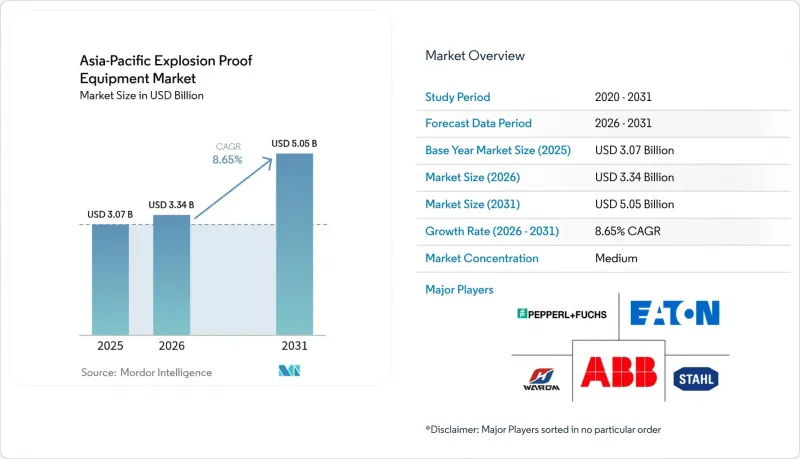
This report is Segmented by Type (Explosion Proof, Explosion Prevention, and Explosion Segregation), Zone (Zone 0, Zone 1, Zone 2, and More), End User (Oil and Gas, Chemical and Petrochemical, and More), System (Power Supply Systems, Material Handling, and More), and Country (China, India, and More). The Market Forecasts are Provided in Terms of Value (USD), Based On Availability.
Asia-Pacific Explosion Proof Equipment Market Trends and Insights
Stricter Regulatory Enforcement Across Hazardous Zones
ATEX and IECEx compliance have expanded from a narrow focus on oil and gas to a broader mandate encompassing pharmaceuticals, food processing, and battery materials. China's GB-3836 upgrade in 2024 imposed higher protection levels for Zone 0 and Zone 20, prompting widespread retrofits. India's PESO regime tightened import approvals, accelerating replacement cycles for legacy gear. Australia and New Zealand have aligned the ANZEx with IECEx, easing multi-country certifications for multinationals. The convergence reduces engineering complexity, enabling regional product platforms that lower development costs and accelerate time-to-market. As plants seek recertification of equipment installed before 2020, the Asia-Pacific explosion-proof equipment market records sizable repeat orders.
Rising Oil, Gas and Mining Capacity Expansions in Emerging Asian Economies
Indonesia's Pertamina has earmarked USD 20 billion for upstream projects through 2030, necessitating robust flameproof motors, pressurized analyzer shelters, and Ex p ventilation skids. Vietnam's Long Son petrochemical hub and Australia's critical minerals rush add large Zone 1 and Zone 20 footprints, respectively. Extended supply lines in offshore rigs and remote mines amplify the need for low-maintenance, condition-monitored Ex lighting and drives. Projects often bundle multi-system packages, such as motors, controls, cameras, and gas detectors, which boosts average order values and deepens vendor lock-in.
High CAPEX and Installation Cost of Explosion-Proof Equipment
Explosion-proof motors, drives, and control panels cost 150-300% more than their general-purpose equivalents. Additionally, certified installation, rigid metallic conduit, and pressurization hardware increase project budgets by an extra 40-60%. SMEs in emerging economies often defer upgrades until inspectors issue notices, causing demand spikes rather than steady growth. Currency swings against the USD raise import bills, especially for sensor and chipset components sourced from the U.S. and Europe. Financing gaps remain acute despite government credit lines, as the uptake among cash-constrained processors slows.
Other drivers and restraints analyzed in the detailed report include:
- Accelerating Shift Toward Explosion-Proof LED Lighting and Smart Sensors
- Rapid Industrial Automation Driving Demand for Intrinsically-Safe Control Systems
- Shortage of Certified Ex Installation and Maintenance Talent
For complete list of drivers and restraints, kindly check the Table Of Contents.
Segment Analysis
Explosion-proof enclosures retained 55.12% of the Asia-Pacific explosion-proof equipment market share in 2025, driven by entrenched oil and gas usage. Still, intrinsic safety and pressurization drive a vigorous 10.05% CAGR through 2031, lifting their contribution to the Asia-Pacific explosion-proof equipment market size, particularly in data-intensive control rooms and sensor networks. Manufacturers exploit semiconductor miniaturization to embed higher power levels into Ex i circuits without exceeding thermal limits, broadening applicability to valve actuators and small motors. Pressurization systems are gaining ground in analyzer houses that handle multiple gas streams; centralized air-purge skids protect several cabinets simultaneously, reducing lifecycle costs compared to per-device enclosures. Encapsulation and powder-fill solutions carve out niches in high-voltage drives and precision instruments, prized for their contamination-free design, especially in clean-room pharmaceuticals.
Second-generation prevention solutions integrate micro-controllers that log pressure, temperature, and purge cycles, transmitting diagnostics to SCADA platforms. Firmware updates enable remote calibration, eliminating the need for site visits and ensuring audit readiness. Service models shift from parts replacement to outcome-based contracts guaranteeing leak-rate thresholds. Competitors are exploring additive-manufactured housings that optimize airflow and reduce weight by up to 25%, thereby lowering crane and footing costs during installation.
Zone 1 retained 33.45% revenue as operators prioritized equipment for areas with frequent gas-vapor presence, sustaining steady retrofits in mature refineries. Conversely, dust-heavy Zone 20 posts the market's fastest 11.35% CAGR, propelled by tablet coating, flour milling, and battery-materials grinding lines that redefine hazardous-area priorities. Several lithium-processing plants in Australia specify hybrid Ex t/Ex p protection for ball mills, which has spurred innovations in dual-rating designs. Equipment makers develop universal mounting kits compliant with both IEC 60079-31 (dust) and 60079-2 (pressurization), enabling single-SKU stocking across varied plant zones.
Zone 0 remains a specialist zone, limited to constant-exposure environments, such as storage tank interiors. New ultrasonic thickness sensors rated Ex ia allow in-service tank-roof inspections, reducing hot-work permits and downtime. Zone 2 retains widespread appeal where intermittent risk suffices; OEMs focus on cost-optimized enclosures that balance compliance and price to counter grey-market imports.
Complete Report Scope:
- By Type
- Explosion Proof (Flameproof/Ex d)
- Explosion Prevention (Intrinsic Safety/Ex i, Pressurisation/Ex p)
- Explosion Segregation (Encapsulation/Ex m, Powder-filling/Ex q)
- By Zone
- Zone 0
- Zone 1
- Zone 2
- Zone 20
- Zone 21
- Zone 22
- By End User
- Oil and Gas
- Chemical and Petrochemical
- Energy and Power
- Mining
- Pharmaceutical
- Food Processing
- Other End Users
- By System
- Power Supply Systems (Transformers, Switchgear)
- Material Handling (Hoists, Conveyors)
- Motors and Drives
- Automation and Control Systems (PLC, SCADA)
- Surveillance and Monitoring (Cameras, Gas Detectors)
- Lighting Systems (LED, Fluorescent)
- By Country
- China
- India
- Japan
- South Korea
- Australia
- Indonesia
- Thailand
- Vietnam
- Malaysia
- Rest of Asia Pacific
List of Companies Covered in this Report:
- ABB Ltd.
- Eaton Corporation plc
- R. Stahl AG
- Pepperl+Fuchs SE
- Warom Technology Inc.
- Bartec GmbH
- Emerson Electric Co.
- Siemens AG
- Honeywell International Inc. (RAE Systems)
- Marechal Electric SA
- Adalet Industries LLC
- Phoenix Mecano AG
- Alloy Industry Co. Ltd.
- Cordex Instruments Ltd.
- G.M. International srl
- CZ Electric Co. Ltd.
- Feice Explosion-Proof Electric Co. Ltd.
- Wolong Electric Group Co. Ltd.
- WEG Equipamentos Eletricos S.A.
- Toshiba International Corporation
Additional Benefits:
- The market estimate (ME) sheet in Excel format
- 3 months of analyst support
TABLE OF CONTENTS
1 INTRODUCTION
- 1.1 Study Assumptions and Market Definition
- 1.2 Scope of the Study
2 RESEARCH METHODOLOGY
3 EXECUTIVE SUMMARY
4 MARKET LANDSCAPE
- 4.1 Market Overview
- 4.2 Market Drivers
- 4.2.1 Stricter regulatory enforcement across hazardous zones (ATEX/IECEx, IEC 60079 series, China GB-3836 upgrade)
- 4.2.2 Rising oil, gas and mining capacity expansions in emerging Asian economies
- 4.2.3 Accelerating shift toward explosion-proof LED lighting and smart sensors
- 4.2.4 Rapid industrial automation driving demand for intrinsically-safe control systems
- 4.2.5 Localisation of certification labs reducing approval lead-times
- 4.2.6 Booming Asia-Pacific pharmaceutical manufacturing clusters needing GMP-compliant Ex equipment
- 4.3 Market Restraints
- 4.3.1 High CAPEX and installation cost of explosion-proof equipment
- 4.3.2 Shortage of certified Ex installation and maintenance talent
- 4.3.3 Proliferation of counterfeit/non-certified devices eroding buyer confidence
- 4.3.4 Volatile copper and rare-earth magnet prices inflating motor costs
- 4.4 Industry Value Chain Analysis
- 4.5 Impact of Macroeconomic Factors
- 4.6 Regulatory Landscape
- 4.7 Technological Outlook
- 4.8 Porter's Five Forces Analysis
- 4.8.1 Bargaining Power of Suppliers
- 4.8.2 Bargaining Power of Buyers
- 4.8.3 Threat of New Entrants
- 4.8.4 Threat of Substitute Products
- 4.8.5 Intensity of Competitive Rivalry
5 MARKET SIZE AND GROWTH FORECASTS (VALUE)
- 5.1 By Type
- 5.1.1 Explosion Proof (Flameproof/Ex d)
- 5.1.2 Explosion Prevention (Intrinsic Safety/Ex i, Pressurisation/Ex p)
- 5.1.3 Explosion Segregation (Encapsulation/Ex m, Powder-filling/Ex q)
- 5.2 By Zone
- 5.2.1 Zone 0
- 5.2.2 Zone 1
- 5.2.3 Zone 2
- 5.2.4 Zone 20
- 5.2.5 Zone 21
- 5.2.6 Zone 22
- 5.3 By End User
- 5.3.1 Oil and Gas
- 5.3.2 Chemical and Petrochemical
- 5.3.3 Energy and Power
- 5.3.4 Mining
- 5.3.5 Pharmaceutical
- 5.3.6 Food Processing
- 5.3.7 Other End Users
- 5.4 By System
- 5.4.1 Power Supply Systems (Transformers, Switchgear)
- 5.4.2 Material Handling (Hoists, Conveyors)
- 5.4.3 Motors and Drives
- 5.4.4 Automation and Control Systems (PLC, SCADA)
- 5.4.5 Surveillance and Monitoring (Cameras, Gas Detectors)
- 5.4.6 Lighting Systems (LED, Fluorescent)
- 5.5 By Country
- 5.5.1 China
- 5.5.2 India
- 5.5.3 Japan
- 5.5.4 South Korea
- 5.5.5 Australia
- 5.5.6 Indonesia
- 5.5.7 Thailand
- 5.5.8 Vietnam
- 5.5.9 Malaysia
- 5.5.10 Rest of Asia Pacific
6 COMPETITIVE LANDSCAPE
- 6.1 Market Concentration
- 6.2 Strategic Moves
- 6.3 Market Share Analysis
- 6.4 Company Profiles (includes Global level Overview, Market level overview, Core Segments, Financials as available, Strategic Information, Market Rank/Share for key companies, Products and Services, and Recent Developments)
- 6.4.1 ABB Ltd.
- 6.4.2 Eaton Corporation plc
- 6.4.3 R. Stahl AG
- 6.4.4 Pepperl+Fuchs SE
- 6.4.5 Warom Technology Inc.
- 6.4.6 Bartec GmbH
- 6.4.7 Emerson Electric Co.
- 6.4.8 Siemens AG
- 6.4.9 Honeywell International Inc. (RAE Systems)
- 6.4.10 Marechal Electric SA
- 6.4.11 Adalet Industries LLC
- 6.4.12 Phoenix Mecano AG
- 6.4.13 Alloy Industry Co. Ltd.
- 6.4.14 Cordex Instruments Ltd.
- 6.4.15 G.M. International srl
- 6.4.16 CZ Electric Co. Ltd.
- 6.4.17 Feice Explosion-Proof Electric Co. Ltd.
- 6.4.18 Wolong Electric Group Co. Ltd.
- 6.4.19 WEG Equipamentos Eletricos S.A.
- 6.4.20 Toshiba International Corporation
7 MARKET OPPORTUNITIES AND FUTURE OUTLOOK
- 7.1 White-space and Unmet-Need Assessment

