PUBLISHER: Mordor Intelligence | PRODUCT CODE: 2121950

PUBLISHER: Mordor Intelligence | PRODUCT CODE: 2121950
Small-scale LNG - Market Share Analysis, Industry Trends & Statistics, Growth Forecasts (2026 - 2031)
According to Mordor Intelligence, the small-scale LNG market size is expected to increase from USD 11.80 billion in 2025 to USD 13.04 billion in 2026 and reach USD 21.60 billion by 2031, growing at a CAGR of 10.62% over 2026-2031.
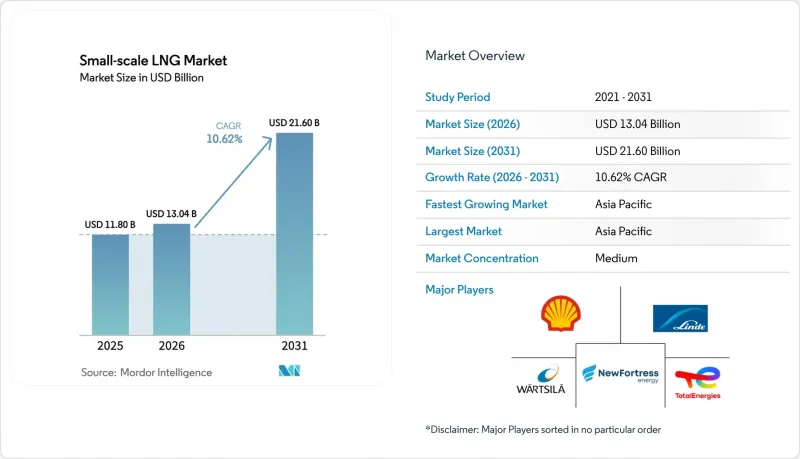
This report is Segmented by Type (Liquefaction Terminal and Regasification Terminal), Mode of Supply (Truck, Pipeline and Rail, Transshipment and Bunkering, and ISO Container), Application (Transportation, Power Generation, and More), End-User (Utilities and IPPs, Oil and Gas Upstream Operators, and More), and Geography (North America, Europe, Asia-Pacific, South America, and Middle East and Africa).
Global Small-scale LNG Market Trends and Insights
Tightening IMO And FuelEU Maritime Sulphur Caps Accelerating Marine LNG Bunkering Adoption
The IMO's 0.50% global sulphur limit and the European Union's FuelEU Maritime greenhouse-gas rules are tilting bunker-fuel economics toward LNG. Shipowners can avoid multi-million-dollar scrubber retrofits and simultaneously reduce CO2, SOx, and particulate emissions by shifting to LNG propulsion. The global LNG bunker fleet reached 61 vessels by late 2024, with Northwest Europe, the Mediterranean, and Asia hosting the largest clusters. TotalEnergies opened a dedicated bunkering terminal at Oman's Port of Duqm in 2024 to serve ships transiting the Arabian Sea. FuelEU Maritime's requirement to account for methane slip is spurring engine makers to adopt high-pressure injection systems that cut unburned methane below 1%. These combined measures foster reliable infrastructure and regulatory certainty for the small-scale LNG market.
Rapid Build-out Of Modular Liquefaction Plants For Remote Mining And Off-Grid Power
Standardized micro and mini liquefiers allow stranded or associated gas to be monetized at capacities as low as 10,000 gallons per day without pipeline connections. Chart Industries' IPSMR(R) process consumes under 0.35 kWh per kilogram of LNG, making off-grid sites viable even when power is supplied by on-site renewables or gensets. Australian mines use containerized LNG to displace diesel trucked over 1,000 km, cutting fuel logistics costs by 40%. Indonesia's island geography relies on virtual pipelines that move ISO tanks from gas-rich islands to population centers, sidestepping multi-billion-dollar subsea lines. Boil-off remains a challenge for plants below 0.05 MTPA, but hybrid solutions, venting vapor to on-site generators, recover up to 80% of the gas's value. As capital costs fall and off-grid demand rises, modular liquefaction underpins long-term growth in the small-scale LNG market.
Russia-Ukraine Conflict Raising Geopolitical Risk Premium On Spot LNG
The 2022 escalation cut 155 billion m3 of Russian pipeline gas to Europe, elevating LNG spot prices to USD 25 per MMBtu before moderating to USD 10-14 by late 2024. Small buyers in bunkering and municipal sectors struggle to secure long-term fixed-price contracts as suppliers push for spot-linked terms. Asian importers compete with Europe for cargoes, diverting supply from Southeast Asia and the Caribbean. Sanctions on Arctic LNG 2 removed 19.8 MTPA of expected output, emboldening other producers to maintain pricing discipline. Buyers are adding storage to buffer volatility, but tanks or small FSRUs raise capital needs by USD 50-100 million, eroding LNG's cost edge over diesel. The resulting uncertainty tempers near-term growth in the small-scale LNG market.
Other drivers and restraints analyzed in the detailed report include:
- Heavy-Duty Truck Fleet Shift To LNG In China's "Blue Corridor" Program
- Tax Incentives For Small-Scale LNG Equipment Under The U.S. Inflation Reduction Act
- High Boil-Off And Re-Liquefaction Costs Below 0.05 MTPA Plants
For complete list of drivers and restraints, kindly check the Table Of Contents.
Segment Analysis
Liquefaction terminals captured 62.3% of the small-scale LNG market in 2025, reflecting the need to monetize stranded gas assets economically. Many micro-plants operate below 0.1 MTPA and use high-efficiency IPSMR(R) technology to reach 90-plus% liquefaction yield. Small units serve biogas upgrading, flare-gas capture, and remote power, while mini and small plants feed export or regional hubs. Compliance with ISO 14001 adds environmental oversight but unlocks green financing. Capital intensity ranges between USD 400 and USD 800 per tonne of annual capacity, a threshold now attainable for frontier markets.
Regasification capacity is accelerating at a 14.4% CAGR to 2031. FSRUs like Hoegh Esperanza and Hoegh Gannet added 10 billion m3 per year to Germany's grid within 18 months, bypassing five-year onshore timelines. The Philippines' BW Mindanao FSRU feeds 5 MTPA into Luzon, enabling the retirement of 2,400 MW of coal. Vapor-recovery systems, required in emission-control areas, add USD 3-5 million but align with FuelEU methane rules. With day-rates between USD 80,000 and USD 150,000, leased FSRUs give buyers flexibility unmatched by fixed terminals, broadening the appeal of the small-scale LNG market.
Truck delivery held a 52.6% share in 2025, anchored by China's heavy-duty LNG fleet. A standard trailer hauls 20-25 tonnes, sufficient for a 5 MW boiler for two days, letting buyers dodge pipeline capacity charges. Hexagon Purus's composite cylinders, introduced in 2024, cut trailer weight by 40%, enabling 28-tonne payloads on weight-restricted European routes. ISO containers support intermodal movements and cut handling costs by up to 30%.
Transshipment and bunkering are growing at a 14.7% CAGR as 18 new bunker vessels join the global fleet by 2027. Singapore licensed 12 bunkering operators in 2024, boosting volumes to 450,000 tonnes. Northwest Europe fields 29 bunker vessels that performed 1,200 ship calls in 2024. As sulfur and CO2 limits tighten, ship-to-ship and shore-to-ship fueling solidify as fast-growing nodes in the small-scale LNG market.
Complete Report Scope:
- By Type
- Liquefaction Terminal (Micro, Mini, and Small)
- Regasification Terminal (Onshore and Offshore FSRU)
- By Mode of Supply
- Truck
- Pipeline and Rail
- Transshipment and Bunkering (Ship-to-ship and Shore-to-ship)
- ISO Container
- By Application
- Transportation (Road and Marine Bunkering)
- Industrial Feedstock
- Power Generation
- Other Applications
- By End-User
- Utilities and Independent Power Producers (IPPs)
- Oil nd Gas Upstream Operators
- Manufacturing Industries
- Commercial and Municipal
- By Geography
- North America
- United States
- Canada
- Mexico
- Europe
- United Kingdom
- Germany
- France
- Spain
- Nordic Countries
- Russia
- Rest of Europe
- Asia-Pacific
- China
- India
- Japan
- South Korea
- Malaysia
- Thailand
- Indonesia
- Vietnam
- Australia
- Rest of Asia-Pacific
- South America
- Brazil
- Argentina
- Colombia
- Rest of South America
- Middle East and Africa
- United Arab Emirates
- Saudi Arabia
- Qatar
- Egypt
- South Africa
- Rest of Middle East and Africa
- North America
Geography Analysis
Asia-Pacific owned 47.9% of the small-scale LNG market in 2025 and is growing at a 15.9% CAGR through 2031. China's 1.2 million LNG trucks, Indonesia's virtual pipelines supplying 12 new city-gas municipalities, and Australia's remote mining demand anchor regional growth. Japan's Sodegaura added truck-loading in 2024 to feed factories in Chiba, while India imported 80,000 tonnes via ISO tanks to reach states beyond pipeline corridors. Europe's pipeline saturation curbs liquefaction investment, yet the region leads in bunkering and FSRUs. FuelEU Maritime penalties starting in 2025 push shipowners toward LNG, and 29 bunker vessels handled 1,200 calls in 2024. Germany's four FSRUs replaced Russian gas volumes, keeping spot prices below EUR 40 per MWh. Nordic countries achieved a 22% bioLNG share in 2024, proving the pathway to carbon-negative shipping fuel.
North America leverages shale gas abundance and the Inflation Reduction Act credits. Chart Industries' micro-liquefiers at breweries and ethanol plants qualify for USD 1.75 per gallon-equivalent incentives, while Canadian rail moves LNG to remote communities. Mexico's 2024 reform opened import terminals to third parties, setting the stage for future growth. South America is nascent but active. New Fortress Energy's floating liquefiers target Brazil's pre-salt gas, and Argentina's 0.5 MTPA plant will serve domestic and Chilean markets. Chile dispatches LNG to Atacama mines, saving Codelco USD 18 million annually. Colombia awarded a terminal concession on its Pacific coast to supply Buenaventura and Tumaco.
In the Middle East and Africa, the UAE and Qatar build domestic bunkering networks, while South Africa's Coega FSRU serves the coastal industry. Mozambique's Coral Sul exports LNG but plans 100,000 tonnes per year for regional ISO-tank distribution starting 2026. Nigeria's virtual-pipeline concept awaits standardized ISO-tank rules. Kenya and Tanzania seek financing for import terminals but face credit hurdles.
- Linde plc
- Wartsila Oyj Abp
- Baker Hughes Co.
- Honeywell UOP
- Chart Industries Inc.
- Black & Veatch
- New Fortress Energy LLC
- Shell plc
- TotalEnergies SE
- Eni SpA
- PJSC Gazprom
- Novatek PJSC
- Gasum Oy
- Engie SA
- Anthony Veder Group NV
- Stolt-Nielsen Gas Ltd
- Eagle LNG Partners
- Guanghui Energy Co.
- Equinor ASA
- Pavilion Energy Pte Ltd
Additional Benefits:
- The market estimate (ME) sheet in Excel format
- 3 months of analyst support
TABLE OF CONTENTS
1 Introduction
- 1.1 Study Assumptions & Market Definition
- 1.2 Scope of the Study
2 Research Methodology
3 Executive Summary
4 Market Landscape
- 4.1 Market Overview
- 4.2 Market Drivers
- 4.2.1 Tightening IMO & FuelEU Maritime Sulphur Caps Accelerating Marine LNG Bunkering Adoption (Europe)
- 4.2.2 Rapid Build-out of Modular Liquefaction Plants for Remote Mining & Off-Grid Power (Asia-Pacific)
- 4.2.3 Heavy-Duty Truck Fleet Shift to LNG in China's "Blue Corridor" Program
- 4.2.4 Caribbean & Central-American Micro-grid Conversions to LNG-to-Power
- 4.2.5 Tax Incentives for Small-Scale LNG Equipment under US Inflation Reduction Act
- 4.2.6 Nordic LNG Bus & Ferry Subsidy Schemes Driving Demand for Bunkering
- 4.3 Market Restraints
- 4.3.1 Sparse ISO-Tank Back-haul Logistics in Sub-Saharan Africa
- 4.3.2 High Boil-Off & Re-liquefaction Costs Below 0.05 MTPA Plants
- 4.3.3 Fragmented Permitting Framework for Mobile Liquefiers in Brazil
- 4.3.4 Russia-Ukraine Conflict Raising Geopolitical Risk Premium on Spot LNG
- 4.4 Supply-Chain Analysis
- 4.5 Regulatory Outlook
- 4.6 Technological Outlook
- 4.7 Porter's Five Forces
- 4.7.1 Bargaining Power of Suppliers
- 4.7.2 Bargaining Power of Buyers
- 4.7.3 Threat of New Entrants
- 4.7.4 Threat of Substitutes
- 4.7.5 Intensity of Competitive Rivalry
5 Market Size & Growth Forecasts
- 5.1 By Type
- 5.1.1 Liquefaction Terminal (Micro, Mini, and Small)
- 5.1.2 Regasification Terminal (Onshore and Offshore FSRU)
- 5.2 By Mode of Supply
- 5.2.1 Truck
- 5.2.2 Pipeline and Rail
- 5.2.3 Transshipment and Bunkering (Ship-to-ship and Shore-to-ship)
- 5.2.4 ISO Container
- 5.3 By Application
- 5.3.1 Transportation (Road and Marine Bunkering)
- 5.3.2 Industrial Feedstock
- 5.3.3 Power Generation
- 5.3.4 Other Applications
- 5.4 By End-User
- 5.4.1 Utilities and Independent Power Producers (IPPs)
- 5.4.2 Oil nd Gas Upstream Operators
- 5.4.3 Manufacturing Industries
- 5.4.4 Commercial and Municipal
- 5.5 By Geography
- 5.5.1 North America
- 5.5.1.1 United States
- 5.5.1.2 Canada
- 5.5.1.3 Mexico
- 5.5.2 Europe
- 5.5.2.1 United Kingdom
- 5.5.2.2 Germany
- 5.5.2.3 France
- 5.5.2.4 Spain
- 5.5.2.5 Nordic Countries
- 5.5.2.6 Russia
- 5.5.2.7 Rest of Europe
- 5.5.3 Asia-Pacific
- 5.5.3.1 China
- 5.5.3.2 India
- 5.5.3.3 Japan
- 5.5.3.4 South Korea
- 5.5.3.5 Malaysia
- 5.5.3.6 Thailand
- 5.5.3.7 Indonesia
- 5.5.3.8 Vietnam
- 5.5.3.9 Australia
- 5.5.3.10 Rest of Asia-Pacific
- 5.5.4 South America
- 5.5.4.1 Brazil
- 5.5.4.2 Argentina
- 5.5.4.3 Colombia
- 5.5.4.4 Rest of South America
- 5.5.5 Middle East and Africa
- 5.5.5.1 United Arab Emirates
- 5.5.5.2 Saudi Arabia
- 5.5.5.3 Qatar
- 5.5.5.4 Egypt
- 5.5.5.5 South Africa
- 5.5.5.6 Rest of Middle East and Africa
- 5.5.1 North America
6 Competitive Landscape
- 6.1 Market Concentration
- 6.2 Strategic Moves (M&A, Partnerships, PPAs)
- 6.3 Market Share Analysis (Market Rank/Share for key companies)
- 6.4 Company Profiles (includes Global level Overview, Market level overview, Core Segments, Financials as available, Strategic Information, Products & Services, and Recent Developments)
- 6.4.1 Linde plc
- 6.4.2 Wartsila Oyj Abp
- 6.4.3 Baker Hughes Co.
- 6.4.4 Honeywell UOP
- 6.4.5 Chart Industries Inc.
- 6.4.6 Black & Veatch
- 6.4.7 New Fortress Energy LLC
- 6.4.8 Shell plc
- 6.4.9 TotalEnergies SE
- 6.4.10 Eni SpA
- 6.4.11 PJSC Gazprom
- 6.4.12 Novatek PJSC
- 6.4.13 Gasum Oy
- 6.4.14 Engie SA
- 6.4.15 Anthony Veder Group NV
- 6.4.16 Stolt-Nielsen Gas Ltd
- 6.4.17 Eagle LNG Partners
- 6.4.18 Guanghui Energy Co.
- 6.4.19 Equinor ASA
- 6.4.20 Pavilion Energy Pte Ltd
7 Market Opportunities & Future Outlook
- 7.1 White-Space & Unmet-Need Assessment

