PUBLISHER: Mordor Intelligence | PRODUCT CODE: 2122170

PUBLISHER: Mordor Intelligence | PRODUCT CODE: 2122170
India Lithium-ion Battery - Market Share Analysis, Industry Trends & Statistics, Growth Forecasts (2026 - 2031)
According to Mordor Intelligence, the India lithium-ion battery market size is estimated at USD 6.73 billion in 2026, and is expected to reach USD 15.17 billion by 2031, at a CAGR of 17.65% during the forecast period (2026-2031).
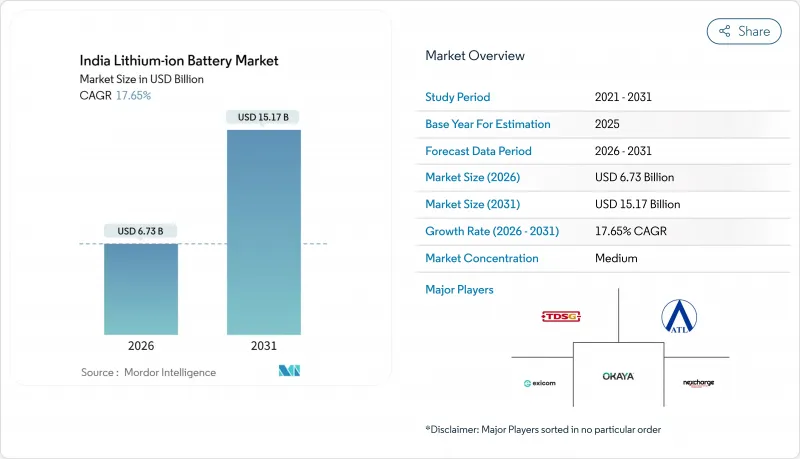
This report is Segmented by Product Type (LCO, LFP, NMC, NCA, LMO, LTO), Form Factor (Cylindrical, Prismatic, Pouch), Power Capacity (Up To 3, 000 MAh, 3, 000 To 10, 000 MAh, 10, 000 To 60, 000 MAh, Above 60, 000 MAh), and End-Use Industry (Automotive, Consumer Electronics, Industrial, Stationary Storage, Aerospace, Marine). The Market Sizes and Forecasts are Provided in Terms of Value (USD).
India Lithium-ion Battery Market Trends and Insights
Declining Lithium-ion Battery Cost Curve Acceleration
Battery-pack prices in India fell to USD 115 per kWh in 2025 from USD 132 per kWh a year earlier as raw-material prices cooled and domestic scale improved. By early 2026, locally produced NMC cells cost USD 95 per kWh, almost matching imported Chinese equivalents once freight and GST are added. This rapid deflation is tipping total-cost-of-ownership equations in favor of electric two- and three-wheelers, where price sensitivity is high. LFP, representing 22% of 2025 demand, offers an 18-22% bill-of-materials discount over NMC, though its energy density is roughly 15-20% lower. Cost parity is also enabling 4-hour stationary systems to undercut diesel gensets on levelized cost in commercial buildings, a milestone crossed in 2025.
Government FAME-II Subsidies and PLI Schemes
The government disbursed INR 7,500 crore (USD 900 million) in FAME-II incentives by March 2025, underwriting 1.2 million electric two-wheelers and 18,000 e-buses and slicing sticker prices by 25-30%. Extension through March 2027 locks in demand visibility, helping OEMs align with phased manufacturing mandates. Complementing demand pull, the ACC-PLI program earmarked INR 18,100 crore (USD 2.17 billion) to catalyze 50 GWh of domestic capacity by 2030. Reliance New Energy's 10 GWh Jamnagar plant and Ola Electric's 20 GWh Tamil Nadu gigafactory headline the beneficiaries, each capturing more than INR 2,900 crore (USD 350 million) in incentives. The 20% value-addition subsidy during the first five years compresses the landed-cost gap with imports to below 5%, galvanizing localization decisions by major OEMs.
Critical-Mineral Import Dependence
India imported 18,200 t of lithium compounds worth USD 1.2 billion in 2025, with 68% dependent on China and 24% on Chile. Cobalt shipments of 4,800 t arrived almost exclusively via Chinese refineries sourcing from the Democratic Republic of Congo, exposing a single-node risk for NMC supply. Although exploratory finds in Karnataka's Mandya district indicate 14,100 t lithium oxide equivalent, commercial extraction is unlikely before 2028. The Critical Mineral Mission has earmarked INR 2,500 crore (USD 300 million) for overseas mine stakes, yet until operational, cell manufacturers will continue to hedge by stockpiling three-month inventories, inflating working-capital cycles.
Other drivers and restraints analyzed in the detailed report include:
- Electric Two-Wheeler Boom in Urban Mobility
- Grid-Scale Energy-Storage Tenders by SECI & NTPC
- Under-Developed Battery-Recycling Ecosystem
For complete list of drivers and restraints, kindly check the Table Of Contents.
Segment Analysis
India's lithium-ion battery market size for NMC chemistry was USD 1.87 billion in 2025, equal to a 33.3% share. LFP's superior cycle life and cobalt-free design underpin its forecast 27.1% CAGR, propelling it to near-parity with NMC by 2031, especially in stationary storage and commercial EVs. Exide Industries and Ola Electric both aim to shift 60% of sourcing to LFP by 2027. Although NMC retains an edge in premium passenger cars demanding 400 km+ range, stricter thermal-propagation tests under AIS-156 tilt mass-market models toward LFP. Minor chemistries like LTO and LMO will remain niche, serving public buses and power tools where rapid charging and temperature resilience override energy density.
India's lithium-ion battery market share for LFP is projected to close the gap as SECI and NTPC tenders mandate iron-phosphate chemistry for safety and lifecycle reasons. Consumer-electronics OEMs still prefer high-density NMC and LCO cells, but rising smartphone battery capacities are gradually cannibalizing LCO volumes. Panasonic Energy's small NCA niche supplies luxury EVs, yet volumes stay marginal due to cost and supply-risk issues.
Cylindrical formats generated USD 3.13 billion of the India lithium-ion battery market size in 2025, equal to 55.8% share, reflecting deep legacy supply chains and automated assembly lines. The 21700 cell, widely used by Ather and Ola, delivers 35% more energy than 18650, lowering per-kWh pack cost by 8-10%. Pouch cells, while only 16.2% share now, are forecast to grow 24.3% CAGR as skateboard EV platforms demand thin, high-utilization modules. LG Energy Solution's 5 GWh Pune plant, due in 2026, will feed this trend with 250 Wh/kg NMC pouches.
Thermal-expansion risks in India's 45 °C summers necessitate enhanced cooling, adding USD 20-30 per kWh to pouch-pack costs, but weight savings of 12-18% are compelling for two-wheeler OEMs chasing sub-100 kg designs. Prismatic cells dominate stationary storage as they simplify racking and BMS integration, despite an 8-12% cost premium. BYD's blade battery technology is under evaluation by Indian bus OEMs for structural integration benefits.
Complete Report Scope:
- By Product Type
- Lithium Cobalt Oxide (LCO)
- Lithium Iron Phosphate (LFP)
- Lithium Nickel Manganese Cobalt (NMC)
- Lithium Nickel Cobalt Aluminium (NCA)
- Lithium Manganese Oxide (LMO)
- Lithium Titanate (LTO)
- By Form Factor
- Cylindrical
- Prismatic
- Pouch
- By Power Capacity
- Up to 3,000 mAh
- 3,000 to 10,000 mAh
- 10,000 to 60,000 mAh
- Above 60,000 mAh
- By End-use Industry
- Automotive (EV, HEV, PHEV)
- Consumer Electronics
- Industrial and Power Tools
- Stationary Energy Storage
- Aerospace and Defense
- Marine
List of Companies Covered in this Report:
- TDS Lithium-Ion Battery Gujarat Pvt. Ltd. (TDSG)
- Nexcharge (Exide & Leclanche)
- Amperex Technology Ltd. (ATL)
- Exicom Tele-Systems Ltd.
- Okaya Power Group
- Amara Raja Energy & Mobility Ltd.
- Reliance New Energy Battery Storage Ltd.
- Tata AutoComp Systems Ltd.
- Panasonic Energy India
- LG Energy Solution (India)
- Future Hi-Tech Batteries
- Trontek Group
- Telemax India Industries
- Inverted Energy Pvt. Ltd.
- Vision Mechatronics Pvt. Ltd.
- iPower Batteries Pvt. Ltd.
- Bharat Electronics Ltd. (BEL)
- Ola Electric Mobility Pvt. Ltd.
- Sunlit Power (SUN Mobility)
- HBL Power Systems Ltd.
- Coslight India
- EON Electric Ltd.
- Toshiba Corporation
- Samsung SDI India
Additional Benefits:
- The market estimate (ME) sheet in Excel format
- 3 months of analyst support
TABLE OF CONTENTS
1 Introduction
- 1.1 Study Assumptions & Market Definition
- 1.2 Scope of the Study
2 Research Methodology
3 Executive Summary
4 Market Landscape
- 4.1 Market Overview
- 4.2 Market Drivers
- 4.2.1 Declining lithium-ion battery cost curve acceleration
- 4.2.2 Government FAME-II subsidies and PLI schemes
- 4.2.3 Electric two-wheeler boom in urban mobility
- 4.2.4 Grid-scale energy-storage tenders by SECI & NTPC
- 4.2.5 Localization of cell manufacturing under "Atmanirbhar Bharat"
- 4.2.6 Corporate renewable + storage PPAs in C&I segment
- 4.3 Market Restraints
- 4.3.1 Critical-mineral import dependence
- 4.3.2 Under-developed battery-recycling ecosystem
- 4.3.3 High GST differential on cells vs. packs
- 4.3.4 Safety & fire incidents eroding consumer confidence
- 4.4 Supply-Chain Analysis
- 4.5 Regulatory Landscape
- 4.6 Technological Outlook
- 4.7 Porter's Five Forces
- 4.7.1 Bargaining Power of Suppliers
- 4.7.2 Bargaining Power of Buyers
- 4.7.3 Threat of New Entrants
- 4.7.4 Threat of Substitutes
- 4.7.5 Intensity of Competitive Rivalry
- 4.8 PESTLE Analysis
5 Market Size & Growth Forecasts
- 5.1 By Product Type
- 5.1.1 Lithium Cobalt Oxide (LCO)
- 5.1.2 Lithium Iron Phosphate (LFP)
- 5.1.3 Lithium Nickel Manganese Cobalt (NMC)
- 5.1.4 Lithium Nickel Cobalt Aluminium (NCA)
- 5.1.5 Lithium Manganese Oxide (LMO)
- 5.1.6 Lithium Titanate (LTO)
- 5.2 By Form Factor
- 5.2.1 Cylindrical
- 5.2.2 Prismatic
- 5.2.3 Pouch
- 5.3 By Power Capacity
- 5.3.1 Up to 3,000 mAh
- 5.3.2 3,000 to 10,000 mAh
- 5.3.3 10,000 to 60,000 mAh
- 5.3.4 Above 60,000 mAh
- 5.4 By End-use Industry
- 5.4.1 Automotive (EV, HEV, PHEV)
- 5.4.2 Consumer Electronics
- 5.4.3 Industrial and Power Tools
- 5.4.4 Stationary Energy Storage
- 5.4.5 Aerospace and Defense
- 5.4.6 Marine
6 Competitive Landscape
- 6.1 Market Concentration
- 6.2 Strategic Moves (M&A, Partnerships, PPAs)
- 6.3 Market Share Analysis (Market Rank/Share for key companies)
- 6.4 Company Profiles (includes Global level Overview, Market level overview, Core Segments, Financials as available, Strategic Information, Products & Services, and Recent Developments)
- 6.4.1 TDS Lithium-Ion Battery Gujarat Pvt. Ltd. (TDSG)
- 6.4.2 Nexcharge (Exide & Leclanche)
- 6.4.3 Amperex Technology Ltd. (ATL)
- 6.4.4 Exicom Tele-Systems Ltd.
- 6.4.5 Okaya Power Group
- 6.4.6 Amara Raja Energy & Mobility Ltd.
- 6.4.7 Reliance New Energy Battery Storage Ltd.
- 6.4.8 Tata AutoComp Systems Ltd.
- 6.4.9 Panasonic Energy India
- 6.4.10 LG Energy Solution (India)
- 6.4.11 Future Hi-Tech Batteries
- 6.4.12 Trontek Group
- 6.4.13 Telemax India Industries
- 6.4.14 Inverted Energy Pvt. Ltd.
- 6.4.15 Vision Mechatronics Pvt. Ltd.
- 6.4.16 iPower Batteries Pvt. Ltd.
- 6.4.17 Bharat Electronics Ltd. (BEL)
- 6.4.18 Ola Electric Mobility Pvt. Ltd.
- 6.4.19 Sunlit Power (SUN Mobility)
- 6.4.20 HBL Power Systems Ltd.
- 6.4.21 Coslight India
- 6.4.22 EON Electric Ltd.
- 6.4.23 Toshiba Corporation
- 6.4.24 Samsung SDI India
7 Market Opportunities & Future Outlook
- 7.1 White-space & Unmet-Need Assessment
- 7.2 Battery-recycling infrastructure scaling
- 7.3 Solid-state battery commercialization potential
- 7.4 Second-life battery leasing models
- 7.5 Local mineral processing & refining opportunities
- 7.6 Advanced BMS & thermal-management solutions

