PUBLISHER: Mordor Intelligence | PRODUCT CODE: 2124704

PUBLISHER: Mordor Intelligence | PRODUCT CODE: 2124704
Southeast Asia Lithium-ion Battery - Market Share Analysis, Industry Trends & Statistics, Growth Forecasts (2026 - 2031)
According to Mordor Intelligence, the Southeast Asia lithium-ion battery market size is expected to increase from USD 7.51 billion in 2025 to USD 8.32 billion in 2026 and reach USD 16.27 billion by 2031, growing at a CAGR of 14.35% over 2026-2031.
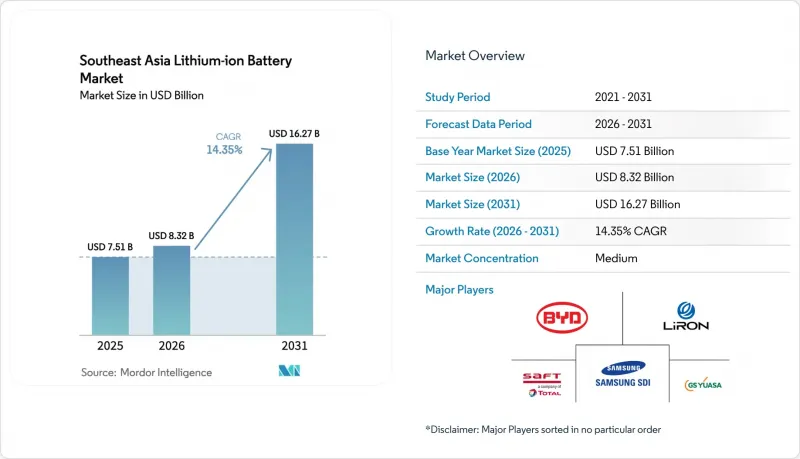
This report is Segmented by Product Type (LCO, LFP, NMC, NCA, LMO, and LTO), Form Factor (Cylindrical, Prismatic, and Pouch), Power Capacity (Up To 3, 000 MAh, 3, 000 To 10, 000 MAh, 10, 000 To 60, 000 MAh, and Above 60, 000 MAh), End-Use Industry (Automotive, Consumer Electronics, Industrial, Stationary Storage, and More), and Geography (Indonesia, Malaysia, Philippines, Vietnam, and More).
Southeast Asia Lithium-ion Battery Market Trends and Insights
Rapid EV-Adoption Incentives
VAT cuts in Indonesia, registration-fee rebates in Vietnam, and Thailand's EV 3.5 cash subsidies narrowed the total-cost-of-ownership gap against internal-combustion vehicles by up to 25 percentage points in 2025, lifting model launches across two-wheelers and compact cars. Automakers now localize cell sourcing to unlock incentives, accelerating gigafactory utilization and cementing cost-competitive LFP chemistry in subsidy-capped vehicle classes. Swappable-battery fleets for last-mile delivery in Jakarta and Bangkok multiply demand for standardized 3,000-to-10,000 mAh packs. Compliance clauses that ratchet local-content thresholds every two years encourage vertical integration but expose foreign OEMs to policy shifts. The net effect is a sustained uplift in the Southeast Asia lithium-ion battery market trajectory through 2028.
Expanding Consumer-Electronics Manufacturing
Vietnam's share of global smartphone and notebook assembly climbed to 31% in 2025 as Samsung and Apple suppliers relocated lines from China, clustering cylindrical- and prismatic-cell demand around Bac Ninh and Bac Giang. Adjacent cell plants shorten logistics lead times to under one week, lowering working capital and locking in repeat orders for 3,000-to-5,000 mAh LCO and NMC cells. Thailand's data-center hardware lines add niche demand for high-cycle-life LTO cells in UPS modules, while compliance with IEC 62133 testing slows new SKUs by up to six weeks. Tightening labor markets raise technician wages but are offset by automation upgrades in electrode coating.
Imported Raw-Material Dependence
The region sources more than 95% of lithium chemicals and 87% of synthetic graphite from abroad, exposing cell makers to volatile commodity swings that eroded margins in 2025 when lithium carbonate ranged between USD 12,500 and USD 18,700/t. China's export-licensing on graphite stretched approval cycles from two to eight weeks, delaying Malaysian cathode ramps. Cobalt price spikes following Glencore's Mutanda force-majeure forced Vietnamese producers to hold 90-day inventories, freezing liquidity. While pilot hydroxide and separator ventures are underway, meaningful substitution is still several years out, keeping the Southeast Asia lithium-ion battery market exposed to upstream shocks.
Other drivers and restraints analyzed in the detailed report include:
- Government-Backed Gigafactory Investments
- Declining Battery-Pack Costs
- Safety Recalls & Thermal-Runaway Concerns
For complete list of drivers and restraints, kindly check the Table Of Contents.
Segment Analysis
Lithium Nickel Manganese Cobalt retained 61.3% revenue in 2025, yet the Southeast Asia lithium-ion battery market size for Lithium Iron Phosphate is projected to triple at a 38.5% CAGR as automakers shift to cobalt-free packs that meet subsidy caps. BYD's Blade licensing to VinFast and Banpu NEXT cut module count and trimmed pack weight by 10%, shrinking per-vehicle battery cost below USD 90 per kWh. CATL's M3P variant, produced in Indonesia from 2026, adds 15% energy density versus baseline LFP without introducing cobalt risk.
Cobalt-free chemistries collectively rise from 28.7% share in 2025 to 46.3% by 2031, propelled by Indonesia's export levies on nickel sulfate that encourage in-country cathode production and Thailand's preference for manganese-rich formulations. NCA remains niche at 8.2% share, reserved for Panasonic cylindrical cells used in Tesla imports, while LTO captures marine and UPS segments requiring 10,000-cycle durability. Competitive pressure revolves around cathode precursor sourcing and cell-to-pack integration efficiencies.
Prismatic units led with 46.5% revenue in 2025 as Chinese EVs favored stackable cans for skateboard chassis, but pouch cells are growing 21.1% annually, spurred by Hyundai-LG's Karawang line that delivers 12% lighter packs and extra driving range. The Southeast Asia lithium-ion battery market share for pouch architecture in premium sedans could top 35% by 2031 as ceramic-coated laminate reduces swelling in tropical heat.
Cylindrical formats maintain a 32.8% share, dominating power-tool and high-performance consumer devices, where automated winding yields low cost and high cycle life. Prismatic designs continue leading in utility-scale storage; CATL's 280 Ah cans deployed in Malaysia's 400 MWh pilot deliver 6,000 cycles at 90% efficiency. Labor-cost parity enables Thai and Vietnamese plants to mass-produce pouch and prismatic cells within 5% of cylindrical price points.
Complete Report Scope:
- By Product Type
- Lithium Cobalt Oxide (LCO)
- Lithium Iron Phosphate (LFP)
- Lithium Nickel Manganese Cobalt (NMC)
- Lithium Nickel Cobalt Aluminium (NCA)
- Lithium Manganese Oxide (LMO)
- Lithium Titanate (LTO)
- By Form Factor
- Cylindrical
- Prismatic
- Pouch
- By Power Capacity
- Up to 3,000 mAh
- 3,000 to 10,000 mAh
- 10,000 to 60,000 mAh
- Above 60,000 mAh
- By End-use Industry
- Automotive (EV, HEV, PHEV)
- Consumer Electronics
- Industrial and Power Tools
- Stationary Energy Storage
- Aerospace and Defense
- Marine
- By Geography
- Indonesia
- Malaysia
- Philippines
- Singapore
- Thailand
- Vietnam
- Rest of Southeast Asia
List of Companies Covered in this Report:
- Contemporary Amperex Technology Co. Ltd. (CATL)
- LG Energy Solution Ltd.
- BYD Co. Ltd.
- Samsung SDI Co., Ltd.
- Panasonic Holdings Corp.
- SK On Co., Ltd.
- EVE Energy Co., Ltd.
- Saft Groupe SA
- GS Yuasa Corp.
- Murata Manufacturing Co., Ltd.
- Tesla, Inc.
- Envision AESC Group Ltd.
- Varta AG
- A123 Systems LLC
- Narada Power Source Co., Ltd.
- Sunwoda Electronic Co., Ltd.
- Dynapack Asia Pte Ltd
- LiRON LIB Power Pte Ltd
- CSB Energy Technology Co., Ltd.
- Northvolt AB
Additional Benefits:
- The market estimate (ME) sheet in Excel format
- 3 months of analyst support
TABLE OF CONTENTS
1 Introduction
- 1.1 Study Assumptions & Market Definition
- 1.2 Scope of the Study
2 Research Methodology
3 Executive Summary
4 Market Landscape
- 4.1 Market Overview
- 4.2 Market Drivers
- 4.2.1 Rapid EV-adoption incentives
- 4.2.2 Expanding consumer-electronics manufacturing
- 4.2.3 Government-backed gigafactory investments
- 4.2.4 Declining battery-pack costs
- 4.2.5 Indonesia nickel-laterite HPAL upsurge
- 4.2.6 Maritime electrification of archipelagos
- 4.3 Market Restraints
- 4.3.1 Imported raw-material dependence
- 4.3.2 Safety recalls & thermal-runaway concerns
- 4.3.3 Grid-instability limiting ESS uptake
- 4.3.4 Restrictive local-content rules
- 4.4 Supply-Chain Analysis
- 4.5 Regulatory Landscape
- 4.6 Technological Outlook
- 4.7 Porter's Five Forces
- 4.7.1 Bargaining Power of Suppliers
- 4.7.2 Bargaining Power of Buyers
- 4.7.3 Threat of New Entrants
- 4.7.4 Threat of Substitutes
- 4.7.5 Competitive Rivalry
5 Market Size & Growth Forecasts
- 5.1 By Product Type
- 5.1.1 Lithium Cobalt Oxide (LCO)
- 5.1.2 Lithium Iron Phosphate (LFP)
- 5.1.3 Lithium Nickel Manganese Cobalt (NMC)
- 5.1.4 Lithium Nickel Cobalt Aluminium (NCA)
- 5.1.5 Lithium Manganese Oxide (LMO)
- 5.1.6 Lithium Titanate (LTO)
- 5.2 By Form Factor
- 5.2.1 Cylindrical
- 5.2.2 Prismatic
- 5.2.3 Pouch
- 5.3 By Power Capacity
- 5.3.1 Up to 3,000 mAh
- 5.3.2 3,000 to 10,000 mAh
- 5.3.3 10,000 to 60,000 mAh
- 5.3.4 Above 60,000 mAh
- 5.4 By End-use Industry
- 5.4.1 Automotive (EV, HEV, PHEV)
- 5.4.2 Consumer Electronics
- 5.4.3 Industrial and Power Tools
- 5.4.4 Stationary Energy Storage
- 5.4.5 Aerospace and Defense
- 5.4.6 Marine
- 5.5 By Geography
- 5.5.1 Indonesia
- 5.5.2 Malaysia
- 5.5.3 Philippines
- 5.5.4 Singapore
- 5.5.5 Thailand
- 5.5.6 Vietnam
- 5.5.7 Rest of Southeast Asia
6 Competitive Landscape
- 6.1 Market Concentration
- 6.2 Strategic Moves (M&A, Partnerships, PPAs)
- 6.3 Market Share Analysis (Market Rank/Share for key companies)
- 6.4 Company Profiles (includes Global level Overview, Market level overview, Core Segments, Financials as available, Strategic Information, Products & Services, and Recent Developments)
- 6.4.1 Contemporary Amperex Technology Co. Ltd. (CATL)
- 6.4.2 LG Energy Solution Ltd.
- 6.4.3 BYD Co. Ltd.
- 6.4.4 Samsung SDI Co., Ltd.
- 6.4.5 Panasonic Holdings Corp.
- 6.4.6 SK On Co., Ltd.
- 6.4.7 EVE Energy Co., Ltd.
- 6.4.8 Saft Groupe SA
- 6.4.9 GS Yuasa Corp.
- 6.4.10 Murata Manufacturing Co., Ltd.
- 6.4.11 Tesla, Inc.
- 6.4.12 Envision AESC Group Ltd.
- 6.4.13 Varta AG
- 6.4.14 A123 Systems LLC
- 6.4.15 Narada Power Source Co., Ltd.
- 6.4.16 Sunwoda Electronic Co., Ltd.
- 6.4.17 Dynapack Asia Pte Ltd
- 6.4.18 LiRON LIB Power Pte Ltd
- 6.4.19 CSB Energy Technology Co., Ltd.
- 6.4.20 Northvolt AB
7 Market Opportunities & Future Outlook
- 7.1 White-space & Unmet-need Assessment

