PUBLISHER: Mordor Intelligence | PRODUCT CODE: 2122180

PUBLISHER: Mordor Intelligence | PRODUCT CODE: 2122180
Smart Gas Meter - Market Share Analysis, Industry Trends & Statistics, Growth Forecasts (2026 - 2031)
According to Mordor Intelligence, the smart gas meter market size was valued at USD 2.24 billion in 2025 and estimated to grow from USD 2.44 billion in 2026 to reach USD 3.78 billion by 2031, at a CAGR of 9.12% during the forecast period (2026-2031).
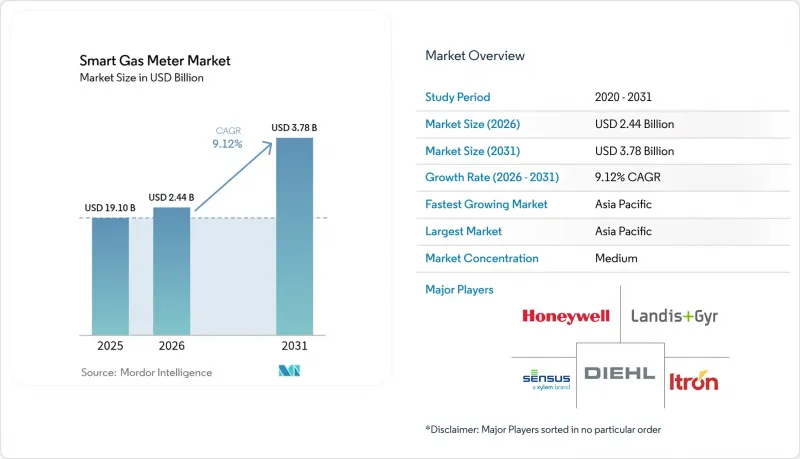
This report is Segmented by Meter Type (Diaphragm, Ultrasonic, Turbine, Rotary Piston, MEMS/Solid-state), Communication Technology (RF, PLC, GSM/GPRS, NB-IoT/LTE-M, Lorawan), Deployment Model (AMR, AMI), End-User (Residential, Commercial, Industrial), and Geography. The Market Forecasts are Provided in Terms of Value (USD) and Volume (Shipments).
Global Smart Gas Meter Market Trends and Insights
Regulatory Mandates and Mass Roll-outs
Governments have moved beyond voluntary adoption by setting hard deadlines that force utilities to act regardless of internal ROI hurdles. Australia's Energy Market Commission requires full residential smart gas coverage by 2030, while Germany mandates meters on all new heat-pump installations from 2025. The European Union's allowance of up to 2% hydrogen in distribution networks adds a compliance layer because legacy diaphragm devices cannot meet accuracy thresholds. FortisBC's 1.1 million-unit exchange running 2025-2028 illustrates how regulations convert discretionary investment into obligatory procurement. Vendors with certified cybersecurity and interoperability credentials are preferred as policymakers tie rollout approvals to data-protection standards.
Utility OPEX Reduction and Billing Accuracy
Utilities battling labor inflation and manual-reading delays can cut 80-90% of truck rolls while bumping billing accuracy from 95% to 99.5% . National Grid's combined electric-gas deployment shows that continuous data streams unlock time-of-use tariffs that shift demand and defer expensive peak-capacity upgrades. Leak-detection analytics reduce unaccounted-for gas losses and mitigate safety incidents, magnifying lifetime OPEX savings over 15-year meter lifecycles. These economic paybacks justify accelerated rollouts even in jurisdictions lacking direct mandates.
High CAPEX and Slow ROI
Smart meters cost USD 150-300 each versus USD 30-50 for mechanical units. When communications backhaul, head-end software, and cybersecurity upgrades are included, full-deployment costs can double. Payback periods stretch to 7-12 years, clashing with utilities' preference for quicker investment cycles. In emerging markets, foreign-exchange volatility and limited concessional funding widen the affordability gap, especially for small municipal utilities with sub-100,000 customer bases.
Other drivers and restraints analyzed in the detailed report include:
- Rising Downstream Natural-Gas Demand
- NB-IoT and LPWAN Boosting Battery Life and Coverage
- Cybersecurity and Data Privacy Risks
For complete list of drivers and restraints, kindly check the Table Of Contents.
Segment Analysis
Diaphragm devices accounted for 41.75% of the smart gas meters market size in 2025, a legacy advantage built on cost and incumbent installed base. Ultrasonic meters, though pricier, are projected to grow at a 12.1% CAGR as hydrogen blending and multi-gas scenarios demand higher accuracy bands.
The migration is most visible in Europe and Japan, where regulators reference ultrasonic performance in hydrogen-ready standards. Utilities prefer future-proof assets to avoid stranded costs should hydrogen ratios rise. Itron has shipped more than 1 million ultrasonic units, confirming scale economics and reliability gains. Turbine and rotary piston meters stay relevant in high-flow industrial niches, while MEMS-based solid-state sensors remain early-stage, constrained by temperature-drift concerns. With expanded production, ultrasonic list prices have fallen 18% since 2023, narrowing the gap and accelerating replacement cycles within the smart gas meters market.
RF solutions operating at 169 MHz in Europe and 902-928 MHz held 38.10% of the smart gas meters market share in 2025. However, NB-IoT/LTE-M is advancing at a 10.72% CAGR, taking share as utilities piggyback on nationwide cellular rollouts.
Cellular modules provide firmware-over-the-air, carrier-grade security, and deep indoor penetration. In China and Italy, national operators offer discounted NB-IoT tariffs to utilities, slashing connectivity OPEX. RF remains competitive in territories where utilities desire network ownership or cellular coverage is patchy, such as Alberta oil fields or rural Indonesia. PLC retains a niche where power-line infrastructure already exists, chiefly in European apartment blocks. LoRaWAN serves sparsely populated districts needing long-range, low-bit-rate connectivity. Over the forecast period, hybrid architectures combining RF mesh backhaul with NB-IoT edge redundancy are emerging to maximize reliability within the smart gas meters market.
Complete Report Scope:
- By Meter Type
- Diaphragm
- Ultrasonic
- Turbine
- Rotary Piston
- MEMS/Solid-state
- By Communication Technology
- RF (169/868 MHz)
- PLC
- GSM/GPRS
- NB-IoT/LTE-M
- LoRaWAN
- By Deployment Model
- Automatic Meter Reading (AMR)
- Advanced Metering Infrastructure (AMI)
- By End-user
- Residential
- Commercial
- Industrial
- By Geography
- North America
- United States
- Canada
- Mexico
- South America
- Brazil
- Argentina
- Rest of South America
- Europe
- Germany
- United Kingdom
- France
- Italy
- Spain
- Russia
- Rest of Europe
- Asia Pacific
- China
- Japan
- South Korea
- India
- Australia and New Zealand
- Rest of Asia Pacific
- Middle East
- Saudi Arabia
- United Arab Emirates
- Turkey
- Rest of the Middle East
- Africa
- South Africa
- Nigeria
- Rest of Africa
- North America
Geography Analysis
Asia Pacific dominated the smart gas meters market with a 41.65% share in 2025 and is advancing at a 15.2% CAGR through 2031. China's province-level smart-city budgets earmark gas metering as a priority, while Japan's net-zero roadmap forces utilities to upgrade to hydrogen-compatible devices. Local manufacturing ecosystems lower hardware costs by 12-18% versus imports, improving project IRR calculations. Osaka Gas Network's adoption of MEEQ SIM for mobile IoT management exemplifies the region's leadership in network innovation.
North America remains the second-largest smart gas meters market, shaped by structured replacement programs and cybersecurity regulation. FortisBC's 1.1 million-meter rollout running 2025-2028 illustrates the region's steady conversion pace. FERC cybersecurity standards, effective in 2025, elevate certification barriers, favoring established vendors with validated encryption stacks. The US Inflation Reduction Act's incentives for methane-leak reduction also sharpen the economic case for AMI adoption.
Europe shows robust growth driven by hydrogen blending and energy-security imperatives following geopolitical disruptions. Germany's 2025 heat-pump rule and the UK's push for 100% hydrogen-ready networks sustain procurement volume. Subsidy schemes under the EU Resilience and Recovery Facility help smaller DSOs finance AMI upgrades, while privacy and interoperability standards maintain vendor accountability.
The Middle East and Africa, though smaller, post above-average growth as governments deploy smart-city projects tied to 5.5G connectivity. Saudi Arabia's NEOM and the United Arab Emirates' Masdar City specify NB-IoT smart metering within master plans. Currency volatility and technical-skill shortages present challenges; however, multilaterals such as the World Bank's EDGE initiative are stepping in with concessional loans, smoothing adoption curves.
- Landis+Gyr Group AG
- Itron Inc.
- Honeywell International Inc.
- Sensus (Xylem Inc.)
- Diehl Stiftung and Co. KG
- Wasion Group Holdings Limited
- Azbil Kimmon Co. Ltd.
- Apator S.A.
- Zenner International GmbH
- Pietro Fiorentini S.p.A
- AEM Limited
- Holley Technology Ltd.
- Secure Meters Ltd.
- Chongqing Shancheng Gas Equipment Co., Ltd.
- Flonidan A/S
- SICK AG
Additional Benefits:
- The market estimate (ME) sheet in Excel format
- 3 months of analyst support
TABLE OF CONTENTS
1 INTRODUCTION
- 1.1 Study Assumptions and Market Definition
- 1.2 Scope of the Study
2 RESEARCH METHODOLOGY
3 EXECUTIVE SUMMARY
4 MARKET LANDSCAPE
- 4.1 Market Overview
- 4.2 Market Drivers
- 4.2.1 Regulatory mandates and mass roll-outs
- 4.2.2 Utility OPEX reduction and billing accuracy
- 4.2.3 Rising downstream natural-gas demand
- 4.2.4 NB-IoT and LPWAN boosting battery life and coverage
- 4.2.5 Mandatory replacement of ageing diaphragm meters
- 4.2.6 Safety-centric shift to ultrasonic meters w/ shut-off
- 4.3 Market Restraints
- 4.3.1 High CAPEX and slow ROI
- 4.3.2 Cybersecurity and data privacy risks
- 4.3.3 Semiconductor and battery supply constraints
- 4.3.4 Interoperability gaps in mixed-fleet retrofits
- 4.4 Value Chain Analysis
- 4.5 Regulatory Landscape
- 4.6 Natural-Gas Consumption Statistics
- 4.7 Porter's Five Forces Analysis
- 4.7.1 Bargaining Power of Suppliers
- 4.7.2 Bargaining Power of Buyers
- 4.7.3 Threat of New Entrants
- 4.7.4 Threat of Substitutes
- 4.7.5 Intensity of Rivalry
- 4.8 An Assessment of Macroeconomic Impact on the Market
5 MARKET SIZE AND GROWTH FORECASTS (VALUE AND VOLUME)
- 5.1 By Meter Type
- 5.1.1 Diaphragm
- 5.1.2 Ultrasonic
- 5.1.3 Turbine
- 5.1.4 Rotary Piston
- 5.1.5 MEMS/Solid-state
- 5.2 By Communication Technology
- 5.2.1 RF (169/868 MHz)
- 5.2.2 PLC
- 5.2.3 GSM/GPRS
- 5.2.4 NB-IoT/LTE-M
- 5.2.5 LoRaWAN
- 5.3 By Deployment Model
- 5.3.1 Automatic Meter Reading (AMR)
- 5.3.2 Advanced Metering Infrastructure (AMI)
- 5.4 By End-user
- 5.4.1 Residential
- 5.4.2 Commercial
- 5.4.3 Industrial
- 5.5 By Geography
- 5.5.1 North America
- 5.5.1.1 United States
- 5.5.1.2 Canada
- 5.5.1.3 Mexico
- 5.5.2 South America
- 5.5.2.1 Brazil
- 5.5.2.2 Argentina
- 5.5.2.3 Rest of South America
- 5.5.3 Europe
- 5.5.3.1 Germany
- 5.5.3.2 United Kingdom
- 5.5.3.3 France
- 5.5.3.4 Italy
- 5.5.3.5 Spain
- 5.5.3.6 Russia
- 5.5.3.7 Rest of Europe
- 5.5.4 Asia Pacific
- 5.5.4.1 China
- 5.5.4.2 Japan
- 5.5.4.3 South Korea
- 5.5.4.4 India
- 5.5.4.5 Australia and New Zealand
- 5.5.4.6 Rest of Asia Pacific
- 5.5.5 Middle East
- 5.5.5.1 Saudi Arabia
- 5.5.5.2 United Arab Emirates
- 5.5.5.3 Turkey
- 5.5.5.4 Rest of the Middle East
- 5.5.6 Africa
- 5.5.6.1 South Africa
- 5.5.6.2 Nigeria
- 5.5.6.3 Rest of Africa
- 5.5.1 North America
6 COMPETITIVE LANDSCAPE
- 6.1 Market Concentration
- 6.2 Strategic Moves
- 6.3 Market Share Analysis
- 6.4 Company Profiles (includes Global level Overview, Market level overview, Core Segments, Financials as available, Strategic Information, Market Rank/Share, Products and Services, Recent Developments)
- 6.4.1 Landis+Gyr Group AG
- 6.4.2 Itron Inc.
- 6.4.3 Honeywell International Inc.
- 6.4.4 Sensus (Xylem Inc.)
- 6.4.5 Diehl Stiftung and Co. KG
- 6.4.6 Wasion Group Holdings Limited
- 6.4.7 Azbil Kimmon Co. Ltd.
- 6.4.8 Apator S.A.
- 6.4.9 Zenner International GmbH
- 6.4.10 Pietro Fiorentini S.p.A
- 6.4.11 AEM Limited
- 6.4.12 Holley Technology Ltd.
- 6.4.13 Secure Meters Ltd.
- 6.4.14 Chongqing Shancheng Gas Equipment Co., Ltd.
- 6.4.15 Flonidan A/S
- 6.4.16 SICK AG
7 MARKET OPPORTUNITIES AND FUTURE OUTLOOK
- 7.1 White-space and Unmet-need Assessment

