PUBLISHER: Mordor Intelligence | PRODUCT CODE: 2122218

PUBLISHER: Mordor Intelligence | PRODUCT CODE: 2122218
Backup Power Systems - Market Share Analysis, Industry Trends & Statistics, Growth Forecasts (2026 - 2031)
According to Mordor Intelligence, the backup power systems market size was valued at USD 35.29 billion in 2025 and estimated to grow from USD 37.32 billion in 2026 to reach USD 49.35 billion by 2031, at a CAGR of 5.74% during the forecast period (2026-2031).
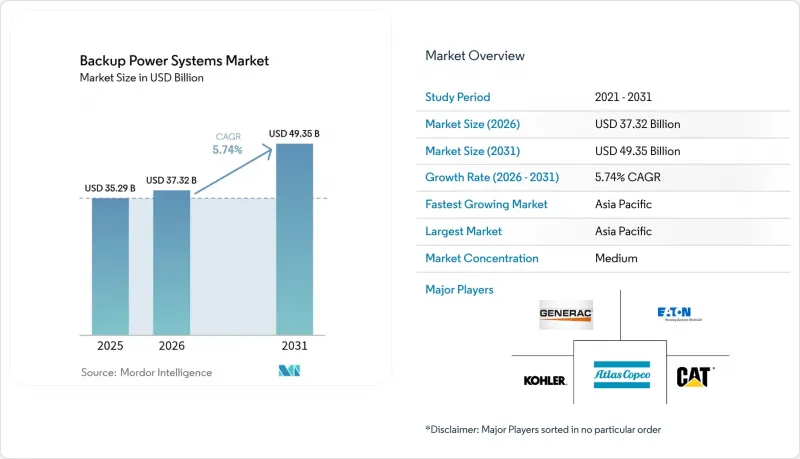
This report is Segmented by Technology (Diesel Generators, Gas Generators, Battery Energy Storage Systems, and More), Power Rating (Up To 50 KVA, 51 To 280 KVA, 501 To 2, 000 KVA, and More), Application (Standby/Emergency Power, Peak Shaving and Load Management, and More), End-User (Industrial and Manufacturing, Data Centres and IT, and More), and Geography (North America, Europe, Asia-Pacific, and More).
Global Backup Power Systems Market Trends and Insights
Grid-Outage Frequency & Economic Losses
Utilities are facing more frequent and severe-weather failures, and 80% of major U.S. outages between 2000 and 2023 were weather-related. Prolonged blackouts prompt enterprises to view backup capacity as operational insurance, particularly when downtime exceeds USD 100,000 per hour. Texas microgrid construction surged after the 2021 winter storm, with projects costing USD 2 million-USD 5 million per MW. Investments therefore favor higher-capacity systems that bridge multi-day disruptions. The modernization of aging grids trails behind reliability needs, so distributed assets remain a critical hedge through 2030. These conditions collectively drive the growth of the backup power systems market.
Expansion of Hyperscale & Edge Data-Centres
Global data-center power demand is on track to reach 35 GW in the United States alone by 2030, with hyperscalers accounting for 60% of that growth. Single campuses now request 1 GW or more of backup capacity, dwarfing previous facility norms. Edge roll-outs multiply the node count, each demanding 50-500 kW of standby supply to guarantee sub-10-millisecond latency. Battery systems gain favor for their silent operation and instantaneous switchover, a must in urban zones with strict noise limits. Renewable-energy power-purchase agreements introduce intermittency, prompting the development of hybrid diesel-battery stacks to protect AI workloads, thereby solidifying robust demand for the backup power systems market.
Volatile Diesel-Fuel Costs & High OPEX
Fuel accounts for up to 70% of a diesel set's lifetime operating expense, and price swings erode budgeting certainty. The Japan Data Center Council cautioned that simultaneous generator runs could strain regional diesel supply chains during lengthy emergencies.Carbon levies inflate delivered fuel prices, raising the total cost of ownership relative to batteries. Storage regulations in city centers often cap on-site volumes, forcing more frequent deliveries that raise logistics risk. These factors temper diesel uptake and moderate the growth rate of the backup power systems market.
Other drivers and restraints analyzed in the detailed report include:
- 24 X 7 Automated Industrial Operations
- Regulatory Mandates for Critical Facilities
- Substitution by Long-Duration BESS
For complete list of drivers and restraints, kindly check the Table Of Contents.
Segment Analysis
The backup power systems market size for diesel generators accounted for a 39.74% share, whereas BESS captured USD 5.76 billion and is projected to advance at a 13.1% CAGR through 2031. Diesel's entrenched fuel logistics keep it essential for remote mines and heavy industry, yet emissions caps motivate data-center and healthcare operators to pivot toward lithium-ion and emerging sodium-ion packs. The backup power systems market share for gas generators remains resilient because natural-gas pipelines offer extended runtimes during grid failures. UPS platforms keep IT racks online for seconds to minutes, bridging the gap until larger assets engage. Hybrid sets that blend PV, batteries, and diesel cut fuel consumption by 35% on islanded microgrids, improving project economics while satisfying carbon-reduction pledges. Fuel-cell pilots in California data centers illustrate future pathways if hydrogen supply chains mature.
A widening supplier base is reducing BESS system costs by 8-10% annually, and installations above 2 MWh now meet four-hour autonomy targets for edge campuses. Technology vendors embed AI controllers to cycle batteries for peak shaving, thereby monetizing the same hardware outside outage events. That dual-value model lifts return on investment and accelerates adoption across the backup power systems market.
Units rated 501-2,000 kVA captured 31.28% of the backup power systems market share in 2025, due to their suitability for mid-tier data halls, hospitals, and light-industrial campuses. Their 7.43% CAGR outlook exceeds that for smaller residential classes, where portable power stations satisfy only critical loads for a few hours. Standardized 1 MW blocks enable operators to scale in 1 MW increments, reducing engineering lead times by 25% compared to bespoke builds. Above-2,000 kVA packages dominate utility-scale stations and petrochemical complexes; however, order cycles are lumpy and tied to the approval of megaprojects.
Segments below 280 kVA serve telecom towers and retail stores, with lithium-iron-phosphate batteries replacing lead-acid banks to curb field maintenance. Vendors integrate remote diagnostics, allowing a single technician to oversee hundreds of dispersed installations, thereby lowering operating costs and supporting volume growth in the backup power systems market.
Complete Report Scope:
- By Technology
- Diesel Generators
- Gas Generators
- Uninterruptible Power Supply (UPS)
- Battery Energy Storage Systems (BESS)
- Hybrid Power Solutions
- Fuel-Cell Backup Systems
- Portable Power Stations
- By Power Rating
- Up to 50 kVA
- 51 to 280 kVA
- 281 to 500 kVA
- 501 to 2,000 kVA
- Above 2,000 kVA
- By Application
- Standby/Emergency Power
- Prime/Continuous Power
- Peak Shaving and Load Management
- Off-Grid and Remote Power
- By End-User
- Residential
- Commercial (Retail, Offices, Hospitality)
- Industrial and Manufacturing
- Data Centres and IT
- Healthcare Facilities
- Telecom Towers
- Utilities and Energy
- Government and Defence
- By Geography
- North America
- United States
- Canada
- Mexico
- Europe
- Germany
- United Kingdom
- France
- Italy
- NORDIC Countries
- Russia
- Rest of Europe
- Asia-Pacific
- China
- India
- Japan
- South Korea
- ASEAN Countries
- Rest of Asia-Pacific
- South America
- Brazil
- Argentina
- Rest of South America
- Middle East and Africa
- Saudi Arabia
- United Arab Emirates
- South Africa
- Egypt
- Rest of Middle East and Africa
- North America
Geography Analysis
Asia-Pacific captured 39.12% of 2025 revenue, and its 6.18% CAGR remains the highest among regions as China, India, and Japan add both hyperscale data halls and smart-factory capacity CBRE.COM. Chinese policy drives local battery suppliers to ramp production, which lowers regional costs and fuels further adoption. India's Production-Linked Incentive scheme for electronics stimulates the construction of new fabs, all of which require high-reliability backup. Japan's utilities pledge JPY 150 billion (USD 1.04 billion) in grid reinforcements tied to data-center clusters, spurring parallel backup system orders.
North America ranks second, driven by US cloud-provider spending and weather-related outage exposure that averages over 7 hours per customer annually. The backup power systems market size for the region benefits from tax credits on battery storage under the Inflation Reduction Act, tipping procurement toward lithium packs for peak shaving. Canada's remote mining belts still favor diesel, but pilot hydrogen-diesel dual-fuel rigs aim to cut emissions 15%.
Europe advances steadily as renewable penetration lifts intermittency risks. Germany's grid had 6.4 TWh of curtailed wind power in 2024, prompting factories to adopt combined heat-and-power engines that also serve as standby units. Ultra-Low-Emission Zones in London and Paris ban older diesel sets during smog alerts, catalyzing BESS retrofits. Southern Europe's wildfire seasons are lengthening, prompting telecoms to deploy containerized solar-battery solutions that meet silent-operation bylaws.
The Middle East and Africa benefit from data localization mandates that seed new Tier III colocation sites in Riyadh, Dubai, and Nairobi. High ambient temperatures shorten battery life, so hybrid gas-plus-battery solutions are often the preferred choice in initial builds. South America's grid investments trail demand growth, and diesel imports swell during drought-linked hydro-power deficits, keeping generator orders brisk. Together, these dynamics distribute growth widely across the backup power systems market.
- Caterpillar Inc.
- Cummins Inc.
- Generac Holdings Inc.
- Kohler Co.
- Eaton Corporation plc
- Schneider Electric SE
- ABB Ltd.
- Vertiv Group Corp.
- Mitsubishi Heavy Industries Ltd.
- Rolls-Royce Holdings plc (MTU)
- Siemens AG
- Honda Motor Co., Ltd.
- Yanmar Holdings Co., Ltd.
- Atlas Copco AB
- Doosan Portable Power
- Delta Electronics Inc.
- Huawei Technologies Co. Ltd.
- Toshiba Corporation
- Perkins Engines Co. Ltd.
- FG Wilson
- Briggs & Stratton LLC
- Goal Zero LLC
Additional Benefits:
- The market estimate (ME) sheet in Excel format
- 3 months of analyst support
TABLE OF CONTENTS
1 Introduction
- 1.1 Study Assumptions & Market Definition
- 1.2 Scope of the Study
2 Research Methodology
3 Executive Summary
4 Market Landscape
- 4.1 Market Overview
- 4.2 Market Drivers
- 4.2.1 Grid-outage frequency & economic losses
- 4.2.2 Expansion of hyperscale & edge data-centres
- 4.2.3 24 X 7 automated industrial operations
- 4.2.4 Regulatory mandates for critical facilities
- 4.2.5 Off-grid EV fast-charging corridors
- 4.2.6 AI-driven predictive maintenance adoption
- 4.3 Market Restraints
- 4.3.1 Volatile diesel-fuel costs & high OPEX
- 4.3.2 Substitution by long-duration BESS
- 4.3.3 Capital-intensive large-scale installs
- 4.3.4 Urban low-noise/ultra-low-emission zoning
- 4.4 Supply-Chain Analysis
- 4.5 Regulatory Landscape
- 4.6 Technological Outlook
- 4.7 Porter's Five Forces
- 4.7.1 Bargaining Power of Suppliers
- 4.7.2 Bargaining Power of Buyers
- 4.7.3 Threat of New Entrants
- 4.7.4 Threat of Substitutes
- 4.7.5 Competitive Rivalry
5 Market Size & Growth Forecasts
- 5.1 By Technology
- 5.1.1 Diesel Generators
- 5.1.2 Gas Generators
- 5.1.3 Uninterruptible Power Supply (UPS)
- 5.1.4 Battery Energy Storage Systems (BESS)
- 5.1.5 Hybrid Power Solutions
- 5.1.6 Fuel-Cell Backup Systems
- 5.1.7 Portable Power Stations
- 5.2 By Power Rating
- 5.2.1 Up to 50 kVA
- 5.2.2 51 to 280 kVA
- 5.2.3 281 to 500 kVA
- 5.2.4 501 to 2,000 kVA
- 5.2.5 Above 2,000 kVA
- 5.3 By Application
- 5.3.1 Standby/Emergency Power
- 5.3.2 Prime/Continuous Power
- 5.3.3 Peak Shaving and Load Management
- 5.3.4 Off-Grid and Remote Power
- 5.4 By End-User
- 5.4.1 Residential
- 5.4.2 Commercial (Retail, Offices, Hospitality)
- 5.4.3 Industrial and Manufacturing
- 5.4.4 Data Centres and IT
- 5.4.5 Healthcare Facilities
- 5.4.6 Telecom Towers
- 5.4.7 Utilities and Energy
- 5.4.8 Government and Defence
- 5.5 By Geography
- 5.5.1 North America
- 5.5.1.1 United States
- 5.5.1.2 Canada
- 5.5.1.3 Mexico
- 5.5.2 Europe
- 5.5.2.1 Germany
- 5.5.2.2 United Kingdom
- 5.5.2.3 France
- 5.5.2.4 Italy
- 5.5.2.5 NORDIC Countries
- 5.5.2.6 Russia
- 5.5.2.7 Rest of Europe
- 5.5.3 Asia-Pacific
- 5.5.3.1 China
- 5.5.3.2 India
- 5.5.3.3 Japan
- 5.5.3.4 South Korea
- 5.5.3.5 ASEAN Countries
- 5.5.3.6 Rest of Asia-Pacific
- 5.5.4 South America
- 5.5.4.1 Brazil
- 5.5.4.2 Argentina
- 5.5.4.3 Rest of South America
- 5.5.5 Middle East and Africa
- 5.5.5.1 Saudi Arabia
- 5.5.5.2 United Arab Emirates
- 5.5.5.3 South Africa
- 5.5.5.4 Egypt
- 5.5.5.5 Rest of Middle East and Africa
- 5.5.1 North America
6 Competitive Landscape
- 6.1 Market Concentration
- 6.2 Strategic Moves (M&A, Partnerships, PPAs)
- 6.3 Market Share Analysis (Market Rank/Share for key companies)
- 6.4 Company Profiles (includes Global level Overview, Market level overview, Core Segments, Financials as available, Strategic Information, Products & Services, and Recent Developments)
- 6.4.1 Caterpillar Inc.
- 6.4.2 Cummins Inc.
- 6.4.3 Generac Holdings Inc.
- 6.4.4 Kohler Co.
- 6.4.5 Eaton Corporation plc
- 6.4.6 Schneider Electric SE
- 6.4.7 ABB Ltd.
- 6.4.8 Vertiv Group Corp.
- 6.4.9 Mitsubishi Heavy Industries Ltd.
- 6.4.10 Rolls-Royce Holdings plc (MTU)
- 6.4.11 Siemens AG
- 6.4.12 Honda Motor Co., Ltd.
- 6.4.13 Yanmar Holdings Co., Ltd.
- 6.4.14 Atlas Copco AB
- 6.4.15 Doosan Portable Power
- 6.4.16 Delta Electronics Inc.
- 6.4.17 Huawei Technologies Co. Ltd.
- 6.4.18 Toshiba Corporation
- 6.4.19 Perkins Engines Co. Ltd.
- 6.4.20 FG Wilson
- 6.4.21 Briggs & Stratton LLC
- 6.4.22 Goal Zero LLC
7 Market Opportunities & Future Outlook
- 7.1 White-Space & Unmet-Need Assessment

