PUBLISHER: Mordor Intelligence | PRODUCT CODE: 2116300

PUBLISHER: Mordor Intelligence | PRODUCT CODE: 2116300
United States Backup Power Systems - Market Share Analysis, Industry Trends & Statistics, Growth Forecasts (2026 - 2031)
According to Mordor Intelligence, the United States backup power systems market size was valued at USD 5.53 billion in 2025 and is estimated to grow from USD 5.84 billion in 2026 to reach USD 7.55 billion by 2031, at a CAGR of 5.28% during the forecast period (2026-2031).
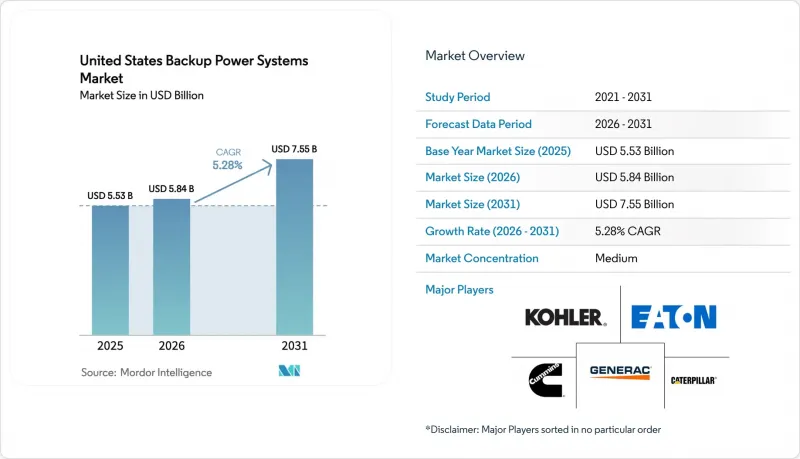
This report is Segmented by Technology (Gas Generators, Battery Energy Storage Systems, Fuel-Cell Backup Systems, and More), Power Rating (Up To 50 KVA, 50 To 280 KVA, 280 To 500 KVA, 500 To 2, 000 KVA, and Above 2, 000 KVA), Application (Standby/Emergency Power, Off-Grid and Remote Power, and More), and End-User (Industrial and Manufacturing, Commercial, Data Centers and IT, and More).
United States Backup Power Systems Market Trends and Insights
Increasing Data-Center Footprint
Hyperscale operators commissioned 11 gigawatts of additional white-space in 2025, prompting 23 gigawatts of redundant onsite generation to satisfy N+1 and 2N topologies. Loudoun County added 1.2 gigawatts of diesel and gas sets, straining local air-quality compliance and catalyzing battery-assisted runtime pilots. Power-density escalation toward 50-60 kilowatts per rack now requires backup systems to stabilize voltage in milliseconds, elevating demand for hybrid UPS paired with quick-start gas turbines. Secondary hubs in Oregon and Texas are scaling because of renewable energy access and land availability, yet transmission congestion heightens the strategic value of onsite standby power. Collectively, these deployments embed long-term growth for the United States backup power systems market.
Severe Grid-Outage Frequency and Duration
The System Average Interruption Duration Index for investor-owned utilities rose 15% in 2024, reflecting extreme weather and equipment aging. Hurricane events in Florida and Louisiana during the 2025 season caused outages averaging 72 hours, spurring insurers to mandate backup generation for policy renewal. California logged 38 days of Public Safety Power Shutoffs in 2025, with some circuits de-energized for 200-plus hours, thereby shifting backup economics from rarely used assets to frequently dispatched resources. Ice storms in Vermont and Maine triggered week-long blackouts, leading to state bills that offer tax credits on residential units above 10 kilowatts. The persistent nature of outages embeds backup power procurement into capital budgets across every vertical, reinforcing growth in the United States backup power systems market.
Tightening EPA Emission Caps
Tier 4 Final rules cap particulate matter at 0.03 g/kWh and NOx at 0.4 g/kWh, adding USD 8,000-15,000 per genset for after-treatment hardware. California's Air Resources Board mandates extra filter regeneration cycles, lifting annual maintenance outlays 12-18%. Best Available Control Technology permitting extends diesel project timelines up to nine months in Los Angeles and the San Joaquin Valley, pushing buyers toward natural-gas and propane units that emit 60% less NOx. Secondary markets for used gensets weaken because non-compliant equipment cannot be resold, raising lifecycle costs. This dynamic trims near-term diesel demand, tempering growth for the United States backup power systems market.
Other drivers and restraints analyzed in the detailed report include:
- Growth of AI-Enabled Manufacturing Lines
- Mandatory Resiliency Codes for Commercial Buildings
- Capital-Allocation Shift Toward On-Site PV-Plus-Storage
For complete list of drivers and restraints, kindly check the Table Of Contents.
Segment Analysis
Gas generators captured 40.2% of 2025 revenue, reflecting widespread pipeline coverage to 77% of commercial sites and lower selective catalytic reduction costs compared with diesel. Fuel-cell platforms, although smaller today, are growing at a 9.6% CAGR in the United States backup power systems market size through 2031 because corporate net-zero pledges and California's 2028 zero-emission mandate incentivize hydrogen and solid-oxide systems.
Diesel sets remain economical for code-minimum standby use where annual operation remains below 100 hours, yet Tier 4 compliance outlays and resale limitations are eroding share. Lithium-ion UPS dominates the sub-50 kVA tier that guards sensitive IT loads, while battery energy storage systems monetize demand-charge avoidance and ancillary-services revenue. Hybrid diesel-plus-battery packages are emerging in microgrids for military bases and remote industrial sites, cutting fuel burn by 30-40% and supporting the broader United States backup power systems market.
The 500-2,000 kVA class held 38.5% of the 2025 market and is set to rise 5.8% annually, underscoring its appeal for multi-tenant data halls and mid-sized factories that need N+1 redundancy without oversizing. Modular enclosures allow parallel operation in 500-kW increments, aligning capacity with demand ramps and preserving capital.
Above-2,000 kVA sets serve hyperscale campuses where 3-4 MW singles reduce interconnect complexity, but they face 12-18 month lead times for custom switchgear, tempering uptake. Units up to 50 kVA dominate residential demand and small commercial offices; natural-gas variants command 65% because of automatic transfer and unlimited runtime. The 50-280 kVA cohort protects retail, hospitality, and small clinics by covering refrigeration and life-safety loads, offering a three-to-five-year payback via avoided spoilage. This nuanced mix supports sustained volume in the United States backup power systems market.
Complete Report Scope:
- By Technology
- Diesel Generators
- Gas Generators
- Uninterruptible Power Supply (UPS)
- Battery Energy Storage Systems (BESS)
- Hybrid Power Solutions
- Fuel-Cell Backup Systems
- Portable Power Stations
- By Power Rating
- Up to 50 kVA
- 50 to 280 kVA
- 280 to 500 kVA
- 500 to 2,000 kVA
- Above 2,000 kVA
- By Application
- Standby/Emergency Power
- Prime/Continuous Power
- Peak Shaving and Load Management
- Off-Grid and Remote Power
- By End-User
- Residential
- Commercial (Retail, Offices, Hospitality)
- Industrial and Manufacturing
- Data Centers and IT
- Healthcare Facilities
- Telecom Towers
- Utilities and Energy
- Government and Defence
List of Companies Covered in this Report:
- Atlas Copco AB
- Briggs & Stratton Corp.
- Caterpillar Inc.
- Cummins Inc.
- Eaton Corp. PLC
- Emerson Electric Co.
- Generac Holdings Inc.
- General Electric Co.
- Kohler Co.
- Mitsubishi Electric Corp.
- Schneider Electric SE
- Vertiv Group Corp.
- ABB Ltd.
- Tesla Inc. (Powerwall/Powerpack)
- Aggreko Ltd.
- United Rentals Inc.
- Honda Motor Co. (Generators)
- Rolls-Royce Power Systems (MTU)
- Wartsila Corp.
- Doosan Portable Power
Additional Benefits:
- The market estimate (ME) sheet in Excel format
- 3 months of analyst support
TABLE OF CONTENTS
1 Introduction
- 1.1 Study Assumptions & Market Definition
- 1.2 Scope of the Study
2 Research Methodology
3 Executive Summary
4 Market Landscape
- 4.1 Market Overview
- 4.2 Market Drivers
- 4.2.1 Increasing data-center footprint
- 4.2.2 Severe grid-outage frequency & duration
- 4.2.3 Growth of AI-enabled manufacturing lines
- 4.2.4 Electrification of critical healthcare assets
- 4.2.5 Mandatory resiliency codes for commercial buildings
- 4.2.6 AI-driven predictive-maintenance platforms unlock TCO savings
- 4.3 Market Restraints
- 4.3.1 Tightening EPA emission caps (Tier 4 Final)
- 4.3.2 Rising interest-rates inflate capex for large gensets
- 4.3.3 Lithium-ion fire-safety concerns in UPS rooms
- 4.3.4 Capital-allocation shift toward on-site PV-plus-storage
- 4.4 Supply-Chain Analysis
- 4.5 Regulatory Landscape
- 4.6 Technological Outlook
- 4.7 Porter's Five Forces
- 4.7.1 Threat of New Entrants
- 4.7.2 Bargaining Power of Buyers
- 4.7.3 Bargaining Power of Suppliers
- 4.7.4 Threat of Substitutes
- 4.7.5 Competitive Rivalry
- 4.8 PESTLE Analysis
5 Market Size & Growth Forecasts
- 5.1 By Technology
- 5.1.1 Diesel Generators
- 5.1.2 Gas Generators
- 5.1.3 Uninterruptible Power Supply (UPS)
- 5.1.4 Battery Energy Storage Systems (BESS)
- 5.1.5 Hybrid Power Solutions
- 5.1.6 Fuel-Cell Backup Systems
- 5.1.7 Portable Power Stations
- 5.2 By Power Rating
- 5.2.1 Up to 50 kVA
- 5.2.2 50 to 280 kVA
- 5.2.3 280 to 500 kVA
- 5.2.4 500 to 2,000 kVA
- 5.2.5 Above 2,000 kVA
- 5.3 By Application
- 5.3.1 Standby/Emergency Power
- 5.3.2 Prime/Continuous Power
- 5.3.3 Peak Shaving and Load Management
- 5.3.4 Off-Grid and Remote Power
- 5.4 By End-User
- 5.4.1 Residential
- 5.4.2 Commercial (Retail, Offices, Hospitality)
- 5.4.3 Industrial and Manufacturing
- 5.4.4 Data Centers and IT
- 5.4.5 Healthcare Facilities
- 5.4.6 Telecom Towers
- 5.4.7 Utilities and Energy
- 5.4.8 Government and Defence
6 Competitive Landscape
- 6.1 Market Concentration
- 6.2 Strategic Moves (M&A, Partnerships, PPAs)
- 6.3 Market Share Analysis (Market Rank/Share for key companies)
- 6.4 Company Profiles (includes Global level Overview, Market level overview, Core Segments, Financials as available, Strategic Information, Products & Services, and Recent Developments)
- 6.4.1 Atlas Copco AB
- 6.4.2 Briggs & Stratton Corp.
- 6.4.3 Caterpillar Inc.
- 6.4.4 Cummins Inc.
- 6.4.5 Eaton Corp. PLC
- 6.4.6 Emerson Electric Co.
- 6.4.7 Generac Holdings Inc.
- 6.4.8 General Electric Co.
- 6.4.9 Kohler Co.
- 6.4.10 Mitsubishi Electric Corp.
- 6.4.11 Schneider Electric SE
- 6.4.12 Vertiv Group Corp.
- 6.4.13 ABB Ltd.
- 6.4.14 Tesla Inc. (Powerwall/Powerpack)
- 6.4.15 Aggreko Ltd.
- 6.4.16 United Rentals Inc.
- 6.4.17 Honda Motor Co. (Generators)
- 6.4.18 Rolls-Royce Power Systems (MTU)
- 6.4.19 Wartsila Corp.
- 6.4.20 Doosan Portable Power
7 Market Opportunities & Future Outlook
- 7.1 White-space & Unmet-Need Assessment

