PUBLISHER: Mordor Intelligence | PRODUCT CODE: 2122584

PUBLISHER: Mordor Intelligence | PRODUCT CODE: 2122584
Human Recombinant Insulin - Market Share Analysis, Industry Trends & Statistics, Growth Forecasts (2026 - 2031)
According to Mordor Intelligence, the human recombinant insulin market size in 2026 is estimated at USD 31.59 billion, growing from 2025 value of USD 29.30 billion with 2031 projections showing USD 45.97 billion, growing at 7.80% CAGR over 2026-2031.
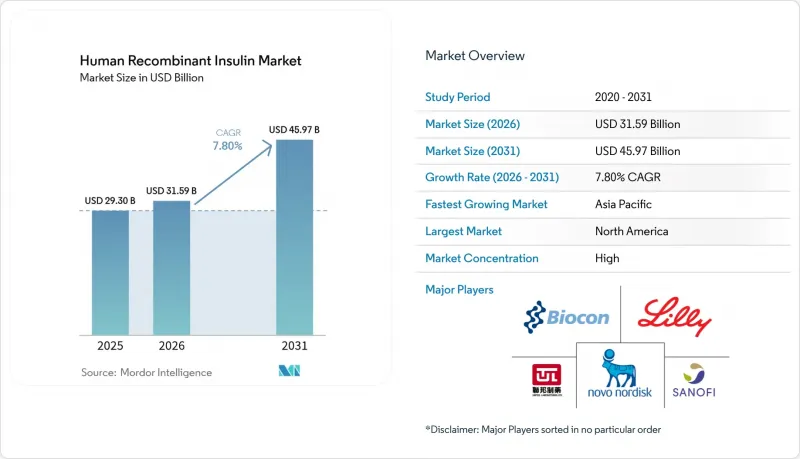
This report is Segmented by Drug Type (Short-Acting Human Insulin, and More), Brand (Humulin, and More), Delivery Device (Vials & Syringes, Insulin Pens (Reusable & Disposable), and More), Diabetes Type (Type-1 Diabetes and Type-2 Diabetes), End User (Hospitals & Clinics, and More), Geography (North America, and More). The Market Forecasts are Provided in Terms of Value (USD).
Global Human Recombinant Insulin Market Trends and Insights
Rising Global Diabetes Prevalence
Diabetes incidence has surged to more than 800 million patients, fundamentally stretching health-system capacity and cementing long-duration demand for insulin. Type-2 Diabetes prevalence is rising fastest in urbanizing Asian and Middle-Eastern economies where sedentary lifestyles and dietary shifts converge. As treatment adherence improves, unit volumes climb because insulin therapy typically starts earlier in the disease continuum. The predictable lifetime-use nature of insulin supports the multibillion-dollar factory investments now underway. That manufacturing build-out, in turn, strengthens supply security and positions leaders to meet the expanding patient base.
Expanding National Reimbursement Programs
Affordability initiatives directly translate into higher script volumes. In the United States, the Medicare Part D USD 35 monthly cap takes effect in 2026, neutralizing price as a barrier for millions of seniors. European payers are tightening cost-effectiveness thresholds yet still broaden access by giving biosimilars preferred formulary slots. India's production-linked incentive scheme, scheduled for 2026, mixes industrial policy with patient-access goals by rewarding local output of diabetes medicines. These actions collectively enlarge the treated population and change brand-choice dynamics inside formularies.
Stringent Global Price Controls
Affordability mandates compress margins and can redirect R&D budgets. The Inflation Reduction Act capped U.S. Medicare insulin prices and catalyzed a voluntary 70% list-price cut for Tresiba and Fiasp effective January 2026. Europe now assesses all diabetes therapies against cost-effectiveness benchmarks, putting premium analogues under budget-holder scrutiny. China's volume-based procurement scheme forces deep discounts for tender winners. Collectively, these policies push manufacturers to find savings in production efficiency and portfolio mix rather than price increases.
Other drivers and restraints analyzed in the detailed report include:
- Growing Adoption of Biosimilar Insulins
- Localization of Biomanufacturing Facilities
- Supply Chain Vulnerabilities in Cold Storage
For complete list of drivers and restraints, kindly check the Table Of Contents.
Segment Analysis
Premixed Human Insulin is the breakout growth story, tracking a 9.22% CAGR for 2026-2031 on the promise of fewer daily injections. Short-Acting formulations still hold the largest slice at 37.88% in 2025, anchoring the human recombinant insulin market through their critical role in mealtime glucose control. Intermediate-Acting products, although clinically valuable, face substitution risk from newer co-formulations that combine basal and bolus action in a single pen.
The human recombinant insulin market responds to patients' desire for simple regimens, pushing firms to refine biphasic ratios that better mimic physiologic profiles. Capacity allocation also shapes growth: Novo Nordisk's choice to cease Levemir production frees tanks for higher-value analogues, hinting that legacy segments may contract faster than demand alone would dictate. Weekly basal candidates remain in limbo after a U.S. filing setback, yet China's nod to insulin icodec displays regional divergence in benefit-risk tolerance.
Humulin commanded 31.02% revenue in 2025, reflecting decades-deep formulary entrenchment. Still, Sanofi's Insuman is on a faster trajectory with a 9.51% CAGR, buoyed by targeted pricing in emerging markets and expanding biosimilar lines. Novolin leverages wide retail distribution but lags on innovation hooks that resonate with payers.
Biosimilar pressure accelerates as patents sunset. Originators adopt "umbrella" strategies: Eli Lilly released an unbranded lispro at half list price to blunt share erosion while protecting rebate flows on the branded SKU. Europe supplies an early look at end-game dynamics, where multiple glargine biosimilars coexist and originator list prices fell yet net prices, after rebates, remain opaque. The human recombinant insulin market thus illustrates how list-price optics diverge from actual transaction economics.
Complete Report Scope:
- By Drug Type
- Short-Acting Human Insulin
- Intermediate-Acting Human Insulin
- Premixed Human Insulin
- By Brand
- Humulin
- Insuman
- Novolin
- Other Brands
- By Delivery Device
- Vials & Syringes
- Insulin Pens (Reusable & Disposable)
- Insulin Pumps & Patch Pumps
- By Diabetes Type
- Type-1 Diabetes
- Type-2 Diabetes
- By End User
- Hospitals & Clinics
- Homecare / Self-Administration
- Geography
- North America
- United States
- Canada
- Mexico
- Europe
- Germany
- United Kingdom
- France
- Italy
- Spain
- Rest of Europe
- Asia-Pacific
- China
- Japan
- India
- Australia
- South Korea
- Rest of Asia-Pacific
- Middle East & Africa
- GCC
- South Africa
- Rest of Middle East & Africa
- South America
- Brazil
- Argentina
- Rest of South America
- North America
Geography Analysis
North America led with 41.98% of 2025 revenue, fueled by comprehensive insurance coverage and rapid adoption of next-generation delivery systems. The Medicare USD 35 cap, effective 2026, will further secure demand continuity for the human recombinant insulin market. Manufacturers cement local supply: Novo Nordisk's North Carolina site and Eli Lilly's Indiana complex collectively add more than 7 million square feet of formulation and fill-finish capacity.
Asia-Pacific is set to deliver the fastest 8.63% CAGR through 2031. China holds the world's largest diabetic population and has recently accelerated regulatory review timelines for priority drugs. Domestic manufacturing incentives encourage both multinationals and homegrown firms to build plants, tightening cost competition. India's incentive program will similarly foster local output and could position the country as a regional export hub, deepening the human recombinant insulin market reach.
Europe exhibits a mature yet evolving environment. Health Technology Assessment bodies scrutinize relative cost-effectiveness, giving biosimilars a tailwind and restraining price inflation. EMA guideline updates in 2024 integrated economic considerations into therapy selection, nudging prescribers toward lower-priced options without compromising clinical efficacy. Price-volume contracts remain common, with originator discounting strategies keeping some biosimilar advantages in check.
Middle East & Africa and South America together account for a modest but rising slice. Recent pooled procurement pilots in Africa lowered per-vial costs by double digits, albeit straining supplier margins. Infrastructure investments in refrigerated warehousing are pivotal, as cold-chain lapses currently drive intermittent stock-outs that cap growth potential. Success in these regions will depend on adaptable distribution models and localized value-add services that ensure consistent supply.
- Novo Nordisk
- Eli Lilly and Company
- Sanofi
- Biocon Ltd
- Bioton
- Gan & Lee Pharmaceuticals
- Julphar
- Zhuhai United Laboratories
- Tonghua Dongbao Pharmaceutical
- Wockhardt
- Aspen Pharmacare
- Sandoz (Novartis)
- Ypsomed
- Dongfeng Biologics
- Civica Rx
- MannKind
- Adocia
- Biopharmax
- Oramed Pharmaceuticals
- Hanmi Pharm
Additional Benefits:
- The market estimate (ME) sheet in Excel format
- 3 months of analyst support
TABLE OF CONTENTS
1 Introduction
- 1.1 Study Assumptions & Market Definition
- 1.2 Scope of the Study
2 Research Methodology
3 Executive Summary
4 Market Landscape
- 4.1 Market Overview
- 4.2 Market Drivers
- 4.2.1 Rising Global Diabetes Prevalence
- 4.2.2 Expanding National Reimbursement Programs
- 4.2.3 Growing Adoption of Biosimilar Insulins
- 4.2.4 Localization of Biomanufacturing Facilities
- 4.2.5 Technological Advances in Yeast Fermentation Efficiency
- 4.2.6 Strategic Pooled Procurement in Emerging Economies
- 4.3 Market Restraints
- 4.3.1 Stringent Global Price Controls
- 4.3.2 Supply Chain Vulnerabilities in Cold Storage
- 4.3.3 High Entry Barriers Due To Biologics Manufacturing Complexity
- 4.3.4 Persistent Plasmid DNA Production Bottlenecks
- 4.4 Regulatory Landscape
- 4.5 Porter's Five Forces Analysis
- 4.5.1 Bargaining Power Of Buyers/Consumers
- 4.5.2 Bargaining Power Of Suppliers
- 4.5.3 Threat Of New Entrants
- 4.5.4 Threat Of Substitute Products
- 4.5.5 Intensity Of Competitive Rivalry
5 Market Size & Growth Forecasts (Value, USD)
- 5.1 By Drug Type
- 5.1.1 Short-Acting Human Insulin
- 5.1.2 Intermediate-Acting Human Insulin
- 5.1.3 Premixed Human Insulin
- 5.2 By Brand
- 5.2.1 Humulin
- 5.2.2 Insuman
- 5.2.3 Novolin
- 5.2.4 Other Brands
- 5.3 By Delivery Device
- 5.3.1 Vials & Syringes
- 5.3.2 Insulin Pens (Reusable & Disposable)
- 5.3.3 Insulin Pumps & Patch Pumps
- 5.4 By Diabetes Type
- 5.4.1 Type-1 Diabetes
- 5.4.2 Type-2 Diabetes
- 5.5 By End User
- 5.5.1 Hospitals & Clinics
- 5.5.2 Homecare / Self-Administration
- 5.6 Geography
- 5.6.1 North America
- 5.6.1.1 United States
- 5.6.1.2 Canada
- 5.6.1.3 Mexico
- 5.6.2 Europe
- 5.6.2.1 Germany
- 5.6.2.2 United Kingdom
- 5.6.2.3 France
- 5.6.2.4 Italy
- 5.6.2.5 Spain
- 5.6.2.6 Rest of Europe
- 5.6.3 Asia-Pacific
- 5.6.3.1 China
- 5.6.3.2 Japan
- 5.6.3.3 India
- 5.6.3.4 Australia
- 5.6.3.5 South Korea
- 5.6.3.6 Rest of Asia-Pacific
- 5.6.4 Middle East & Africa
- 5.6.4.1 GCC
- 5.6.4.2 South Africa
- 5.6.4.3 Rest of Middle East & Africa
- 5.6.5 South America
- 5.6.5.1 Brazil
- 5.6.5.2 Argentina
- 5.6.5.3 Rest of South America
- 5.6.1 North America
6 Competitive Landscape
- 6.1 Market Concentration
- 6.2 Market Share Analysis
- 6.3 Company Profiles (includes Global level Overview, Market level overview, Core Business Segments, Financials, Headcount, Key Information, Market Rank, Market Share, Products and Services, and analysis of Recent Developments)
- 6.3.1 Novo Nordisk A/S
- 6.3.2 Eli Lilly And Company
- 6.3.3 Sanofi S.A.
- 6.3.4 Biocon Ltd
- 6.3.5 Bioton S.A.
- 6.3.6 Gan & Lee Pharmaceuticals
- 6.3.7 Julphar Gulf Pharmaceutical Industries
- 6.3.8 Zhuhai United Laboratories Co., Ltd.
- 6.3.9 Tonghua Dongbao Pharmaceutical
- 6.3.10 Wockhardt Ltd
- 6.3.11 Aspen Pharmacare
- 6.3.12 Sandoz (Novartis)
- 6.3.13 Ypsomed AG
- 6.3.14 Dongfeng Biologics
- 6.3.15 Civica Rx
- 6.3.16 MannKind Corporation
- 6.3.17 Adocia
- 6.3.18 Biopharmax
- 6.3.19 Oramed Pharmaceuticals
- 6.3.20 Hanmi Pharm
7 Market Opportunities & Future Outlook
- 7.1 White-Space & Unmet-Need Assessment

