PUBLISHER: Mordor Intelligence | PRODUCT CODE: 2123073

PUBLISHER: Mordor Intelligence | PRODUCT CODE: 2123073
Virtual Private Network - Market Share Analysis, Industry Trends & Statistics, Growth Forecasts (2026 - 2031)
According to Mordor Intelligence, the virtual private network market size is expected to grow from USD 61.26 billion in 2025 to USD 70.46 billion in 2026 and is forecast to reach USD 142.06 billion by 2031 at 15.05% CAGR over 2026-2031.
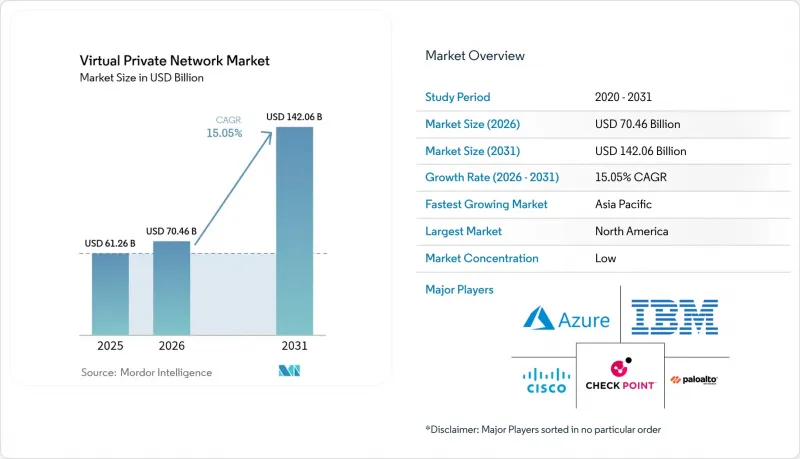
This report is Segmented by Component (Hardware, Software, Services), Type (Hosted/Managed, Ipsec VPN, MPLS VPN and More), Deployment Mode (Cloud, On-Premise), End-User Industry (BFSI, Healthcare and Life Sciences, IT and Telecom and More), and by Geography. The Market Forecasts are Provided in Terms of Value (USD).
Global Virtual Private Network Market Trends and Insights
Rising Hybrid-Workforce Dependence on Secure Remote Access
Shifts in work patterns have elevated VPN connectivity to business-critical status. The New York City Department of Education migrated more than 1 million users and 2 million devices to a zero-trust framework and reported a 15% reduction in attacks alongside a 40% increase in blocked threats. Enterprises increasingly adopt cloud-native SASE platforms that route traffic directly to applications, eliminating the latency and patching burdens found in traditional concentrators.
Proliferation of IoT Devices Requiring Encrypted Connectivity
Industrial networks now demand granular, identity-based access. Cisco's Secure Equipment Access replaces broad VPN tunnels with fine-grained, zero-trust controls for operational technology resources. At Guangdong University, China Mobile's 5G VPN delivered ten-fold downlink speed versus legacy solutions while supporting 20,000 concurrent users.
Talent Shortage in VPN/SASE Administration Inflating Total Cost of Ownership
Demand for skilled engineers exceeds supply, pushing organizations toward managed services. Providers report staffing outlays approaching 30% of total operating expense, steering customers to integrated SASE offerings that reduce manual upkeep.
Other drivers and restraints analyzed in the detailed report include:
- Escalating Ransomware Losses Driving Zero-Trust Network Spending
- Cloud-Native Application Adoption Boosting Demand for Cloud VPN and SASE
- Performance and Latency Penalties Versus SDP and ZTNA Alternatives
For complete list of drivers and restraints, kindly check the Table Of Contents.
Segment Analysis
Hardware appliances accounted for 42.80% of the virtual private network market in 2025, underpinning many large-scale remote access roll-outs. Segment resilience is tied to long refresh cycles in sectors with on-premises compliance mandates. Yet software is growing at a 15.72% CAGR, fueled by containerized gateways and virtual firewalls that deploy in minutes on hyperscale clouds. Supply-chain tightness around semiconductors catalyzed adoption of cloud-hosted images such as pfSense Plus on AWS and Azure, accelerating proofs of concept. Services revenue, spanning managed operations and implementation projects, scales in tandem with SASE transitions and currently forms the third pillar of component spend. Organizations continue to blend hardware for on-site performance with software gateways to extend reach, signalling coexistence rather than replacement.
Hosted and managed offerings secured 24.45% of virtual private network market share in 2025 as enterprises shifted maintenance burdens to specialists. These services integrate continuous updates, threat intelligence feeds, and 24X7 monitoring within predictable subscription models. Meanwhile, MPLS VPN shows a renaissance, pacing at 16.52% CAGR as firms require deterministic latency for hybrid cloud and mission-critical collaboration. Cloud VPN and broader SASE suites converge IPsec, SD-WAN, and firewall-as-a-service under unified orchestration, trimming policy sprawl. IPsec VPN remains essential for defense and government entities adhering to established protocol accreditation, while emerging WireGuard solutions emphasize streamlined code bases and near-line-rate throughput.
Complete Report Scope:
- By Component
- Hardware
- Software
- Services
- By Type
- Hosted / Managed
- IPsec VPN
- MPLS VPN
- Cloud VPN / SASE
- Others
- By Deployment Mode
- Cloud
- On-premise
- By End-User Industry
- BFSI
- Healthcare and Life Sciences
- IT and Telecom
- Government and Public Sector
- Manufacturing and Industrial
- Retail and E-Commerce
- Education
- Others
- By Geography
- North America
- United States
- Canada
- Mexico
- South America
- Brazil
- Argentina
- Rest of South America
- Europe
- Germany
- United Kingdom
- France
- Netherlands
- Rest of Europe
- Asia-Pacific
- China
- Japan
- India
- South Korea
- Australia and New Zealand
- Rest of Asia-Pacific
- Middle East and Africa
- Middle East
- United Arab Emirates
- Saudi Arabia
- Turkey
- Rest of Middle East
- Africa
- South Africa
- Nigeria
- Rest of Africa
- Middle East
- North America
Geography Analysis
North America remained the largest regional contributor with 26.85% of virtual private network market revenue in 2025. Spending momentum is sustained by early zero-trust pilots and stringent breach disclosure regulations. Federal and state programs accelerate upgrades from IPsec concentrators to identity-centric SASE nodes, while hyperscalers' dense PoP distribution keeps latency low for dispersed users.
Asia-Pacific delivers the fastest expansion at 15.96% CAGR. Massive digitization programs, combined with rising cyber insurance uptake, push enterprises to secure cloud workloads and mobile workforces. Trials in Chinese universities demonstrate ten-fold performance gains for mobile VPN on 5G stand-alone networks. India's financial regulators now require encrypted connectivity for outsourced processing centers, further catalyzing adoption.
Europe maintains steady progress under General Data Protection Regulation enforcement. Enterprises prefer providers with in-region data centers to ensure sovereignty, and many layer VPN with data-loss prevention for compliance. Government projects in Germany and France specify post-quantum readiness in new remote access procurement.
Meanwhile, Middle East and Africa benefit from Starlink roll-outs that extend broadband to rural districts; VPN services ride on top to protect emerging e-commerce and e-government traffic. Latin America gains traction as Brazilian banks and Mexican retailers embrace managed VPN to bypass local talent shortages.
- Cisco Systems Inc.
- Microsoft Corp. (Azure)
- Palo Alto Networks Inc.
- Check Point Software Technologies Ltd.
- IBM Corp.
- Nord Security (NordVPN)
- Kape Technologies PLC (ExpressVPN, CyberGhost)
- Avast s.r.o. (AVG Secure)
- Fortinet Inc.
- Juniper Networks Inc.
- OpenVPN Inc.
- Citrix Systems Inc.
- Array Networks Inc.
- NetMotion Software Inc. (Absolute Secure Access)
- Golden Frog GmbH (VyprVPN)
- Cloudflare Inc. (Cloudflare One / WARP)
- Google LLC (Google VPN)
- McAfee LLC
- Sophos Ltd.
- F5 Inc. (BIG-IP APM)
- Zscaler Inc. (Zscaler Private Access)
- Barracuda Networks Inc.
- Perimeter 81 Ltd.
- Tailscale Inc.
- WireGuard Development Team
Additional Benefits:
- The market estimate (ME) sheet in Excel format
- 3 months of analyst support
TABLE OF CONTENTS
1 INTRODUCTION
- 1.1 Study Assumptions and Market Definition
- 1.2 Scope of the Study
2 RESEARCH METHODOLOGY
3 EXECUTIVE SUMMARY
4 MARKET LANDSCAPE
- 4.1 Market Overview
- 4.2 Market Drivers
- 4.2.1 Rising hybrid-workforce dependence on secure remote access
- 4.2.2 Proliferation of IoT devices requiring encrypted connectivity
- 4.2.3 Escalating ransomware losses driving zero-trust network spending
- 4.2.4 Cloud-native application adoption boosting demand for Cloud VPN and SASE
- 4.2.5 Emergence of privacy regulations (GDPR, CPRA, LGPD) spurring corporate VPN roll-outs
- 4.2.6 Satellite broadband expansion in emerging regions unlocking new VPN user bases
- 4.3 Market Restraints
- 4.3.1 Talent shortage in VPN/SASE administration inflating total cost of ownership
- 4.3.2 Performance/latency penalties versus SDP and ZTNA alternatives
- 4.3.3 Heightened regulatory scrutiny on consumer VPN logging practices
- 4.3.4 Commodity pricing wars among 400+ retail VPN brands squeezing margins
- 4.4 Supply-Chain Analysis
- 4.5 Regulatory Landscape
- 4.6 Technological Outlook (WireGuard, Post-Quantum, SASE Convergence)
- 4.7 Porter's Five Forces
- 4.7.1 Threat of New Entrants
- 4.7.2 Bargaining Power of Buyers/Consumers
- 4.7.3 Bargaining Power of Suppliers
- 4.7.4 Threat of Substitutes
- 4.7.5 Intensity of Competitive Rivalry
- 4.8 Assesment of Macroeconomic Factors on the Market
5 MARKET SIZE AND GROWTH FORECASTS (VALUE)
- 5.1 By Component
- 5.1.1 Hardware
- 5.1.2 Software
- 5.1.3 Services
- 5.2 By Type
- 5.2.1 Hosted / Managed
- 5.2.2 IPsec VPN
- 5.2.3 MPLS VPN
- 5.2.4 Cloud VPN / SASE
- 5.2.5 Others
- 5.3 By Deployment Mode
- 5.3.1 Cloud
- 5.3.2 On-premise
- 5.4 By End-User Industry
- 5.4.1 BFSI
- 5.4.2 Healthcare and Life Sciences
- 5.4.3 IT and Telecom
- 5.4.4 Government and Public Sector
- 5.4.5 Manufacturing and Industrial
- 5.4.6 Retail and E-Commerce
- 5.4.7 Education
- 5.4.8 Others
- 5.5 By Geography
- 5.5.1 North America
- 5.5.1.1 United States
- 5.5.1.2 Canada
- 5.5.1.3 Mexico
- 5.5.2 South America
- 5.5.2.1 Brazil
- 5.5.2.2 Argentina
- 5.5.2.3 Rest of South America
- 5.5.3 Europe
- 5.5.3.1 Germany
- 5.5.3.2 United Kingdom
- 5.5.3.3 France
- 5.5.3.4 Netherlands
- 5.5.3.5 Rest of Europe
- 5.5.4 Asia-Pacific
- 5.5.4.1 China
- 5.5.4.2 Japan
- 5.5.4.3 India
- 5.5.4.4 South Korea
- 5.5.4.5 Australia and New Zealand
- 5.5.4.6 Rest of Asia-Pacific
- 5.5.5 Middle East and Africa
- 5.5.5.1 Middle East
- 5.5.5.1.1 United Arab Emirates
- 5.5.5.1.2 Saudi Arabia
- 5.5.5.1.3 Turkey
- 5.5.5.1.4 Rest of Middle East
- 5.5.5.2 Africa
- 5.5.5.2.1 South Africa
- 5.5.5.2.2 Nigeria
- 5.5.5.2.3 Rest of Africa
- 5.5.5.1 Middle East
- 5.5.1 North America
6 COMPETITIVE LANDSCAPE
- 6.1 Market Concentration
- 6.2 Strategic Moves
- 6.3 Market Share Analysis
- 6.4 Company Profiles (includes Global-level Overview, Market-level Overview, Core Segments, Financials, Strategic Info, Market Share, Products and Services, Recent Developments)
- 6.4.1 Cisco Systems Inc.
- 6.4.2 Microsoft Corp. (Azure)
- 6.4.3 Palo Alto Networks Inc.
- 6.4.4 Check Point Software Technologies Ltd.
- 6.4.5 IBM Corp.
- 6.4.6 Nord Security (NordVPN)
- 6.4.7 Kape Technologies PLC (ExpressVPN, CyberGhost)
- 6.4.8 Avast s.r.o. (AVG Secure)
- 6.4.9 Fortinet Inc.
- 6.4.10 Juniper Networks Inc.
- 6.4.11 OpenVPN Inc.
- 6.4.12 Citrix Systems Inc.
- 6.4.13 Array Networks Inc.
- 6.4.14 NetMotion Software Inc. (Absolute Secure Access)
- 6.4.15 Golden Frog GmbH (VyprVPN)
- 6.4.16 Cloudflare Inc. (Cloudflare One / WARP)
- 6.4.17 Google LLC (Google VPN)
- 6.4.18 McAfee LLC
- 6.4.19 Sophos Ltd.
- 6.4.20 F5 Inc. (BIG-IP APM)
- 6.4.21 Zscaler Inc. (Zscaler Private Access)
- 6.4.22 Barracuda Networks Inc.
- 6.4.23 Perimeter 81 Ltd.
- 6.4.24 Tailscale Inc.
- 6.4.25 WireGuard Development Team
7 MARKET OPPORTUNITIES AND FUTURE OUTLOOK
- 7.1 White-space and Unmet-need Assessment

