PUBLISHER: Mordor Intelligence | PRODUCT CODE: 2123402

PUBLISHER: Mordor Intelligence | PRODUCT CODE: 2123402
Media And Entertainment - Market Share Analysis, Industry Trends & Statistics, Growth Forecasts (2026 - 2031)
According to Mordor Intelligence, the media and entertainment market size stood at USD 3.12 trillion in 2026 and is projected to reach USD 3.78 trillion by 2031, reflecting a 3.93% CAGR over the forecast period.
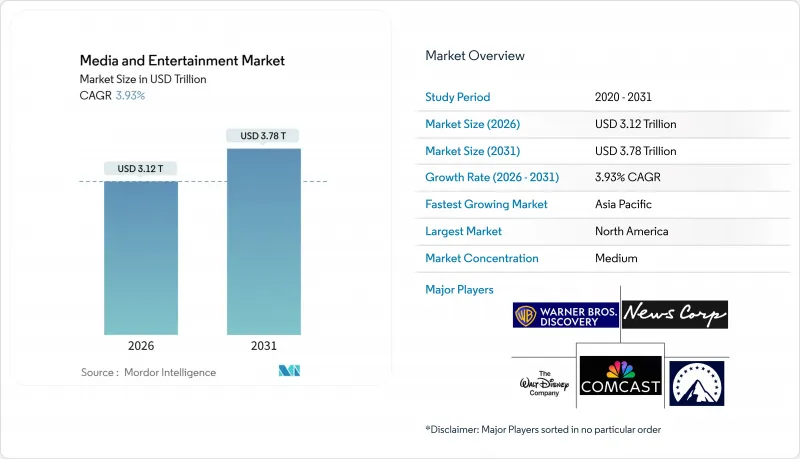
This report is Segmented by Type (Print Media, Digital Media, Streaming Media, Video Games and ESports, and More), Revenue Model (Advertising, Subscription, and More), Device Platform (Smartphones and Tablets, Smart TVs and Set-Top Boxes, Pcs and Laptops, Gaming Consoles, and More), and Geography. The Market Forecasts are Provided in Terms of Value (USD).
Global Media And Entertainment Market Trends and Insights
Proliferation Of 5G-Enabled Mobile Video Consumption In Asia
Asia-Pacific crossed 1.7 billion 5G connections in 2025, lowering latency below 20 milliseconds and turning mobile into the primary screen for video. Indian operators bundled unlimited streaming in low-cost data plans, lifting regional-language short-video apps to 40% of daily active users. Hyper-localized creators bypassed traditional gatekeepers, while programmatic mobile video ad spend reached USD 28 billion in 2025, a 35% jump year over year. Affordable 5G devices priced under USD 200 opened tier-2 and tier-3 cities where fixed broadband penetration lags, providing new runways for the media and entertainment market.
Surging Connected-TV Ad Spend By U.S. Retail And CPG Brands
United States connected-TV outlays hit USD 26.6 billion in 2025, with retail and CPG supplying 38% of incremental dollars as first-party purchase data drove conversion rates three to five times above linear TV. Netflix, Disney+, and Amazon launched ad tiers, adding 60% more premium inventory and letting brands reach cord-cutters at household level. Cross-platform measurement standards from the Joint Industry Committee calmed attribution concerns, shifting budgets structurally toward connected-TV.
Heightened EU Regulatory Scrutiny On Targeted Digital Ads
The Digital Services Act forced explicit opt-in consent, cutting addressable video audiences 15-20% and driving compliance costs such as Meta's EUR 500 million (USD 565 million) annual spend. Lower consent rates in Germany and France dampen conversion efficiency, pushing advertisers toward contextual targeting that delivers weaker returns and slowing media and entertainment market revenue expansion in Europe.
Other drivers and restraints analyzed in the detailed report include:
- Rapid Uptake Of FAST Channels In Europe
- Generative-AI Based Local-Language Dubbing Expanding OTT Reach In Middle East
- Piracy And Illegal Restreaming Curtailing Premium OTT ARPUs In Asia-Pacific
For complete list of drivers and restraints, kindly check the Table Of Contents.
Segment Analysis
Streaming posted the fastest 4.77% CAGR, while digital media retained 52.54% of revenue share in 2025. Print continued its slide as mobile-first news apps ate into circulation, while video games and esports delivered double-digit mobile revenue in Asia-Pacific. Virtual reality accounted for less than 2% of the media and entertainment market despite USD 15 billion in investments from Meta, Apple, and Sony. Podcast ad revenue exceeded USD 2.5 billion in 2025, underscoring advertiser appetite for high-engagement audio.
The media and entertainment market for streaming is poised to expand as on-demand formats align with younger audiences, while legacy television grapples with an aging audience. Subscription fatigue is steering cost-conscious households toward ad-supported tiers, and high-end franchises migrate from pay-per-view to bundled offerings, pressuring transactional models but bolstering stickiness for hybrid platforms.
Complete Report Scope:
- By Type
- Print Media
- Newspaper
- Magazines
- Billboards
- Banners, Leaflets and Flyers
- Other Print Media
- Digital Media
- Television
- Music and Radio
- Electronic Signage
- Mobile Advertising
- Podcasts
- Other Digital Media
- Streaming Media
- OTT Streaming
- Live Streaming
- Video Games and eSports
- Virtual / Augmented Reality Content
- Print Media
- By Revenue Model
- Advertising
- Subscription
- Pay-Per-View / Transactional
- Licensing and Merchandising
- By Device Platform
- Smartphones and Tablets
- Smart TVs and Set-top Boxes
- PCs and Laptops
- Gaming Consoles
- VR / AR Headsets
- By Geography
- North America
- United States
- Canada
- Mexico
- South America
- Brazil
- Argentina
- Rest of South America
- Europe
- Germany
- United Kingdom
- France
- Spain
- Rest of Europe
- Asia-Pacific
- China
- Japan
- India
- South Korea
- Australia and New Zealand
- Rest of Asia-Pacific
- Middle East and Africa
- Middle East
- Saudi Arabia
- United Arab Emirates
- Turkey
- Rest of Middle East
- Africa
- South Africa
- Egypt
- Nigeria
- Rest of Africa
- Middle East
- North America
Geography Analysis
North America retained 39.87% media and entertainment market share in 2025, buoyed by USD 26.6 billion connected-TV ads and subscription penetration exceeding three-quarters of broadband homes. However, saturation is constraining net additions, and regulators are scrutinizing data-privacy practices. Mexico is a bright spot as 5G expands, while password-sharing crackdowns lifted U.S. paid subscriber counts.
Asia-Pacific is on a 5.03% CAGR path, driven by India's 300 million 5G users, China's USD 45 billion mobile-gaming haul, and Southeast Asia's rising middle class. Domestic Chinese platforms dominate via localized content and social integration, whereas foreign entrants face ownership caps. Japan and South Korea boast high per-capita spend, and Australia mirrors U.S. dynamics but on a smaller scale.
Europe posts steady progress powered by FAST channel uptake, yet the Digital Services Act and Digital Markets Act weigh on targeted ad returns. The United Kingdom, Germany, and France top revenue ranks, though Poland and Romania deliver faster growth from lower bases. South America, led by Brazil's 80 million OTT subscribers, benefits from telco bundles and local originals. The Middle East and Africa lag in payment infrastructure, yet AI dubbing and mobile money are lowering barriers, with Saudi Arabia's Vision 2030 accelerating digital entertainment investment.
- News Corporation
- Comcast Corporation
- Walt Disney Company
- Warner Bros. Discovery, Inc.
- Paramount Global
- Netflix, Inc.
- Amazon.com, Inc.
- Alphabet Inc.
- Apple Inc.
- Sony Group Corporation
- Tencent Holdings Ltd.
- Bertelsmann SE and Co. KGaA
- ByteDance Ltd.
- Axel Springer SE
- Reliance Industries Ltd.
- Roku, Inc.
- WPP plc
- Omnicom Group Inc.
- Publicis Groupe
- Spotify Technology S.A.
- Electronic Arts Inc.
- Nintendo Co., Ltd.
- Activision Blizzard, Inc.
Additional Benefits:
- The market estimate (ME) sheet in Excel format
- 3 months of analyst support
TABLE OF CONTENTS
1 INTRODUCTION
- 1.1 Study Assumptions and Market Definition
- 1.2 Scope of the Study
2 RESEARCH METHODOLOGY
3 EXECUTIVE SUMMARY
4 MARKET LANDSCAPE
- 4.1 Market Overview
- 4.2 Market Drivers
- 4.2.1 Proliferation of 5G-Enabled Mobile Video Consumption in Asia
- 4.2.2 Surging Connected-TV Ad Spend by U.S. Retail and CPG Brands
- 4.2.3 Rapid Uptake of FAST (Free Ad-Supported TV) Channels in Europe
- 4.2.4 Generative-AI Based Local-Language Dubbing Expanding OTT Reach in Middle East
- 4.2.5 Emergence of Virtual Production Studios Reducing Content Creation Costs
- 4.2.6 In-game Advertising Monetisation in Mobile Esports Titles
- 4.3 Market Restraints
- 4.3.1 Heightened EU Regulatory Scrutiny on Targeted Digital Ads
- 4.3.2 Piracy and Illegal Restreaming Curtailing Premium OTT ARPUs in Asia-Pacific
- 4.3.3 Supply-Chain Shortages of Next-Gen Graphics Chips for Immersive Media
- 4.3.4 Rising Content Acquisition Costs Eroding Streaming Profitability
- 4.4 Industry Value Chain Analysis
- 4.5 Regulatory Outlook
- 4.6 Technological Outlook
- 4.7 Impact of Macroeconomic Factors on the Market
- 4.8 Porter's Five Forces Analysis
- 4.8.1 Bargaining Power of Suppliers
- 4.8.2 Bargaining Power of Buyers / Consumers
- 4.8.3 Threat of New Entrants
- 4.8.4 Threat of Substitutes
- 4.8.5 Intensity of Competitive Rivalry
- 4.9 Investment and Funding Trends
5 MARKET SIZE AND GROWTH FORECASTS (VALUE)
- 5.1 By Type
- 5.1.1 Print Media
- 5.1.1.1 Newspaper
- 5.1.1.2 Magazines
- 5.1.1.3 Billboards
- 5.1.1.4 Banners, Leaflets and Flyers
- 5.1.1.5 Other Print Media
- 5.1.2 Digital Media
- 5.1.2.1 Television
- 5.1.2.2 Music and Radio
- 5.1.2.3 Electronic Signage
- 5.1.2.4 Mobile Advertising
- 5.1.2.5 Podcasts
- 5.1.2.6 Other Digital Media
- 5.1.3 Streaming Media
- 5.1.3.1 OTT Streaming
- 5.1.3.2 Live Streaming
- 5.1.4 Video Games and eSports
- 5.1.5 Virtual / Augmented Reality Content
- 5.1.1 Print Media
- 5.2 By Revenue Model
- 5.2.1 Advertising
- 5.2.2 Subscription
- 5.2.3 Pay-Per-View / Transactional
- 5.2.4 Licensing and Merchandising
- 5.3 By Device Platform
- 5.3.1 Smartphones and Tablets
- 5.3.2 Smart TVs and Set-top Boxes
- 5.3.3 PCs and Laptops
- 5.3.4 Gaming Consoles
- 5.3.5 VR / AR Headsets
- 5.4 By Geography
- 5.4.1 North America
- 5.4.1.1 United States
- 5.4.1.2 Canada
- 5.4.1.3 Mexico
- 5.4.2 South America
- 5.4.2.1 Brazil
- 5.4.2.2 Argentina
- 5.4.2.3 Rest of South America
- 5.4.3 Europe
- 5.4.3.1 Germany
- 5.4.3.2 United Kingdom
- 5.4.3.3 France
- 5.4.3.4 Spain
- 5.4.3.5 Rest of Europe
- 5.4.4 Asia-Pacific
- 5.4.4.1 China
- 5.4.4.2 Japan
- 5.4.4.3 India
- 5.4.4.4 South Korea
- 5.4.4.5 Australia and New Zealand
- 5.4.4.6 Rest of Asia-Pacific
- 5.4.5 Middle East and Africa
- 5.4.5.1 Middle East
- 5.4.5.1.1 Saudi Arabia
- 5.4.5.1.2 United Arab Emirates
- 5.4.5.1.3 Turkey
- 5.4.5.1.4 Rest of Middle East
- 5.4.5.2 Africa
- 5.4.5.2.1 South Africa
- 5.4.5.2.2 Egypt
- 5.4.5.2.3 Nigeria
- 5.4.5.2.4 Rest of Africa
- 5.4.5.1 Middle East
- 5.4.1 North America
6 COMPETITIVE LANDSCAPE
- 6.1 Market Concentration
- 6.2 Strategic Moves
- 6.3 Market Share Analysis
- 6.4 Company Profiles (includes Global Level Overview, Market Level Overview, Core Segments, Financials as available, Strategic Information, Market Rank/Share, Products and Services, Recent Developments)
- 6.4.1 News Corporation
- 6.4.2 Comcast Corporation
- 6.4.3 Walt Disney Company
- 6.4.4 Warner Bros. Discovery, Inc.
- 6.4.5 Paramount Global
- 6.4.6 Netflix, Inc.
- 6.4.7 Amazon.com, Inc.
- 6.4.8 Alphabet Inc.
- 6.4.9 Apple Inc.
- 6.4.10 Sony Group Corporation
- 6.4.11 Tencent Holdings Ltd.
- 6.4.12 Bertelsmann SE and Co. KGaA
- 6.4.13 ByteDance Ltd.
- 6.4.14 Axel Springer SE
- 6.4.15 Reliance Industries Ltd.
- 6.4.16 Roku, Inc.
- 6.4.17 WPP plc
- 6.4.18 Omnicom Group Inc.
- 6.4.19 Publicis Groupe
- 6.4.20 Spotify Technology S.A.
- 6.4.21 Electronic Arts Inc.
- 6.4.22 Nintendo Co., Ltd.
- 6.4.23 Activision Blizzard, Inc.
7 MARKET OPPORTUNITIES AND FUTURE OUTLOOK
- 7.1 White-space and Unmet-Need Assessment

