PUBLISHER: Mordor Intelligence | PRODUCT CODE: 2124300

PUBLISHER: Mordor Intelligence | PRODUCT CODE: 2124300
Africa Entertainment And Telecommunication - Market Share Analysis, Industry Trends & Statistics, Growth Forecasts (2026 - 2031)
According to Mordor Intelligence, the Africa entertainment and telecommunication market size is expected to grow from USD 87.94 billion in 2025 to USD 92.56 billion in 2026 and is forecast to reach USD 118.07 billion by 2031 at 4.99% CAGR over 2026-2031.
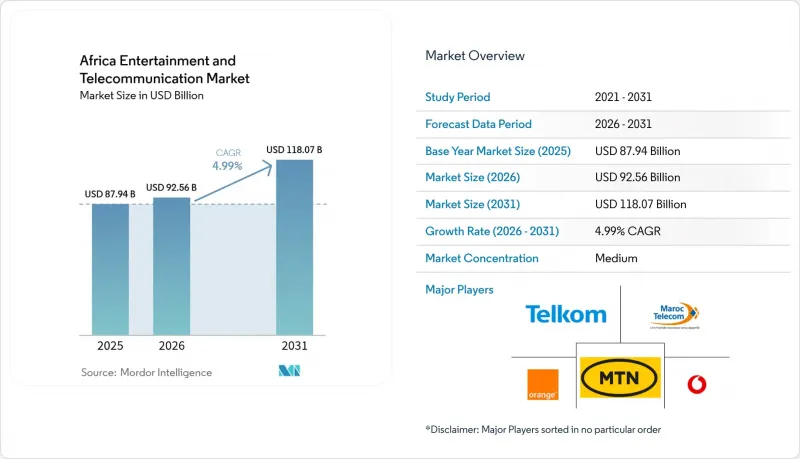
This report is Segmented by Market Type (Telecommunication Services, and Entertainment), Connectivity Technology (2G, 3G, 4G/LTE, 5G, and Satellite Broadband), Revenue Stream (Subscription, Advertising-Funded, Micro-Transactions/Pay-Per-View, and Wholesale), Subscriber Category (Consumer, and Enterprise), and Geography. The Market Forecasts are Provided in Terms of Value (USD).
Africa Entertainment And Telecommunication Market Trends and Insights
Rapid Rollout of 5G Fixed-Wireless Access in Capital Cities
Capital deployments of 5G fixed-wireless access supply fiber-like speeds at roughly one-third of last-mile cost. Operators such as MTN South Africa and Safaricom Nairobi marketed unlimited home-broadband plans that undercut local fiber by about 30%. National regulators obligate passive-infrastructure sharing, trimming site acquisition delays and smoothing fast-track rollouts. Because household fixed-line penetration lingers under 1% across most African economies, 5G emerges as the primary household pipe rather than a pure mobile upgrade. The model also pushes legacy internet service providers toward wholesale alignment, deepening operator dominance at the access layer.
Mobile-Money-Bundled Data Plans Among Unbanked Youth
Linking airtime and data purchases to mobile-wallet top-ups converts unbanked youths into digital subscribers without credit cards. Platforms such as M-Pesa, Telebirr, and MTN Mobile Money embed frictionless data-bundle menus inside payment apps, slashing acquisition costs and lifting ecosystem stickiness. Agent networks originally designed for cash-in and cash-out activities now double as connectivity storefronts across peri-urban markets. As mobile-money throughput nears the USD 700 billion mark annually, bundled data plans remain a prime lever for prepaid growth, especially where scratch-card distribution is expensive or insecure.
Under-Sea Cable Fragility Causing Backbone Outages
Submarine-fiber breaks exposed reliance on single routes when a 2024 failure sidelined 12 nations for three days. Mobile operators throttled video, enterprises lost cloud uptime, and local e-commerce shed over USD 100 million in potential transactions. Slow repair-ship mobilization underscores the need for mesh topologies and redundant landings, yet financing remains constrained. Until additional loops like Equiano and 2Africa fully land, corporate digital-transformation projects face elevated continuity risk.
Other drivers and restraints analyzed in the detailed report include:
- Infrastructure-Sharing Mandates Lowering Tower Capex
- Local-Content Incentives Boosting OTT Subscriptions
- Currency Devaluation Compressing ARPU in Key Markets
For complete list of drivers and restraints, kindly check the Table Of Contents.
Segment Analysis
Entertainment added momentum to the Africa entertainment and telecommunication market size as telecommunication services still accounted for 61.22% of 2025 earnings. Voice revenue slipped to 18% of the telecommunication mix after over-the-top chat apps displaced domestic and international calling minutes. Data now underwrites 68% of operator turnover, mainly from video streaming, social networking, and nascent cloud use. Complementary services such as mobile money and IoT delivered 14% and grow double digits because enterprises demand connected devices for agriculture and logistics.
Subscription video-on-demand held 42% of entertainment receipts in 2025, buoyed by Showmax, Netflix, and IrokoTV, while digital music captured 22% thanks to Boomplay's surging user base. Video gaming secured 18% and gains extra lift from mobile esports, a format well suited to Africa's handset-first habits. E-publishing and digital advertising combined for the residual slice, but both still climb as smartphone adoption widens and print legacy channels migrate online. Collectively, entertainment's superior 5.67% CAGR confirms a pivot toward content monetization inside the wider Africa entertainment and telecommunication market.
4G and LTE owned 46.47% Africa entertainment and telecommunication market share in 2025, affirming their status as workhorse layers. Yet 5G advances at a 5.45% clip because fixed-wireless packages undercut home fiber while matching speed expectations. Legacy 2G and 3G footprints continue to recede as sub-USD 50 smartphones arrive, freeing spectrum for higher efficiency air interfaces. Satellite broadband's 3% revenue share may seem minor, but Starlink-driven landmark pricing shifts the competitive calculus in underserved provinces.
By 2025, 29 nations counted at least one active 5G network, and operators tout installation costs roughly one-quarter of fiber deployments, lifting return profiles. Spectrum auctions, however, move at uneven cadence; Francophone reserve prices slow launches and cede mindshare to Anglophone peers. Long-run uptake hinges on smartphone affordability and the regulatory pace at which digital-dividend and 3.5 GHz bands clear for commercial use.
Complete Report Scope:
- By Market Type
- Telecommunication Services
- Voice (Fixed And Mobile)
- Data (Fixed And Mobile)
- Other Telco Services (IoT, Messaging)
- Entertainment
- Digital Music
- Download
- Streaming
- Video Games
- Video-On-Demand
- Svod
- Tvod
- Download-To-Own
- E-Publishing
- Advertising
- Newspaper
- Magazine
- Digital Music
- Telecommunication Services
- By Connectivity Technology
- 2G
- 3G
- 4G / LTE
- 5G
- Satellite Broadband
- By Revenue Stream
- Subscription
- Advertising-Funded
- Micro-Transactions / Pay-Per-View
- Licensing And Wholesale
- By Subscriber Category
- Consumer
- Enterprise
- Sme
- Large Enterprise
List of Companies Covered in this Report:
- MTN Group
- Vodacom Group
- Orange Middle East And Africa
- Airtel Africa plc
- Telkom SA SOC Ltd
- Maroc Telecom SA
- Globacom Ltd
- Safaricom PLC
- Ethio Telecom
- Liquid Intelligent Technologies
- Telecel Group
- Cell C Ltd
- Zain Sudan Zain Sudan Company
- Econet Wireless Zimbabwe
- Telecom Egypt
- Sonatel (Senegal) SA
- Unitel S.A.
- Movitel S.A.
- MultiChoice Group
- Showmax Ltd
- MBC Group
- Orbit Showtime Network
- IrokoTV Limited
Additional Benefits:
- The market estimate (ME) sheet in Excel format
- 3 months of analyst support
TABLE OF CONTENTS
1 INTRODUCTION
- 1.1 Study Assumptions And Market Definition
- 1.2 Scope Of The Study
2 RESEARCH METHODOLOGY
3 EXECUTIVE SUMMARY
4 MARKET LANDSCAPE
- 4.1 Market Overview
- 4.2 Impact Of Macroeconomic Factors On The Market
- 4.3 Market Drivers
- 4.3.1 Rapid Rollout Of 5G Fixed-Wireless Access In Capital Cities
- 4.3.2 Mobile-Money-Bundled Data Plans Among Unbanked Youth
- 4.3.3 Infrastructure-Sharing Mandates Lowering Tower Capex
- 4.3.4 Local-Content Incentives Boosting Ott Subscriptions
- 4.3.5 Coastal Hyperscale Data Centres Enabling Cloud Gaming
- 4.3.6 Expansion Of Low-Earth-Orbit Satellite Constellations For Rural Connectivity
- 4.4 Market Restraints
- 4.4.1 Under-Sea Cable Fragility Causing Backbone Outages
- 4.4.2 Currency Devaluation Compressing Arpu In Key Markets
- 4.4.3 Nollywood And Afrobeats Piracy On Telegram Channels
- 4.4.4 High 3.5 GHz Spectrum Fees Delaying 5G In Francophone Africa
- 4.5 Regulatory Outlook
- 4.6 Industry Value-Chain Analysis
- 4.7 Technological Outlook
- 4.8 Porter's Five Forces Analysis
- 4.8.1 Bargaining Power Of Suppliers
- 4.8.2 Bargaining Power Of Buyers
- 4.8.3 Threat Of New Entrants
- 4.8.4 Threat Of Substitutes
- 4.8.5 Degree Of Competition
5 MARKET SIZE AND GROWTH FORECASTS (VALUE)
- 5.1 By Market Type
- 5.1.1 Telecommunication Services
- 5.1.1.1 Voice (Fixed And Mobile)
- 5.1.1.2 Data (Fixed And Mobile)
- 5.1.1.3 Other Telco Services (IoT, Messaging)
- 5.1.2 Entertainment
- 5.1.2.1 Digital Music
- 5.1.2.1.1 Download
- 5.1.2.1.2 Streaming
- 5.1.2.2 Video Games
- 5.1.2.3 Video-On-Demand
- 5.1.2.3.1 Svod
- 5.1.2.3.2 Tvod
- 5.1.2.3.3 Download-To-Own
- 5.1.2.4 E-Publishing
- 5.1.2.5 Advertising
- 5.1.2.5.1 Newspaper
- 5.1.2.5.2 Magazine
- 5.1.2.1 Digital Music
- 5.1.1 Telecommunication Services
- 5.2 By Connectivity Technology
- 5.2.1 2G
- 5.2.2 3G
- 5.2.3 4G / LTE
- 5.2.4 5G
- 5.2.5 Satellite Broadband
- 5.3 By Revenue Stream
- 5.3.1 Subscription
- 5.3.2 Advertising-Funded
- 5.3.3 Micro-Transactions / Pay-Per-View
- 5.3.4 Licensing And Wholesale
- 5.4 By Subscriber Category
- 5.4.1 Consumer
- 5.4.2 Enterprise
- 5.4.2.1 Sme
- 5.4.2.2 Large Enterprise
6 COMPETITIVE LANDSCAPE
- 6.1 Market Concentration
- 6.2 Strategic Moves
- 6.3 Market Share Analysis
- 6.4 Company Profiles (includes Global Level Overview, Market Level Overview, Core Segments, Financials As Available, Strategic Information, Market Rank/Share, Products And Services, Recent Developments)
- 6.4.1 MTN Group
- 6.4.2 Vodacom Group
- 6.4.3 Orange Middle East And Africa
- 6.4.4 Airtel Africa plc
- 6.4.5 Telkom SA SOC Ltd
- 6.4.6 Maroc Telecom SA
- 6.4.7 Globacom Ltd
- 6.4.8 Safaricom PLC
- 6.4.9 Ethio Telecom
- 6.4.10 Liquid Intelligent Technologies
- 6.4.11 Telecel Group
- 6.4.12 Cell C Ltd
- 6.4.13 Zain Sudan Zain Sudan Company
- 6.4.14 Econet Wireless Zimbabwe
- 6.4.15 Telecom Egypt
- 6.4.16 Sonatel (Senegal) SA
- 6.4.17 Unitel S.A.
- 6.4.18 Movitel S.A.
- 6.4.19 MultiChoice Group
- 6.4.20 Showmax Ltd
- 6.4.21 MBC Group
- 6.4.22 Orbit Showtime Network
- 6.4.23 IrokoTV Limited
7 MARKET OPPORTUNITIES AND FUTURE OUTLOOK
- 7.1 White-Space And Unmet-Need Assessment

