PUBLISHER: Mordor Intelligence | PRODUCT CODE: 2123779

PUBLISHER: Mordor Intelligence | PRODUCT CODE: 2123779
Electric Toothbrush - Market Share Analysis, Industry Trends & Statistics, Growth Forecasts (2026 - 2031)
According to Mordor Intelligence, the electric toothbrush market size is valued at USD 6.75 billion in 2026, growing from the 2025 value of USD 6.21 billion, and is forecast to climb to USD 9.85 billion by 2031, advancing at a 7.25% CAGR.
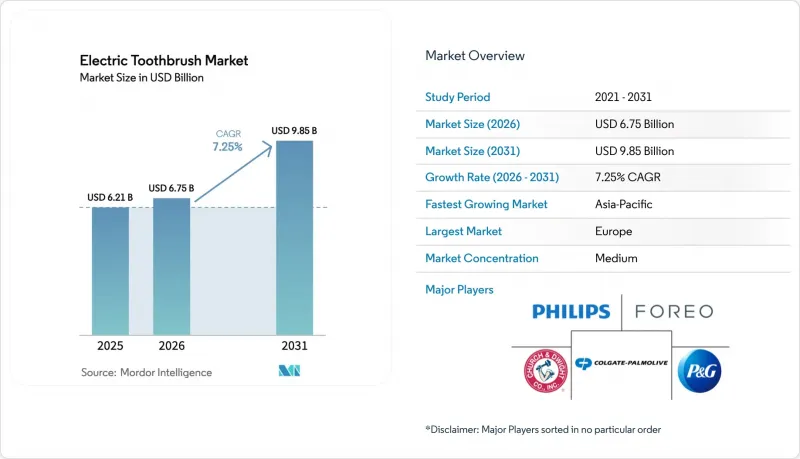
This report Segments the Industry Into Product Form (Electric, Battery-Powered and Replacement Brush Heads), Brushing Technology (Oscillating/Rotating and Sonic/Ultrasonic), End User (Adults and Kids), Distribution Channel (Supermarkets/Hypermarkets, Convenience/Grocery Stores, and More), and Geography (North America, Europe, and More). The Market Forecasts are Provided in Terms of Value (USD).
Global Electric Toothbrush Market Trends and Insights
Increasing Consumer Awareness of Oral Hygiene
The World Health Organization's 2022 Global Oral Health Status Report documented that 3.5 billion people suffer from oral diseases, positioning preventive care as a public health imperative rather than discretionary spending. This awareness translates into behavioral shifts: consumers now recognize that electric toothbrushes deliver superior plaque removal compared to manual brushing, a fact validated by clinical studies showing up to 21% better cleaning efficacy. Japan's Ministry of Health, Labour and Welfare reported rising per-capita dental medical expenditure from 2009 through 2024. What matters strategically is that awareness alone does not guarantee adoption-88.6% of Japanese youth still use manual toothbrushes despite high health literacy, revealing a gap between knowledge and behavior that brands must bridge through education and trial programs. The impact peaks in the medium term as digital health platforms integrate oral care tracking, creating feedback loops that reinforce usage.
Technological Advancements in Product Design and Functionality
Oclean launched the world's first Wi-Fi-enabled electric toothbrush in 2024, featuring AI-guided brushing with bone-conduction voice prompts and real-time feedback on 8 oral zones, illustrating how connectivity is transforming a commodity product into a data-driven health device. Philips Sonicare's patented sonic technology operates at 31,000 brush strokes per minute, generating fluid dynamics that clean interdental spaces without mechanical abrasion, while Oral-B's iO series integrates 3D motion tracking and pressure sensors that alert users to over-brushing. The strategic implication is that technology is bifurcating the market: premium segments justify USD 100-140 price points through app connectivity and personalized brushing plans, while mid-tier products at USD 35-50 adopt maglev motors and multiple cleaning modes to compete on performance. Battery life has become a differentiator-Oclean Flow claims 180 days per charge, reducing friction for travelers and eliminating the need for proprietary chargers that lock consumers into ecosystems. This driver delivers short-term impact because product cycles in consumer electronics run 18-24 months, compelling continuous innovation.
Prevalence of Traditional Way of Tooth Cleaning
Cultural preferences and behavioral inertia sustain manual toothbrush dominance in emerging markets, where 88.6% of Japanese youth continue using manual brushes despite high health literacy and product availability. This persistence stems from multiple factors: manual brushing is embedded in childhood routines, parents do not perceive electric toothbrushes as necessary for children, and the tactile feedback of manual brushing provides a sense of control that powered devices disrupt. In rural areas across Asia-Pacific, Africa, and Latin America, inconsistent electricity access makes rechargeable models impractical, while battery-powered alternatives face skepticism about performance and durability. The long-term impact reflects the generational time horizon required to shift ingrained habits-brands must target children through gamified devices and school partnerships to normalize powered brushing before adulthood. The strategic challenge is that overcoming this restraint requires sustained investment in education and trial programs that may not yield returns for 5-10 years, testing the patience of public-market investors focused on quarterly results.
Other drivers and restraints analyzed in the detailed report include:
- Rising Prevalence of Dental Diseases
- Growing Demand for Eco-friendly and Rechargeable Products
- Fluctuating Raw Material Prices
For complete list of drivers and restraints, kindly check the Table Of Contents.
Segment Analysis
Electric rechargeable models commanded 82.14% of market share in 2025, reflecting consumer preference for devices that eliminate battery replacement costs and deliver consistent power output throughout the charge cycle. Battery-powered variants, though capturing only 17.86% share, will expand at 8.75% CAGR through 2031 as manufacturers target price-sensitive consumers in emerging markets where electricity access remains inconsistent. Replacement brush heads constitute a critical recurring-revenue stream, with subscription models from Quip (USD 7 per quarter), Philips Sonicare (USD 7.99-13.99 per quarter), and Burst (USD 7 per quarter) locking consumers into ecosystems and generating lifetime values that exceed the initial device sale. The strategic tension lies in battery technology: rechargeable models use sealed lithium-ion cells that degrade after 2-3 years, creating e-waste and forcing repurchases, while battery-powered devices allow users to replace AA or AAA batteries, extending product life but reducing manufacturer lock-in.
Oclean's Flow model claims 180-day battery life per charge, eliminating the friction of frequent recharging and appealing to travelers who resist carrying proprietary charging cables. Oral-B's Pro 3 series, priced at GBP 35-45 (USD 44-57), demonstrates how incumbents are defending share through aggressive promotions-up to 71% off recommended retail prices-that compress margins but maintain volume. The replacement brush-head segment faces disruption from third-party manufacturers offering compatible heads at 30-40% discounts, eroding brand loyalty and forcing OEMs to differentiate through proprietary features like RFID chips that communicate brush-head age to the device. This segmentation will see further bifurcation as premium users demand smart features while value-conscious buyers prioritize basic functionality and low total cost of ownership.
Oscillating and rotating brush heads held 54.68% of the market share in 2025, leveraging decades of clinical validation and strong brand equity from Oral-B's market leadership, yet sonic and ultrasonic designs will grow at 9.95% CAGR through 2031, driven by superior interdental cleaning and reduced gum irritation. Philips Sonicare's patented sonic technology operates at 31,000 brush strokes per minute, generating fluid dynamics that dislodge plaque in hard-to-reach areas without mechanical abrasion, while ultrasonic devices exceed 1.6 MHz frequency to disrupt biofilm at the cellular level. Oclean's X Ultra S delivers 84,000 movements per minute through a maglev motor, positioning sonic technology as the performance frontier. The clinical distinction matters: sonic brushing relies on fluid flow to clean, whereas oscillating heads depend on direct bristle contact, making sonic designs gentler for users with sensitive gums or orthodontic appliances.
The technology race is intensifying as manufacturers file patents on motor designs, brush-head geometries, and control algorithms. Oclean claims 300+ toothbrush technology patents, positioning itself as a leader in intellectual property quantity, though patent count does not directly correlate with market share. Oral-B's iO series integrates magnetic drive systems that combine oscillation with micro-vibrations, blurring the line between categories and illustrating how incumbents are hybridizing technologies to defend their installed base. The strategic implication is that brushing technology is becoming a secondary consideration for consumers, who prioritize smart features over motor type. Brands that fail to communicate the clinical benefits of their chosen technology risk commoditization, where price becomes the primary purchase criterion. Compliance with IEC 60601-1 safety standards for medical electrical equipment remains a baseline requirement, though most electric toothbrushes qualify as low-risk Class I devices under FDA regulations, simplifying market entry.
Complete Report Scope:
- By Product Form
- Electric
- Battery-Powered
- Replacement Brush Heads
- By Brushing Technology
- Oscillating/Rotating
- Sonic/Ultrasonic
- By End User
- Adults
- Kids
- By Distribution Channels
- Supermarkets/Hypermarkets
- Convenience/Grocery Stores
- Pharmacies/Drug Stores
- Online Retaile Stores
- Other Distribution Channels
- By Geography
- North America
- United States
- Mexico
- Canada
- Rest of North America
- Europe
- United Kingdom
- Germany
- France
- Italy
- Spain
- Russia
- Netherlands
- Sweden
- Rest of Europe
- Asia-Pacific
- Japan
- China
- India
- Australia
- Rest of Asia-Pacific
- South America
- Brazil
- Argentina
- Chile
- Colombia
- Peru
- Rest of South America
- Middle East and Africa
- United Arab Emirates
- South Africa
- Nigeria
- Saudi Arabia
- Egypt
- Morocco
- Turkey
- Rest of Middle East and Africa
- North America
Geography Analysis
Europe generated 36.89% of 2025 revenue, anchored by Germany, the United Kingdom, and France, where dental insurance often reimburses powered brushes for periodontal patients. Regional growth is moderating to 5-6% CAGR as penetration plateaus in urban centers, yet Eastern Europe remains under-penetrated, offering room for mid-tier price points. Sustainability is now prerequisite; brands lacking take-back programs draw regulatory scrutiny and social-media backlash.
Asia-Pacific represents the fastest lane, poised for 8.74% CAGR to 2031. China's middle-class expansion and India's upgrade cycle underpin momentum, while Oclean and Usmile drive local pricing wars that compress entry thresholds. Japan's paradoxical low youth adoption reveals cultural stickiness that education campaigns aim to dismantle. Australia, supported by high income and robust insurance, acts as a premium stronghold within the region. Success depends on balancing localized aesthetics and price bands with platform efficiencies.
North America accounted for roughly 23% of 2025 sales, with the United States debating FSA and HSA inclusion that could lift premium uptake by cutting net cost. DTC pioneers Quip and Burst started here, forcing incumbents into digital pivots. Canada mirrors U.S. trends but at smaller scale, whereas Mexico's lower income limits penetration to metropolitan zones. South America and the Middle East-Africa each deliver near-10% shares; their urban growth pockets sit against rural affordability and infrastructure challenges, limiting expansion until macro-economic gains arrive.
- Procter and Gamble Company
- Colgate-Palmolive Company
- Koninklijke Philips N.V.
- Church and Dwight Co., Inc.
- FOREO AB
- Panasonic Holdings Corporation
- Lion Corporation
- Den-Mat Holdings LLC
- Snow Cosmetics LLC
- Ningbo Seago Electric Co. Ltd.
- Xiaomi (Oclean)
- Quip NYC Inc.
- Burst Oral Care Inc.
- Kolibree (BARACODA)
- Playbrush GmbH
- Usmile Co., Ltd.
- FOSOO Technologies
- Mornwell (Foshan Roson Medical Instruments Co., Ltd.)
- Brio Product Group
- SURI
Additional Benefits:
- The market estimate (ME) sheet in Excel format
- 3 months of analyst support
TABLE OF CONTENTS
1 INTRODUCTION
- 1.1 Study Assumptions and Market Definition
- 1.2 Scope of the Study
2 RESEARCH METHODOLOGY
3 EXECUTIVE SUMMARY
4 MARKET LANDSCAPE
- 4.1 Market Overview
- 4.2 Market Drivers
- 4.2.1 Increasing Consumer Awareness of Oral Hygiene
- 4.2.2 Technological Advancements in Product Design and Functionality
- 4.2.3 Rising Prevalence of Dental Diseases
- 4.2.4 Growing Demand for Eco-friendly and Rechargeable Products
- 4.2.5 Favorable Government Initiatives on Oral Hygiene
- 4.2.6 Aggressive Marketing and Advertising by Brands
- 4.3 Market Restraints
- 4.3.1 Prevelance of Traditional Way of Tooth Cleaning
- 4.3.2 Fluctuating Raw Material Prices
- 4.3.3 Low Penetration in Developing and Under-Developed Countries
- 4.3.4 High Cost Associated with the Product
- 4.4 Consumer Behaviour Analysis
- 4.5 Regulatory Outlook
- 4.6 Porter's Five Forces Analysis
- 4.6.1 Bargaining Power of Suppliers
- 4.6.2 Bargaining Power of Buyers
- 4.6.3 Threat of New Entrants
- 4.6.4 Threat of Substitutes
- 4.6.5 Degree of Competition
5 MARKET SIZE AND GROWTH FORECASTS (VALUE )
- 5.1 By Product Form
- 5.1.1 Electric
- 5.1.2 Battery-Powered
- 5.1.3 Replacement Brush Heads
- 5.2 By Brushing Technology
- 5.2.1 Oscillating/Rotating
- 5.2.2 Sonic/Ultrasonic
- 5.3 By End User
- 5.3.1 Adults
- 5.3.2 Kids
- 5.4 By Distribution Channels
- 5.4.1 Supermarkets/Hypermarkets
- 5.4.2 Convenience/Grocery Stores
- 5.4.3 Pharmacies/Drug Stores
- 5.4.4 Online Retaile Stores
- 5.4.5 Other Distribution Channels
- 5.5 By Geography
- 5.5.1 North America
- 5.5.1.1 United States
- 5.5.1.2 Mexico
- 5.5.1.3 Canada
- 5.5.1.4 Rest of North America
- 5.5.2 Europe
- 5.5.2.1 United Kingdom
- 5.5.2.2 Germany
- 5.5.2.3 France
- 5.5.2.4 Italy
- 5.5.2.5 Spain
- 5.5.2.6 Russia
- 5.5.2.7 Netherlands
- 5.5.2.8 Sweden
- 5.5.2.9 Rest of Europe
- 5.5.3 Asia-Pacific
- 5.5.3.1 Japan
- 5.5.3.2 China
- 5.5.3.3 India
- 5.5.3.4 Australia
- 5.5.3.5 Rest of Asia-Pacific
- 5.5.4 South America
- 5.5.4.1 Brazil
- 5.5.4.2 Argentina
- 5.5.4.3 Chile
- 5.5.4.4 Colombia
- 5.5.4.5 Peru
- 5.5.4.6 Rest of South America
- 5.5.5 Middle East and Africa
- 5.5.5.1 United Arab Emirates
- 5.5.5.2 South Africa
- 5.5.5.3 Nigeria
- 5.5.5.4 Saudi Arabia
- 5.5.5.5 Egypt
- 5.5.5.6 Morocco
- 5.5.5.7 Turkey
- 5.5.5.8 Rest of Middle East and Africa
- 5.5.1 North America
6 COMPETITIVE LANDSCAPE
- 6.1 Market Concentration
- 6.2 Strategic Moves
- 6.3 Market Share Analysis
- 6.4 Company Profiles (Includes Global-level Overview, Market-level Overview, Core Segments, Financials, Strategic Info, Market Rank/Share, Products and Services, Recent Developments)
- 6.4.1 Procter and Gamble Company
- 6.4.2 Colgate-Palmolive Company
- 6.4.3 Koninklijke Philips N.V.
- 6.4.4 Church and Dwight Co., Inc.
- 6.4.5 FOREO AB
- 6.4.6 Panasonic Holdings Corporation
- 6.4.7 Lion Corporation
- 6.4.8 Den-Mat Holdings LLC
- 6.4.9 Snow Cosmetics LLC
- 6.4.10 Ningbo Seago Electric Co. Ltd.
- 6.4.11 Xiaomi (Oclean)
- 6.4.12 Quip NYC Inc.
- 6.4.13 Burst Oral Care Inc.
- 6.4.14 Kolibree (BARACODA)
- 6.4.15 Playbrush GmbH
- 6.4.16 Usmile Co., Ltd.
- 6.4.17 FOSOO Technologies
- 6.4.18 Mornwell (Foshan Roson Medical Instruments Co., Ltd.)
- 6.4.19 Brio Product Group
- 6.4.20 SURI
7 MARKET OPPORTUNITIES AND FUTURE OUTLOOK

