PUBLISHER: Mordor Intelligence | PRODUCT CODE: 2124046

PUBLISHER: Mordor Intelligence | PRODUCT CODE: 2124046
Europe Serious Gaming - Market Share Analysis, Industry Trends & Statistics, Growth Forecasts (2026 - 2031)
According to Mordor Intelligence, the Europe serious gaming market size stood at USD 7.73 billion in 2026 and is projected to reach USD 17.63 billion by 2031, delivering a 17.93% CAGR over the forecast period.
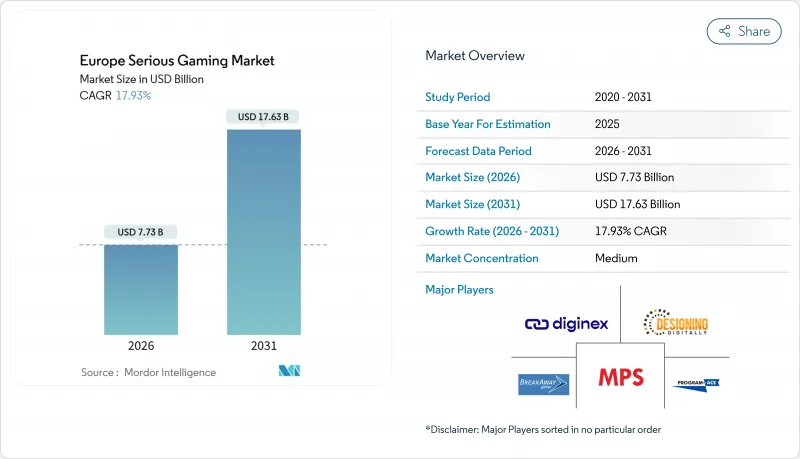
This report is Segmented by Application (Advertising and Marketing, Simulation Training, and More), End-User Industry (Healthcare, Education, Retail, Media and Entertainment, Automotive, and More), Platform/Technology (Mobile Platforms, PC and Console, and More), Age Group (Children (K-12), Young Adults (18-30), and More), and Geography. The Market Forecasts are Provided in Terms of Value (USD).
Europe Serious Gaming Market Trends and Insights
Growing Usage of Mobile-Based Educational Games
Mobile platforms secured 49.87% of revenue in 2025, underscoring their affordability and ease of deployment for schools in budget-constrained regions. Smartphones sidestep IT procurement delays, allow for asynchronous learning, and enable fast localization through modular asset libraries. Multilingual titles such as the Joint Research Centre's Happy Onlife reach pan-European audiences without recoding. Bring-your-own-device policies in secondary schools further expand mobile reach, although parental consent thresholds under GDPR vary from 13 to 16 across member states. Public funding in France's Digital Decade roadmap, amounting to EUR 2.5 billion (USD 2.75 billion), specifically prioritizes mobile-first programs that serve rural learners.
Improved Learning Outcomes Driving Adoption Among Enterprises and Educational Institutions
Return-on-investment evidence is converting pilots into budget-line staples. Play it Secure reported training completion four times faster and 30% fewer infringements after deployment in European firms. NHS England's Becoming Simulation Faculty Program embedded immersive modules that cut adverse events in high-acuity wards. OECD research has linked action games to improved spatial reasoning, providing policymakers with empirical evidence to support edtech grants. Germany's broadband build-out is expected to connect 43,000 schools by 2025, creating device-ready classrooms where serious games can integrate smoothly.
Lack of Standardized Assessment Tools to Measure Effectiveness
Procurement teams struggle to benchmark vendors because there is no ISO-like metric that directly links gameplay to on-the-job competence. Proprietary dashboards track quiz scores yet seldom correlate with patient safety or production quality indicators. Switching providers can require recalibrating entire analytics frameworks, locking institutions into legacy platforms. The European Research Institute on Simulation received EUR 1 million (USD 1.1 million) in April 2025 to craft cardiac-training protocols, but its narrow scope underlines the broader gap.
Other drivers and restraints analyzed in the detailed report include:
- Proliferation of Affordable VR and AR Hardware
- Government Initiatives Promoting Digital Skills and Gamified Learning
- Concerns Over Data Privacy Compliance in Gamified Platforms (GDPR)
For complete list of drivers and restraints, kindly check the Table Of Contents.
Segment Analysis
Learning and Education dominated the Europe serious gaming market with 42.36% revenue in 2025. Corporate advertisers, however, are accelerating; their segment is projected to register an 18.76% CAGR as interactive storytelling sidesteps ad blockers. Simulation Training spans Healthcare, automotive, and aerospace, garnering recurring revenue from mandatory recertification cycles. Other applications, such as logistics and emergency response, rely on scenario-based drills that reduce the costs of live exercises.
Advertising and Marketing growth pivot on emotional engagement. Campaigns like "Lost in the World," a Fortnite-based Alzheimer's simulator, reached Gen Z users who ignore banner ads, validating sponsor investment. Simulation Training gains regulatory ballast, with NHS England's procurement framework guaranteeing pipeline demand. Bundling analytics that feed compliance reports into learning-management systems bolsters enterprise traction across the Europe serious gaming market.
Education retained the largest slice at 34.21% in 2025; however, Healthcare is on track for a 19.32% CAGR through 2031 as accreditation bodies integrate simulation into curricula. Automotive players are leveraging gamified modules to retrain staff on electric-vehicle powertrains. Retail adoption remains modest due to slim training budgets, but luxury brands test virtual showrooms. Government agencies conduct cybersecurity and emergency-response drills to protect critical infrastructure.
Healthcare momentum is illustrated by Vall d'Hebron Barcelona Hospital teaming with the Cleveland Clinic to pilot ultrasound simulators that eliminate patient risk. The Europe serious gaming market size for Healthcare alone is projected to rise sharply as trusts tap the NHS procurement system. Automotive gains scale through Valeo's Tech Academy, which delivers certified modules across five countries, evidencing cross-border scalability once content aligns with industry standards.
Complete Report Scope:
- By Application
- Advertising and Marketing
- Simulation Training
- Learning and Education
- Other Applications
- By End-User Industry
- Healthcare
- Education
- Retail
- Media and Entertainment
- Automotive
- Government
- Other End-User Industries
- By Platform/Technology
- Mobile Platforms
- PC and Console
- VR Headsets
- AR/MR Devices
- Cloud/Web-Based
- By Age Group
- Children (K-12)
- Young Adults (18-30)
- Adults (31-60)
- Seniors (Above 60)
- By Country
- Germany
- United Kingdom
- France
- Italy
- Spain
- Netherlands
- Sweden
- Rest of Europe
List of Companies Covered in this Report:
- Breakaway Games, Ltd.
- Designing Digitally Inc.
- Diginex Limited
- MPS Interactive Systems Limited
- Serious Games Solutions
- Tygron BV
- Triseum LLC
- KTM Advance
- Firsthand Technology
- Bedaux Serious Games
- Ubisoft Serious Games Division
- PlayGen Ltd.
- Neuro-Insight Games
- SimforHealth
- BIBA Bremen Institute for Production and Logistics
- Gamelearn
- Virtual Heroes (Applied Research Associates)
- Gamar Ltd.
- Make Real Ltd.
- Pixel Legend S.A.
Additional Benefits:
- The market estimate (ME) sheet in Excel format
- 3 months of analyst support
TABLE OF CONTENTS
1 INTRODUCTION
- 1.1 Study Assumptions and Market Definition
- 1.2 Scope of the Study
2 RESEARCH METHODOLOGY
3 EXECUTIVE SUMMARY
4 MARKET LANDSCAPE
- 4.1 Market Overview
- 4.2 Market Drivers
- 4.2.1 Growing Usage of Mobile-Based Educational Games
- 4.2.2 Improved Learning Outcomes Driving Adoption Among Enterprises and Educational Institutions
- 4.2.3 Proliferation of Affordable VR and AR Hardware
- 4.2.4 Government Initiatives Promoting Digital Skills and Gamified Learning
- 4.2.5 Integration of Serious Games with Learning Management Systems for Data Analytics
- 4.2.6 Growing Demand for Gamified Cybersecurity Training in European SMEs
- 4.3 Market Restraints
- 4.3.1 Lack of Standardized Assessment Tools to Measure Effectiveness
- 4.3.2 High Development Costs for High-Fidelity Content
- 4.3.3 Concerns Over Data Privacy Compliance in Gamified Platforms (GDPR)
- 4.3.4 Limited Multilingual Content Hindering Cross-Border Adoption
- 4.4 Industry Value Chain Analysis
- 4.5 Impact of Macroeconomic Factors on the Market
- 4.6 Regulatory Landscape
- 4.7 Technological Outlook
- 4.8 Porter's Five Forces Analysis
- 4.8.1 Bargaining Power of Suppliers
- 4.8.2 Bargaining Power of Buyers
- 4.8.3 Threat of New Entrants
- 4.8.4 Intensity of Competitive Rivalry
- 4.8.5 Threat of Substitute Products
5 MARKET SIZE AND GROWTH FORECASTS (VALUE)
- 5.1 By Application
- 5.1.1 Advertising and Marketing
- 5.1.2 Simulation Training
- 5.1.3 Learning and Education
- 5.1.4 Other Applications
- 5.2 By End-User Industry
- 5.2.1 Healthcare
- 5.2.2 Education
- 5.2.3 Retail
- 5.2.4 Media and Entertainment
- 5.2.5 Automotive
- 5.2.6 Government
- 5.2.7 Other End-User Industries
- 5.3 By Platform/Technology
- 5.3.1 Mobile Platforms
- 5.3.2 PC and Console
- 5.3.3 VR Headsets
- 5.3.4 AR/MR Devices
- 5.3.5 Cloud/Web-Based
- 5.4 By Age Group
- 5.4.1 Children (K-12)
- 5.4.2 Young Adults (18-30)
- 5.4.3 Adults (31-60)
- 5.4.4 Seniors (Above 60)
- 5.5 By Country
- 5.5.1 Germany
- 5.5.2 United Kingdom
- 5.5.3 France
- 5.5.4 Italy
- 5.5.5 Spain
- 5.5.6 Netherlands
- 5.5.7 Sweden
- 5.5.8 Rest of Europe
6 COMPETITIVE LANDSCAPE
- 6.1 Market Concentration
- 6.2 Strategic Moves
- 6.3 Market Share Analysis
- 6.4 Company Profiles (includes Global Level Overview, Market Level Overview, Core Segments, Financials as available, Strategic Information, Market Rank/Share for key companies, Products and Services, and Recent Developments)
- 6.4.1 Breakaway Games, Ltd.
- 6.4.2 Designing Digitally Inc.
- 6.4.3 Diginex Limited
- 6.4.4 MPS Interactive Systems Limited
- 6.4.5 Serious Games Solutions
- 6.4.6 Tygron BV
- 6.4.7 Triseum LLC
- 6.4.8 KTM Advance
- 6.4.9 Firsthand Technology
- 6.4.10 Bedaux Serious Games
- 6.4.11 Ubisoft Serious Games Division
- 6.4.12 PlayGen Ltd.
- 6.4.13 Neuro-Insight Games
- 6.4.14 SimforHealth
- 6.4.15 BIBA Bremen Institute for Production and Logistics
- 6.4.16 Gamelearn
- 6.4.17 Virtual Heroes (Applied Research Associates)
- 6.4.18 Gamar Ltd.
- 6.4.19 Make Real Ltd.
- 6.4.20 Pixel Legend S.A.
7 MARKET OPPORTUNITIES AND FUTURE OUTLOOK
- 7.1 White-space and Unmet-Need Assessment

