PUBLISHER: Mordor Intelligence | PRODUCT CODE: 2124119

PUBLISHER: Mordor Intelligence | PRODUCT CODE: 2124119
Unidirectional Tape - Market Share Analysis, Industry Trends & Statistics, Growth Forecasts (2026 - 2031)
According to Mordor Intelligence, the unidirectional tape market size is estimated at USD 473.61 million in 2026, and is expected to reach USD 780.95 million by 2031, at a CAGR of 10.52% during the forecast period (2026-2031).
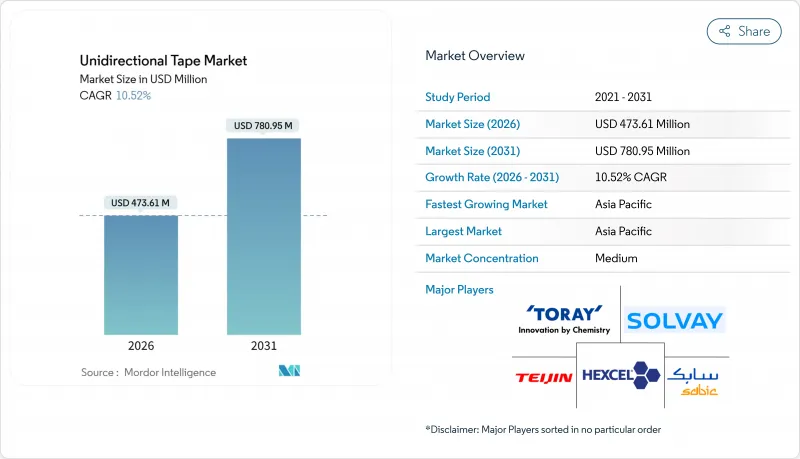
This report is Segmented by Reinforcement Type (Glass Fiber, Carbon Fiber, and Other), Backing Material (PEEK, Polyamide, Polypropylene, Polycarbonate, PPS, and Other), Adhesive Type (Epoxy, Polyurethane, and Other), End-User Industry (Aerospace and Defense, and More), and Geography (Asia-Pacific, North America, Europe, South America, and Middle-East and Africa). Market Forecasts are in Value (USD).
Global Unidirectional Tape Market Trends and Insights
Surging Composite Demand in Next-Gen Narrow-Body Aircraft
Programs like the Airbus A321XLR and Boeing 737 MAX are increasingly using carbon-fiber tape in their fuselage panels, spars, and floor beams to reduce airframe weight. NASA's HiCAM trials demonstrated that automated tape-laying can significantly reduce the cycle time for fuselage sections, highlighting its potential for high-rate production. Suppliers with established databases gain an advantage due to qualifications under FAA AC 20-107B and EASA AMC 20-29, creating a protective barrier for existing players. Given that narrow-body jets represent a significant portion of anticipated future deliveries, even slight increases in composite content lead to substantial demand in the unidirectional tapes market. Anticipated certification milestones in 2026-2027 further bolster demand projections.
Aggressive OEM Lightweighting Targets for 800 V EV Platforms
Premium carmakers, targeting a 500 km range with 800 V architectures, are pushing for a reduction in battery-enclosure mass. Recent crash tests on the Lucid Air have showcased a breakthrough: thermoplastic tapes can craft intricate tray shapes that achieve the stiffness of stamped steel, but at a significantly lower weight. However, the high capital costs pose a challenge for Tier-2 adoption. Each AFP cell commands a high price, and the programming demands significant labor. In response, Chinese OEMs are taking the reins by vertically integrating tape production, managing to cut part costs. This move solidifies Asia's lead in the burgeoning unidirectional tapes market.
Persistent Carbon-Fiber Price Volatility Tied to PAN Precursor Supply
After China imposed export curbs in 2024, spot prices for PAN surged, driven by China's dominant share in the market. In 2025, Hexcel and SGL Carbon experienced a drop in gross margins, unable to hedge against losses due to their fixed-price aerospace contracts. While new precursor lines set to debut in 2027 offer some respite, the 30-month lead times combined with geopolitical uncertainties ensure continued volatility in the cost base of the unidirectional tapes market.
Other drivers and restraints analyzed in the detailed report include:
- Rise of Automated Tape-Laying Lines in Chinese Wind-Blade Factories
- Certification of Thermoplastic Unidirectional Tapes for Hydrogen Pressure Vessels
- Low Pull-Through Rates of AFP Equipment Among Tier-2 Auto Suppliers
For complete list of drivers and restraints, kindly check the Table Of Contents.
Segment Analysis
Carbon fiber captured 58.42% of 2025 revenue, highlighting its significance in aerospace primary structures, where its fatigue resistance justifies a premium. Both Boeing's 787 and Airbus's A350 heavily utilize carbon-fiber tape for their wing spars and fuselage frames. Glass fiber, though less stiff, is surging at 9.25% CAGR. This rise is driven by the offshore wind blades exceeding 115 m in length, which necessitates cost-effective spar-cap materials. Consequently, the market size for unidirectional tapes in the glass-fiber segment is set to expand steadily through 2031. Hybrid carbon-glass tapes, like Hexcel's HiTape, strike a balance between cost and modulus, finding their niche in automotive battery enclosures.
In emerging markets, Chinese turbine OEMs are opting for glass-fiber tapes in their 8-12 MW platforms, a trend echoed by Indian manufacturers. While aramid and basalt fibers cater to niche markets-primarily ballistic armor and high-temperature industrial applications-together they hold a modest share. Given these market dynamics, while carbon fiber is poised to maintain its dominance, the absolute tonnage gains of glass fiber will play a crucial role in shaping the unidirectional tapes market in the coming five years.
Polyamide backing held 31.36% of 2025 demand due to its balanced processing window, impact toughness, and moisture resistance, traits suited for automotive crash structures. PEEK is expanding at 9.68% CAGR as engine-bay brackets and bleed-air ducts migrate to thermoplastics capable of withstanding 200 °C continuous temperatures. The unidirectional tapes market share for PEEK applications should therefore expand gradually, especially after aerospace certifications are finalized in 2027.
Polypropylene remains popular where cost trumps performance, for example, in wind-blade shear webs. PPS and PC round out the portfolio with specialty applications in chemical processing and electronics. Solvay's KetaSpire PEEK is also penetrating downhole oil-and-gas tools, underscoring the widening high-temperature envelope for thermoplastic tapes.
Complete Report Scope:
- By Reinforcement Type
- Glass Fiber
- Carbon Fiber
- Other Reinforcement Types
- By Backing Material
- Polyether Ether Ketone (PEEK)
- Polyamide (PA)
- Polypropylene (PP)
- Polycarbonate (PC)
- Polyphenylene Sulfide (PPS)
- Other Backing Materials
- By Adhesive Type
- Epoxy
- Polyurethane
- Other Adhesive Types
- By End-user Industry
- Aerospace and Defense
- Automotive
- Sports and Leisure
- Industrial
- Wind Energy
- Other End-user Industries
- By Geography
- Asia-Pacific
- China
- Japan
- South Korea
- India
- Rest of Asia-Pacific
- North America
- United States
- Canada
- Mexico
- Europe
- Germany
- France
- United Kingdom
- Italy
- Spain
- Russia
- Rest of Europe
- South America
- Brazil
- Argentina
- Rest of South America
- Middle-East and Africa
- Saudi Arabia
- South Africa
- Rest of Middle-East and Africa
- Asia-Pacific
Geography Analysis
Asia-Pacific generated 44.53% of 2025 revenue and is projected to grow at a 10.88% CAGR to 2031, driven by China's extensive wind-blade production, Japan's advancements in carbon-fiber technology, and South Korea's adoption of EV battery trays. In Jiangsu, automated tape-laying cells achieved high fiber alignment consistency, minimizing waste and solidifying China's cost advantage. Toray's facility in Ehime bolsters regional supply, while a new tape line in Hyderabad caters to India's domestic aerospace needs. Although smaller ASEAN markets currently rely on imports, they stand poised to adapt swiftly, especially as the demand for battery-electric two-wheelers rises, further boosting the unidirectional tapes market.
North America accounted for a notable share of the 2025 revenue. Boeing's Everett facility, as the 737 MAX production stabilizes, utilizes a significant amount of carbon-fiber tape annually. Additionally, Lockheed Martin's F-35 and MQ-25 programs bolster defense demand. Yet, the automotive sector hesitates: both General Motors and Ford point to high recycling costs and inconsistent material pricing as concerns. Meanwhile, Mexico's expanding carbon-fiber hub in Queretaro hints at a diversifying supply chain, potentially benefiting the United States' electric truck initiatives.
Europe represented a considerable portion of the 2025 demand. Composite consumption remains anchored at Airbus facilities in Toulouse and Broughton, despite recyclability pressures from the End-of-Life Vehicles Directive. While German OEMs experiment with carbon-fiber battery trays for their premium models, widespread adoption hinges on achieving cost parity. Post-Brexit tariffs have squeezed margins for the United Kingdom converters, particularly affecting SMEs. In a notable shift, Spanish and Danish factories, pivoting to tape-laying, are now catering to 15 MW offshore turbines, a move likely to bolster the continent's unidirectional tapes market.
South America and the Middle East-Africa, together contributing a smaller share in 2025, exhibit emerging potential. While Embraer's E2 jets utilize locally produced prepregs, Saudi Arabia's NEOM is exploring hydrogen cylinders, potentially requiring thermoplastic tapes. Though these regional initiatives are modest, they diversify the unidirectional tapes industry's landscape and hold promise for growth as infrastructure develops.
- Barrday Inc.
- BASF
- BUFA Thermoplastic Composites GmbH & Co. KG
- Celanese Corporation
- DSM
- Evonik Industries AG
- Gurit Services AG, Zurich (CH)
- Hexcel Corporation
- Mitsui Chemicals Inc.
- Oxeon AB (TeXtreme)
- Plastic Reinforcement Fabrics Ltd
- SABIC
- SGL Carbon
- Solvay
- TCR Composites Inc.
- TEIJIN LIMITED
- TOPOLO New Materials
- TORAY INDUSTRIES INC.
- Victrex plc
Additional Benefits:
- The market estimate (ME) sheet in Excel format
- 3 months of analyst support
TABLE OF CONTENTS
1 Introduction
- 1.1 Study Assumptions and Market Definition
- 1.2 Scope of the Study
2 Research Methodology
3 Executive Summary
4 Market Landscape
- 4.1 Market Overview
- 4.2 Market Drivers
- 4.2.1 Surging composite demand in next-gen narrow-body aircraft
- 4.2.2 Aggressive OEM lightweighting targets for 800 V EV platforms
- 4.2.3 Rise of automated tape-laying lines in Chinese wind-blade factories
- 4.2.4 Certification of thermoplastic Unidirectional tapes for hydrogen pressure vessels
- 4.2.5 Defense requirement for radar-transparent structures and stealth kits
- 4.3 Market Restraints
- 4.3.1 Persistent carbon-fiber price volatility tied to PAN precursor supply
- 4.3.2 Low pull-through rates of AFP equipment among Tier-2 auto suppliers
- 4.3.3 Recycling and end-of-life mandates tightening in EU (lack of infra)
- 4.4 Value Chain Analysis
- 4.5 Porter's Five Forces Analysis
- 4.5.1 Threat of New Entrants
- 4.5.2 Bargaining Power of Consumers
- 4.5.3 Bargaining Power of Suppliers
- 4.5.4 Threat of Substitutes
- 4.5.5 Degree of Competition
5 Market Size and Growth Forecasts (Value)
- 5.1 By Reinforcement Type
- 5.1.1 Glass Fiber
- 5.1.2 Carbon Fiber
- 5.1.3 Other Reinforcement Types
- 5.2 By Backing Material
- 5.2.1 Polyether Ether Ketone (PEEK)
- 5.2.2 Polyamide (PA)
- 5.2.3 Polypropylene (PP)
- 5.2.4 Polycarbonate (PC)
- 5.2.5 Polyphenylene Sulfide (PPS)
- 5.2.6 Other Backing Materials
- 5.3 By Adhesive Type
- 5.3.1 Epoxy
- 5.3.2 Polyurethane
- 5.3.3 Other Adhesive Types
- 5.4 By End-user Industry
- 5.4.1 Aerospace and Defense
- 5.4.2 Automotive
- 5.4.3 Sports and Leisure
- 5.4.4 Industrial
- 5.4.5 Wind Energy
- 5.4.6 Other End-user Industries
- 5.5 By Geography
- 5.5.1 Asia-Pacific
- 5.5.1.1 China
- 5.5.1.2 Japan
- 5.5.1.3 South Korea
- 5.5.1.4 India
- 5.5.1.5 Rest of Asia-Pacific
- 5.5.2 North America
- 5.5.2.1 United States
- 5.5.2.2 Canada
- 5.5.2.3 Mexico
- 5.5.3 Europe
- 5.5.3.1 Germany
- 5.5.3.2 France
- 5.5.3.3 United Kingdom
- 5.5.3.4 Italy
- 5.5.3.5 Spain
- 5.5.3.6 Russia
- 5.5.3.7 Rest of Europe
- 5.5.4 South America
- 5.5.4.1 Brazil
- 5.5.4.2 Argentina
- 5.5.4.3 Rest of South America
- 5.5.5 Middle-East and Africa
- 5.5.5.1 Saudi Arabia
- 5.5.5.2 South Africa
- 5.5.5.3 Rest of Middle-East and Africa
- 5.5.1 Asia-Pacific
6 Competitive Landscape
- 6.1 Market Concentration
- 6.2 Strategic Moves
- 6.3 Market Share/Ranking Analysis
- 6.4 Company Profiles (includes Global level Overview, Market level overview, Core Segments, Financials as available, Strategic Information, Market Rank/Share for key companies, Products and Services, and Recent Developments)
- 6.4.1 Barrday Inc.
- 6.4.2 BASF
- 6.4.3 BUFA Thermoplastic Composites GmbH & Co. KG
- 6.4.4 Celanese Corporation
- 6.4.5 DSM
- 6.4.6 Evonik Industries AG
- 6.4.7 Gurit Services AG, Zurich (CH)
- 6.4.8 Hexcel Corporation
- 6.4.9 Mitsui Chemicals Inc.
- 6.4.10 Oxeon AB (TeXtreme)
- 6.4.11 Plastic Reinforcement Fabrics Ltd
- 6.4.12 SABIC
- 6.4.13 SGL Carbon
- 6.4.14 Solvay
- 6.4.15 TCR Composites Inc.
- 6.4.16 TEIJIN LIMITED
- 6.4.17 TOPOLO New Materials
- 6.4.18 TORAY INDUSTRIES INC.
- 6.4.19 Victrex plc
7 Market Opportunities and Future Outlook
- 7.1 White-space and Unmet-Need Assessment

