PUBLISHER: Mordor Intelligence | PRODUCT CODE: 2124248

PUBLISHER: Mordor Intelligence | PRODUCT CODE: 2124248
Industry 4.0 - Market Share Analysis, Industry Trends & Statistics, Growth Forecasts (2026 - 2031)
According to Mordor Intelligence, the industry 4.0 market reached USD 314.12 billion in 2026 and is projected to climb to USD 790.29 billion by 2031, reflecting a 20.26% CAGR over the forecast period, underscoring the structural shift toward mandatory cyber-physical convergence across global production networks.
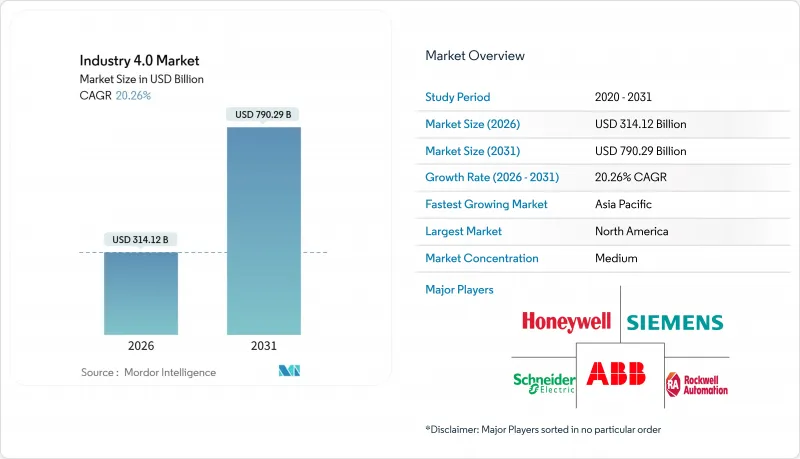
This report is Segmented by Technology Type (Industrial Robotics, Iiot, and More), Component (Hardware, Software/Platforms, and Services), Deployment Model (On-Premises, Cloud, and Hybrid), End-User Industry (Discrete Manufacturing, Automotive, and More), and Geography (North America, South America, Europe, Middle East, Africa, Asia-Pacific). The Market Forecasts are Provided in Terms of Value (USD).
Insights and Trends of Industry 4.0 Market
Favorable Government Initiatives And Multi-Stakeholder Collaborations
National programs are accelerating cyber-physical adoption by underwriting pilot expenses, codifying best practices, and providing workforce training roadmaps. Germany channeled EUR 200 million (USD 226 million) in 2025 to 5G testbeds that validate machine-to-machine protocols, cutting integration risk for mid-sized suppliers. The United Kingdom's Made Smarter initiative earmarked GBP 120 million (USD 156 million) to subsidize automation for smaller manufacturers, shortening payback periods to below three years for many projects. Singapore's Advanced Remanufacturing and Technology Centre partnered with global OEMs to demonstrate predictive-maintenance programs that trimmed unplanned downtime by 40%, a milestone now embedded in the Smart Industry Readiness Index. India's Production-Linked Incentive mechanism offers capital subsidies up to 25%, driving a surge in collaborative-robot orders across electronics and pharmaceutical verticals. These orchestrated efforts squeeze deployment cycles from years to quarters and create de facto standards that ease vendor selection.
Surging Demand For Industrial And Collaborative Robotics
Global robot installations reached 542,000 units in 2024, doubling the volume of a decade earlier as price declines and modular architectures unlocked new use cases. Cobots captured 18% of 2025 shipments, reflecting manufacturers' push for flexible automation that can coexist safely with human workers. Automotive assembly lines now rely on cobots for windshield bonding and battery-module insertion, tasks demanding precision but tolerant of human proximity. Semiconductor foundries across Taiwan and South Korea installed more than 35,000 robots in 2025 to offset labor shortages while meeting sub-micron yield targets. Vendors are embedding vision sensors and force-torque feedback to enable adaptive gripping, extending automation to high-mix environments previously relegated to manual labor.
Uncertain ROI Perception Among Tier-2 And Tier-3 Suppliers
A 2025 survey of 800 manufacturers revealed that 70% of smaller suppliers delayed Industry 4.0 investments due to payback horizons beyond five years, a threshold misaligned with volatile order books. Deloitte found that 58% of SMEs deferred automation projects in 2024 because potential volume swings could strand assets prior to full cost recovery. Attribution is challenging; a German tier-one spent EUR 3 million (USD 3.4 million) on a digital-twin suite yet struggled to isolate its contribution to a 12% scrap reduction because multiple process changes occurred simultaneously. While subsidies alleviate upfront costs, application paperwork can overwhelm firms without in-house engineering capacity, delaying access to funds.
Other drivers and restraints analyzed in the detailed report include:
- Rapid SME-Led Digital Transformation Programs
- Edge And Private 5G Rollouts Enabling Ultra-Low-Latency Factory Networks
- Workforce Upskilling And Union Push-Back On Cobot Adoption
For complete list of drivers and restraints, kindly check the Table Of Contents.
Segment Analysis
Industry automation technologies held 38.33% revenue in 2025, anchoring production lines with programmable logic controllers and supervisory systems vital to the Industry 4.0 market. Blockchain, though only mid-single-digit spending today, is forecast to grow at 22.81% annually through 2031 as regulators tighten traceability rules for pharmaceuticals and vehicle components. Nestle and Walmart joined a 500-member food consortium in 2025, raising confidence in permissioned ledgers for cold-chain integrity. Industrial IoT sensors captured 19% of technology budgets, funneling vibration, temperature, and pressure data into predictive-maintenance models. Artificial intelligence held 14% share, mainly vision inspection and demand forecasting, but edge-compatible chips are lowering inference costs, broadening use cases. Extended-reality platforms posted a 21% jump as aerospace assemblers cut error rates on complex airframe tasks. Digital twins represented 11% of spending, aiding automotive firms in simulating capacity changes before committing capital.
Expanded use of additive manufacturing is reshaping spare-parts logistics. GE Aerospace produced 100,000 fuel-nozzle parts via powder-bed fusion in 2025, slashing lead times from 18 months to three. Edge computing and private 5G infrastructure, at 7% share, are growing swiftly as manufacturers adopt on-premises analytics to satisfy data-sovereignty mandates and lower cloud egress fees. The Industry 4.0 market size for blockchain-centric applications is expected to widen considerably as automotive recalls and pharmaceutical serialisation laws enforce immutable data trails. Vendors combining AI vision, edge inference, and permissioned ledgers now position themselves as end-to-end compliance providers in the Industry 4.0 industry.
Hardware captured 42.21% of 2025 revenue, reflecting robot, sensor, and edge-server purchases indispensable to large-scale digitization in the Industry 4.0 market. Software is projected to grow at a 21.57% CAGR through 2031 as perpetual licenses give way to SaaS, slicing first-year costs for SMEs and ensuring continuous updates. Siemens MindSphere attracted 1,200 new clients in 2025 on pay-as-you-go rates, bundling predictive maintenance and energy dashboards under one contract. SAP Digital Manufacturing Cloud integrated with over 50 equipment brands, enabling unified visibility across multi-site inventory and quality data. Services, including integration and managed support, accounted for 31% revenue as buyers outsource complex retrofits; Rockwell Automation noted 65% of 2025 bookings carried multi-year service terms.
Hardware spending is concentrating in edge-AI accelerators and smart cameras. Intel shipped 2.3 million inference processors to industrial clients in 2025, embedding neural networks inside cameras, cutting network traffic by processing images locally. Regulatory pressure also drives software demand; the FDA requires statistical process control for continuous drug manufacturing, prompting pharma plants to adopt real-time data historians and lab-information links. In turn, the Industry 4.0 market size for SaaS-based twins, historians, and analytics tools is widening faster than hardware budgets, underscoring a secular transition toward data-driven operations within the Industry 4.0 industry.
Complete Report Scope:
- By Technology Type
- Industrial Robotics
- Industrial Internet of Things (IIoT)
- Artificial Intelligence and Machine Learning
- Blockchain
- Extended Reality (AR/VR/MR)
- Digital Twin
- 3D Printing / Additive Manufacturing
- Edge Computing and Private 5G
- By Component
- Hardware
- Software / Platforms
- Services (Integration, Consulting, Support)
- By Deployment Model
- On-Premises
- Cloud
- Hybrid
- By End-User Industry
- Discrete Manufacturing
- Automotive
- Oil and Gas
- Energy and Utilities
- Electronics and Semiconductor Foundry
- Food and Beverage
- Aerospace and Defense
- Healthcare and Pharma
- Logistics and Warehousing
- By Geography
- North America
- United States
- Canada
- Mexico
- South America
- Brazil
- Rest of South America
- Europe
- Germany
- United Kingdom
- France
- Italy
- Spain
- Nordics
- Rest of Europe
- Middle East
- Saudi Arabia
- United Arab Emirates
- Rest of Middle East
- Africa
- South Africa
- Nigeria
- Rest of Africa
- Asia-Pacific
- China
- Japan
- South Korea
- India
- Singapore
- Australia
- Rest of Asia-Pacific
- North America
Geography Analysis
North America commanded 35.13% revenue in 2025, aided by USD 85 billion hyperscaler data-center spending that supplies low-latency compute for simulations and AI workloads. Mexico drew USD 40 billion manufacturing investment in 2025 as firms nearshored to cut tariff exposure, a trend bolstering sensor and robotics demand. The U.S. Manufacturing Extension Partnership demonstrated scalable SME adoption, reinforcing that federal technical assistance accelerates digital penetration beyond multinationals. Cybersecurity guidelines from CISA are shaping vendor roadmaps as buyers demand built-in zero-trust controls.
Asia Pacific is forecast to grow at a 21.18% CAGR through 2031, powered by China's USD 1.4 trillion Made in China 2025 agenda, India's USD 26 billion Production-Linked Incentive schemes, and Japan's Society 5.0 policy that aligns digital tools with aging-workforce challenges. South Korea invested USD 15 billion in smart-factory programs in 2025, concentrating on semiconductor and battery-cell lines requiring sub-micron tolerances. Singapore's Smart Industry Readiness Index helped 300 firms benchmark maturity, enabling phased digital rollouts that avoid over-capitalization.
Europe held 22% revenue in 2025, underpinned by Germany's Industrie 4.0 platform and U.K. subsidies. Mittelstand firms ramped digital-twin investment by 42% as SaaS pricing harmonized with cash flows. The European Union's Carbon Border Adjustment Mechanism, effective January 2026, has spurred energy-management installations that log emissions data for tariff compliance. The Middle East, with 4% share, channels spending into remote monitoring for oil and gas, exemplified by Saudi Aramco's upstream deployments. Africa, at 2%, shows early gains in South African automotive plants and Nigerian food processors, although infrastructure gaps and skills shortages limit scale.
- ABB Ltd
- Siemens AG
- Schneider Electric SE
- Rockwell Automation Inc.
- Honeywell International Inc.
- Robert Bosch GmbH
- Emerson Electric Co.
- General Electric Co.
- Cisco Systems Inc.
- Intel Corporation
- Fanuc Corporation
- Denso Corporation
- Mitsubishi Electric Corp.
- Yaskawa Electric Corp.
- PTC Inc.
- SAP SE
- Dassault Systemes SE
- IBM Corp.
- Microsoft Corp.
- Oracle Corp.
Additional Benefits:
- The market estimate (ME) sheet in Excel format
- 3 months of analyst support
TABLE OF CONTENTS
1 INTRODUCTION
- 1.1 Study Assumptions and Market Definition
- 1.2 Scope of the Study
2 RESEARCH METHODOLOGY
3 EXECUTIVE SUMMARY
4 MARKET LANDSCAPE
- 4.1 Market Overview
- 4.2 Market Drivers
- 4.2.1 Favorable Government Initiatives and Multi-Stakeholder Collaborations
- 4.2.2 Surging Demand for Industrial and Collaborative Robotics
- 4.2.3 Rapid SME-Led Digital Transformation Programs
- 4.2.4 Edge and Private 5G Rollouts Enabling Ultra-Low-Latency Factory Networks
- 4.2.5 Decarbonisation Premiums for Smart-Energy, Self-Optimising Plants
- 4.2.6 AI-Powered Generative Design Cutting Prototyping Cost and Time
- 4.3 Market Restraints
- 4.3.1 Uncertain ROI Perception Among Tier-2 and Tier-3 Suppliers
- 4.3.2 Workforce Upskilling and Union Push-Back on Cobot Adoption
- 4.3.3 Cyber-Physical Security Liabilities and Patch-Management Costs
- 4.3.4 Fragmented Interoperability Standards Across Brownfield Assets
- 4.4 Industry Value Chain Analysis
- 4.5 Regulatory Landscape
- 4.6 Technological Outlook
- 4.7 Porter's Five Forces Analysis
- 4.7.1 Bargaining Power of Suppliers
- 4.7.2 Bargaining Power of Buyers
- 4.7.3 Threat of New Entrants
- 4.7.4 Threat of Substitutes
- 4.7.5 Intensity of Competitive Rivalry
- 4.8 Impact of Macroeconomic Factors on the Market
5 MARKET SIZE AND GROWTH FORECASTS (VALUE)
- 5.1 By Technology Type
- 5.1.1 Industrial Robotics
- 5.1.2 Industrial Internet of Things (IIoT)
- 5.1.3 Artificial Intelligence and Machine Learning
- 5.1.4 Blockchain
- 5.1.5 Extended Reality (AR/VR/MR)
- 5.1.6 Digital Twin
- 5.1.7 3D Printing / Additive Manufacturing
- 5.1.8 Edge Computing and Private 5G
- 5.2 By Component
- 5.2.1 Hardware
- 5.2.2 Software / Platforms
- 5.2.3 Services (Integration, Consulting, Support)
- 5.3 By Deployment Model
- 5.3.1 On-Premises
- 5.3.2 Cloud
- 5.3.3 Hybrid
- 5.4 By End-User Industry
- 5.4.1 Discrete Manufacturing
- 5.4.2 Automotive
- 5.4.3 Oil and Gas
- 5.4.4 Energy and Utilities
- 5.4.5 Electronics and Semiconductor Foundry
- 5.4.6 Food and Beverage
- 5.4.7 Aerospace and Defense
- 5.4.8 Healthcare and Pharma
- 5.4.9 Logistics and Warehousing
- 5.5 By Geography
- 5.5.1 North America
- 5.5.1.1 United States
- 5.5.1.2 Canada
- 5.5.1.3 Mexico
- 5.5.2 South America
- 5.5.2.1 Brazil
- 5.5.2.2 Rest of South America
- 5.5.3 Europe
- 5.5.3.1 Germany
- 5.5.3.2 United Kingdom
- 5.5.3.3 France
- 5.5.3.4 Italy
- 5.5.3.5 Spain
- 5.5.3.6 Nordics
- 5.5.3.7 Rest of Europe
- 5.5.4 Middle East
- 5.5.4.1 Saudi Arabia
- 5.5.4.2 United Arab Emirates
- 5.5.4.3 Rest of Middle East
- 5.5.5 Africa
- 5.5.5.1 South Africa
- 5.5.5.2 Nigeria
- 5.5.5.3 Rest of Africa
- 5.5.6 Asia-Pacific
- 5.5.6.1 China
- 5.5.6.2 Japan
- 5.5.6.3 South Korea
- 5.5.6.4 India
- 5.5.6.5 Singapore
- 5.5.6.6 Australia
- 5.5.6.7 Rest of Asia-Pacific
- 5.5.1 North America
6 COMPETITIVE LANDSCAPE
- 6.1 Market Concentration
- 6.2 Strategic Moves
- 6.3 Market Share Analysis
- 6.4 Company Profiles (includes Global Level Overview, Market Level Overview, Core Segments, Financials as Available, Strategic Information, Market Rank/Share for Key Companies, Products and Services, and Recent Developments)
- 6.4.1 ABB Ltd
- 6.4.2 Siemens AG
- 6.4.3 Schneider Electric SE
- 6.4.4 Rockwell Automation Inc.
- 6.4.5 Honeywell International Inc.
- 6.4.6 Robert Bosch GmbH
- 6.4.7 Emerson Electric Co.
- 6.4.8 General Electric Co.
- 6.4.9 Cisco Systems Inc.
- 6.4.10 Intel Corporation
- 6.4.11 Fanuc Corporation
- 6.4.12 Denso Corporation
- 6.4.13 Mitsubishi Electric Corp.
- 6.4.14 Yaskawa Electric Corp.
- 6.4.15 PTC Inc.
- 6.4.16 SAP SE
- 6.4.17 Dassault Systemes SE
- 6.4.18 IBM Corp.
- 6.4.19 Microsoft Corp.
- 6.4.20 Oracle Corp.
7 MARKET OPPORTUNITIES AND FUTURE OUTLOOK
- 7.1 White-Space and Unmet-Need Assessment

