PUBLISHER: Mordor Intelligence | PRODUCT CODE: 2124260

PUBLISHER: Mordor Intelligence | PRODUCT CODE: 2124260
Asia Industry 4.0 - Market Share Analysis, Industry Trends & Statistics, Growth Forecasts (2026 - 2031)
According to Mordor Intelligence, the Asia industry 4.0 market size is expected to grow from USD 99.76 billion in 2025 to USD 120.76 billion in 2026 and is forecast to reach USD 314.08 billion by 2031 at 21.05% CAGR over 2026-2031.
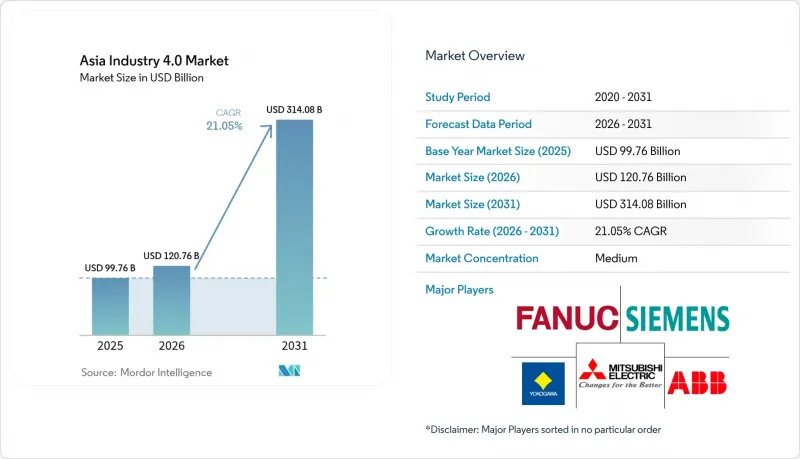
This report is Segmented by Technology Type (Industrial Robotics, Iiot Platforms and Connectivity, AI and ML, and More), End-User Industry (Discrete Manufacturing, Automotive, Oil and Gas, and More), Deployment Model (On-Premise, Cloud, and More), Organisation Size (Large Enterprises and SMEs), and Geography (China, Japan, India, and More). The Market Forecasts are Provided in Terms of Value (USD).
Insights and Trends of Asia Industry 4.0 Market
Pro-digital manufacturing stimulus packages accelerate industrial transformation
Across Asia, cumulative government commitments exceed USD 200 billion for subsidies to smart factories, tax holidays, and low-interest loans. China's 14th Five-Year Plan and India's Production Linked Incentive schemes are lowering capital hurdles for automation projects and widening supplier eligibility in public procurement. Japan's Society 5.0 and South Korea's K-Digital New Deal introduce additional grants and workforce upskilling programs that encourage vendors to adopt integrated, platform-based offerings. The Asia Industry 4.0 market benefits directly as component makers, systems integrators, and software providers experience synchronized demand across multiple verticals. Manufacturers receiving early stimulus support report 15%-20% productivity lifts within two years of deployment, reinforcing a positive feedback loop for follow-on investment.
Surging industrial-robotics demand transforms electronics and EV supply chains
In 2024, seventy percent of global robot installations took place in Asia, with China alone commissioning 290,000 new units for semiconductor packaging and battery-cell assembly. Growing electric-vehicle output in Shanghai and battery expansion in South Korea require micron-scale accuracy that only high-density robotics cells can deliver. Shorter takt times and 24/7 lights-out operations align with OEM goals to stabilize throughput during supply-chain shocks, reinforcing the Asia Industry 4.0 market's migration toward autonomous production. Robotics makers now bundle vision sensors and AI-based quality analytics, enhancing system value and differentiating offerings in crowded bidding contests. Rapid paybacks often under two years in high-volume electronics lines are convincing finance teams to prioritize multi-robot cells over incremental manual upgrades.
High upfront capital expenditure creates adoption barriers despite long-term benefits
Smart-factory retrofits often require USD 10-50 million per site, surpassing conventional equipment-replacement budgets for mid-tier manufacturers. Local banks in Vietnam and Indonesia rarely extend long-term loans for intangible software assets, forcing equity funding or delayed projects. Payback estimates hinge on predictive-maintenance savings and scrap reductions that remain unfamiliar to finance teams, suppressing approval rates even when internal rates of return align with corporate thresholds. The Asia Industry 4.0 market thus exhibits a bifurcation, where cash-rich multinational companies advance, while domestic suppliers lag behind. Capex-light subscription models are emerging, but uptake is limited by perceived vendor lock-in and ambiguous total cost-of-ownership frameworks.
Other drivers and restraints analyzed in the detailed report include:
- Government-funded SME digital-transformation vouchers democratize advanced manufacturing
- Private 5G campus networks enable ultra-low-latency industrial control systems
- Skills shortage and organizational resistance impede technology integration
For complete list of drivers and restraints, kindly check the Table Of Contents.
Segment Analysis
Industrial Robotics commanded a 23.05% share of the Asia Industry 4.0 market in 2025, driven by continued demand for electronics and battery-cell automation. However, Digital Twin platforms are growing at a 22.15% CAGR, asserting themselves as indispensable companions to physical automation by enabling virtual commissioning, predictive maintenance, and scenario planning. The Asia Industry 4.0 market size tied to digital-twin subscriptions is expected to triple by 2031 as license-based revenue models replace one-time software sales. Regional OEMs are bundling twins with robotics cells to minimize ramp-up times, cutting new-line validation from six months to three weeks. IIoT connectivity and edge analytics also experience double-digit growth, driven by the increasing availability of 5G and declining sensor costs. Blockchain remains a niche technology, but it is gaining traction in food safety and pharmaceutical serialization, while XR applications are assisting with remote maintenance for remote, rural factories. Vendors offering integrated stacks that merge twins, analytics, and AI vision stand to capture a higher wallet share as plant managers consolidate their suppliers.
Asian semiconductor fabs are adopting AI-assisted optical inspection tools that achieve sub-micron defect detection accuracy, a requirement for chips below the 5nm node. These tools feed data directly into digital-twin models, closing the loop between design and manufacturing. Japanese robotics manufacturers are now incorporating Nvidia-based GPU modules for on-arm AI inference, enhancing robotics cell flexibility without the need for external servers. Edge gateways ship with Time-Sensitive Networking (TSN) features to maintain deterministic traffic, crucial for synchronized multi-robot operations. As computing costs decrease, simulation throughput increases, allowing manufacturers to test hundreds of parameter combinations before a single physical change is made. This holistic approach cements the Asia Industry 4.0 market as an innovation sandbox where hardware and software co-evolve.
Discrete manufacturing retained 20.65% of the Asia Industry 4.0 market share in 2025, driven by high-volume assembly of consumer electronics. Yet aerospace and defense companies are embracing additive manufacturing, digital twins, and predictive analytics at a 21.95% CAGR to meet stringent component tolerances and traceability mandates. Government defense-modernization budgets in Japan, South Korea, and India finance smart-factory retrofits at prime contractors, accelerating their supplier ecosystems. Electric-vehicle platforms in China and Southeast Asia further stimulate robotics density, particularly in battery and power electronics lines. Semiconductor fabs are expanding advanced-node production to meet the growing demand for AI chips, thereby increasing the adoption of defect-inspection vision systems and sub-micron motion controllers.
Food and beverage processors integrate blockchain traceability to comply with new safety labeling laws, while oil and gas operators deploy AI-driven asset-integrity platforms to extend well life. Energy and utilities firms invest in digital control centers that synchronize distributed renewable assets, driving the adoption of predictive maintenance software across turbine and inverter fleets. These dynamics collectively broaden the Asia Industry 4.0 market's customer mix, reducing segment concentration risk for technology vendors. As high-value verticals mature, service revenue from maintenance, upgrades, and data analytics is expected to outpace hardware growth, reshaping vendor business models toward recurring income streams.
Complete Report Scope:
- By Technology Type
- Industrial Robotics
- IIoT Platforms and Connectivity
- Artificial Intelligence and Machine Learning
- Blockchain for Industrial Traceability
- Extended / Augmented / Mixed Reality
- Digital Twin
- 3-D Printing / Additive Manufacturing
- Other Technology Types
- By End-user Industry
- Discrete Manufacturing
- Automotive
- Oil and Gas
- Energy and Utilities
- Electronics and Foundry
- Food and Beverage
- Aerospace and Defence
- Other End-user Industries
- By Deployment Model
- On-premise
- Cloud
- Hybrid
- By Organisation Size
- Large Enterprises
- Small and Medium-sized Enterprises (SMEs)
- By Country
- China
- Japan
- India
- South Korea
- South-East Asia
- Rest of Asia-Pacific
List of Companies Covered in this Report:
- ABB Ltd.
- Mitsubishi Electric Corporation
- Siemens AG
- Fanuc Corporation
- Yaskawa Electric Corporation
- Yokogawa Electric Corporation
- Omron Corporation
- Robert Bosch GmbH
- Schneider Electric SE
- Rockwell Automation Inc.
- Honeywell International Inc.
- Emerson Electric Co.
- Cisco Systems Inc.
- Intel Corporation
- IBM Corporation
- SAP SE
- PTC Inc.
- Fujitsu Ltd.
- Hitachi Ltd.
- Keyence Corporation
- Panasonic Corporation
- Huawei Technologies Co. Ltd.
- Samsung Electronics Co. Ltd.
- Denso Corporation
Additional Benefits:
- The market estimate (ME) sheet in Excel format
- 3 months of analyst support
TABLE OF CONTENTS
1 INTRODUCTION
- 1.1 Study Assumptions and Market Definition
- 1.2 Scope of the Study
2 RESEARCH METHODOLOGY
3 EXECUTIVE SUMMARY
4 MARKET LANDSCAPE
- 4.1 Market Overview
- 4.2 Market Drivers
- 4.2.1 Pro-digital manufacturing stimulus packages across Asia
- 4.2.2 Surging demand for industrial robotics in electronics and EV supply chains
- 4.2.3 Government-funded SME digital-transformation vouchers
- 4.2.4 Private 5G campus networks enabling ultra-low-latency control
- 4.2.5 Carbon-neutral manufacturing mandates driving OPEX optimisation
- 4.2.6 Regional supply-chain resilience schemes (e.g., "China + 1")
- 4.3 Market Restraints
- 4.3.1 High upfront capex and unclear pay-back windows
- 4.3.2 Acute OT-IT skills shortage and change-management inertia
- 4.3.3 Fragmented industrial data standards hindering interoperability
- 4.3.4 Escalating cyber-insurance premiums for connected OT assets
- 4.4 Supply-Chain Analysis
- 4.5 Regulatory Landscape
- 4.6 Technological Outlook
- 4.7 Porter's Five Forces Analysis
- 4.7.1 Bargaining Power of Suppliers
- 4.7.2 Bargaining Power of Buyers
- 4.7.3 Threat of New Entrants
- 4.7.4 Threat of Substitutes
- 4.7.5 Intensity of Competitive Rivalry
- 4.8 Impact of Macroeconomic Factors on the Market
- 4.9 Investment Analysis
5 MARKET SIZE AND GROWTH FORECASTS (VALUE)
- 5.1 By Technology Type
- 5.1.1 Industrial Robotics
- 5.1.2 IIoT Platforms and Connectivity
- 5.1.3 Artificial Intelligence and Machine Learning
- 5.1.4 Blockchain for Industrial Traceability
- 5.1.5 Extended / Augmented / Mixed Reality
- 5.1.6 Digital Twin
- 5.1.7 3-D Printing / Additive Manufacturing
- 5.1.8 Other Technology Types
- 5.2 By End-user Industry
- 5.2.1 Discrete Manufacturing
- 5.2.2 Automotive
- 5.2.3 Oil and Gas
- 5.2.4 Energy and Utilities
- 5.2.5 Electronics and Foundry
- 5.2.6 Food and Beverage
- 5.2.7 Aerospace and Defence
- 5.2.8 Other End-user Industries
- 5.3 By Deployment Model
- 5.3.1 On-premise
- 5.3.2 Cloud
- 5.3.3 Hybrid
- 5.4 By Organisation Size
- 5.4.1 Large Enterprises
- 5.4.2 Small and Medium-sized Enterprises (SMEs)
- 5.5 By Country
- 5.5.1 China
- 5.5.2 Japan
- 5.5.3 India
- 5.5.4 South Korea
- 5.5.5 South-East Asia
- 5.5.6 Rest of Asia-Pacific
6 COMPETITIVE LANDSCAPE
- 6.1 Market Concentration
- 6.2 Strategic Moves
- 6.3 Market Share Analysis
- 6.4 Company Profiles (includes Global level Overview, Market level overview, Core Segments, Financials as available, Strategic Information, Market Rank/Share for key companies, Products and Services, and Recent Developments)
- 6.4.1 ABB Ltd.
- 6.4.2 Mitsubishi Electric Corporation
- 6.4.3 Siemens AG
- 6.4.4 Fanuc Corporation
- 6.4.5 Yaskawa Electric Corporation
- 6.4.6 Yokogawa Electric Corporation
- 6.4.7 Omron Corporation
- 6.4.8 Robert Bosch GmbH
- 6.4.9 Schneider Electric SE
- 6.4.10 Rockwell Automation Inc.
- 6.4.11 Honeywell International Inc.
- 6.4.12 Emerson Electric Co.
- 6.4.13 Cisco Systems Inc.
- 6.4.14 Intel Corporation
- 6.4.15 IBM Corporation
- 6.4.16 SAP SE
- 6.4.17 PTC Inc.
- 6.4.18 Fujitsu Ltd.
- 6.4.19 Hitachi Ltd.
- 6.4.20 Keyence Corporation
- 6.4.21 Panasonic Corporation
- 6.4.22 Huawei Technologies Co. Ltd.
- 6.4.23 Samsung Electronics Co. Ltd.
- 6.4.24 Denso Corporation
7 MARKET OPPORTUNITIES AND FUTURE OUTLOOK
- 7.1 White-space and Unmet-Need Assessment

