PUBLISHER: Mordor Intelligence | PRODUCT CODE: 2124281

PUBLISHER: Mordor Intelligence | PRODUCT CODE: 2124281
Europe Diesel Generator - Market Share Analysis, Industry Trends & Statistics, Growth Forecasts (2026 - 2031)
According to Mordor Intelligence, the Europe diesel generator market size is expected to grow from USD 3.71 billion in 2025 to USD 3.87 billion in 2026 and is forecast to reach USD 4.74 billion by 2031 at 4.18% CAGR over 2026-2031.
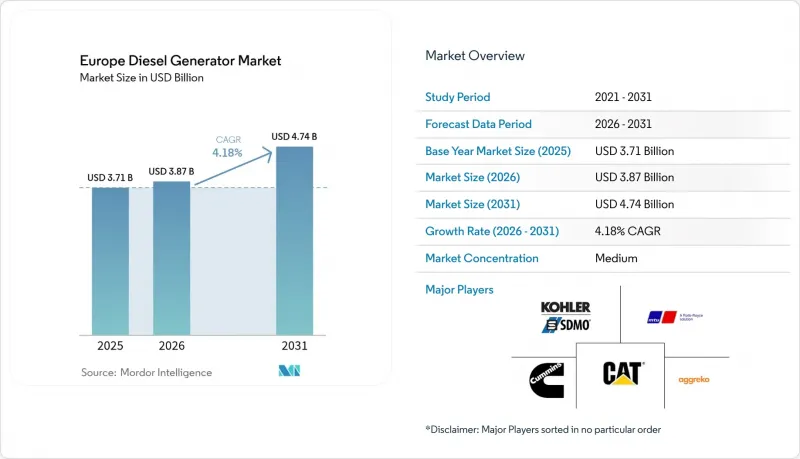
This report is Segmented by Capacity (below 75 KVA, 75 To 375 KVA, 375 To 750 KVA, 750 To 2, 000 KVA, and Above 2, 000 KVA), Application (Stand-by/Backup Power, Prime/Continuous Power, and Peak-shaving/Load Management), End User (Residential, Commercial, and Industrial), and Geography (Germany, Russia, United Kingdom, France, Italy, Spain, NORDIC Countries, Russia, and the Rest of Europe).
Europe Diesel Generator Market Trends and Insights
Grid-Outage Driven Standby Demand Surge
Fourteen member states face capacity shortfalls in the 2024-2025 winter outlook, prompting hospitals, data centers, and telecom towers to secure new standby sets. The United Kingdom alone installed 1,200 hospital backup units in 2024 to satisfy a 72-hour autonomy rule. After the Baltic Sea cable sabotage, mobile gensets were dispatched to remote cell sites once fed only by the grid, underscoring how security threats convert into immediate equipment orders. Manufacturers have responded with automatic transfer switches that start within ten seconds to protect critical loads. This surge keeps the European diesel generator market at the forefront of emergency-power planning across the continent.
Industrial and Commercial Capacity Expansion
New semiconductor fabs, mixed-use towers, and logistics hubs require multi-megawatt contingencies that conventional grids cannot always guarantee. With every cleanroom spin valued in the millions, voltage dips are intolerable, so developers specify redundant diesel arrays during design. Paris and Milan high-rises are similarly pre-installing 200 to 500 kVA sets to secure lift and HVAC uptime. Because these projects lock in long-run demand, the European diesel generator market gains durable revenue streams even as operating profiles evolve toward hybrid duty.
Renewables plus Storage Displacement
Battery energy-storage installations hit 9.2 GW in 2024, with 4-hour discharge systems now beating diesel variable costs in many markets. Data centers in Frankfurt and Amsterdam cut genset runtime by up to 70% by shifting short outages to lithium-ion banks. Residential and small commercial users with capacities below 200 kVA are adopting rooftop solar plus batteries, reducing demand for portable diesel. Price declines below EUR 150 per megawatt-hour put further pressure on traditional standby sets. Nonetheless, diesel remains the only economical choice for multi-day outages, which preserves a baseline for the European diesel generator market.
Other drivers and restraints analyzed in the detailed report include:
- Growth in Generator-Rental Ecosystem
- Stage-V Retrofit Boom
- Stricter EU Stage V/VI Emission Caps
For complete list of drivers and restraints, kindly check the Table Of Contents.
Segment Analysis
The 75-to-375 kVA band accounted for 45.12% of 2025 revenue, thanks to strong uptake in retail chains and municipal treatment plants. Rental fleets also favor this range because it strikes a balance between transport weight and fuel efficiency. Sub-75 kVA sets remain common on job sites, yet they face substitution from solar-battery combinations in subsidized markets. Above-750 kVA units serve oil refineries and mines that lack economical grid feeders, with Wartsila containerized modules delivering 20-MW blocks to Arctic locales.
Hybrid demand converges on 150-to-300 kVA, where batteries smooth load spikes and reduce fuel burn by roughly one-third. Stage-V rules accelerate turnover in the 200 to 500 kVA cohort, as pre-2019 engines prove cost-prohibitive to retrofit. Together, these mechanics underpin sustained volume in this core tranche of the European diesel generator market.
Complete Report Scope:
- By Capacity (kVA)
- Below 75 kVA
- 75 to 375 kVA
- 375 to 750 kVA
- 750 to 2,000 kVA
- Above 2,000 kVA
- By Application
- Stand-by/Backup Power
- Prime/Continuous Power
- Peak-shaving/Load Management
- By End User
- Residential
- Commercial
- Industrial
- By Geography
- Germany
- United Kingdom
- France
- Italy
- Spain
- NORDIC Countries
- Russia
- Rest of Europe
List of Companies Covered in this Report:
- Caterpillar Inc.
- Cummins Inc.
- Rolls-Royce Power Systems (MTU)
- Kohler-SDMO
- Aggreko PLC
- Mitsubishi Heavy Industries Engine & Turbocharger Ltd
- FG Wilson
- Yanmar Holdings Co. Ltd / Himoinsa
- Generac Power Systems
- Doosan Corporation
- Atlas Copco AB
- Wartsila Corporation
- Deutz AG
- Volvo Penta AB
- AKSA Power Generation
- Perkins Engines Company
- Pramac Group
- Grupel S.A.
- Wacker Neuson SE
- JCB Power Products
Additional Benefits:
- The market estimate (ME) sheet in Excel format
- 3 months of analyst support
TABLE OF CONTENTS
1 Introduction
- 1.1 Study Assumptions & Market Definition
- 1.2 Scope of the Study
2 Research Methodology
3 Executive Summary
4 Market Landscape
- 4.1 Market Overview
- 4.2 Market Drivers
- 4.2.1 Grid-outage driven standby demand surge
- 4.2.2 Industrial & commercial capacity expansion
- 4.2.3 Growth in generator-rental ecosystem
- 4.2.4 Residential back-up adoption (sub-75 kVA)
- 4.2.5 Stage-V retrofit boom (2027-2029)
- 4.2.6 NATO energy-security stockpiles
- 4.3 Market Restraints
- 4.3.1 Renewables + storage displacement
- 4.3.2 Stricter EU Stage V/VI emission caps
- 4.3.3 Bio-/eFuel & hybrid microgrid shift
- 4.3.4 Urban noise-ordinance bans (>90 dB)
- 4.4 Supply-Chain Analysis
- 4.5 Regulatory Landscape
- 4.6 Technological Outlook
- 4.7 Porter's Five Forces Analysis
- 4.7.1 Bargaining Power of Suppliers
- 4.7.2 Bargaining Power of Buyers
- 4.7.3 Threat of New Entrants
- 4.7.4 Threat of Substitutes
- 4.7.5 Intensity of Competitive Rivalry
5 Market Size & Growth Forecasts
- 5.1 By Capacity (kVA)
- 5.1.1 Below 75 kVA
- 5.1.2 75 to 375 kVA
- 5.1.3 375 to 750 kVA
- 5.1.4 750 to 2,000 kVA
- 5.1.5 Above 2,000 kVA
- 5.2 By Application
- 5.2.1 Stand-by/Backup Power
- 5.2.2 Prime/Continuous Power
- 5.2.3 Peak-shaving/Load Management
- 5.3 By End User
- 5.3.1 Residential
- 5.3.2 Commercial
- 5.3.3 Industrial
- 5.4 By Geography
- 5.4.1 Germany
- 5.4.2 United Kingdom
- 5.4.3 France
- 5.4.4 Italy
- 5.4.5 Spain
- 5.4.6 NORDIC Countries
- 5.4.7 Russia
- 5.4.8 Rest of Europe
6 Competitive Landscape
- 6.1 Market Concentration
- 6.2 Strategic Moves (M&A, Partnerships, PPAs)
- 6.3 Market Share Analysis (Market Rank/Share for key companies)
- 6.4 Company Profiles (includes Global level Overview, Market level overview, Core Segments, Financials as available, Strategic Information, Products & Services, and Recent Developments)
- 6.4.1 Caterpillar Inc.
- 6.4.2 Cummins Inc.
- 6.4.3 Rolls-Royce Power Systems (MTU)
- 6.4.4 Kohler-SDMO
- 6.4.5 Aggreko PLC
- 6.4.6 Mitsubishi Heavy Industries Engine & Turbocharger Ltd
- 6.4.7 FG Wilson
- 6.4.8 Yanmar Holdings Co. Ltd / Himoinsa
- 6.4.9 Generac Power Systems
- 6.4.10 Doosan Corporation
- 6.4.11 Atlas Copco AB
- 6.4.12 Wartsila Corporation
- 6.4.13 Deutz AG
- 6.4.14 Volvo Penta AB
- 6.4.15 AKSA Power Generation
- 6.4.16 Perkins Engines Company
- 6.4.17 Pramac Group
- 6.4.18 Grupel S.A.
- 6.4.19 Wacker Neuson SE
- 6.4.20 JCB Power Products
7 Market Opportunities & Future Outlook
- 7.1 White-space & Unmet-need Assessment
- 7.2 Increasing Demand for Hybrid Diesel Generators

