PUBLISHER: Mordor Intelligence | PRODUCT CODE: 2124340

PUBLISHER: Mordor Intelligence | PRODUCT CODE: 2124340
India Diesel Generator - Market Share Analysis, Industry Trends & Statistics, Growth Forecasts (2026 - 2031)
According to Mordor Intelligence, the India diesel generator market size was valued at USD 1.24 billion in 2025 and estimated to grow from USD 1.33 billion in 2026 to reach USD 1.88 billion by 2031, at a CAGR of 7.18% during the forecast period (2026-2031).
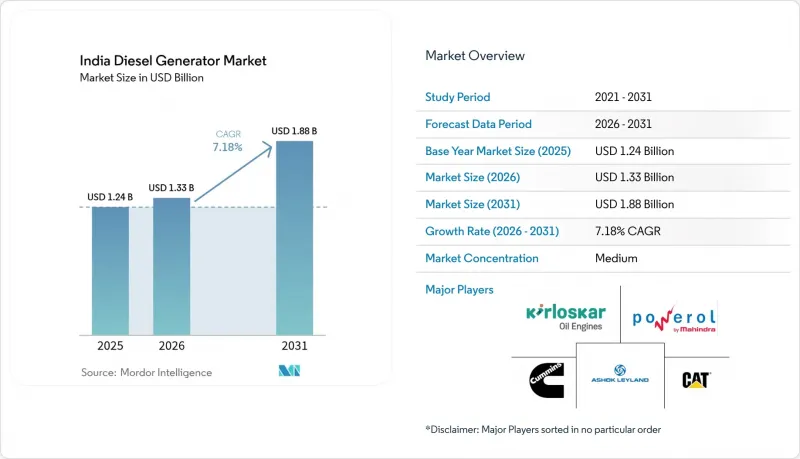
This report is Segmented by Capacity (below 75 KVA, 75 To 375 KVA, 375 To 750 KVA, 750 To 2, 000 KVA, and Above 2, 000 KVA), Application (Stand-by/Backup Power, Prime/Continuous Power, and Peak-shaving/Load Management), and End User (Residential, Commercial, and Industrial).
India Diesel Generator Market Trends and Insights
Rising Power Outages in Tier-II & Tier-III Cities
Localized reliability gaps keep the India diesel generator market indispensable outside the metros. A survey showed that 85% of households in smaller cities still suffer from 2- to 4-hour daily outages, despite the national deficit falling to 0.1%. Commercial chains, diagnostic labs, and cold-storage outlets cannot tolerate voltage sags, so gensets remain budgeted as core operating costs. The Revamped Distribution Sector Scheme allocates USD 36 billion for feeder and smart-meter upgrades; however, fiscally weaker states lag, perpetuating reliance on gensets. Even after average urban supply improved to 23.4 hours, the residual downtime often coincides with evening peaks, prompting buyers to size units for full-load duty. Consequently, sets below 75 kVA continue to rotate on a five- to seven-year replacement cycle across Tier II and Tier III clusters.
Infrastructure Boom in Construction & Real Estate
India's construction sector, valued at USD 1.4 trillion, now accounts for approximately 9% of the country's GDP and employs around 71 million workers. Government capex of USD 134 billion in FY25 under the PM Gati Shakti plan channels funds into expressways, metros, airports, and industrial corridors. Early-stage civil works are powered by rented 375 to 750 kVA generators because distribution connections are not available until structural milestones are reached. Real growth of 13.3% year-over-year in Q3 2023 and 80 million tonnes of new cement capacity signal a multi-year surge in power demand. Flagship projects such as the Delhi-Mumbai Industrial Corridor or GIFT City each require multi-megawatt standby fleets for cranes, pumps, and welders. The rollout of affordable housing under PM Awas Yojana across peri-urban zones adds further depth to mid-range genset demand.
Rapid Adoption of Rooftop Solar + Storage Systems
Residential rooftop installations reached 3.2 GW by March 2024, and the PM Surya Ghar Muft Bijli Yojana added another 1.8 GW in six months through simplified approvals and capital subsidies. Commercial users have deployed roughly 4 GW, increasingly paired with battery storage, as tariffs for stand-alone BESS fell through the viability gap due to funding. Storage tenders totaling 6.1 GW in Q1 2025 reveal that utilities view batteries as an economic substitute for peaking diesel fleets. Telecom operators now run photovoltaic hybrids at select towers, slashing CO2 output by up to 58%. These trends compress demand in grid-connected light-commercial and residential segments, although off-grid prime-power niches remain protected by renewable intermittency.
Other drivers and restraints analyzed in the detailed report include:
- Telecom-Tower Proliferation in Rural India
- Advancements in Generator Efficiency & Remote Monitoring
- Stricter CPCB IV+ Emission Norms Inflating Capex
For complete list of drivers and restraints, kindly check the Table Of Contents.
Segment Analysis
The 375-750 kVA class is projected to grow at an annual rate of 8.75% to 2031, significantly outpacing the 7.18% baseline, as colocation halls and large construction sites increasingly favor units that can parallel seamlessly for N+1 redundancy. Below 75 kVA sets still command 34.86% of India's diesel generator market share, anchored in gated communities and corner stores across Tier-II cities, yet rooftop solar cuts into fresh installations. The 75 to 375 kVA range services mid-sized factories, retail chains, and hospitals that must replace aging fleets with CPCB IV+ models, as pre-2024 units reach the end of their life. Larger machines, with capacities of 750 to 2,000 kVA, supply manufacturing plants, mining sites, and public-sector utilities that require multi-megawatt clusters. Premiumization is most visible in mid-range orders, where buyers request IoT-enabled monitoring, five-year warranties, and expedited spare parts fulfillment. Kirloskar Oil Engines has responded by bundling fuel-agnostic engines and cloud dashboards that reduce unplanned downtime, thereby cementing its hold on high-value accounts.
A second driver for mid-range uptake is the mandatory backup requirement embedded in several state data-center policies. Each 1 MW of IT load requires up to 1.5 MW of standby diesel, resulting in clusters of synchronized 500 to 750 kVA units rated for a 10-second black-start capability. Cummins reported a 30.8% revenue surge in Q2 FY25, driven by such orders, a segment that was negligible three years ago. OEMs with proven SCR and DPF service capacity thus command healthy price premiums. Smaller assemblers, meanwhile, face margin compression as buyers pivot to warranty-rich branded sets. The India diesel generator market consequently tilts toward organized players within the 375 to 750 kVA sweet spot, even as the sub-75 kVA category maintains a broad but low-margin installed base.
Complete Report Scope:
- By Capacity (kVA)
- Below 75 kVA
- 75 to 375 kVA
- 375 to 750 kVA
- 750 to 2,000 kVA
- Above 2,000 kVA
- By Application
- Stand-by/Backup Power
- Prime/Continuous Power
- Peak-shaving/Load Management
- By End User
- Residential
- Commercial
- Industrial
List of Companies Covered in this Report:
- Cummins India Ltd.
- Kirloskar Oil Engines Ltd.
- Caterpillar Inc. (FG Wilson)
- Mahindra Powerol Ltd.
- Ashok Leyland Ltd.
- Mitsubishi Heavy Industries Ltd.
- Greaves Cotton Ltd.
- Cooper Corporation Pvt. Ltd.
- Atlas Copco AB
- Sterling & Wilson Powergen Pvt. Ltd.
- Generac Power Systems
- Kohler-SDMO
- Volvo Penta India
- Doosan Portable Power
- TAFE Motors & Tractors (Eicher)
- Jakson Group
- Sudhir Power Ltd.
- Wartsila India Pvt. Ltd.
- Yanmar Holdings (India)
Additional Benefits:
- The market estimate (ME) sheet in Excel format
- 3 months of analyst support
TABLE OF CONTENTS
1 Introduction
- 1.1 Study Assumptions & Market Definition
- 1.2 Scope of the Study
2 Research Methodology
3 Executive Summary
4 Market Landscape
- 4.1 Market Overview
- 4.2 Market Drivers
- 4.2.1 Rising power outages in Tier-II & Tier-III cities
- 4.2.2 Infrastructure boom in construction & real estate
- 4.2.3 Telecom-tower proliferation in rural India
- 4.2.4 Advancements in generator efficiency & remote monitoring
- 4.2.5 Mandatory back-up for new data-centre colocation facilities (IT Policy 2025)
- 4.2.6 Growth of genset-leasing models for MSMEs post-GST input-credit rules
- 4.3 Market Restraints
- 4.3.1 Rapid adoption of rooftop solar + storage systems
- 4.3.2 Stricter CPCB IV+ emission norms inflating capex
- 4.3.3 NBFC credit-tightening limiting contractor purchases
- 4.3.4 Diesel-supply disruptions during festival/election seasons
- 4.4 Supply-Chain Analysis
- 4.5 Regulatory Landscape
- 4.6 Technological Outlook
- 4.7 Porter's Five Forces Analysis
- 4.7.1 Threat of New Entrants
- 4.7.2 Bargaining Power of Suppliers
- 4.7.3 Bargaining Power of Buyers
- 4.7.4 Threat of Substitutes
- 4.7.5 Competitive Rivalry
- 4.8 PESTLE Analysis
5 Market Size & Growth Forecasts
- 5.1 By Capacity (kVA)
- 5.1.1 Below 75 kVA
- 5.1.2 75 to 375 kVA
- 5.1.3 375 to 750 kVA
- 5.1.4 750 to 2,000 kVA
- 5.1.5 Above 2,000 kVA
- 5.2 By Application
- 5.2.1 Stand-by/Backup Power
- 5.2.2 Prime/Continuous Power
- 5.2.3 Peak-shaving/Load Management
- 5.3 By End User
- 5.3.1 Residential
- 5.3.2 Commercial
- 5.3.3 Industrial
6 Competitive Landscape
- 6.1 Market Concentration
- 6.2 Strategic Moves (M&A, Partnerships, PPAs)
- 6.3 Market Share Analysis (Market Rank/Share for key companies)
- 6.4 Company Profiles (includes Global level Overview, Market level overview, Core Segments, Financials as available, Strategic Information, Products & Services, and Recent Developments)
- 6.4.1 Cummins India Ltd.
- 6.4.2 Kirloskar Oil Engines Ltd.
- 6.4.3 Caterpillar Inc. (FG Wilson)
- 6.4.4 Mahindra Powerol Ltd.
- 6.4.5 Ashok Leyland Ltd.
- 6.4.6 Mitsubishi Heavy Industries Ltd.
- 6.4.7 Greaves Cotton Ltd.
- 6.4.8 Cooper Corporation Pvt. Ltd.
- 6.4.9 Atlas Copco AB
- 6.4.10 Sterling & Wilson Powergen Pvt. Ltd.
- 6.4.11 Generac Power Systems
- 6.4.12 Kohler-SDMO
- 6.4.13 Volvo Penta India
- 6.4.14 Doosan Portable Power
- 6.4.15 TAFE Motors & Tractors (Eicher)
- 6.4.16 Jakson Group
- 6.4.17 Sudhir Power Ltd.
- 6.4.18 Wartsila India Pvt. Ltd.
- 6.4.19 Yanmar Holdings (India)
7 Market Opportunities & Future Outlook
- 7.1 White-space & Unmet-need Assessment

