PUBLISHER: Mordor Intelligence | PRODUCT CODE: 2124323

PUBLISHER: Mordor Intelligence | PRODUCT CODE: 2124323
Energy As A Service (EaaS) - Market Share Analysis, Industry Trends & Statistics, Growth Forecasts (2026 - 2031)
According to Mordor Intelligence, the energy as a service market size was valued at USD 107.59 billion in 2025 and estimated to grow from USD 119.67 billion in 2026 to reach USD 203.74 billion by 2031, at a CAGR of 11.23% during the forecast period (2026-2031).
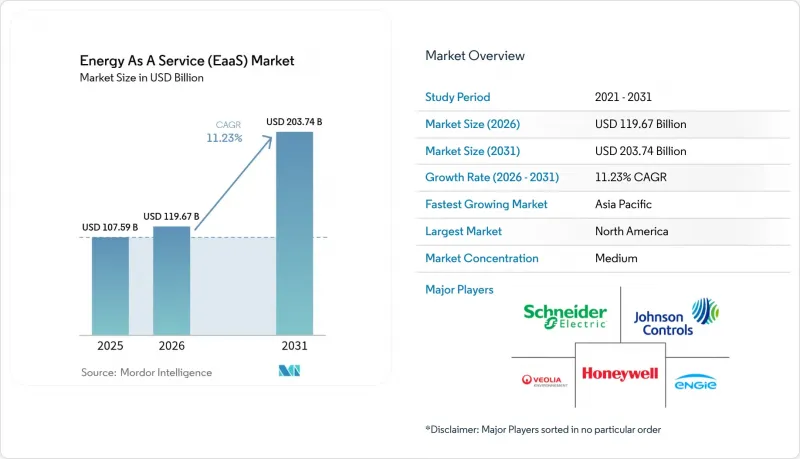
This report is Segmented by Service Type (Energy Supply Services, Microgrid-As-A-Service, Energy Infrastructure Services, and More), Service-Delivery Model (Pay-For-Service, Leasing and Rental Models, and More), Technology (Distributed Generation, EV-Charging Infrastructure, and More), End User (Commercial and Industrial), and Geography (North America, Europe, Asia-Pacific, South America, and More).
Global Energy As A Service (EaaS) Market Trends and Insights
Corporate Decarbonization Mandates & Scope-3 Pressure
Mandatory greenhouse-gas disclosure rules, such as California's SB 253, require firms with revenue exceeding USD 1 billion to report Scope 3 emissions starting in 2027, prompting procurement teams to prioritize renewable electricity and verified emissions accounting. Multinational buyers extend these requirements along their supply chains, amplifying demand for turnkey Energy as a Service market solutions that bundle green power, energy efficiency, and transparent reporting. Financial institutions also factor climate risk into lending decisions, so companies perceive service-based energy contracts as a convenient Energy-as-a-Service market that expands the path to greener balance sheets. Mid-sized enterprises lacking in-house sustainability staff benefit the most, outsourcing both technology selection and monitoring. As disclosure deadlines approach, the addressable customer pool for the Energy as a Service market widens across every major sector.
Grid Volatility Driving Microgrid Adoption
Ageing infrastructure, extreme weather, and data center growth stress legacy grids; the International Energy Agency estimates that 80 million km of power lines will need refurbishment or replacement by 2040. Microgrids mitigate outage risk by allowing critical loads to island and self-supply. Demonstrations funded by the California Energy Commission have shown 20-60% energy cost savings while maintaining uptime during blackouts. Corporations now view microgrids not as backup assets, but as integrated components of their facility management strategies, and service providers supply them under multi-year pay-for-performance contracts. Regulatory treatment varies by jurisdiction, yet policy experimentation-such as performance-based tariffs and reduced interconnection fees-continues to unlock new demand pockets for the Energy as a Service market.
Long-Term Contract Lock-In Concerns
Standard Energy Savings Performance Contracts span 5-20 years, raising anxiety about technology obsolescence and operational flexibility. The U.S. Department of Energy advises rigorous measurement and verification to safeguard customer value and audit readiness. Service providers are increasingly inserting mid-term upgrade clauses or opt-out windows, but these features can raise pricing. Consequently, risk-averse prospects may delay signing, reducing immediate growth potential for the Energy as a Service market.
Other drivers and restraints analyzed in the detailed report include:
- Shift from CAPEX to OPEX in Fortune-1000 Facilities
- AI-Driven Energy Analytics Improving ROI
- Cyber-Security Liabilities on Third-Party Assets
For complete list of drivers and restraints, kindly check the Table Of Contents.
Segment Analysis
Energy Supply Services generated 39.12% of 2025 turnover, reflecting enterprises' priority to secure competitively priced, low-carbon electricity without managing complex procurement processes. Within this segment, the Energy as a Service market share advantage stems from bundled power-purchase arrangements, hedging strategies, and management of renewable certificates. Microgrid-as-a-Service is projected to record the fastest 14.05% CAGR through 2031, as hospitals, airports, and manufacturing parks seek island-mode resiliency during grid disturbances. The Energy as a Service market size for microgrids is projected to more than double between 2026 and 2031, supported by falling battery prices and streamlined permitting. Services covering operations & maintenance, as well as lifecycle upgrades, add sticky recurring revenue streams, further entrenching providers.
In parallel, Energy Infrastructure Services-engineering, interconnection, and asset monitoring-gain importance as clients demand seamless integration of generation, storage, and advanced controls. The Energy as a Service market is seeing rising cross-sell opportunities, where a single contract now spans supply, efficiency optimization, and on-site generation. Providers with deep software stacks and nationwide field service crews command premium valuations, reflecting the synergistic value created by integrated offerings.
Pay-for-service agreements accounted for 39.55% of 2025 revenue, as they transform volatile utility expenses into a single, predictable monthly line item. These contracts typically bundle performance guarantees and align provider compensation with realized savings, reinforcing customer confidence. Leasing & Rental models gain traction at an 18.02% CAGR by offering shorter tenures and simplified off-balance-sheet treatment, which appeals to tenants or property managers with limited lease horizons. While the Energy as a Service industry occasionally employs Build-Own-Operate-Transfer structures for municipalities seeking eventual ownership, subscription plans are the dominant form of private-sector uptake.to legacy ESCO arrangements, modern Pay-for-Service contracts emphasize modular add-ons, such as demand-response participation, electric vehicle charging, and carbon reporting
Performance-based contracts remain prevalent in the public and institutional arena, supported by statutory frameworks that authorize multi-year repayment from guaranteed savings. Compared with legacy ESCO arrangements, modern Pay-for-Service contracts emphasize modular add-ons such as demand-response participation, electric-vehicle charging, and carbon-reporting dashboards. This evolution reinforces the Energy as a Service market's positioning as a scalable, tech-enabled solution rather than a one-off retrofit scheme.
Complete Report Scope:
- By Service Type
- Energy Supply Services
- Energy Efficiency and Optimisation Services
- Operation and Maintenance Services
- Energy Infrastructure Services
- Microgrid-as-a-Service
- By Service-Delivery Model
- Pay-for-Service (Subscription)
- Performance-based Contracting (ESCO/EPC)
- Build-Own-Operate-Transfer (BOOT)
- Leasing and Rental Models
- By Technology
- Distributed Generation (Solar PV, Wind, Combined Heat & Power and Fuel Cells)
- Energy Storage (Battery Storage, and Thermal Storage)
- Smart Energy Management & Analytics
- EV-Charging Infrastructure
- By End User
- Commercial (Data Centres, Retail & Shopping Malls, Healthcare Facilities, Educational Institutions, Hospitality and Others)
- Industrial (Heavy Manufacturing, Food & Beverage Processing, Chemicals & Pharmaceuticals, Mining & Metals and Others)
- By Geography
- North America
- United States
- Canada
- Mexico
- Europe
- Germany
- United Kingdom
- France
- Italy
- NORDIC Countries
- Russia
- Rest of Europe
- Asia-Pacific
- China
- India
- Japan
- South Korea
- ASEAN Countries
- Rest of Asia-Pacific
- South America
- Brazil
- Argentina
- Rest of South America
- Middle East and Africa
- Saudi Arabia
- United Arab Emirates
- South Africa
- Egypt
- Rest of Middle East and Africa
- North America
Geography Analysis
North America retained 42.18% of global revenue in 2025, powered by the IRA's USD 370 billion stimulus, state-level storage mandates, and mature corporate procurement programs. The Greenhouse Gas Reduction Fund steers low-interest capital to disadvantaged communities, broadening the customer base beyond Fortune 500 enterprises. Canada reinforces regional momentum through carbon pricing and provincial clean-energy auctions. Cross-border interoperability of smart-metering standards and open-data policies further accelerates platform scalability for energy-as-a-service market participants.
The Asia-Pacific region records the fastest growth, with a 16.32% CAGR to 2031, reflecting rapid urbanization and sustained public-sector investment. China's multi-gigawatt distributed-generation schemes and India's transmission build-out unlock substantial opportunities for turnkey microgrid and storage offerings. Japan and South Korea deploy high-penetration renewables paired with advanced predictive maintenance analytics, establishing templates that are replicable across ASEAN nations. Although financing costs remain elevated in certain jurisdictions, blended-finance facilities and export-credit support mitigate risk and catalyze the regional Energy-as-a-Service market.
Europe maintains a sizable share, bolstered by the Fit-for-55 decarbonization targets that compel large emitters to contract for renewable power and energy efficiency guarantees. Harmonized data-sharing frameworks simplify multi-country rollouts, though each member state retains discretion over behind-the-meter incentive design, which introduces execution complexity. South America, the Middle East, and Africa together contribute a modest but growing slice of global revenue. Currency volatility and policy uncertainty temper uptake, yet landmark projects-such as Morocco's 822,000 m3/day desalination plant incorporating solar-plus-storage under a 35-year concession-demonstrate feasibility for bankable Energy as a Service market structures
- Schneider Electric SE
- Engie SA
- Honeywell International Inc.
- Veolia Environnement SA
- Electricite de France (EDF) SA
- Johnson Controls International plc
- Bernhard
- Enel SpA
- Sparkfund
- Siemens AG
- ABB Ltd.
- Centrica Business Solutions
- Ameresco
- NRG Energy
- Shell Energy
- Duke Energy Sustainable Solutions
- Orsted A/S
- TotalEnergies
- E.ON SE
- Brookfield Renewable
- Generate Capital
Additional Benefits:
- The market estimate (ME) sheet in Excel format
- 3 months of analyst support
TABLE OF CONTENTS
1 Introduction
- 1.1 Study Assumptions & Market Definition
- 1.2 Scope of the Study
2 Research Methodology
3 Executive Summary
4 Market Landscape
- 4.1 Market Overview
- 4.2 Market Drivers
- 4.2.1 Corporate decarbonisation mandates & Scope-3 pressure
- 4.2.2 Grid volatility driving micro-grid adoption
- 4.2.3 Shift from CAPEX to OPEX in Fortune-1000 facilities
- 4.2.4 AI-driven energy analytics improving ROI
- 4.2.5 Inflation Reduction Act & other green-funding pools
- 4.2.6 Rise of C&I battery storage "as-a-service" offers
- 4.3 Market Restraints
- 4.3.1 Long-term contract lock-in concerns
- 4.3.2 Cyber-security liabilities on third-party assets
- 4.3.3 Policy uncertainty on behind-the-meter incentives
- 4.3.4 Inflated WACC on energy infrastructure in EMs
- 4.4 Supply-Chain Analysis
- 4.5 Regulatory Landscape
- 4.6 Technological Outlook
- 4.7 Porter's Five Forces
- 4.7.1 Bargaining Power of Suppliers
- 4.7.2 Bargaining Power of Buyers
- 4.7.3 Threat of New Entrants
- 4.7.4 Threat of Substitutes
- 4.7.5 Intensity of Rivalry
5 Market Size & Growth Forecasts
- 5.1 By Service Type
- 5.1.1 Energy Supply Services
- 5.1.2 Energy Efficiency and Optimisation Services
- 5.1.3 Operation and Maintenance Services
- 5.1.4 Energy Infrastructure Services
- 5.1.5 Microgrid-as-a-Service
- 5.2 By Service-Delivery Model
- 5.2.1 Pay-for-Service (Subscription)
- 5.2.2 Performance-based Contracting (ESCO/EPC)
- 5.2.3 Build-Own-Operate-Transfer (BOOT)
- 5.2.4 Leasing and Rental Models
- 5.3 By Technology
- 5.3.1 Distributed Generation (Solar PV, Wind, Combined Heat & Power and Fuel Cells)
- 5.3.2 Energy Storage (Battery Storage, and Thermal Storage)
- 5.3.3 Smart Energy Management & Analytics
- 5.3.4 EV-Charging Infrastructure
- 5.4 By End User
- 5.4.1 Commercial (Data Centres, Retail & Shopping Malls, Healthcare Facilities, Educational Institutions, Hospitality and Others)
- 5.4.2 Industrial (Heavy Manufacturing, Food & Beverage Processing, Chemicals & Pharmaceuticals, Mining & Metals and Others)
- 5.5 By Geography
- 5.5.1 North America
- 5.5.1.1 United States
- 5.5.1.2 Canada
- 5.5.1.3 Mexico
- 5.5.2 Europe
- 5.5.2.1 Germany
- 5.5.2.2 United Kingdom
- 5.5.2.3 France
- 5.5.2.4 Italy
- 5.5.2.5 NORDIC Countries
- 5.5.2.6 Russia
- 5.5.2.7 Rest of Europe
- 5.5.3 Asia-Pacific
- 5.5.3.1 China
- 5.5.3.2 India
- 5.5.3.3 Japan
- 5.5.3.4 South Korea
- 5.5.3.5 ASEAN Countries
- 5.5.3.6 Rest of Asia-Pacific
- 5.5.4 South America
- 5.5.4.1 Brazil
- 5.5.4.2 Argentina
- 5.5.4.3 Rest of South America
- 5.5.5 Middle East and Africa
- 5.5.5.1 Saudi Arabia
- 5.5.5.2 United Arab Emirates
- 5.5.5.3 South Africa
- 5.5.5.4 Egypt
- 5.5.5.5 Rest of Middle East and Africa
- 5.5.1 North America
6 Competitive Landscape
- 6.1 Market Concentration
- 6.2 Strategic Moves (M&A, Partnerships, PPAs)
- 6.3 Market Share Analysis (Market Rank/Share for key companies)
- 6.4 Company Profiles (includes Global level Overview, Market level overview, Core Segments, Financials as available, Strategic Information, Products & Services, and Recent Developments)
- 6.4.1 Schneider Electric SE
- 6.4.2 Engie SA
- 6.4.3 Honeywell International Inc.
- 6.4.4 Veolia Environnement SA
- 6.4.5 Electricite de France (EDF) SA
- 6.4.6 Johnson Controls International plc
- 6.4.7 Bernhard
- 6.4.8 Enel SpA
- 6.4.9 Sparkfund
- 6.4.10 Siemens AG
- 6.4.11 ABB Ltd.
- 6.4.12 Centrica Business Solutions
- 6.4.13 Ameresco
- 6.4.14 NRG Energy
- 6.4.15 Shell Energy
- 6.4.16 Duke Energy Sustainable Solutions
- 6.4.17 Orsted A/S
- 6.4.18 TotalEnergies
- 6.4.19 E.ON SE
- 6.4.20 Brookfield Renewable
- 6.4.21 Generate Capital
7 Market Opportunities & Future Outlook
- 7.1 White-space & Unmet-Need Assessment

