PUBLISHER: Mordor Intelligence | PRODUCT CODE: 2124357

PUBLISHER: Mordor Intelligence | PRODUCT CODE: 2124357
Africa CNG And LPG Vehicle - Market Share Analysis, Industry Trends & Statistics, Growth Forecasts (2026 - 2031)
According to Mordor Intelligence, the Africa CNG and LPG Vehicle Market size in 2026 is estimated at USD 1.65 billion, growing from 2025 value of USD 1.54 billion with 2031 projections showing USD 2.29 billion, growing at 6.84% CAGR over 2026-2031.
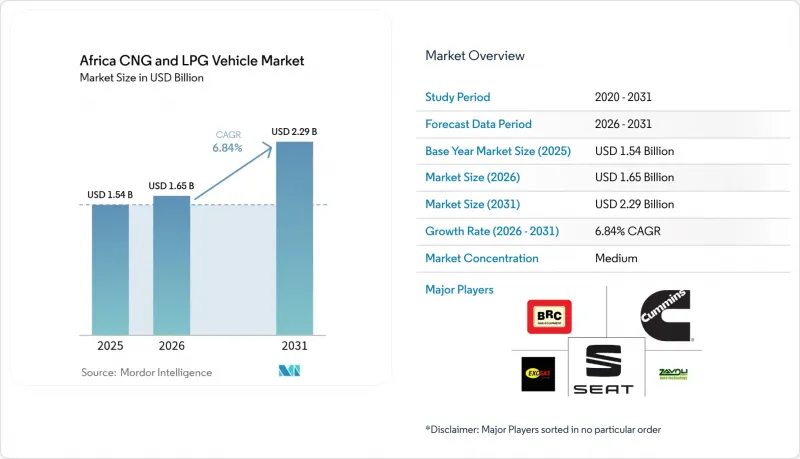
This report is Segmented by Fuel Type (Compressed Natural Gas and Liquefied Petroleum Gas), Vehicle Type (Passenger Cars, Light Commercial Vehicles, and More), Sales Channel (Original Equipment Manufacturer and Aftermarket), Conversion Technology (Dedicated CNG/LPG, Bi-Fuel Gasoline-Gas, and Dual-Fuel Diesel-CNG), and Geography. The Market Forecasts are Provided in Terms of Value (USD) and Volume (Units).
Africa CNG And LPG Vehicle Market Trends and Insights
Rising Investments in Refueling Infrastructure
Nigeria's NNPC targets multiple CNG stations by 2025, and Egypt already operates numerous sites, giving both nations a substantial first-mover advantage in network coverage . Capital also flows into micro-LNG-to-CNG hubs that monetize previously flared associated gas volumes, lowering unit transportation costs for rural operators. The Nigeria-Morocco pipeline and Nigeria-Equatorial Guinea gas-link agreements underscore regional ambitions to unify supply specifications. Early investors gain location advantages because infrastructure typically precedes demand, locking in high-traffic urban corridors. As stations spread, fleet owners increasingly base procurement plans on assured refueling proximity rather than speculative future builds.
Government Incentives & Subsidies for Gaseous Fuels
Nigeria's Presidential CNG Initiative bundles conversion rebates, tax holidays, and mandatory public-sector fleet transitions that target one million vehicles-or roughly half of the current commercial fleet-by 2027 . Tanzania's completed conversions illustrate the catalytic effect of even modest fiscal support when paired with visible pilot fleets. Such frameworks tilt total cost-of-ownership calculations decidedly toward gaseous fuels, but fiscal sustainability hinges on complementary private capital in infrastructure and service delivery. Coordinated public-private investment structures matter because unchecked subsidy outlays risk crowding out other energy-transition priorities. Thus, policy architects increasingly design sunset clauses that phase incentives out as network density approaches economic self-sufficiency.
Inadequate Regulatory Frameworks
Regulation gaps foster informal workshops that install uncertified high-pressure tanks, raising safety concerns that erode consumer confidence. Approval protocols differ widely among African states, driving up compliance costs for kit suppliers who must customize paperwork for each jurisdiction. Absent harmonized fuel-quality rules, cross-border fleets face engine-damage risk when methane numbers or LPG octane levels vary unexpectedly. Such friction fragments scale economies, inhibiting OEMs from committing to dedicated assembly lines. ECOWAS discussions on standard gaseous-fuel specification could lower these barriers, but progress remains incremental and politically sensitive.
Other drivers and restraints analyzed in the detailed report include:
- Volatile Gasoline and Diesel Prices
- Stricter Vehicle-Emission Standards
- Limited OEM Gaseous-Fuel Vehicle Portfolio
For complete list of drivers and restraints, kindly check the Table Of Contents.
Segment Analysis
Compressed Natural Gas commanded a 76.79% 2025 revenue share, reflecting the dense station networks in Egypt and emerging corridors in Nigeria. The Africa CNG and LPG vehicle market size for CNG-powered units is forecast to climb at a 6.74% CAGR through 2031 as additional pipelines lower wholesale methane costs and make retail pricing more competitive. Infrastructure prerequisites create natural oligopolies in urban centers, incentivizing long-term supply contracts between fleet operators and station consortia. LPG continues serving territories without pipeline access, offering bottled-gas convenience where road density is low yet cooking-gas distribution already exists.
Nonetheless, as pipeline-based supply pushes deeper inland, investment logic tilts toward CNG for high-utilization freight. Once commissioned, the Nigeria-Morocco trunk line will likely expand CNG market access into interior West Africa. That extension will further widen the cost gap between CNG and LPG, nudging mixed-fuel fleets toward single-fuel strategies that simplify maintenance.
Passenger cars held 62.88% of cumulative conversions in 2025, yet buses and coaches are projected to lead growth at a 6.90% CAGR to 2031. High-mileage urban passenger transport amplifies savings: a city bus completing triple-shift duty can recoup conversion costs within one fiscal year, compelling payback calculations. Freight logistics likewise sees mounting interest, illustrated by Dangote Group's rollout of multiple CNG trucks that collectively displace sizable diesel volumes.
The Africa CNG and LPG vehicle market share captured by commercial categories will expand as e-commerce accelerates delivery-van utilization and operators seek a shield against oil-price swings. Private car uptake, though slower, rises in lockstep with public confidence built by visible fleet examples and growing station density. The trajectory implies a commercial-first adoption curve, with retail consumers following once infrastructural convenience reaches parity with legacy fuels.
Complete Report Scope:
- By Fuel Type
- Compressed Natural Gas (CNG)
- Liquefied Petroleum Gas (LPG)
- By Vehicle Type
- Passenger Cars
- Light Commercial Vehicles
- Medium and Heavy Commercial Vehicles
- Buses & Coaches
- By Sales Channel
- Original Equipment Manufacturer (OEM)
- Aftermarket
- By Conversion Technology
- Dedicated CNG/LPG
- Bi-fuel (Gasoline-Gas)
- Dual-fuel Diesel-CNG (HDVs)
- By Country
- Egypt
- Nigeria
- South Africa
- Morocco
- Ethiopia
- Rest of Africa
List of Companies Covered in this Report:
- Iveco S.p.A.
- Volkswagen AG
- AB Volvo
- Ford Motor Company
- Cummins Inc.
- Toyota South Africa Motors
- Hyundai Motor Company
- Kia Corporation
- Stellantis N.V. (Fiat Professional)
- Landi Renzo S.p.A.
- BRC Gas Equipment
- Westport Fuel Systems
- Prins Autogassystemen
- Zavoli S.r.l.
- Valtec
- African Gas Equipment
- ExoGas
- Clean Energy NG
- NGVAfrica
- SEAT S.A.
Additional Benefits:
- The market estimate (ME) sheet in Excel format
- 3 months of analyst support
TABLE OF CONTENTS
1 Introduction
- 1.1 Study Assumptions & Market Definition
- 1.2 Scope of the Study
2 Research Methodology
3 Executive Summary
4 Market Landscape
- 4.1 Market Overview
- 4.2 Market Drivers
- 4.2.1 Rising Investments in Refueling Infrastructure
- 4.2.2 Government Incentives & Subsidies for Gaseous Fuels
- 4.2.3 Volatile Gasoline and Diesel Prices
- 4.2.4 Stricter Vehicle-Emission Standards
- 4.2.5 Micro-LNG-To-CNG Hubs Enabling Rural Supply
- 4.2.6 Ride-Hailing Fleet Conversion to CNG/LPG
- 4.3 Market Restraints
- 4.3.1 Inadequate Regulatory Frameworks
- 4.3.2 Limited OEM Gaseous-Fuel Vehicle Portfolio
- 4.3.3 Gas-Supply Disruptions Impacting Station Uptime
- 4.3.4 Safety-Perception Issues From Informal Converters
- 4.4 Value / Supply-Chain Analysis
- 4.5 Regulatory Landscape
- 4.6 Technological Outlook
- 4.7 Porter's Five Forces
- 4.7.1 Threat of New Entrants
- 4.7.2 Bargaining Power of Buyers
- 4.7.3 Bargaining Power of Suppliers
- 4.7.4 Threat of Substitutes
- 4.7.5 Intensity of Competitive Rivalry
- 4.8 Investment & Infrastructure Analysis
5 Market Size & Growth Forecasts (Value (USD) and Volume (Units))
- 5.1 By Fuel Type
- 5.1.1 Compressed Natural Gas (CNG)
- 5.1.2 Liquefied Petroleum Gas (LPG)
- 5.2 By Vehicle Type
- 5.2.1 Passenger Cars
- 5.2.2 Light Commercial Vehicles
- 5.2.3 Medium and Heavy Commercial Vehicles
- 5.2.4 Buses & Coaches
- 5.3 By Sales Channel
- 5.3.1 Original Equipment Manufacturer (OEM)
- 5.3.2 Aftermarket
- 5.4 By Conversion Technology
- 5.4.1 Dedicated CNG/LPG
- 5.4.2 Bi-fuel (Gasoline-Gas)
- 5.4.3 Dual-fuel Diesel-CNG (HDVs)
- 5.5 By Country
- 5.5.1 Egypt
- 5.5.2 Nigeria
- 5.5.3 South Africa
- 5.5.4 Morocco
- 5.5.5 Ethiopia
- 5.5.6 Rest of Africa
6 Competitive Landscape
- 6.1 Market Concentration
- 6.2 Strategic Moves
- 6.3 Market Share Analysis
- 6.4 Company Profiles (includes Global Level Overview, Market Level Overview, Core Segments, Financials as Available, Strategic Information, Market Rank/Share for Key Companies, Products and Services, SWOT Analysis, and Recent Developments)
- 6.4.1 Iveco S.p.A.
- 6.4.2 Volkswagen AG
- 6.4.3 AB Volvo
- 6.4.4 Ford Motor Company
- 6.4.5 Cummins Inc.
- 6.4.6 Toyota South Africa Motors
- 6.4.7 Hyundai Motor Company
- 6.4.8 Kia Corporation
- 6.4.9 Stellantis N.V. (Fiat Professional)
- 6.4.10 Landi Renzo S.p.A.
- 6.4.11 BRC Gas Equipment
- 6.4.12 Westport Fuel Systems
- 6.4.13 Prins Autogassystemen
- 6.4.14 Zavoli S.r.l.
- 6.4.15 Valtec
- 6.4.16 African Gas Equipment
- 6.4.17 ExoGas
- 6.4.18 Clean Energy NG
- 6.4.19 NGVAfrica
- 6.4.20 SEAT S.A.
7 Market Opportunities & Future Outlook
- 7.1 White-Space & Unmet-Need Assessment

