PUBLISHER: Mordor Intelligence | PRODUCT CODE: 2124433

PUBLISHER: Mordor Intelligence | PRODUCT CODE: 2124433
Instrument Transformer - Market Share Analysis, Industry Trends & Statistics, Growth Forecasts (2026 - 2031)
According to Mordor Intelligence, the instrument transformer market size was valued at USD 7.21 billion in 2025 and estimated to grow from USD 7.56 billion in 2026 to reach USD 9.59 billion by 2031, at a CAGR of 4.87% during the forecast period (2026-2031).
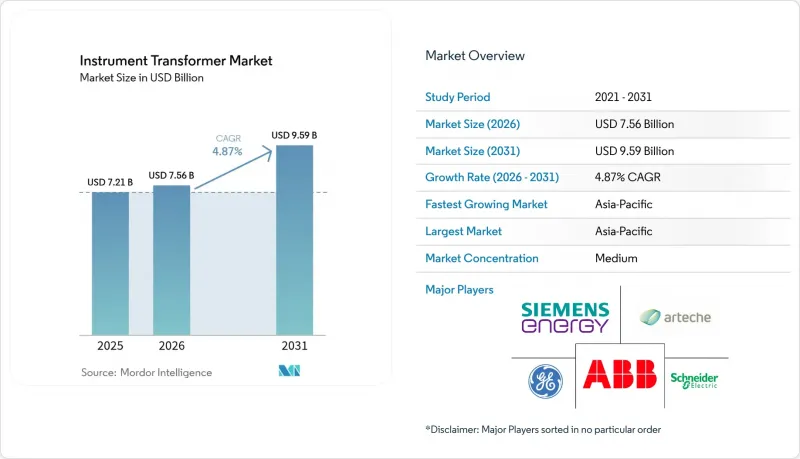
This report is Segmented by Type (Current Transformer, Voltage/Potential Transformer, and Combined/Capacitive Transformer), End User (Power Utilities, Industrial, and Infrastructure and Commercial), and Geography (North America, Europe, Asia-Pacific, South America, and Middle East and Africa). The Market Sizes and Forecasts are Provided in Terms of Value (USD).
Global Instrument Transformer Market Trends and Insights
Substantial T&D Grid-Modernization Outlays
Transmission-upgrade programs are accelerating. The U.S. Department of Energy approved USD 1.5 billion of interregional projects in 2024, noting that national transfer capacity must double by mid-century. The European Commission estimates that EUR 584 billion (USD 640 billion) of grid spending is required by 2030 to integrate renewable resources. These plans specify high-accuracy instrument transformers compatible with synchrophasor measurement units, driving multi-year procurement for class 0.2 and 0.15 devices. Utilities are standardising on IEC 61869 performance envelopes, which is widening the addressable demand for premium optical and electronic designs. Vendors with global production footprints can meet country-of-origin guidelines and mitigate tariff exposure, securing frame agreements with transmission owners.
Accelerated Renewable-Integration Build-Outs
Wind and solar projects introduce high harmonic content that stresses traditional magnetic cores. The Asia-Pacific region leads global renewable capacity additions and is forecast to grow at a 9% annual rate, requiring collector transformers rated up to 500 kV with specialized winding configurations. Utility-scale inverters demand wide-bandwidth current measurement, spurring orders for Rogowski-coil sensors and resistive divider voltage units that maintain linearity under distorted waveforms. Manufacturers able to certify products for both grid-code compliance and inverter OEM specifications command price premiums and repeat orders across regional solar clusters.
HVDC Transmission Roll-Outs Replacing Conventional AC Bays
Multi-terminal HVDC schemes reduce reactive losses on long routes and employ measurement principles that differ from those used in 50/60 Hz AC practice. Ready4DC test beds in Europe illustrate the shift, specifying fiber-optic voltage dividers instead of inductive potential transformers. While total unit volumes remain comparatively small, every 500 kV DC converter station displaces several AC bays. Instrument transformer vendors must therefore add DC-graded designs, or risk erosion of addressable demand in long-distance corridors.
Other drivers and restraints analyzed in the detailed report include:
- Rapid Industrialisation Across APAC
- Digitisation of Substations & Adoption of Electronic CTs/VTs
- Copper & CRGO Steel Price Volatility
For complete list of drivers and restraints, kindly check the Table Of Contents.
Segment Analysis
Current transformers retained a 55.70% share of the instrument transformer market in 2025, owing to their mandatory role in relay operations across all voltage classes. The instrument transformer market size for current transformers is projected to climb steadily as every new breaker panel incorporates at least two measurement cores. Demand strength is particularly evident in 145 kV and 245 kV ratings associated with onshore wind projects. In contrast, voltage/potential transformers remain relevant for revenue metering, where class 0.2 accuracy is still required; however, they face a substitution risk from capacitive sensors in gas-insulated substations. Combined/capacitive units registered the fastest CAGR at 7.08% through 2031, reflecting compact builds that fit into urban GIS yards.
The digital transition is altering the attributes of products. Electronic current transformers based on Rogowski coils offer +-0.5% accuracy over a 1 Hz-10 kHz bandwidth, aligning with harmonic-rich inverter applications. GE Vernova's 1 200 kV porcelain-clad series retains market attention for ultra-high-voltage corridors, while ABB's shielded resin sensors address indoor switchgear below 36 kV. Suppliers combining magnetic design know-how with embedded signal-conditioning boards satisfy utilities that must standardise both conventional and process-bus topologies during phased retrofits.
Complete Report Scope:
- Type
- Current Transformer
- Voltage/Potential Transformer
- Combined/Capacitive Transformer
- End User
- Power Utilities
- Industrial
- Infrastructure and Commercial
- Geography
- North America
- United States
- Canada
- Mexico
- Europe
- Germany
- United Kingdom
- France
- Italy
- NORDIC Countries
- Russia
- Rest of Europe
- Asia-Pacific
- China
- India
- Japan
- South Korea
- ASEAN Countries
- Rest of Asia-Pacific
- South America
- Brazil
- Argentina
- Rest of South America
- Middle East and Africa
- Saudi Arabia
- United Arab Emirates
- South Africa
- Egypt
- Rest of Middle East and Africa
- North America
Geography Analysis
The Asia-Pacific region led the instrument transformer market with a 43.65% share in 2025 and is forecasted to grow at a 6.62% CAGR through 2031. China's State Grid invested USD 83 billion in 2024 alone, commissioning multiple 800 kV lines that each require hundreds of bushing-type current transformers. India's smart-metering and renewable corridors add further momentum, and Japanese utilities are retrofitting GIS yards with SF6-free switchgear equipped with electronic sensors. Korean suppliers, such as Hyosung, leverage domestic GIS expertise to export compact transformers, highlighting the APAC region's manufacturing self-sufficiency.
North America exhibits moderate expansion anchored by federal funding for transmission upgrades. The Grid Resilience and Innovation Partnerships program allocates USD 10.5 billion for the replacement of aging assets, resulting in sustained orders for 362 kV and 550 kV instrument transformers. U.S. utilities are early adopters of electronic sensors in distribution switchgear, stimulated by wildfire mitigation mandates that require fast-acting protection.
Europe's growth is steadier yet driven by offshore-wind interconnections. Each offshore platform integrates compact gas-insulated bays populated with capacitive dividers to minimise footprint. EU industrial policy encourages SF6-free equipment, steering orders toward dry-air-insulated transformers from EU-based factories. Procurement guidelines now include embedded life-cycle assessment data, prompting vendors to disclose material traceability.
The Middle East and Africa are recording a rising spend as diversification agendas target petrochemical clusters and green hydrogen zones. Saudi Arabia's transmission operator has standardized 400 kV gas-insulated substations for desert resilience, and these substations incorporate polymer-clad current transformers rated for 60 °C ambient temperatures. South America remains a smaller share yet benefits from Chilean solar developments that require 220 kV collector yards equipped with split-core sensors for easy field retrofits.
- ABB Ltd
- Siemens Energy AG
- General Electric Co.
- Schneider Electric SE
- Arteche Group
- PFIFFNER Instrument Transformers Ltd
- CG Power & Industrial Solutions Ltd
- Mitsubishi Electric Corp.
- Nissin Electric Co. Ltd
- Amran Inc.
- Hitachi Energy
- Toshiba Energy Systems
- Hyosung Heavy Industries
- Bharat Heavy Electricals Ltd
- WEG SA
- Trench Group
- KONCAR - Instrument Transformers
- Jiangsu Huapeng Group
- Instrument Transformers Ltd (UK)
- Kappa Engineering
Additional Benefits:
- The market estimate (ME) sheet in Excel format
- 3 months of analyst support
TABLE OF CONTENTS
1 Introduction
- 1.1 Study Assumptions & Market Definition
- 1.2 Scope of the Study
2 Research Methodology
3 Executive Summary
4 Market Landscape
- 4.1 Market Overview
- 4.2 Market Drivers
- 4.2.1 Substantial T&D grid-modernization outlays
- 4.2.2 Accelerated renewable-integration build-outs
- 4.2.3 Rapid industrialisation across APAC
- 4.2.4 Digitisation of substations & adoption of electronic CTs/VTs
- 4.2.5 Stricter IEC/IEEE accuracy-class upgrades for PMU roll-outs
- 4.2.6 Surging hyperscale-data-centre additions
- 4.3 Market Restraints
- 4.3.1 HVDC transmission roll-outs replacing conventional AC bays
- 4.3.2 Copper & CRGO steel price volatility
- 4.3.3 60-plus-week global lead-times & supply-chain bottlenecks
- 4.3.4 Optical non-intrusive sensing alternatives gaining traction
- 4.4 Supply-Chain Analysis
- 4.5 Regulatory Landscape
- 4.6 Technological Outlook
- 4.7 Porter's Five Forces Analysis
- 4.7.1 Bargaining Power of Suppliers
- 4.7.2 Bargaining Power of Consumers
- 4.7.3 Threat of New Entrants
- 4.7.4 Threat of Substitute Products and Services
- 4.7.5 Intensity of Competitive Rivalry
5 Market Size & Growth Forecasts
- 5.1 Type
- 5.1.1 Current Transformer
- 5.1.2 Voltage/Potential Transformer
- 5.1.3 Combined/Capacitive Transformer
- 5.2 End User
- 5.2.1 Power Utilities
- 5.2.2 Industrial
- 5.2.3 Infrastructure and Commercial
- 5.3 Geography
- 5.3.1 North America
- 5.3.1.1 United States
- 5.3.1.2 Canada
- 5.3.1.3 Mexico
- 5.3.2 Europe
- 5.3.2.1 Germany
- 5.3.2.2 United Kingdom
- 5.3.2.3 France
- 5.3.2.4 Italy
- 5.3.2.5 NORDIC Countries
- 5.3.2.6 Russia
- 5.3.2.7 Rest of Europe
- 5.3.3 Asia-Pacific
- 5.3.3.1 China
- 5.3.3.2 India
- 5.3.3.3 Japan
- 5.3.3.4 South Korea
- 5.3.3.5 ASEAN Countries
- 5.3.3.6 Rest of Asia-Pacific
- 5.3.4 South America
- 5.3.4.1 Brazil
- 5.3.4.2 Argentina
- 5.3.4.3 Rest of South America
- 5.3.5 Middle East and Africa
- 5.3.5.1 Saudi Arabia
- 5.3.5.2 United Arab Emirates
- 5.3.5.3 South Africa
- 5.3.5.4 Egypt
- 5.3.5.5 Rest of Middle East and Africa
- 5.3.1 North America
6 Competitive Landscape
- 6.1 Market Concentration
- 6.2 Strategic Moves (M&A, Partnerships, PPAs)
- 6.3 Market Share Analysis (Market Rank/Share for key companies)
- 6.4 Company Profiles (includes Global level Overview, Market level overview, Core Segments, Financials as available, Strategic Information, Products & Services, and Recent Developments)
- 6.4.1 ABB Ltd
- 6.4.2 Siemens Energy AG
- 6.4.3 General Electric Co.
- 6.4.4 Schneider Electric SE
- 6.4.5 Arteche Group
- 6.4.6 PFIFFNER Instrument Transformers Ltd
- 6.4.7 CG Power & Industrial Solutions Ltd
- 6.4.8 Mitsubishi Electric Corp.
- 6.4.9 Nissin Electric Co. Ltd
- 6.4.10 Amran Inc.
- 6.4.11 Hitachi Energy
- 6.4.12 Toshiba Energy Systems
- 6.4.13 Hyosung Heavy Industries
- 6.4.14 Bharat Heavy Electricals Ltd
- 6.4.15 WEG SA
- 6.4.16 Trench Group
- 6.4.17 KONCAR - Instrument Transformers
- 6.4.18 Jiangsu Huapeng Group
- 6.4.19 Instrument Transformers Ltd (UK)
- 6.4.20 Kappa Engineering
7 Market Opportunities & Future Outlook
- 7.1 White-space & Unmet-Need Assessment

