PUBLISHER: Mordor Intelligence | PRODUCT CODE: 2124523

PUBLISHER: Mordor Intelligence | PRODUCT CODE: 2124523
Europe Biodiesel - Market Share Analysis, Industry Trends & Statistics, Growth Forecasts (2026 - 2031)
According to Mordor Intelligence, the Europe biodiesel market size is expected to grow from USD 22.17 billion in 2025 to USD 24.29 billion in 2026 and is forecast to reach USD 37.17 billion by 2031 at 8.88% CAGR over 2026-2031.
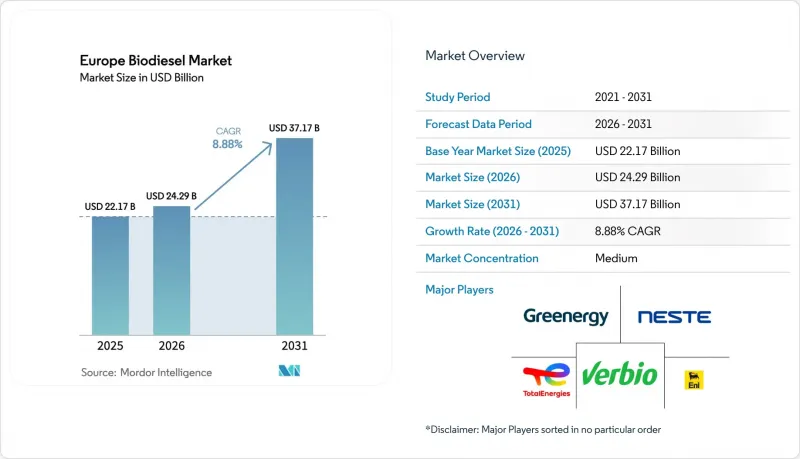
This report is Segmented by Feedstock (Rapeseed Oil, Used Cooking Oil, Soybean Oil, Palm Oil, Sunflower Oil, Animal Fats and Tallow, and Algal and Other Advanced Feedstocks), Biodiesel Blends (B5, B7, B10, and Higher Blends), and Geography (Germany, France, Spain, United Kingdom, Italy, Netherlands, Poland, Sweden, Finland, and More). The Market Sizes and Forecasts are Provided in Terms of Value (USD).
Europe Biodiesel Market Trends and Insights
Rapeseed-Oil Cost Advantage Versus Competing Low-Carbon Fuels
Rapeseed oil traded at EUR 580-620 per tonne in early 2026, a EUR 60-100 discount to landed soybean oil, giving refiners a structural edge when producing FAME that meets EN 14214 specs. Logistics from French and German farms to nearby plants keep freight low, and the feedstock avoids the deforestation risk premiums tied to palm-derived biodiesel under RED III. The resulting cost cushion of EUR 0.08-0.12 per liter versus fossil diesel supports blending mandates without extra subsidies. Weather volatility narrowed that margin in 2024-2025, when drought and flooding cut yields below 3.2 tonnes per hectare and lifted rapeseed prices above EUR 620 per tonne, showing how agronomic shocks can rapidly erode a seemingly durable advantage. Refiners then turned to soybean oil, but higher carbon-intensity scores under FuelEU shrank profitability and reinforced the value of local rapeseed when harvests normalize.
RED III Double-Counting That Turbo-Charges Waste-Oil Demand
Since November 2023, waste oils and animal fats earn double compliance credits toward national transport targets, effectively doubling their economic value. Spot UCO prices climbed from EUR 850 per tonne in early 2024 to EUR 1,150 by mid-2025 as refiners competed for limited supply. Investors responded by expanding collection networks across Spain, Italy, and Poland, regions previously underserved by structured pick-up systems. The incentive also spurred fraudulent imports, prompting mandatory ISCC PLUS audits on all non-EU waste-lipid cargoes from January 2026. While the rule accelerates feedstock diversification, it tightens supply for road biodiesel as aviation mandates rise, forcing producers to balance rapeseed reliance with compliance credit economics.
Rapeseed Supply Crunch From 2024-2026 Harvest Deficits
Crop shortfalls cut European rapeseed output to 16.8 million tonnes in 2024-2025, versus 18.2 million tonnes two years earlier, lifting oil prices above EUR 620 per tonne. The squeeze forced refiners to import soybean oil that carries higher lifecycle emissions, reducing margin under RED III rules. Surpluses from Poland and Romania offset only part of the deficit. The episode underscored the need to diversify feedstocks and highlighted yield risk in a warming climate. Continued weather volatility is likely to keep rapeseed costs elevated into 2027, muting growth for the crop-based tier of the European biodiesel market.
Other drivers and restraints analyzed in the detailed report include:
- Record HVO Capacity Build-Out Across Spain, France & the Nordics
- Maritime FuelEU Bunker Demand for FAME/HVO Blends
- SAF Mandates Cannibalizing Waste-Lipid Pools From 2027
For complete list of drivers and restraints, kindly check the Table Of Contents.
Segment Analysis
Rapeseed retained 62.5% of the 2025 volume, equal to 13.8 million tonnes out of a 22 million tonne pool, underlining its entrenched position in the European biodiesel market for feedstocks. Yet animal fats and tallow are forecast to expand at a 12.5% CAGR through 2031, outpacing every other input. UCO sits second today but faces traceability scrutiny after customs uncovered adulterated imports in 2024. Soybean and palm oils together stay below 10% because carbon-intensity penalties and logistical costs blunt their appeal. Sunflower oil experienced a temporary bump during the rapeseed shortfall, though its high iodine number limits winter blending in northern Europe. Advanced lipids such as algae remain below 1%, confined to pilot plants that have yet to hit commercial scale.
Waste-lipid valuation has doubled since 2023 on RED III credits, sparking investment in collection fleets across southern and eastern Europe. However, the 2027 aviation mandate threatens to siphon 15-20% of that pool, tightening road-fuel supply and lifting volatility. Producers with vertically integrated waste-oil sourcing enjoy premium margins, while spot-market buyers face elevated credit risk. The tussle between rapeseed stability and waste-lipid incentives will determine the next phase of the European biodiesel market, with dual-feedstock flexibility emerging as a key competitive lever.
Complete Report Scope:
- By Feedstock
- Rapeseed Oil
- Used Cooking Oil (UCO)
- Soybean Oil
- Palm Oil
- Sunflower Oil
- Animal Fats and Tallow
- Algal and Other Advanced Feedstocks
- By Biodiesel Blends
- B5
- B7
- B10
- Higher Blends (B20, B30, B100)
- By Geography
- Germany
- France
- Spain
- United Kingdom
- Italy
- Netherlands
- Poland
- Sweden
- Finland
- Rest of Europe
List of Companies Covered in this Report:
- Neste Oyj
- TotalEnergies SE
- Eni S.p.A.
- Preem AB
- Cepsa
- Repsol S.A.
- Greenergy International Ltd.
- Verbio AG
- Argent Energy
- ADM
- Cargill
- Shell plc
- BP plc
- Bunge Limited
- Louis Dreyfus Company
- Envien Group
- Abengoa Bioenergia
- German Biofuels GmbH
- BDI-BioEnergy
- Verbund BioPower
Additional Benefits:
- The market estimate (ME) sheet in Excel format
- 3 months of analyst support
TABLE OF CONTENTS
1 Introduction
- 1.1 Study Assumptions & Market Definition
- 1.2 Scope of the Study
2 Research Methodology
3 Executive Summary
4 Market Landscape
- 4.1 Market Overview
- 4.2 Market Drivers
- 4.2.1 Rapeseed-oil cost advantage versus competing low-carbon fuels
- 4.2.2 RED III double-counting that turbo-charges waste-oil demand
- 4.2.3 Record HVO capacity build-out across Spain, France & the Nordics
- 4.2.4 Maritime "FuelEU" bunker demand for FAME/HVO blends
- 4.2.5 Export arbitrage to the US post-2024 EU price crash
- 4.2.6 OEM pre-approval of B30/B100 truck engines for EU ETS-road compliance
- 4.3 Market Restraints
- 4.3.1 Rapeseed supply crunch from 2024-26 harvest deficits
- 4.3.2 Fraudulent UCO imports triggering tighter traceability audits
- 4.3.3 Fast-tracking of battery-electric vans under AFIR hurting urban biodiesel blends
- 4.3.4 SAF mandates cannibalising waste-lipid pools from 2027
- 4.4 Supply-Chain Analysis
- 4.5 Regulatory Landscape
- 4.6 Technological Outlook
- 4.7 Porter's Five Forces
- 4.7.1 Bargaining Power of Suppliers
- 4.7.2 Bargaining Power of Consumers
- 4.7.3 Threat of New Entrants
- 4.7.4 Threat of Substitutes
- 4.7.5 Intensity of Competitive Rivalry
5 Market Size & Growth Forecasts
- 5.1 By Feedstock
- 5.1.1 Rapeseed Oil
- 5.1.2 Used Cooking Oil (UCO)
- 5.1.3 Soybean Oil
- 5.1.4 Palm Oil
- 5.1.5 Sunflower Oil
- 5.1.6 Animal Fats and Tallow
- 5.1.7 Algal and Other Advanced Feedstocks
- 5.2 By Biodiesel Blends
- 5.2.1 B5
- 5.2.2 B7
- 5.2.3 B10
- 5.2.4 Higher Blends (B20, B30, B100)
- 5.3 By Geography
- 5.3.1 Germany
- 5.3.2 France
- 5.3.3 Spain
- 5.3.4 United Kingdom
- 5.3.5 Italy
- 5.3.6 Netherlands
- 5.3.7 Poland
- 5.3.8 Sweden
- 5.3.9 Finland
- 5.3.10 Rest of Europe
6 Competitive Landscape
- 6.1 Market Concentration
- 6.2 Strategic Moves (M&A, Partnerships, PPAs)
- 6.3 Market Share Analysis (Market Rank/Share for key companies)
- 6.4 Company Profiles (includes Global level Overview, Market level overview, Core Segments, Financials as available, Strategic Information, Products & Services, and Recent Developments)
- 6.4.1 Neste Oyj
- 6.4.2 TotalEnergies SE
- 6.4.3 Eni S.p.A.
- 6.4.4 Preem AB
- 6.4.5 Cepsa
- 6.4.6 Repsol S.A.
- 6.4.7 Greenergy International Ltd.
- 6.4.8 Verbio AG
- 6.4.9 Argent Energy
- 6.4.10 ADM
- 6.4.11 Cargill
- 6.4.12 Shell plc
- 6.4.13 BP plc
- 6.4.14 Bunge Limited
- 6.4.15 Louis Dreyfus Company
- 6.4.16 Envien Group
- 6.4.17 Abengoa Bioenergia
- 6.4.18 German Biofuels GmbH
- 6.4.19 BDI-BioEnergy
- 6.4.20 Verbund BioPower
7 Market Opportunities & Future Outlook
- 7.1 White-space & Unmet-Need Assessment

