PUBLISHER: Mordor Intelligence | PRODUCT CODE: 2124664

PUBLISHER: Mordor Intelligence | PRODUCT CODE: 2124664
Europe, Middle East And Africa (EMEA) Flexible Packaging - Market Share Analysis, Industry Trends & Statistics, Growth Forecasts (2026 - 2031)
According to Mordor Intelligence, the Europe, Middle East and Africa (EMEA) flexible packaging market size in 2026 is estimated at USD 101.34 billion, growing from 2025 value of USD 97.77 billion with 2031 projections showing USD 121.22 billion, growing at 3.65% CAGR over 2026-2031.
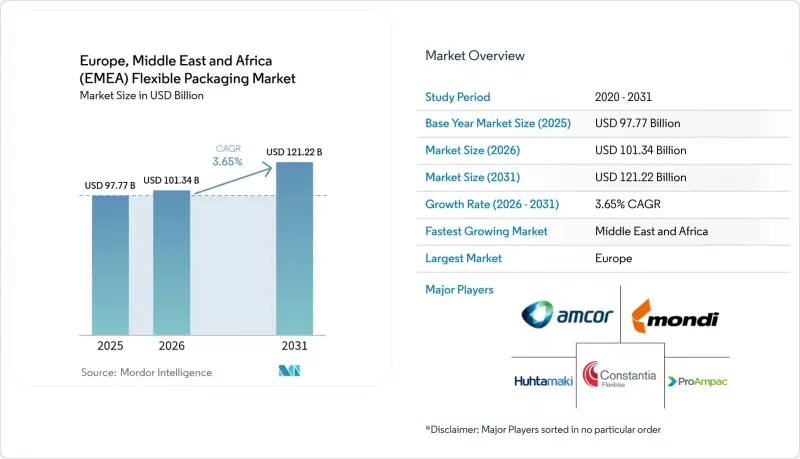
This report is Segmented by Material (Plastics, Paper, and More), Product Type (Bags and Pouches, Films and Wraps, and More), End-User Industry (Food, Beverage, and More), Printing Technology (Flexography, Rotogravure, and More), and Geography (Europe, Middle East and Africa). The Market Forecasts are Provided in Terms of Value (USD).
Europe, Middle East And Africa (EMEA) Flexible Packaging Market Trends and Insights
Steady Rise in Demand for Processed and Convenience Foods
Urban migration is reshaping meal habits, prompting retailers and foodservice operators to favor lightweight, shelf-stable packs that protect freshness during extended distribution cycles. Cost-effective bags and pouches displace rigid alternatives, lowering freight bills and CO2 footprints. Converters introduce grab-and-go designs such as ProAmpac's RotiBag, a leak-resistant format able to carry hot foods without outer cartons. Combined with HACCP and ISO 22000 compliance, these performance upgrades increase baseline volume for film substrates and zipper closures across the EMEA flexible packaging market.
Regulatory Push for Recyclable and Sustainable Packaging
The EU Packaging and Packaging Waste Regulation 2025/40 enforces 65% recyclable content by 2030 and bans PFAS barrier chemistries, triggering broad redesign of legacy multi-layer laminates. R&D centers now prioritize mono-PE or mono-PP structures with compatibilizers that preserve oxygen and moisture barrier while allowing mechanical recovery. BASF's compostable coatings and Sudpack's chemically recycled polyamide layers show how innovation is aligning with PPWR milestones. Brand owners standardize global SKUs around EU-level compliance, giving bioplastic suppliers and fiber-based converters new share-gain avenues in the EMEA flexible packaging market.
Volatility in Polymer Resin Prices
Crude-oil swings and Europe's higher energy tariff structure distort input costs for PE and PP grades, forcing converters to renegotiate customer contracts every quarter. Integrated players hedge exposure through multi-year feedstock deals, but small and mid-scale firms face margin erosion that curtails CapEx on new presses and rewinders. The net effect tempers replacement cycles and slows innovation adoption in price-sensitive portions of the EMEA flexible packaging market.
Other drivers and restraints analyzed in the detailed report include:
- Lightweighting for Logistics-Cost Reduction
- Rapid E-commerce Growth Across EMEA
- Intensifying Competitive Landscape Squeezing Margins
For complete list of drivers and restraints, kindly check the Table Of Contents.
Segment Analysis
Plastics retained 67.35% of the EMEA flexible packaging market share in 2025, anchored by cost advantages, high mechanical strength and well-established supply chains. Yet bioplastics and compostables are gaining ground-advancing at 4.88% CAGR-because regulatory stringency and brand commitments lean toward renewable content. EU-funded pilots, such as AIMPLAS' PHA-from-waste initiative, illustrate institutional support that de-risks scale-up. Converters now run parallel extrusion lines for seaweed, PHA or PLA films alongside traditional LDPE, a dual-track approach that hedges compliance risks while servicing early-adopter brands. The EMEA flexible packaging market size for bio-based substrates is set to breach the USD 5.28 billion mark by 2031, a material share jump underpinned by supply-chain co-location and rising consumer visibility of compostability logos.
To prevent performance compromises, hybrid laminates blend chemically recycled PP with virgin-free PET tie layers, hitting both recycled-content quotas and downgauge objectives. Such innovations are timely because the PPWR places the onus on converters to prove recyclability through EU-accepted protocols-a compliance ceiling that plastics incumbents must clear or surrender share to emerging cellulosic webs.
Bags and pouches still dominated 47.05% of the EMEA flexible packaging market size in 2025, a position grounded in versatility from cereals to detergents. Yet sachets and stick packs are enjoying headline-grabbing momentum with a 4.43% CAGR through 2031, driven by single-serve coffee, electrolyte powders and dermatology creams. Personal-care multinationals deploy digitally printed sachets to trial scents or SPF formulas in subscription boxes, harnessing variable graphics to spark social media engagement. The format's low-material footprint slots neatly into convenience stores where shelf space commands a premium. Edible alginate sachets displayed at IFFA 2025 push the envelope further by erasing secondary waste streams altogether.
Consumer demand for precise dosing and on-the-go use aligns with national nutrition labeling schemes that discourage oversized servings. Consequently, the EMEA flexible packaging market is retooling form-fill-seal lines for faster lane counters, micro-perforation systems and hermetic edge seals that withstand courier networks. Sachet adoption also dovetails with cold-chain pharmaceutical requirements, where foil-barrier four-side seals protect hygroscopic APIs during regional transport.
Complete Report Scope:
- By Material
- Plastics
- Polyethylene (PE)
- Biaxially Oriented Polypropylene (BOPP)
- Cast Polypropylene (CPP)
- Other Plastics
- Paper
- Metal Foil
- Bioplastics and Compostable Materials
- Plastics
- By Product Type
- Bags and Pouches
- Films and Wraps
- Sachets and Stick Packs
- Other Product Types
- BY End-user Industry
- Food
- Baked Goods
- Snacks
- Meat, Poultry and Seafood
- Confectionery
- Pet Food
- Other Food Products
- Beverage
- Healthcare and Pharmaceutical
- Personal Care and Cosmetics
- Agriculture and Horticulture
- Other End-Use Industries
- Food
- By Printing Technology
- Flexography
- Rotogravure
- Digital Printing
- Other Printing Technologies
- By Geography
- Europe
- United Kingdom
- Germany
- France
- Italy
- Spain
- Rest of Europe
- Middle East and Africa
- Middle East
- Saudi Arabia
- United Arab Emirates
- Turkey
- Rest of Middle East
- Africa
- South Africa
- Nigeria
- Kenya
- Rest of Africa
- Middle East
- Europe
List of Companies Covered in this Report:
- Amcor plc
- Constantia Flexibles Group GmbH
- Mondi plc
- Huhtamaki Oyj
- ProAmpac Holdings Inc.
- Bischof + Klein SE & Co. KG
- Aluflexpack AG
- Bak Ambalaj Sanayi ve Ticaret A.S.
- Coveris Management GmbH
- Danaflex OOO
- Gualapack S.p.A.
- Wipak Oy
- SUDPACK Holding GmbH & Co. KG
- Schur Flexibles Holding Ges.m.b.H.
- ePac Holdings LLC
- Treofan Germany GmbH & Co. KG
- Cellografica Gerosa S.p.A.
- Flextrus AB
Additional Benefits:
- The market estimate (ME) sheet in Excel format
- 3 months of analyst support
TABLE OF CONTENTS
1 INTRODUCTION
- 1.1 Study Assumptions and Market Definition
- 1.2 Scope of the Study
2 RESEARCH METHODOLOGY
3 EXECUTIVE SUMMARY
4 MARKET LANDSCAPE
- 4.1 Market Overview
- 4.2 Market Drivers
- 4.2.1 Steady rise in demand for processed and convenience foods
- 4.2.2 Regulatory push for recyclable and sustainable packaging
- 4.2.3 Lightweighting for logistics cost reduction
- 4.2.4 Rapid e-commerce growth across EMEA
- 4.2.5 Expansion of pharma cold-chain requiring high-barrier laminates
- 4.2.6 Digital printing enabling low-MOQ, localized SKUs
- 4.3 Market Restraints
- 4.3.1 Volatility in polymer resin prices
- 4.3.2 Intensifying competitive landscape squeezing margins
- 4.3.3 Inadequate film-recycling infrastructure in MEA
- 4.3.4 Emerging PFAS and mineral-oil migration regulations
- 4.4 Industry Value Chain Analysis
- 4.5 Regulatory Landscape
- 4.6 Technological Outlook
- 4.7 Porter's Five Forces Analysis
- 4.7.1 Threat of New Entrants
- 4.7.2 Bargaining Power of Suppliers
- 4.7.3 Bargaining Power of Buyers
- 4.7.4 Threat of Substitutes
- 4.7.5 Competitive Rivalry
- 4.8 Impact of Macroeconomic Factors on the Market
5 MARKET SIZE AND GROWTH FORECASTS (VALUE)
- 5.1 By Material
- 5.1.1 Plastics
- 5.1.1.1 Polyethylene (PE)
- 5.1.1.2 Biaxially Oriented Polypropylene (BOPP)
- 5.1.1.3 Cast Polypropylene (CPP)
- 5.1.1.4 Other Plastics
- 5.1.2 Paper
- 5.1.3 Metal Foil
- 5.1.4 Bioplastics and Compostable Materials
- 5.1.1 Plastics
- 5.2 By Product Type
- 5.2.1 Bags and Pouches
- 5.2.2 Films and Wraps
- 5.2.3 Sachets and Stick Packs
- 5.2.4 Other Product Types
- 5.3 BY End-user Industry
- 5.3.1 Food
- 5.3.1.1 Baked Goods
- 5.3.1.2 Snacks
- 5.3.1.3 Meat, Poultry and Seafood
- 5.3.1.4 Confectionery
- 5.3.1.5 Pet Food
- 5.3.1.6 Other Food Products
- 5.3.2 Beverage
- 5.3.3 Healthcare and Pharmaceutical
- 5.3.4 Personal Care and Cosmetics
- 5.3.5 Agriculture and Horticulture
- 5.3.6 Other End-Use Industries
- 5.3.1 Food
- 5.4 By Printing Technology
- 5.4.1 Flexography
- 5.4.2 Rotogravure
- 5.4.3 Digital Printing
- 5.4.4 Other Printing Technologies
- 5.5 By Geography
- 5.5.1 Europe
- 5.5.1.1 United Kingdom
- 5.5.1.2 Germany
- 5.5.1.3 France
- 5.5.1.4 Italy
- 5.5.1.5 Spain
- 5.5.1.6 Rest of Europe
- 5.5.2 Middle East and Africa
- 5.5.2.1 Middle East
- 5.5.2.1.1 Saudi Arabia
- 5.5.2.1.2 United Arab Emirates
- 5.5.2.1.3 Turkey
- 5.5.2.1.4 Rest of Middle East
- 5.5.2.2 Africa
- 5.5.2.2.1 South Africa
- 5.5.2.2.2 Nigeria
- 5.5.2.2.3 Kenya
- 5.5.2.2.4 Rest of Africa
- 5.5.2.1 Middle East
- 5.5.1 Europe
6 COMPETITIVE LANDSCAPE
- 6.1 Market Concentration
- 6.2 Strategic Moves
- 6.3 Market Share Analysis
- 6.4 Company Profiles {(includes Global level Overview, Market level overview, Core Segments, Financials as available, Strategic Information, Market Rank/Share for key companies, Products and Services, and Recent Developments)}
- 6.4.1 Amcor plc
- 6.4.2 Constantia Flexibles Group GmbH
- 6.4.3 Mondi plc
- 6.4.4 Huhtamaki Oyj
- 6.4.5 ProAmpac Holdings Inc.
- 6.4.6 Bischof + Klein SE & Co. KG
- 6.4.7 Aluflexpack AG
- 6.4.8 Bak Ambalaj Sanayi ve Ticaret A.S.
- 6.4.9 Coveris Management GmbH
- 6.4.10 Danaflex OOO
- 6.4.11 Gualapack S.p.A.
- 6.4.12 Wipak Oy
- 6.4.13 SUDPACK Holding GmbH & Co. KG
- 6.4.14 Schur Flexibles Holding Ges.m.b.H.
- 6.4.15 ePac Holdings LLC
- 6.4.16 Treofan Germany GmbH & Co. KG
- 6.4.17 Cellografica Gerosa S.p.A.
- 6.4.18 Flextrus AB
7 MARKET OPPORTUNITIES AND FUTURE OUTLOOK
- 7.1 White-space and Unmet-Need Assessment

