PUBLISHER: Mordor Intelligence | PRODUCT CODE: 2124698

PUBLISHER: Mordor Intelligence | PRODUCT CODE: 2124698
India Industrial Sensors And Transmitters - Market Share Analysis, Industry Trends & Statistics, Growth Forecasts (2026 - 2031)
According to Mordor Intelligence, the India industrial sensors and transmitters market size is expected to grow from USD 1.39 billion in 2025 to USD 1.52 billion in 2026 and is forecast to reach USD 2.36 billion by 2031 at 9.24% CAGR over 2026-2031.
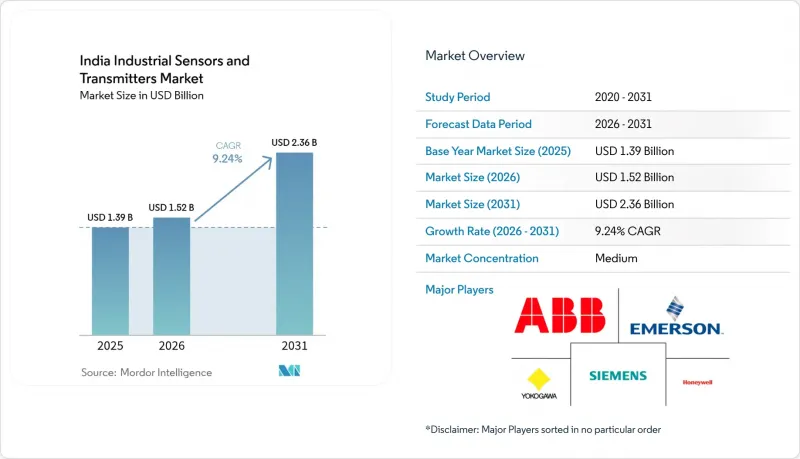
This report is Segmented by Sensor Type (Flow, Temperature, Pressure, Level, and More), End-User Industry (Power Generation and Utilities, Oil and Gas, and More), Form Factor/Installation (Contact/In-line and Non-contact/Clamp-on/Remote), Communication Technology (Wired, Industrial Ethernet, and Wireless), and Region. The Market Forecasts are Provided in Terms of Value (USD).
India Industrial Sensors And Transmitters Market Trends and Insights
Government "Make-in-India" and PLI Schemes Catalyzing Smart Factories
Performance-linked incentives worth INR 76,000 crore (USD 9.1 billion) reward manufacturers that demonstrate sustained capital expenditure and output growth, tilting sourcing decisions toward domestically produced sensor components. Multinationals have responded by building vertically integrated plants that reduce logistics costs, compress lead times, and adapt product lines to Indian operating conditions. Larger domestic content also shields buyers in the India industrial sensors and transmitters market from exchange rate volatility. Over the medium term, a denser local vendor ecosystem is likely to compress price premiums for advanced smart sensors, further accelerating adoption across mid-tier manufacturers.
Rising Industry 4.0 Adoption Across Discrete Manufacturing
Automakers transitioning to electric vehicles, electronics assemblers optimizing line changeovers, and capital-goods makers deploying predictive analytics share a common need for real-time condition data. Factory leaders report up to 30% downtime reduction after embedding vibration, thermal, and power-quality sensors into production assets, which translates to notably higher throughput per square foot. Success stories such as Daifuku's sensor-rich material-handling plant in Hyderabad catalyze copy-cat projects among Tier-2 suppliers keen to preserve OEM rankings. The India industrial sensors and transmitters market will therefore benefit from a virtuous loop: performance gains justify larger sensor budgets, and larger installations yield more data, which in turn feeds higher-value analytics services.
High CAPEX of Advanced Smart-Sensor Retrofits
Smart units with built-in diagnostics and wireless modules often cost triple the price of legacy counterparts, and comprehensive facility conversions can require USD 2-5 million in fresh outlays. SMEs with slim margins hesitate to lock capital into five-year payback horizons, delaying sizable orders that would otherwise lift the India industrial sensors and transmitters market. Government low-interest loans and accelerated depreciation allowances partially offset sticker shock, yet awareness of such schemes remains patchy outside tier-one industrial parks.
Other drivers and restraints analyzed in the detailed report include:
- Quality-Centric Regulations in Pharma and Food and Beverage sectors
- Energy-Efficiency Mandates for Utilities and Process Industries
- Interoperability and Legacy System Integration Issues
For complete list of drivers and restraints, kindly check the Table Of Contents.
Segment Analysis
Pressure devices accounted for 27.12% of 2025 shipments, underscoring their foundational role in safe and efficient hydrocarbon processing, chemical synthesis, and power-generation boiler operations. The India industrial sensors and transmitters market size tied to pressure measurement is expected to compound at a steady clip as regulatory bodies enforce tighter safety margins in high-pressure pipelines. Manufacturers continue to widen portfolios with explosion-proof and differential configurations suited to the diverse viscosity and corrosiveness profiles seen in Indian refineries. Meanwhile, vibration and condition-monitoring sensors are set to post an 10.95% CAGR through 2031, propelled by maintenance digitization programs that aim to slash unplanned downtimes across automotive, cement, and steel plants. Suppliers that bundle sensors with predictive analytics dashboards secure annuity-style service revenue streams, strengthening overall value capture within the India industrial sensors and transmitters market.
Beyond the top two categories, temperature probes retain durable demand in pharma sterilization loops and dairy pasteurization lines where precise thermal control guards against batch spoilage. Flow sensors enjoy rising penetration in effluent treatment and desalination projects funded by municipal smart-water schemes. Level sensors migrate from discrete silo monitoring toward integrated inventory-management suites, providing ERP-ready feedstock visibility. Gas and humidity sensing extend from cleanrooms into next-generation data centers, where consistent air quality boosts server lifespan. Across all classes, OEMs increasingly push multi-parameter platforms that condense several sensing modalities into a single housing, lowering installation labor while expanding the India industrial sensors and transmitters market's average selling price.
Hydrocarbon value-chain participants commanded 26.15% of 2025 revenue, anchored by capital projects such as Indian Oil Corporation's INR 24,000 crore (USD 2.88 billion) petrochemical expansion. Safety instrumentation ranging from SIL-rated pressure transmitters to combustible-gas detectors forms the bulk of oil-and-gas outlays, with environmental authorities mandating continuous emissions monitoring that further enlarges the India industrial sensors and transmitters market. Over the forecast period, however, pharma and biotech facilities are poised for an 11.02% CAGR, narrowing the share gap as vaccine and biologics plants scale GMP-compliant sensor grids spanning cold-chain storage, lyophilization chambers, and classified cleanrooms.
Utilities deploy smart metering and sub-station automation, driving uptake of power-quality transducers and fiber-optic temperature loops in transformers. Petrochemicals, chemicals, and fertilizers chase throughput optimization via multivariable sensors that monitor cross-linked reaction parameters. Food and beverage processors move beyond HACCP checklists, integrating cloud-linked sensors for real-time traceability from blending to packaging. Water and wastewater operators embrace clamp-on ultrasonic flow meters that eliminate service disruptions during tie-ins. Metals and mining companies adopt ruggedized vibration probes to anticipate drivetrain wear in conveyors and ball mills. Collectively, these verticals diversify the India industrial sensors and transmitters market, reducing over-reliance on any single commodity cycle.
Complete Report Scope:
- By Sensor Type
- Flow
- Temperature
- Pressure
- Level
- Vibration/Condition-Monitoring
- Gas and Humidity
- Other Sensor Types
- By End-user Industry
- Power Generation and Utilities
- Oil and Gas
- Petrochemicals, Chemicals and Fertilizers
- Food and Beverage
- Life Sciences (Pharma, Biotech and Medical Devices)
- Water and Waste-water
- Metals and Mining
- Other Manufacturing (Textile, Pulp and Paper, Auto, etc.)
- By Form Factor/Installation
- Contact/In-line
- Non-contact/Clamp-on/Remote
- By Communication Technology
- Wired (HART, MODBUS, PROFIBUS, etc.)
- Industrial Ethernet (PROFINET, EtherNet/IP, etc.)
- Wireless (ISA100, WirelessHART, Wi-SUN, LPWAN)
- By Region
- North India
- West India
- South India
- East and North-East India
- Central India
List of Companies Covered in this Report:
- ABB India Limited
- Honeywell Automation India Limited
- Siemens Limited
- Yokogawa India Ltd.
- Emerson Process Management (India) Pvt. Ltd.
- Schneider Electric Systems India Pvt. Ltd.
- Endress+Hauser (India) Automation Instruments Pvt. Ltd.
- WIKA Instruments India Pvt. Ltd.
- Pepperl+Fuchs (India) Pvt. Ltd.
- Turck India Automation Pvt. Ltd.
- Omron Automation Private Limited
- Bosch Rexroth (India) Pvt. Ltd.
- Vega India Level and Pressure Measurement Pvt. Ltd.
- Baumer Technologies India Pvt. Ltd.
- Phoenix Contact (India) Pvt. Ltd.
- ifm electronic India Pvt. Ltd.
- Rockwell Automation India Pvt. Ltd.
- SICK India Pvt. Ltd.
- Vishay Components India Private Ltd.
- EXA Thermometrics India Pvt. Ltd.
- SRI Electronics
- Sensorex, Inc.
Additional Benefits:
- The market estimate (ME) sheet in Excel format
- 3 months of analyst support
TABLE OF CONTENTS
1 INTRODUCTION
- 1.1 Study Assumptions and Market Definition
- 1.2 Scope of the Study
2 RESEARCH METHODOLOGY
3 EXECUTIVE SUMMARY
4 Market Landscape
- 4.1 Market Overview
- 4.2 Market Drivers
- 4.2.1 Government "Make-in-India" and PLI schemes catalyzing smart factories
- 4.2.2 Rising Industry 4.0 adoption across discrete manufacturing
- 4.2.3 Quality-centric regulations in pharma and Food and Beverage sectors
- 4.2.4 Energy-efficiency mandates for utilities and process industries
- 4.2.5 Data-center boom demanding precision HVAC sensors
- 4.2.6 Localization of sensor component supply chains
- 4.3 Market Restraints
- 4.3.1 High CAPEX of advanced smart-sensor retrofits
- 4.3.2 Interoperability and legacy system integration issues
- 4.3.3 Shortage of skilled instrumentation technicians
- 4.3.4 Semiconductor import dependence causing supply bottlenecks
- 4.4 Industry Value Chain Analysis
- 4.5 Regulatory Landscape
- 4.6 Technological Outlook
- 4.7 Porter's Five Forces Analysis
- 4.7.1 Threat of New Entrants
- 4.7.2 Bargaining Power of Buyers
- 4.7.3 Bargaining Power of Suppliers
- 4.7.4 Threat of Substitutes
- 4.7.5 Intensity of Competitive Rivalry
- 4.8 Impact of Macroeconomic Trends on the Market
5 MARKET SIZE AND GROWTH FORECASTS (VALUES)
- 5.1 By Sensor Type
- 5.1.1 Flow
- 5.1.2 Temperature
- 5.1.3 Pressure
- 5.1.4 Level
- 5.1.5 Vibration/Condition-Monitoring
- 5.1.6 Gas and Humidity
- 5.1.7 Other Sensor Types
- 5.2 By End-user Industry
- 5.2.1 Power Generation and Utilities
- 5.2.2 Oil and Gas
- 5.2.3 Petrochemicals, Chemicals and Fertilizers
- 5.2.4 Food and Beverage
- 5.2.5 Life Sciences (Pharma, Biotech and Medical Devices)
- 5.2.6 Water and Waste-water
- 5.2.7 Metals and Mining
- 5.2.8 Other Manufacturing (Textile, Pulp and Paper, Auto, etc.)
- 5.3 By Form Factor/Installation
- 5.3.1 Contact/In-line
- 5.3.2 Non-contact/Clamp-on/Remote
- 5.4 By Communication Technology
- 5.4.1 Wired (HART, MODBUS, PROFIBUS, etc.)
- 5.4.2 Industrial Ethernet (PROFINET, EtherNet/IP, etc.)
- 5.4.3 Wireless (ISA100, WirelessHART, Wi-SUN, LPWAN)
- 5.5 By Region
- 5.5.1 North India
- 5.5.2 West India
- 5.5.3 South India
- 5.5.4 East and North-East India
- 5.5.5 Central India
6 COMPETITIVE LANDSCAPE
- 6.1 Market Concentration
- 6.2 Strategic Moves
- 6.3 Market Share Analysis
- 6.4 Company Profiles (includes Global level Overview, Market level overview, Core Segments, Financials as available, Strategic Information, Market Rank/Share for key companies, Products and Services, and Recent Developments)
- 6.4.1 ABB India Limited
- 6.4.2 Honeywell Automation India Limited
- 6.4.3 Siemens Limited
- 6.4.4 Yokogawa India Ltd.
- 6.4.5 Emerson Process Management (India) Pvt. Ltd.
- 6.4.6 Schneider Electric Systems India Pvt. Ltd.
- 6.4.7 Endress+Hauser (India) Automation Instruments Pvt. Ltd.
- 6.4.8 WIKA Instruments India Pvt. Ltd.
- 6.4.9 Pepperl+Fuchs (India) Pvt. Ltd.
- 6.4.10 Turck India Automation Pvt. Ltd.
- 6.4.11 Omron Automation Private Limited
- 6.4.12 Bosch Rexroth (India) Pvt. Ltd.
- 6.4.13 Vega India Level and Pressure Measurement Pvt. Ltd.
- 6.4.14 Baumer Technologies India Pvt. Ltd.
- 6.4.15 Phoenix Contact (India) Pvt. Ltd.
- 6.4.16 ifm electronic India Pvt. Ltd.
- 6.4.17 Rockwell Automation India Pvt. Ltd.
- 6.4.18 SICK India Pvt. Ltd.
- 6.4.19 Vishay Components India Private Ltd.
- 6.4.20 EXA Thermometrics India Pvt. Ltd.
- 6.4.21 SRI Electronics
- 6.4.22 Sensorex, Inc.
7 MARKET OPPORTUNITIES AND FUTURE OUTLOOK
- 7.1 White-space and Unmet-Need Assessment

