PUBLISHER: Mordor Intelligence | PRODUCT CODE: 2124961

PUBLISHER: Mordor Intelligence | PRODUCT CODE: 2124961
Asia-Pacific Industrial Sensors - Market Share Analysis, Industry Trends & Statistics, Growth Forecasts (2026 - 2031)
According to Mordor Intelligence, the Asia-Pacific industrial sensors market size is expected to grow from USD 9.58 billion in 2025 to USD 10.98 billion in 2026 and is forecast to reach USD 21.73 billion by 2031 at 14.64% CAGR over 2026-2031.
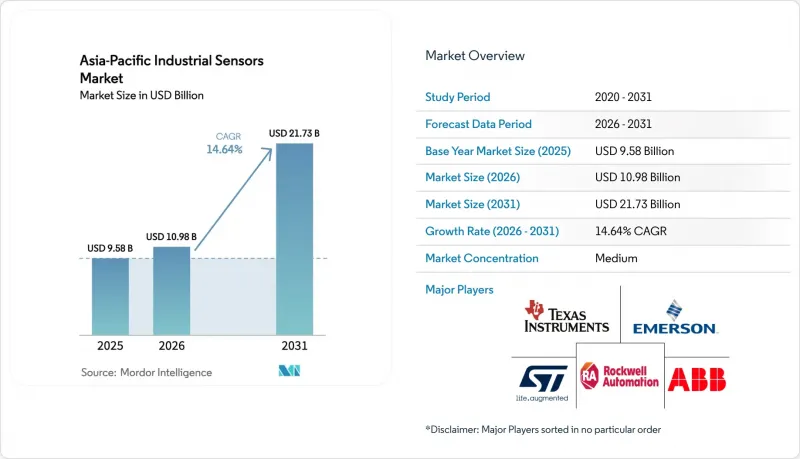
This report is Segmented by Product Type (Pressure, Temperature, Level, Flow, and More), End-User Industry (Automotive, Electronics and Semiconductor, and More), Sensor Connectivity (Wired, Wireless, IO-Link, and Edge-Integrated Smart Sensors), Sensing Technology (MEMS-Based, CMOS-Based, Piezoresistive, and More), and Geography. The Market Forecasts are Provided in Terms of Value (USD).
Asia-Pacific Industrial Sensors Market Trends and Insights
IIoT And Industry 4.0 Penetration
Manufacturers are migrating from point-level automation to fully connected operations where every asset streams time-series data to on-premise or cloud analytics platforms. China's 94% industrial-AI adoption in 2024 validates the scale of this shift, with sensors underpinning yield optimization in semiconductor fabs and energy management routines in chemical plants. Japan's Society 5.0 program accelerates adoption in aging-workforce scenarios, as collaborative robots rely on force and proximity sensors to ensure operator safety. South Korea aims to establish 30,000 smart factories by 2025, effectively repositioning sensors from optional hardware to a compliance necessity. Open-protocol devices are proliferating as buyers seek interoperability, fragmenting brand loyalty but enlarging the total hardware pool. Premium vendors now bundle analytics subscriptions with hardware, transforming one-off sensor sales into recurring revenue.
Rapid Automation Across Asia-Pacific Manufacturing
Rising labor costs and the reshoring of supply chains push producers to automate every repetitive task. India's PLI scheme is expected to generate USD 130.8 billion in additional factory output by 2024 and spur new orders for temperature, pressure, and optical sensors in greenfield electronics and automotive plants. Vietnam's USD 100 billion electronics output relies on optical sensors for surface-mount accuracy, replacing them every three to five years as component miniaturization tightens tolerances. Thailand's retrofit of hybrid-vehicle lines demands higher-precision pressure and flow devices, while Indonesia's food processors are shifting from manual checks to machine-vision quality control. As throughput targets climb, sensor refresh cycles shorten, lifting annual replacement revenue.
High Upfront Cost And ROI Uncertainty
SMEs often lack the working capital to absorb 12- to 18-month payback periods typical of predictive-maintenance pilots. Indian family-owned mills with annual revenue below USD 10 million prefer machinery that lifts output immediately over sensors offering indirect gains. Slim margins at Southeast Asian auto-component plants demand ROI in under 24 months, whereas wireless deployments may take up to 36 months when integration and learning curves are counted. Leasing models that could spread payments remain scarce, prolonging the investment hurdle. The result is a widening digital gap between cash-rich corporations and resource-constrained suppliers.
Other drivers and restraints analyzed in the detailed report include:
- Government Incentives For Smart Factories
- Demand For Predictive Maintenance Solutions
- Legacy-System Integration Complexity
For complete list of drivers and restraints, kindly check the Table Of Contents.
Segment Analysis
Pressure sensors commanded 34.28% Asia-Pacific industrial sensors market share in 2025, reflecting their indispensability in process control, hydraulics, and vehicle safety systems. Projections show a strong 14.95% CAGR growth through 2031, driven by private 5G's ability to eliminate latency issues in compressor optimization and steam-distribution loops. Temperature sensors remain the next-largest category, underpinned by semiconductor fabs' pursuit of sub-0.1 °C stability and biologics' requirement for cold-chain integrity below 8 °C. Level-measurement growth is driven by municipal water upgrades replacing corroding mechanical floats with radar units that perform effectively in high-solids effluent. Flow sensors are shifting toward mass-flow technology in custody-transfer transactions, where volumetric variance previously led to inflated billing disputes.
Across the remainder of the portfolio, gas sensors are expanding into indoor-air monitoring for sterile spaces, vibration devices are standard equipment in predictive-maintenance kits, and optical sensors are crucial for label placement accuracy exceeding 300 units per minute. Magnetic-field sensors fulfill niche roles in EV powertrain alignment and current sensing. With each incremental production upgrade, buyers accent hybrid stacks, combining pressure, temperature, and optical sensing, to gain multidimensional visibility, intensifying cross-selling opportunities for multi-product vendors.
Automotive lines accounted for 26.15% of the Asia-Pacific industrial sensors market size in 2025, driven by the embedding of over 100 temperature and voltage nodes per unit in EV battery packs and the integration of radar, lidar, and ultrasonic devices in ADAS suites. In contrast, the pharmaceutical and life sciences segment is on track for a 14.72% CAGR through 2031, as regulators tighten mandates for continuous environmental monitoring within sterile zones. Electronics manufacturing ranks third, as chipfabs often exceed 50,000 installed sensors per site to sustain nanometer-class process stability. Chemical and petrochemical complexes rely on pressure and flow sensing to prevent runaway reactions, while power producers utilize vibration monitoring to maximize the uptime of wind turbine gearboxes and solar inverter strings.
Oil-and-gas operators favor wireless builds on offshore platforms where cabling exceeds USD 1,000 per meter. Food processors are pushing for stainless-steel IP69K sensors that can withstand high-pressure washdowns, resulting in three- to five-year replacement cycles. Water utilities adopt radar level gauges and pH probes to comply with increasingly stringent discharge limits, whereas mining sites rely on proximity and gas sensors to prevent costly evacuations. Aerospace and defense remain specialty niches demanding radiation-hardened, wide-temperature-range devices that command premium pricing.
Complete Report Scope:
- By Product Type
- Pressure
- Temperature
- Level
- Flow
- Magnetic Field
- Acceleration and Yaw Rate
- Gas
- Vibration
- Proximity
- Optical / Photo-electric
- By End-user Industry
- Automotive
- Electronics and Semiconductor
- Chemical and Petrochemical
- Power Generation
- Oil and Gas
- Food and Beverage
- Water and Wastewater
- Pharmaceuticals and Life Sciences
- Metals and Mining
- Aerospace and Defense
- By Sensor Connectivity
- Wired Sensors
- Wireless Sensors
- IO-Link Sensors
- Edge-integrated Smart Sensors
- By Sensing Technology
- MEMS-based
- CMOS-based
- Piezoresistive
- Capacitive
- Optical
- Electromagnetic
- By Geography
- China
- Japan
- South Korea
- India
- Southeast Asia
- Australia and New Zealand
- Rest of Asia-Pacific
List of Companies Covered in this Report:
- ABB Ltd.
- Emerson Electric Co.
- Honeywell International Inc.
- Siemens AG
- Rockwell Automation Inc.
- Texas Instruments Incorporated
- STMicroelectronics N.V.
- Yokogawa Electric Corporation
- Endress+Hauser AG
- Schneider Electric SE
- Mitsubishi Electric Corporation
- Omron Corporation
- Keyence Corporation
- SICK AG
- Pepperl+Fuchs SE
- Balluff GmbH
- ifm electronic gmbh
- Hans Turck GmbH and Co. KG
- TE Connectivity Ltd.
- Analog Devices Inc.
- Infineon Technologies AG
- Sensata Technologies Holding plc
- Panasonic Holdings Corp.
- First Sensor AG
- Amphenol Advanced Sensors
- Ericco International Ltd.
- Others (fully profiled >=20)
Additional Benefits:
- The market estimate (ME) sheet in Excel format
- 3 months of analyst support
TABLE OF CONTENTS
1 INTRODUCTION
- 1.1 Study Assumptions and Market Definition
- 1.2 Scope of the Study
2 RESEARCH METHODOLOGY
3 EXECUTIVE SUMMARY
4 MARKET LANDSCAPE
- 4.1 Market Overview
- 4.2 Market Drivers
- 4.2.1 IIoT And Industry 4.0 Penetration
- 4.2.2 Rapid Automation Across Asia-Pacific Manufacturing
- 4.2.3 Government Incentives For Smart Factories
- 4.2.4 Demand For Predictive Maintenance Solutions
- 4.2.5 IO-Link And Edge-Configurable Sensors Adoption
- 4.2.6 Private 5G Industrial Campus Roll-Outs
- 4.3 Market Restraints
- 4.3.1 High Upfront Cost And ROI Uncertainty
- 4.3.2 Legacy-System Integration Complexity
- 4.3.3 Chip-Supply Volatility For MEMS Devices
- 4.3.4 Spectrum Regulations Limiting Industrial Wireless
- 4.4 Industry Value Chain Analysis
- 4.5 Regulatory Landscape
- 4.6 Technological Outlook
- 4.7 Porter's Five Forces Analysis
- 4.7.1 Threat of New Entrants
- 4.7.2 Bargaining Power of Buyers
- 4.7.3 Bargaining Power of Suppliers
- 4.7.4 Threat of Substitutes
- 4.7.5 Intensity of Competitive Rivalry
5 MARKET SIZE AND GROWTH FORECASTS (VALUE)
- 5.1 By Product Type
- 5.1.1 Pressure
- 5.1.2 Temperature
- 5.1.3 Level
- 5.1.4 Flow
- 5.1.5 Magnetic Field
- 5.1.6 Acceleration and Yaw Rate
- 5.1.7 Gas
- 5.1.8 Vibration
- 5.1.9 Proximity
- 5.1.10 Optical / Photo-electric
- 5.2 By End-user Industry
- 5.2.1 Automotive
- 5.2.2 Electronics and Semiconductor
- 5.2.3 Chemical and Petrochemical
- 5.2.4 Power Generation
- 5.2.5 Oil and Gas
- 5.2.6 Food and Beverage
- 5.2.7 Water and Wastewater
- 5.2.8 Pharmaceuticals and Life Sciences
- 5.2.9 Metals and Mining
- 5.2.10 Aerospace and Defense
- 5.3 By Sensor Connectivity
- 5.3.1 Wired Sensors
- 5.3.2 Wireless Sensors
- 5.3.3 IO-Link Sensors
- 5.3.4 Edge-integrated Smart Sensors
- 5.4 By Sensing Technology
- 5.4.1 MEMS-based
- 5.4.2 CMOS-based
- 5.4.3 Piezoresistive
- 5.4.4 Capacitive
- 5.4.5 Optical
- 5.4.6 Electromagnetic
- 5.5 By Geography
- 5.5.1 China
- 5.5.2 Japan
- 5.5.3 South Korea
- 5.5.4 India
- 5.5.5 Southeast Asia
- 5.5.6 Australia and New Zealand
- 5.5.7 Rest of Asia-Pacific
6 COMPETITIVE LANDSCAPE
- 6.1 Market Concentration
- 6.2 Strategic Moves
- 6.3 Market Share Analysis
- 6.4 Company Profiles (includes Global level Overview, Market level overview, Core Segments, Financials as available, Strategic Information, Market Rank/Share for key companies, Products and Services, and Recent Developments)
- 6.4.1 ABB Ltd.
- 6.4.2 Emerson Electric Co.
- 6.4.3 Honeywell International Inc.
- 6.4.4 Siemens AG
- 6.4.5 Rockwell Automation Inc.
- 6.4.6 Texas Instruments Incorporated
- 6.4.7 STMicroelectronics N.V.
- 6.4.8 Yokogawa Electric Corporation
- 6.4.9 Endress+Hauser AG
- 6.4.10 Schneider Electric SE
- 6.4.11 Mitsubishi Electric Corporation
- 6.4.12 Omron Corporation
- 6.4.13 Keyence Corporation
- 6.4.14 SICK AG
- 6.4.15 Pepperl+Fuchs SE
- 6.4.16 Balluff GmbH
- 6.4.17 ifm electronic gmbh
- 6.4.18 Hans Turck GmbH and Co. KG
- 6.4.19 TE Connectivity Ltd.
- 6.4.20 Analog Devices Inc.
- 6.4.21 Infineon Technologies AG
- 6.4.22 Sensata Technologies Holding plc
- 6.4.23 Panasonic Holdings Corp.
- 6.4.24 First Sensor AG
- 6.4.25 Amphenol Advanced Sensors
- 6.4.26 Ericco International Ltd.
- 6.4.27 Others (fully profiled >=20)
7 MARKET OPPORTUNITIES AND FUTURE OUTLOOK
- 7.1 White-space and Unmet-need Assessment

