PUBLISHER: Mordor Intelligence | PRODUCT CODE: 2124785

PUBLISHER: Mordor Intelligence | PRODUCT CODE: 2124785
India White Oil - Market Share Analysis, Industry Trends & Statistics, Growth Forecasts (2026 - 2031)
According to Mordor Intelligence, India white oil market size in 2026 is estimated at 319.95 million liters, growing from 2025 value of 314.85 million liters with 2031 projections showing 346.73 million liters, growing at 1.62% CAGR over 2026-2031.
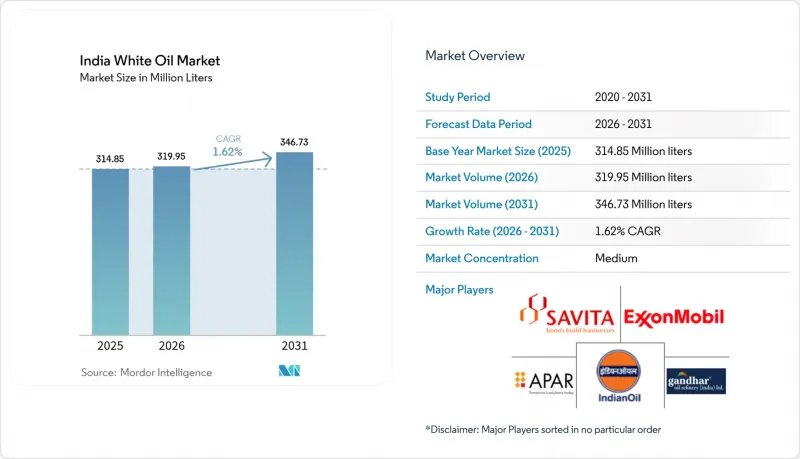
This report is Segmented by Grade (Technical/Industrial Grade and Pharma and Other High-Purity Grades), Viscosity (Low, Medium, and High), and Application (Plastics and Elastomers, Adhesives, Personal Care, Agriculture, Food and Beverage, Pharmaceutical, and Other Applications). The Market Forecasts are Provided in Terms of Volume (Liters).
India White Oil Market Trends and Insights
Booming Cosmetics and Personal-Care Manufacturing Clusters
Robust growth in India's cosmetics manufacturing hubs drives substantial uptake of high-purity white oils for emollient and carrier functions. Consumption remains well below levels in developed economies, providing a long runway for expansion. Major formulators such as Galaxy Surfactants require consistent white oil inputs to ensure product stability and texture across large-scale output lines. Integrated clusters in Gujarat, Maharashtra, and Tamil Nadu leverage feedstock proximity and consolidated logistics, lowering landed costs for processors. Brand owners targeting "clean beauty" formulations paradoxically depend on USP-grade mineral oils that deliver inertness and allergen-free properties, keeping demand resilient despite natural-ingredient marketing. These factors collectively strengthen the India white oil market as personal-care exports rise under free-trade pacts.
Expanding Domestic Pharmaceutical Formulations Capacity
India's status as a global generics hub underpins sustained demand for USP-grade white oils in ointments, capsules, and processing equipment lubrication. Government incentives through Production Linked Incentive (PLI) schemes support Bulk Drug Parks, increasing active-pharmaceutical-ingredient self-sufficiency. U.S. FDA and EU regulatory regimes require strict batch traceability, favoring suppliers with documented quality systems. High-purity producers gain price premiums by offering certificates of analysis, stability data, and regulatory filing assistance. As production scales, consistent domestic supply reduces lead times for export consignments, reinforcing the India white oil market positioning in regulated pharma corridors.
Availability of Functional Substitutes
Silicone fluids and synthetic esters capture applications demanding high thermal stability, low volatility, or biodegradable profiles, thereby capping mineral-oil penetration in premium segments. Aerospace, electronics cooling, and high-temperature food-processing lines increasingly specify synthetics whose lifecycle cost offsets their higher unit price. Manufacturers weighing formulation shifts must validate compatibility, redesign supply chains, and absorb material costs-factors that slow but do not halt substitution. Consequently, mineral grades maintain dominance in cost-sensitive and legacy formulations, moderating but not eliminating the India white oil market growth trajectory.
Other drivers and restraints analyzed in the detailed report include:
- Rising Polymer-Processing Demand from Plastic and Elastomer Plants
- Stricter Regulatory Compliance Driving High-Purity Adoption
- Base-Oil Price Volatility Linked to Crude Swings
For complete list of drivers and restraints, kindly check the Table Of Contents.
Segment Analysis
Pharma and other high-purity grades held 72.45% India white oil market share in 2025 and are slated to expand at a 1.69% CAGR through 2031. Rising audits from foreign regulators and domestic authorities elevate purity expectations, prompting formulators to pay premiums for oils supplied with extensive documentation. USP, EP, and cosmetic-grade certifications enable access to lucrative export channels, boosting profitability despite modest volume growth. The India white oil market size realized from high-purity sales thus outperforms technical-grade revenues per liter.
Technical/industrial grades remain critical for polymer processing, lubricant blending, and general-purpose manufacturing, where cost sensitivity outweighs performance differentials. Integrated refiners capable of switching between grades without extensive downtime maximize plant utilization, blending base stocks to meet shifting demand patterns. Grade flexibility and in-house testing underpin customer confidence in batch consistency and strengthen long-term supply agreements.
Complete Report Scope:
- By Grade
- Technical / Industrial Grade
- Pharma and Other High-Purity Grades
- By Viscosity
- Low
- Medium
- High
- By Application
- Plastics and Elastomers
- Adhesives
- Personal Care
- Agriculture
- Food and Beverage
- Pharmaceutical
- Other Applications
List of Companies Covered in this Report:
- Apar Industries
- Bharat Petroleum Corporation Ltd (BPCL)
- Columbia Petro Chem Pvt Ltd
- Daewoo
- ExxonMobil Corp
- Gandhar Oil Refinery (India) Ltd
- H&R Group
- Indian Oil Corporation Ltd (IOCL)
- Raj Petro Specialities Pvt Ltd
- Renkert Oil
- Sasol Ltd
- Savita Oil Technologies Ltd
- Shell plc
Additional Benefits:
- The market estimate (ME) sheet in Excel format
- 3 months of analyst support
TABLE OF CONTENTS
1 Introduction
- 1.1 Study Assumptions and Market Definition
- 1.2 Scope of the Study
2 Research Methodology
3 Executive Summary
4 Market Landscape
- 4.1 Market Overview
- 4.2 Market Drivers
- 4.2.1 Booming cosmetics and personal-care manufacturing clusters
- 4.2.2 Expanding domestic pharmaceutical formulations capacity
- 4.2.3 Rising polymer-processing demand from plastic and elastomer plants
- 4.2.4 Stricter Regulatory Compliance (BIS, USFDA, EU) and Multinational Standards Driving High-Purity White Oil Adoption
- 4.2.5 Notable growth in the food and beverage sector
- 4.3 Market Restraints
- 4.3.1 Availability of functional substitutes (silicone, synthetic ester oils)
- 4.3.2 Base-oil price volatility linked to crude swings
- 4.3.3 Domestic ultra-low-sulfur refining scale-up delays
- 4.4 Value Chain Analysis
- 4.5 Porter's Five Forces
- 4.5.1 Bargaining Power of Suppliers
- 4.5.2 Bargaining Power of Buyers
- 4.5.3 Threat of New Entrants
- 4.5.4 Threat of Substitutes
- 4.5.5 Degree of Rivalry
5 Market Size and Growth Forecasts (Volume)
- 5.1 By Grade
- 5.1.1 Technical / Industrial Grade
- 5.1.2 Pharma and Other High-Purity Grades
- 5.2 By Viscosity
- 5.2.1 Low
- 5.2.2 Medium
- 5.2.3 High
- 5.3 By Application
- 5.3.1 Plastics and Elastomers
- 5.3.2 Adhesives
- 5.3.3 Personal Care
- 5.3.4 Agriculture
- 5.3.5 Food and Beverage
- 5.3.6 Pharmaceutical
- 5.3.7 Other Applications
6 Competitive Landscape
- 6.1 Market Concentration
- 6.2 Strategic Moves
- 6.3 Market Share(%)/Ranking Analysis
- 6.4 Company Profiles {(includes Global level Overview, Market level overview, Core Segments, Financials as available, Strategic Information, Market Rank/Share for key companies, Products and Services, and Recent Developments)}
- 6.4.1 Apar Industries
- 6.4.2 Bharat Petroleum Corporation Ltd (BPCL)
- 6.4.3 Columbia Petro Chem Pvt Ltd
- 6.4.4 Daewoo
- 6.4.5 ExxonMobil Corp
- 6.4.6 Gandhar Oil Refinery (India) Ltd
- 6.4.7 H&R Group
- 6.4.8 Indian Oil Corporation Ltd (IOCL)
- 6.4.9 Raj Petro Specialities Pvt Ltd
- 6.4.10 Renkert Oil
- 6.4.11 Sasol Ltd
- 6.4.12 Savita Oil Technologies Ltd
- 6.4.13 Shell plc
7 Market Opportunities and Future Outlook
- 7.1 White-space and Unmet-need Assessment

